1. Introduction
Charging different prices for the same room or seat according to demand and time of booking is the core of revenue management, a practice developed by airlines and now standard across travel (Talluri and van Ryzin, 2004). Hotel rates for a given night, like air fares, now move repeatedly as the date approaches. What has changed in recent years is the point of contact. Budget travellers, meaning backpackers, students, and others for whom price is the first criterion, increasingly search and book on a phone, often close to the date of travel and sometimes on the day.
Acceptance of dynamic pricing has been studied for three decades, mostly in full-service hotels and airlines and mostly with the desktop website or the telephone in mind. This note asks what that body of work implies for budget travellers using mobile platforms. It is a commentary on existing knowledge and presents no survey, experiment or booking data.
2. Fairness as the Basis of Acceptance
The starting point is the principle of dual entitlement: buyers feel entitled to a reference price and sellers to a reference profit, and a price rise that protects profit against higher cost is judged fair while one that exploits a surge in demand is not (Kahneman et al., 1986). Thaler (1985) had shown that the satisfaction of a purchase depends on the gap between the price paid and a reference price, in addition to the value of the good. Kimes (1994) applied these ideas to yield management and concluded that customers accept varying prices when the information is available and restrictions are matched by benefits.
Later work filled in the mechanism. Campbell (1999) showed that the motive buyers infer for a price change shapes the fairness judgement. Bolton et al. (2003) found that consumers underestimate sellers' costs and readily attribute price differences to profit. Xia et al. (2004) proposed a framework in which comparison with what a similar customer paid is the most powerful trigger of perceived unfairness, and Haws and Bearden (2006) confirmed experimentally that differences between consumers are judged more harshly than differences over time. In hotels, framing a rate difference as a discount is received better than framing it as a surcharge (Kimes and Wirtz, 2003), and telling guests how prices are set improves fairness perceptions (Choi and Mattila, 2005).
3. Why Budget Travellers Are a Distinct Case
Three features set budget travellers apart from the business and leisure guests on whom most of this research was done. They are price-sensitive by definition, so a small absolute difference is a large relative one and is noticed. They are often flexible about dates, routes and even destinations, which turns price variation into an opportunity: the traveller who can leave on a Tuesday benefits from the system that penalises the one who must leave on a Friday. And they travel socially. Dormitories, shared transport and online forums make it normal to ask what others paid, which supplies exactly the peer comparison that fairness research identifies as most damaging.
The same group is likely to be familiar with the practice. Familiarity has been shown to raise the perceived fairness of revenue management pricing (Wirtz and Kimes, 2007), and travellers who have grown up with low-cost airlines can be expected to regard fluctuating fares as a norm. Acceptance in this group may therefore be high for the principle and fragile for particular instances.
4. What the Mobile Channel Changes
A phone is not a small desktop. It changes how prices are encountered, compared and remembered. Table 1 lists the features of mobile booking that bear on fairness and the direction of their likely effect, reasoned from the literature above.
| Feature | What it does | Likely bearing on acceptance |
|---|---|---|
| Small screen | Shows few options and little detail at once | Harder to see conditions; raises reliance on the headline price |
| Frequent checking | Lets the traveller see a price several times a day | Makes changes visible and resets the reference price |
| Push notifications | Announce price drops and expiring deals | Frames variation as a gain when prices fall |
| App-only rates | Offer a lower price inside the app | Accepted as a discount Kimes and Wirtz, 2003 |
| Urgency messages | State that few rooms remain or others are viewing | May prompt booking; invites suspicion if disbelieved |
| Location and device data | Allow prices to differ by user | Judged unfair when detected Haws and Bearden, 2006 |
Two of these deserve comment. Frequent checking means that the reference price is no longer a remembered rate from a previous trip. It is the number seen that morning, and a rise since breakfast is felt as a loss. The second is personalisation. Mobile devices disclose location, operating system and browsing history, and the belief that platforms raise prices for returning users or for owners of expensive phones is widespread among travellers whether or not it is true. Early research on internet retail found that dynamic pricing lowered trust in the seller (Garbarino and Lee, 2003), and a budget traveller who suspects profiling has little reason to stay loyal to a platform.
5. Implications for Platforms and Operators
Figure 1 gathers the considerations above into four groups: the reference price a traveller holds, the motive attributed to the seller, the rules of the offer and the traveller's own situation. The practical lessons follow from the first three, which a platform can influence.
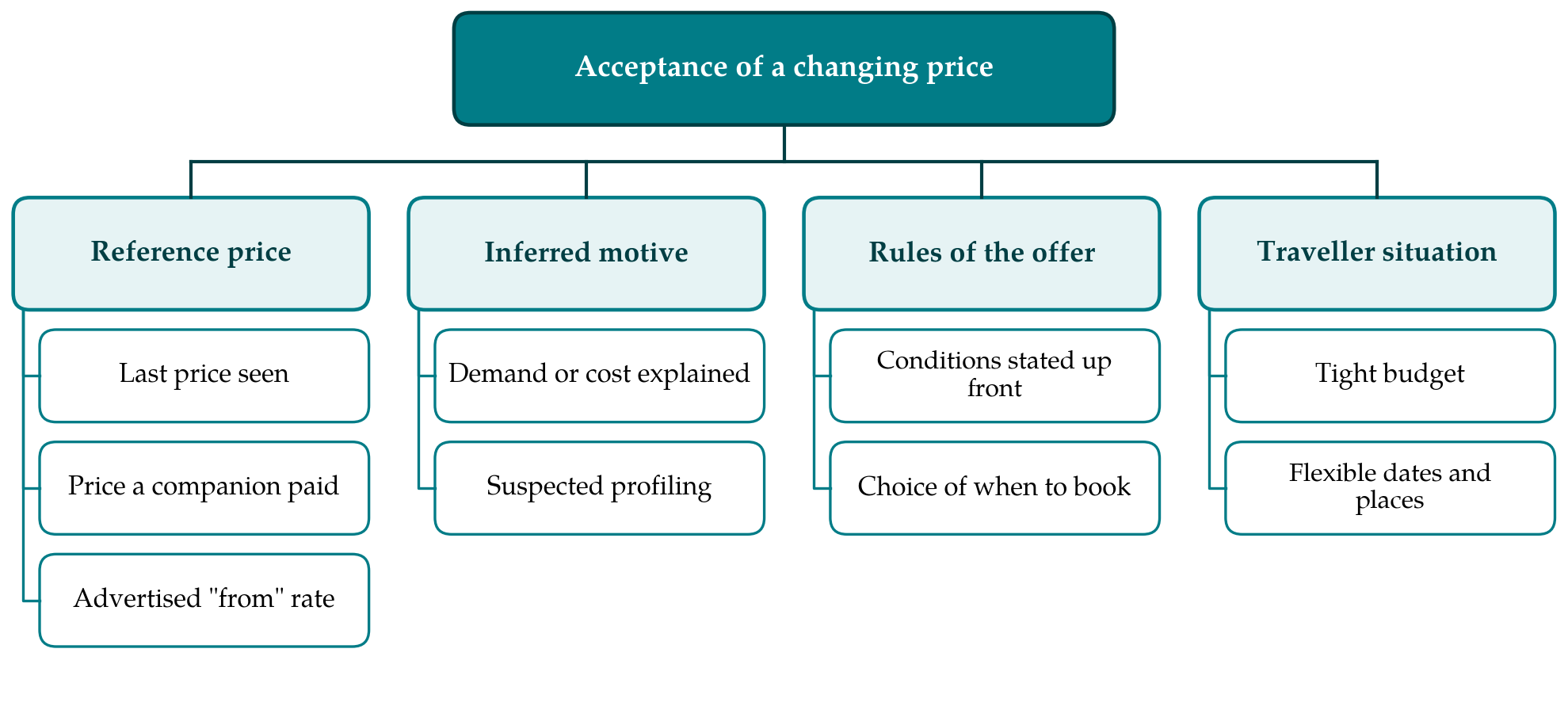
Operators should make time-based variation legible. A calendar of prices by date shows the traveller that the fare depends on when, and invites the flexible to choose cheaper days. Differences should be framed as reductions from a stated standard rate. Conditions such as non-refundability belong on the first screen, since restrictions that surface after payment are remembered as tricks. Urgency messages should be literally true. And platforms that do not personalise prices should say so plainly, because the suspicion alone is costly.
6. Open Questions
Several points in this commentary are inferences that field research could test. It is not known how often budget travellers actually compare prices with peers, or how such comparisons affect later choice of platform. The effect of price-drop notifications on perceived fairness, as distinct from conversion, has not been separated out. Nor is it clear whether acceptance differs between accommodation and transport, or between regions with different norms of bargaining. Studies that combine booking records with interviews would be better placed to answer these than scenario experiments alone.
7. Conclusion
The fairness literature gives good grounds for expecting budget travellers to accept dynamic pricing that follows time and demand, to make active use of it where they are flexible, and to reject pricing that seems to depend on the identity of the buyer. Mobile platforms intensify both tendencies by making every change visible and every suspicion plausible. Transparency about how and why prices move is therefore the condition on which acceptance in this market rests.
Conflict of interest
To be declared by the author(s) before publication.
Funding
To be declared by the author(s) before publication.