1. Introduction
The cement in concrete is responsible for something like eight per cent of global anthropogenic carbon dioxide emissions (Andrew, 2018). Roughly three fifths of the emissions from making clinker come from the decomposition of limestone itself and cannot be removed by switching fuel (Scrivener et al., 2018). As operational energy use in buildings falls, the emissions embodied in materials make up a growing part of the whole-life total, and for new efficient buildings they can be the larger part (Röck et al., 2020). The structure is usually the largest single contributor to that embodied share.
The quantity of concrete in a structure and the composition of that concrete are fixed by structural engineers and specifiers working within codes of practice. In Europe these are the Eurocodes for design (CEN, 2002; CEN, 2004) and EN 206 for the material (CEN, 2013). The stated requirements of these documents concern resistance, serviceability, durability and robustness. None places a limit on greenhouse gas emissions. The question debated in the profession, and addressed here, is whether one should.
This perspective argues for a qualified yes. The qualification matters more than the answer, because much of the disagreement comes from treating three different instruments, the material standard, the design code and building regulation, as though they were one.
2. The Case for Limits
The first argument is reach. Voluntary rating schemes and client briefs touch a minority of projects, mostly large ones with well-resourced design teams. A code provision touches all of them. Reviews of embodied carbon mitigation have found no shortage of technical measures; what is lacking is a mechanism that makes their adoption normal and not exceptional (Pomponi and Moncaster, 2016).
The second is that current practice leaves a great deal of material unused. Studies of real steel frames found that members were typically loaded well below their capacity, and that the cause lay in rationalisation and in design habits and not in code requirements (Moynihan and Allwood, 2014; Dunant et al., 2018). A survey of practitioners by Orr et al. (2019) found that engineers recognise the tendency and attribute it to fee pressure, perceived risk and the absence of any requirement to do otherwise. There is no reason to think concrete structures are different. When nothing in the code rewards efficiency and everything in commercial practice rewards speed and margin, over-provision is the rational outcome.
The third argument is that the codes are not neutral now. Prescriptive durability rules specify minimum cement contents and maximum water to cement ratios by exposure class (CEN, 2013). These limits were calibrated for Portland cement concretes and take no account of how efficiently the binder is used. Damineli et al. (2010) showed that the binder needed to deliver a unit of strength varies widely between mixes of the same grade, and Purnell and Black (2012) that embodied carbon per unit of strength has an optimum that minimum cement rules can prevent a mix from reaching. A code that mandates cement is already regulating carbon, in the wrong direction.
Finally, the means of measurement exist. European standards define how the environmental performance of a building and of a construction product are to be calculated and declared (CEN, 2011; CEN, 2019), and the structural engineering profession has published its own calculation guidance for structures (Gibbons and Orr, 2020). Several European countries, France, Denmark and the Netherlands among them, have introduced regulatory limits on the whole-life carbon or environmental impact of new buildings.
3. The Objections
The objections are substantial, and Table 1 sets each against the response offered in this article. They are discussed in turn.
| Objection | What is right about it | Response |
|---|---|---|
| Codes are for safety | Reliability must never be traded for carbon | Keep reliability targets untouched; add reporting, not relaxed factors |
| Carbon data are unreliable | Declarations differ in scope and quality De Wolf et al., 2017 | Limit only what is declared to a common standard |
| Limits per cubic metre mislead | Weak concrete in thick sections can score well | Tie material limits to strength class; judge structures per floor area |
| Materials are not available everywhere | Slag and fly ash supply is limited and regional | Set classes nationally and by performance, not by recipe |
| Durability may suffer | Low-clinker binders carbonate faster | Require performance testing for exposure |
| Liability and innovation | Engineers fear blame; fixed caps can freeze technology | Phase in; report first, limit later |
The most serious objection is that structural codes exist to protect life, and that loading them with a second objective invites compromise of the first. The concern is well founded if a carbon limit were to be met by shaving partial factors or accepting lower reliability. It has no force against a provision that leaves the reliability framework of the basis-of-design standard exactly as it is (CEN, 2002) and asks only that the designer account for material used beyond what that framework requires. Over-provision is not safety. A slab thicker than serviceability demands, in a grade higher than durability demands, is no more reliable in any sense the code recognises.
The data objection has more substance. Product declarations vary in system boundary, in the age and source of their background data and in how they treat allocation between co-products, and De Wolf et al. (2017) documented how much reported values for nominally similar buildings diverge for methodological reasons alone. A limit enforced on numbers of that quality would reward the favourable declaration and not the better building. The answer is to confine early limits to quantities that can be declared under one product category rule by one type of party, which for concrete means the production stage emissions of a cubic metre as supplied.
The choice of unit raises a further difficulty. A limit per cubic metre of concrete is easy to verify and easy to game: the designer who uses a larger volume of lean concrete meets it comfortably while emitting more in total. A limit per square metre of floor captures the structure as a whole but depends on span, loading, storey height and ground conditions that the structural engineer does not choose alone, and it cannot sensibly sit in a code for one material when the alternative may be steel or timber. Each unit is correct for one decision-maker and wrong for the others.
Availability and durability are linked objections. The supplementary materials that have carried most clinker reduction so far, blast furnace slag and coal fly ash, are by-products of industries that are themselves contracting, and their supply is uneven between regions (Scrivener et al., 2018; Habert et al., 2020). A cap that can be met only with a material that a region does not have is a trade barrier. Binders with low clinker content also tend to carbonate faster, and a structure that needs early repair has not saved carbon. Both points argue for limits framed by performance and set at a level national conditions can meet, and against a single number fixed in an international code.
4. A Position: Limits Divided by Responsibility
The argument and the objections can be reconciled once it is accepted that different parties control different quantities and that each should be regulated where its decisions are made. Figure 1 sets out the division proposed.
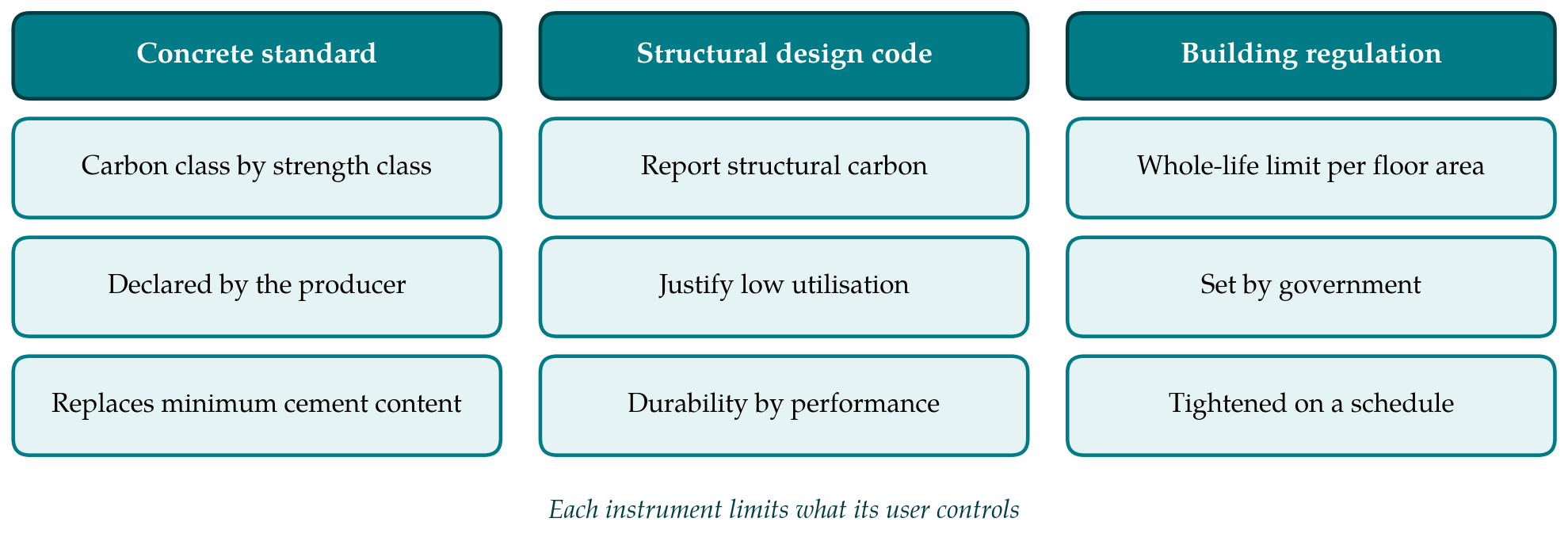
The concrete producer controls the binder and the mix. The material standard is therefore the place for carbon classes: bands of declared production-stage emissions per cubic metre, defined separately for each strength class so that a low figure cannot be obtained simply by supplying weaker concrete. The specifier would call up a carbon class in the same way as a strength class or an exposure class, and national provisions would set which classes are permitted. At the same time, minimum cement contents should give way to performance-based demonstration of durability, so that efficient low-clinker mixes are not excluded by rule. Miller et al. (2016) estimated that measures of this readily available kind could cut emissions from concrete production substantially without new technology. Classes also give producers a stable target to invest against, which a project-by-project negotiation of mix designs does not, and they let a region with good access to calcined clay or slag set a tighter band than one that has neither.
The structural engineer controls the quantity of material. The design code is the place for a duty to calculate and report the embodied carbon of the structure by a stated method, and to justify significant under-utilisation of members where it is not required by serviceability, robustness or buildability. This is a procedural requirement of a kind codes already contain, comparable with the obligation to consider robustness. It makes over-provision visible to the client and to the checker without prescribing a number that would be wrong for most structures.
The client and the design team together control form, span, grid and material choice. A numerical limit on these belongs in building regulation, expressed per unit of floor area for the whole building, set by government and tightened on a published schedule. Regulation is material-neutral in a way that a concrete code cannot be, and it carries democratic authority for what is in the end a policy choice about how fast emissions must fall.
5. Implications
If this division is accepted, several consequences follow for those who write standards. Committees responsible for concrete specification would need to agree declaration rules and class boundaries, a task that depends on the quality of product declarations and so on the standard that governs them (CEN, 2019). Committees responsible for design codes would need to add reporting clauses and to review prescriptive rules, minimum cement content above all, that stand in the way of efficient mixes. Educators would need to treat material quantity as a design outcome to be minimised and checked, which is a change of habit more than of knowledge.
There are risks in acting and in waiting. Reporting duties add work, and small practices will feel it first. Classes set too leniently become a licence; set too tightly, they exclude regions without access to low-carbon binders. Against these stands the size of the prize. Analyses of decarbonisation pathways for the sector agree that using less clinker in concrete and less concrete in structures are the measures available now, at low cost, while capture technologies mature (Habert et al., 2020). Standards are the instrument through which such measures become ordinary practice.
6. Conclusion
Embodied carbon should be regulated through the system of standards that governs structural concrete, but a numerical cap in the design code is the wrong form. The material standard should carry carbon classes tied to strength and should drop cement minima in favour of performance. The design code should require engineers to report what their structures embody and to justify waste. Whole-building limits should be left to regulation. Divided in this way, the provisions leave the safety function of the codes untouched and put each obligation on the party able to meet it.
Conflict of interest
To be declared by the author(s) before publication.
Funding
To be declared by the author(s) before publication.