1. Introduction
Handicraft production in rural areas is commonly organised in households and small workshops, and the route from maker to urban buyer has traditionally run through traders, exporters and exhibition organisers. Cooperatives are one response: by pooling output, members can negotiate better terms and share the cost of design, quality control and transport. What a cooperative does not automatically gain is direct contact with the people who finally buy its goods. Without that contact it learns little about what customers value and remains dependent on whoever stands between.
Social commerce offers a way to make the contact. The term covers commercial activity carried out through social media, where content, conversation and community support the transaction (Liang and Turban, 2011). A cooperative can show its products on a photo-sharing or short-video service, answer questions in a messaging application, and take payment by mobile transfer, with no website of its own. The entry cost is low. The organisational demands are not, since someone must photograph, post, reply, pack, dispatch and account for money, and the cooperative must decide collectively who does so and how the proceeds are shared.
This article proposes a framework for that process. It is written as a methodological guide: a sequence of stages with the reasoning for each, drawn from published theory. It describes no actual cooperative and reports no results. Whether the framework works in practice is a question for later empirical study, and the final sections say how such study could be designed.
2. Background
The framework draws on three literatures: research on trust in social commerce, theories of technology adoption by small organisations, and work on how member-governed groups manage shared resources.
2.1. Social commerce and the problem of trust
Buyers of handmade goods face the quality uncertainty that Akerlof (1970) analysed: the seller knows how an item was made and the buyer, at a distance, does not. Research on online shopping places trust beside usefulness and ease of use as a determinant of intention to buy (Gefen et al., 2003). Social commerce supplies its own trust-building devices. Ratings and reviews, recommendations and referrals, and communities in which buyers talk to each other have been shown to shape trust and purchase intention (Hajli, 2015), and reviews of the field describe these social cues as its distinguishing feature (Zhang and Benyoucef, 2016). Sellers also benefit from links to one another, since connections among shops make each easier to find (Stephen and Toubia, 2010).
2.2. Adoption by small organisations
Three theories of adoption are relevant. Diffusion theory holds that an innovation spreads faster when potential adopters perceive relative advantage, compatibility with existing practice, low complexity, and the chance to try it and observe results (Rogers, 2003). The technology acceptance model reduces individual adoption to perceived usefulness and perceived ease of use (Davis, 1989). The technology-organisation-environment framework locates a firm's decision in the technology available, the organisation's resources and structure, and its external setting (Tornatzky and Fleischer, 1990); it is among the most used models at the level of the firm (Oliveira and Martins, 2011).
Work on developing economies adds two cautions. Molla and Licker (2005) showed that electronic commerce adoption there depends on the organisation's own perceived readiness and on external readiness, including the support of market forces, government and supporting industries such as payment and logistics. Heeks (2002) attributed the frequent failure of information systems in developing countries to the gap between the assumptions built into a design and the realities of the place where it is used. A framework for rural cooperatives must therefore begin from local conditions and not from the features of a platform.
2.3. The cooperative as an adopter
A cooperative differs from a small firm in ways that matter for adoption. It is owned and democratically controlled by its members, who also share in its economic results (International Co-operative Alliance, 1995). A decision to sell through social media is a collective one, and the gains and the work it creates must be divided by rules that members accept. Ostrom (1990) found that durable self-governing institutions share certain design principles, among them clear membership boundaries, rules made by those affected, monitoring, graduated sanctions and accessible means of resolving disputes. These principles apply as well to a shared online shop as to a shared irrigation canal.
3. The Proposed Framework
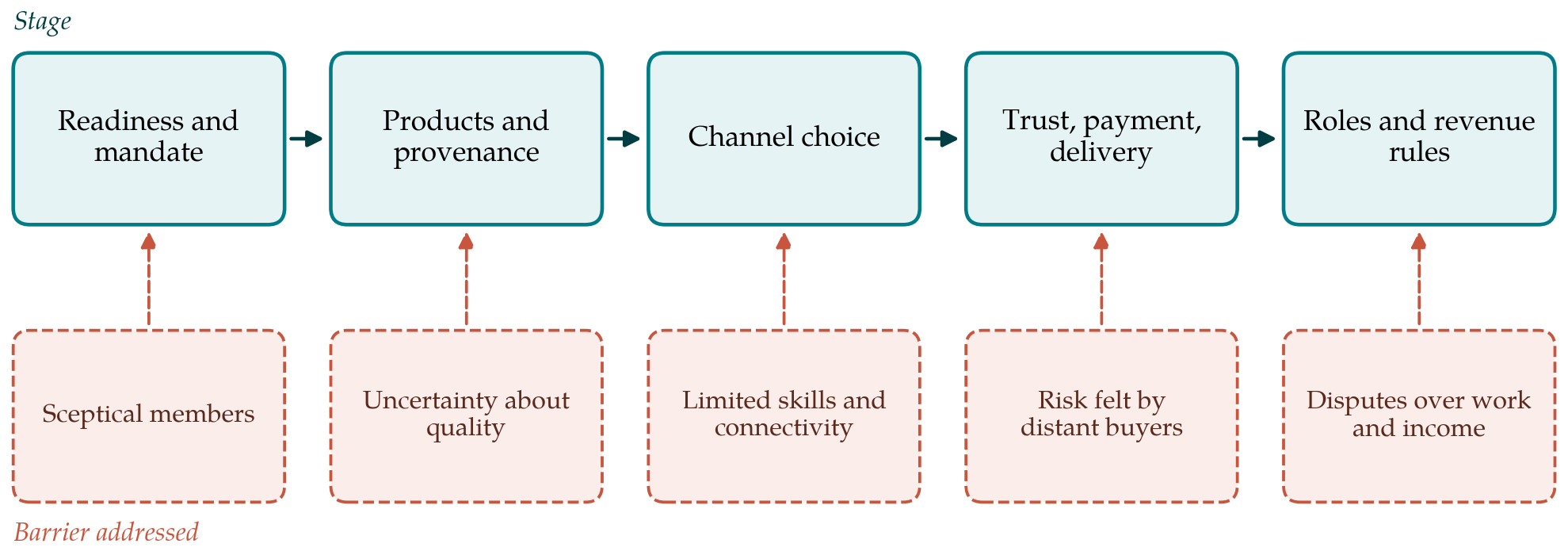
The framework has six stages, listed in Table 1 with the output expected from each. Figure 1 sets the first five stages against the barrier that each is meant to overcome. The sixth, review, returns the cooperative to any earlier stage that needs revision. The stages are sequential on the first pass and iterative afterwards.
| Stage | Main activity | Output |
|---|---|---|
| 1. Readiness and mandate | Assess skills, devices, connectivity and courier reach; put the decision to members | Readiness summary and recorded resolution |
| 2. Products and provenance | Choose a small opening range; record maker, material and technique | Catalogue with photographs and accounts of origin |
| 3. Channel choice | Match one or two platforms to intended buyers and to member skills | Channel plan and an account held by the cooperative |
| 4. Trust, payment and delivery | Set payment methods, packing standard, courier and returns policy | Published terms for buyers |
| 5. Roles and revenue rules | Assign selling tasks; agree pricing and the division of proceeds | Written rules approved by members |
| 6. Review | Examine enquiries, orders, complaints, costs and time spent at fixed intervals | Decision to continue, adjust or stop |
3.1. Stage 1: Readiness and mandate
The first stage establishes whether the cooperative can and wishes to proceed. Readiness has an internal side, covering members' devices, network coverage in the village, literacy and language, and any prior experience of selling online, and an external side, covering the reach of courier services and the payment methods that urban buyers use (Molla and Licker, 2005). The findings are put to the membership for decision. A recorded mandate matters because the later stages commit shared money and reputation, and because members who doubt the usefulness of the venture are unlikely to supply products or labour for it (Davis, 1989).
3.2. Stage 2: Products and provenance
The second stage chooses what to sell and prepares the evidence of its origin. A narrow opening range is preferable: items that photograph well, survive transport, can be made to a consistent standard and are priced so that delivery cost is a small part of the total. For each item the cooperative records who makes it, from what materials and by what technique. This record is the raw material for the content on which social commerce depends, and it answers the buyer's uncertainty about authenticity directly (Akerlof, 1970). Where a craft holds a geographical indication or similar certification, that fact belongs in the record.
3.3. Stage 3: Channel choice
Platforms differ in what they are good for. The functional building blocks proposed by Kietzmann et al. (2011), which include identity, conversations, sharing, relationships, reputation and groups, give a vocabulary for the comparison. A visual service suits display and discovery. A messaging application suits negotiation, custom orders and repeat buyers. A marketplace with social features adds payment protection and logistics at the cost of commission. The framework recommends beginning with no more than two channels, chosen by where the intended urban buyers already spend time and by what members can operate, and holding the account in the cooperative's name so that it survives changes of personnel.
3.4. Stage 4: Trust, payment and delivery
A buyer who has never met the seller needs reassurance at three points: paying, receiving and complaining. The cooperative should offer payment methods familiar to its buyers, state delivery times honestly, pack to a written standard and publish a simple policy on damage and returns. Each completed order is also an opportunity to gather the reviews and referrals on which later buyers rely (Hajli, 2015). Trust built this way accumulates in the account's visible history, which is one more reason for the account to belong to the cooperative and not to an individual.
3.5. Stage 5: Roles and revenue rules
Online selling creates tasks that craft production does not: photography, writing, replying to messages, packing and bookkeeping. The fifth stage assigns them, decides whether they are paid, and fixes how prices are set and how proceeds are divided among the maker, those who do the selling work and the common fund. Following Ostrom (1990), the rules should be made by the members they bind, be simple enough to monitor, and provide a way of settling disagreements. Records of orders and payments that any member may inspect are the practical form of monitoring. Education and training of members, itself a cooperative principle (International Co-operative Alliance, 1995), spreads the new skills beyond a few younger members.
3.6. Stage 6: Review
At fixed intervals the cooperative reviews what has happened: enquiries received, orders completed, complaints, costs, and the time members have spent. The review follows the logic of action research, in which a group diagnoses a problem, plans, acts, evaluates and records what it has learned before the next cycle (Susman and Evered, 1978). Its results may send the cooperative back to an earlier stage, to change the product range, drop a channel or revise the revenue rules. The attributes of trialability and observability are served by this design: a modest first cycle lets members see results before committing more (Rogers, 2003).
4. Fitting the Framework to Local Conditions
The stages are general and their content is local. Where connectivity is intermittent, posting and replying may have to be concentrated at set times or delegated to a member who travels to a market town, and buyers should be told when replies can be expected. Where members do not share a language with urban buyers, the selling roles fall to those who do, and the revenue rules must recognise that work without letting it become a new form of intermediation. Evidence from mobile phone use in other rural markets shows that better information can improve the functioning of markets for producers (Jensen, 2007), but that result concerned price information in the trade of a standard commodity and should not be assumed to carry over to differentiated craft goods.
Environmental conditions in the sense of Tornatzky and Fleischer (1990) also constrain choices. Courier coverage determines which products can be offered at all. Rules on consumer protection, taxation and digital payments differ by country and affect what must be disclosed and recorded. Support organisations, including craft development agencies, non-governmental organisations and cooperative federations, can supply training and photography equipment, though reliance on an outside sponsor carries the risk described by Heeks (2002): a design that reflects the sponsor's assumptions more than the members' circumstances, and that lapses when the sponsor leaves.
5. Evaluating the Framework
A framework of this kind is best assessed in use. Two research designs are suitable. The first is the case study, which examines a contemporary phenomenon in its real setting using several sources of evidence (Yin, 2018). A researcher could follow one or more cooperatives through the stages, drawing on meeting records, account histories and interviews, and compare what happened at each stage with what the framework anticipates. Multiple cases chosen to differ in connectivity, product type or governance would show where the framework holds and where it needs qualification.
The second design is action research conducted with a cooperative, in which the researcher takes part in the review cycles and the framework is revised as the group learns (Susman and Evered, 1978). In either design the outcomes of interest extend beyond sales. They include the share of the final price retained by makers, the distribution of benefit and workload among members, the cooperative's knowledge of its buyers, and whether the activity continues once outside support ends.
6. Limitations and What Remains to Be Shown
The framework is proposed and has not been applied or validated in this article. It is assembled from theories developed for other settings: diffusion and acceptance models built largely on individuals and firms in industrialised economies, social commerce research focused on consumers, and governance principles derived from common-pool resources. Their combination is reasoned, not tested. It is possible that the order of stages matters less than supposed, that some stages are redundant for cooperatives with younger members, or that barriers not considered here, such as platform rule changes or account suspension, dominate in practice.
Three questions in particular need evidence. One is whether a formal mandate and written revenue rules improve persistence, or merely slow a process that informal groups manage well without them. Another is whether direct selling in fact raises makers' incomes after the time and cost of fulfilment are counted. The last is dependence: a cooperative that leaves a trader for a platform has exchanged one intermediary for another, whose ranking and fee policies it cannot influence. The review stage is meant to keep that question before the members, but it cannot answer it.
7. Conclusion
Social commerce gives rural handicraft cooperatives a low-cost route to urban buyers, and the main obstacles to using it are organisational more than technical. The six-stage framework proposed here addresses them in order: a mandate from members, a documented product range, a deliberate choice of channels, arrangements that let distant buyers trust the seller, agreed roles and revenue rules, and regular review. Each stage rests on established theory and yields a concrete output. The framework's value in practice is undemonstrated, and case study and action research with cooperatives willing to try it are the appropriate next step.
Conflict of interest
To be declared by the author(s) before publication.
Funding
To be declared by the author(s) before publication.