1. Introduction
When malted barley has been mashed and the sweet wort run off, what remains in the lauter tun is a bed of husk, pericarp, seed coat and residual endosperm. This spent grain accounts for the great majority of the solid by-products of brewing (Mussatto et al., 2006). Because the starch has been removed, the residue is concentrated in what the wort left behind: arabinoxylan, cellulose, lignin and protein, together with phenolic acids bound in the cell walls (Lynch et al., 2016; Bartolomé et al., 2002).
That composition has made spent grain a standard example in discussions of upcycled food, a term used for products made from ingredients that would otherwise not have gone to human consumption (Spratt et al., 2021). The nutritional case is easy to state. Fibre intakes in many populations fall short of recommendations, and here is a fibre-rich cereal material available in quantity at low cost. Published trials have incorporated it into extruded snacks, breadsticks and cookies (Stojceska et al., 2008; Ktenioudaki et al., 2012; Öztürk et al., 2002).
Those studies began with grain that had already been dried and milled in a laboratory. A small processor begins with a bin of hot, wet material on a brewery floor. This article proposes a process and food safety framework for the stages in between, and for the snack bar that follows. It is a proposal assembled from the literature and from regulatory requirements. No plant trial is reported.
2. Background: Why Spent Grain Is Hard to Use
Three properties of the raw material dictate the design of any process that uses it.
2.1. Perishability
Fresh spent grain contains roughly three quarters water by weight and enough residual sugar and protein to support rapid microbial growth (Mussatto et al., 2006). It leaves the mash hot, which keeps the initial microbial load low, and then cools slowly through the temperature range in which bacteria multiply fastest. Robertson et al. (2010), who profiled spent grain at the site of production, described the microbial population at discharge and its development on storage, and concluded that the material must be stabilised promptly if it is to be used for anything more demanding than feed. Reviews of the microbiology reach the same conclusion (Bianco et al., 2020). The time between discharge and stabilisation is therefore the central control variable of the whole undertaking.
2.2. Variability
Spent grain is not a uniform commodity. Its composition depends on the barley variety and malting, on the adjuncts in the grist, and on the mashing regime, and Santos et al. (2003) showed that it varies between brews even within one brewery. Craft breweries, the natural suppliers of a regional processor, change recipes often and use wheat, oats, rye and dark malts freely. Each of those changes the fibre and protein content, the colour, the flavour and the allergen status of the residue.
2.3. Effect on eating quality
The literature on bakery and snack applications is consistent on one point. Small additions of dried spent grain raise fibre content with little penalty, and larger additions darken the product, coarsen its texture and reduce expansion or volume (Stojceska et al., 2008; Ktenioudaki et al., 2012). Particle size is part of the explanation, since coarse husk fragments are perceived as gritty. A cold-formed or lightly baked bar, which is dense by nature and usually contains nuts, seeds and whole grains, is more tolerant of such an ingredient than an aerated product would be. That tolerance is the reason for choosing a bar.
3. The Proposed Framework
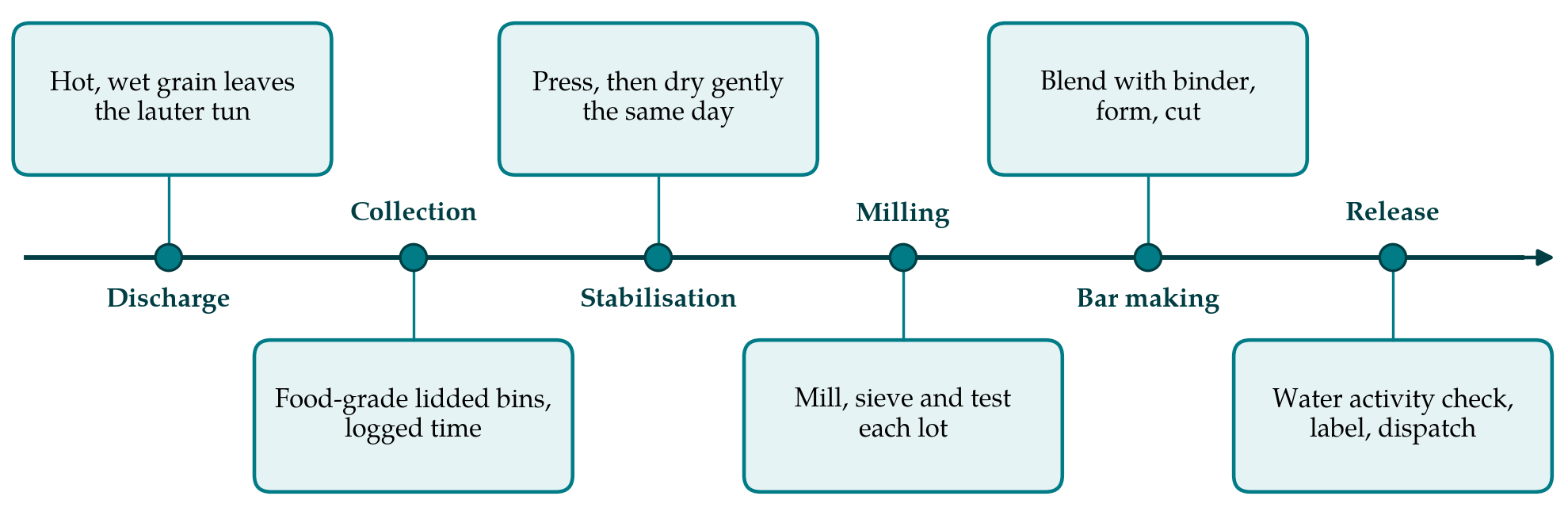
The framework has six stages, which Figure 1 places in order from the brewery to the finished bar. The first three convert a perishable by-product into a specified ingredient. The last three convert that ingredient into a product with a defensible label.
3.1. Stage 1: Supply agreement
The decisive change is one of status. Grain destined for cattle is handled as feed, and it becomes a food ingredient only if it is treated as one from the moment it leaves the lauter tun. The proposed agreement with each brewery therefore specifies dedicated, lidded, food-grade containers that are cleaned between uses; a discharge route that keeps the grain away from floor drains, cleaning chemicals and yeast or trub waste streams; a record of the brew, its grist bill and the time of discharge; and a maximum interval before collection. It also specifies which brews are excluded, for instance those containing ingredients the processor does not wish to declare. The brewery's own malt purchasing specification, including its supplier's assurances on mycotoxins, is requested as part of the agreement.
3.2. Stage 2: Same-day stabilisation
Stabilisation means removing water quickly. Mechanical pressing first lowers the moisture content cheaply, and thermal drying then brings it to a level at which the material is shelf-stable; around ten per cent moisture is the figure commonly cited. The literature also advises keeping the drying temperature moderate, below about 60 °C, because higher temperatures generate unpleasant toasted flavours (Mussatto et al., 2006). For a small processor a tray or belt dryer with good air circulation is the realistic option. Where same-day drying capacity is lacking, the framework allows chilling or freezing as a holding step with its own time limit. It does not allow wet grain to be held at ambient temperature.
3.3. Stage 3: Milling and lot specification
Dried grain is milled and sieved to a particle size fine enough to avoid grittiness, and each lot is identified with the brews from which it came. A lot specification is proposed with limits for moisture and water activity, particle size, total dietary fibre and protein, and microbiological criteria including indicator organisms and Bacillus cereus, a spore-former associated with cereals that survives mashing temperatures. Dietary fibre is determined by an accepted enzymatic-gravimetric method (Lee et al., 1992). The method is fixed in the specification, because later integrated methods, which also capture resistant starch and small non-digestible carbohydrates, do not give identical results. Mycotoxin testing is scheduled on a risk basis against the legal maximum levels for cereals and cereal products (European Commission, 2023).
3.4. Stage 4: Formulation against a fibre claim
The commercial point of the bar is its fibre content, so the formulation is worked backwards from the claim. In the European Union a food may be called high in fibre if it contains at least 6 g of fibre per 100 g or at least 3 g per 100 kcal, and a source of fibre at half those amounts (European Union, 2006). From the fibre content of the milled grain and of the other ingredients, the processor calculates the minimum inclusion needed, adds a margin for lot variation, and then tests whether a bar at that inclusion is pleasant to eat. A simple mixture approach is proposed, varying the proportions of spent grain flour, a base of oats or other cereal, and binder, with nuts, seeds or dried fruit held constant. The binder, usually a syrup with or without fat, controls both cohesion and water activity.
3.5. Stage 5: Hazard analysis
A hazard analysis following the Codex General Principles of Food Hygiene is carried out for the whole chain, including the brewery end (Codex Alimentarius Commission, 2020). Practical guidance on applying the method in a small business is available in standard texts (Mortimore and Wallace, 2013). Table 1 lists the hazards and quality risks that the literature and the nature of the material suggest, with proposed controls. Two deserve emphasis. Water activity is the principal barrier in the finished bar: microbial growth is not expected below a water activity of about 0.6, and most bacteria require much higher values (Scott, 1957). And spent grain from barley contains gluten, so the bar must declare cereals containing gluten and cannot be positioned as gluten-free, whatever the other ingredients (European Union, 2011).
| Hazard or risk | Where it arises | Proposed control | Check |
|---|---|---|---|
| Microbial growth in wet grain | Between discharge and drying | Time limit; same-day drying or chilled holding | Logged times and temperatures |
| Spore-forming bacteria | Raw material; slow cooling | Rapid drying; low water activity in bar | Lot microbiology; water activity |
| Mycotoxins | Malt and adjuncts | Brewery malt specification; risk-based testing | Supplier documents; laboratory analysis |
| Chemical or foreign-body contamination | Brewery floor, bins, transport | Dedicated food-grade bins; segregated route | Collection inspection; sieving |
| Undeclared allergens | Variable grist; bar ingredients | Grist record per brew; excluded brews | Label review against records |
| Fibre claim not met | Lot-to-lot variation | Lot fibre analysis; formulation margin | Finished-product analysis |
| Off-flavour or gritty texture | Over-drying; coarse milling | Moderate drying temperature; particle size limit | Sensory check per lot |
3.6. Stage 6: Shelf-life and consumer testing
Bars made from at least three separate lots of grain are stored in the intended packaging and examined at intervals for water activity, texture, rancidity and microbiological status. Lipid oxidation merits attention, since spent grain retains the lipids of the barley and bars often contain nuts and seeds. Acceptance is assessed with a hedonic test among consumers conducted according to the relevant international standard (ISO, 2014), against a comparable bar without spent grain. The purpose is to learn whether the product is liked for what it is, not only whether it is tolerated for its origin.
4. Fitting the Framework to a Small Processor
Scale shapes every choice. A regional processor has the advantage of proximity, which makes same-day collection and drying feasible where a national manufacturer would need the brewery to install a dryer. It has the disadvantage of limited laboratory capacity. The framework therefore separates checks that can be done on site for every lot, such as moisture, water activity, sieve analysis and tasting, from analyses sent to an external laboratory at a set frequency, such as dietary fibre, microbiology and mycotoxins. Blending dried lots before milling is a simple way to reduce the variability that Santos et al. (2003) documented.
The economics depend on energy. Drying is the costliest step, and pressing before drying, using waste heat where the site allows, and matching batch size to the dryer are the levers available. A processor should also be candid about how much of the bar is in fact upcycled. If the inclusion that consumers accept is modest, the environmental benefit per bar is modest as well, and marketing claims should be kept in proportion.
5. Limitations and What Remains to Be Shown
The framework is proposed and has not been validated here. It rests on published compositional and microbiological studies, on formulation trials in other product types, and on legal requirements. Whether its time limits, drying conditions and specifications are adequate in a particular plant can only be established by applying it. A first application would need to demonstrate four things: that the interval and conditions between discharge and drying keep microbial counts within the lot specification; that the dried ingredient is consistent enough for the fibre claim to hold across lots; that the bar remains stable and palatable through its shelf life; and that the costs of collection, drying and testing leave a viable margin.
The legal references are those of the European Union, and a processor elsewhere would substitute the corresponding national rules on claims, allergens and contaminants. The framework says nothing about physiological benefit. A fibre claim describes composition, and any statement about the health effects of spent grain fibre in particular would require evidence that the literature does not yet supply in a form regulators accept.
6. Conclusion
Brewers' spent grain can be turned into a fibre-rich snack bar by a small processor, provided the grain is managed as food from the moment of discharge and stabilised the same day. The six-stage framework proposed here links a supply agreement, rapid drying, lot specification, claim-led formulation, hazard analysis and shelf-life testing into one sequence that a business with modest resources could operate. Its adequacy in practice is an open question that a documented first application would answer.
Conflict of interest
To be declared by the author(s) before publication.
Funding
To be declared by the author(s) before publication.