1. Introduction
Titanium alloys earn their place in airframes, engines and implants through high specific strength and corrosion resistance, and they are expensive to machine for reasons that follow from the same metallurgy. The standard reviews list them: thermal conductivity so low that most of the heat of cutting flows into the tool, strength retained at elevated temperature, a strong chemical affinity for tool materials, and a low elastic modulus that lets the workpiece deflect and rub (Machado and Wallbank, 1990; Ezugwu and Wang, 1997). Cutting speeds are kept low, tools wear quickly all the same, and cutting fluid is applied in volume to carry heat away.
That fluid has costs of its own. It must be bought, mixed, filtered, monitored, cleaned from parts and chips, and finally treated as waste, and it exposes operators to mist and skin contact. Klocke and Eisenblätter (1997), making the case for dry cutting, cited industrial surveys in which fluid-related costs were several times the cost of the tools. Minimum quantity lubrication, in which a very small flow of oil is delivered to the cutting zone as an aerosol, was developed as a way of keeping the lubricating function while giving up the flood (Weinert et al., 2004).
For titanium the proposal is contentious, because the function that is given up is the one the material seems most to need. This review examines the evidence on two outcomes that settle the matter for a manufacturer of titanium parts: the integrity of the surface produced, and the cost of producing it.
2. Scope and Approach
This is a narrative review of the published literature. It relies on the established reviews of titanium machinability, of minimum quantity lubrication and of surface integrity, and on experimental papers that are frequently cited for turning, milling and drilling of titanium alloys, chiefly Ti-6Al-4V. The sources were chosen for their standing in the field and not through a formal search protocol, and no count of records is offered. Findings are reported qualitatively. Flow rates, oils, nozzle arrangements and cutting conditions vary so much between studies that pooling their numerical results would mislead.
3. Why Titanium Is a Hard Case
In cutting titanium the chip is thin, segmented and in contact with the rake face over a short length, so that high temperature and stress are concentrated close to the cutting edge (Ezugwu and Wang, 1997). Tool wear is governed by diffusion and adhesion at that hot contact, and by chipping as the segmented chip loads and unloads the edge (Arrazola et al., 2009; Pervaiz et al., 2014). A fluid helps in two ways: it removes heat from the tool, chip and workpiece, and it reduces friction where it can reach the interface. Flood supply does the first well and the second only at low speed, since the contact is largely sealed against liquid at higher speed. High-pressure jets directed at the chip root improve access and chip breaking and have a strong record with aerospace alloys (Ezugwu, 2005).
Minimum quantity lubrication works the other way round. The oil film is intended to lower friction and adhesion, while cooling is limited to convection by the air stream and the small latent heat of the oil. On this reasoning the technique should be well suited to operations in which adhesion and friction dominate and the tool has time to cool between engagements, and poorly suited to continuous cuts at high thermal load. The experimental record, discussed below, broadly follows that expectation.
4. How Minimum Quantity Lubrication Is Applied
Weinert et al. (2004) describe the technique and its equipment in detail. Oil is consumed at rates of the order of tens of millilitres per hour, against litres per minute in flood supply, and leaves the chips and the part nearly dry. The aerosol is delivered either through external nozzles aimed at the rake and flank faces or through channels in the spindle and tool, with the oil and air mixed before the spindle or at the tool. The oils are mostly synthetic esters and fatty alcohols, chosen for lubricity, biodegradability and a high flash point, and vegetable oils have been studied as alternatives (Debnath et al., 2014).
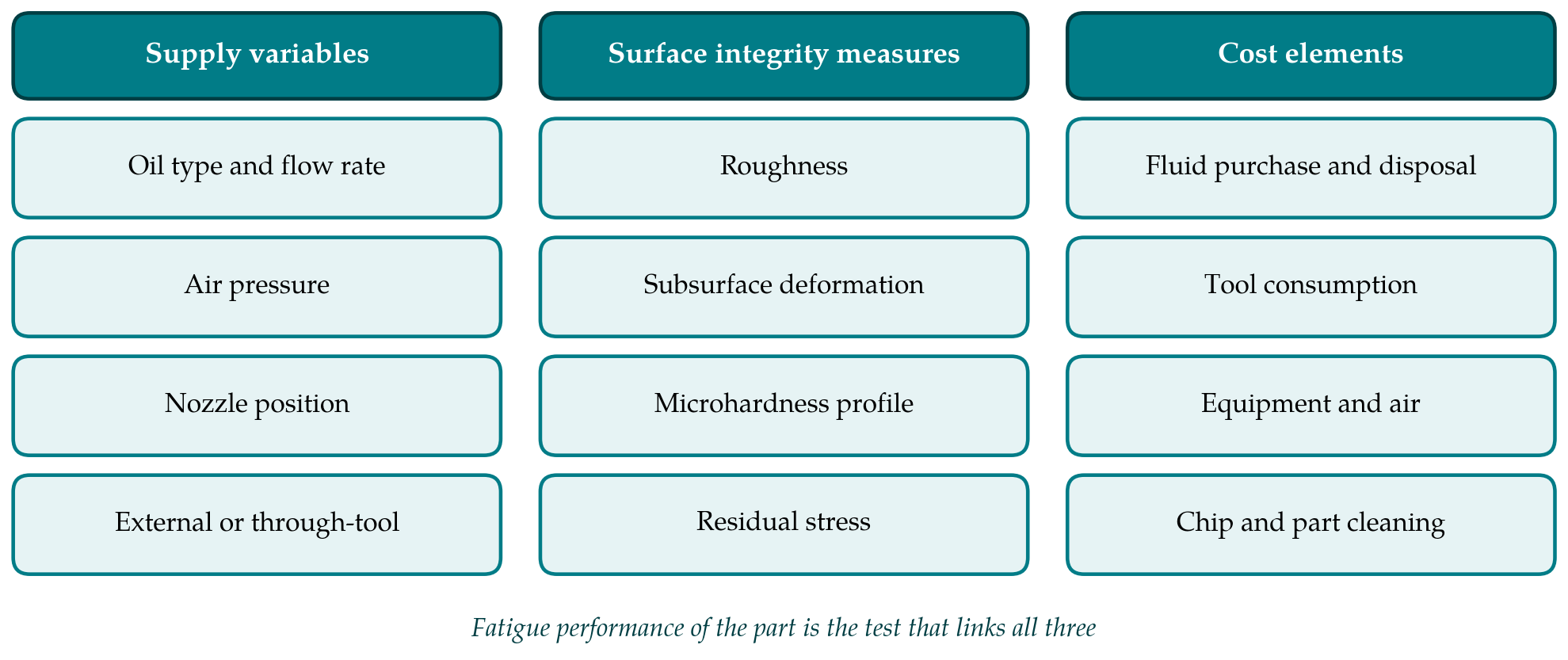
The number of adjustable quantities is a difficulty for anyone comparing studies. Figure 1 sets the main supply variables beside the surface integrity measures and the cost elements with which this review is concerned. Reviews of the wider literature note that reported outcomes are sensitive to nozzle position and flow rate and that these are not always documented (Sharma et al., 2016; Boswell et al., 2017).
5. Evidence on Tool Wear and Cutting Temperature
Tool wear is not the subject of this review, but it cannot be left out, because a worn tool is the main cause of surface damage and tool consumption is a large part of cost. In end milling the findings favour reduced lubricant supply. Sun et al. (2006) reported longer tool life with minimum quantity lubrication than with dry cutting or flood coolant when end milling a titanium alloy. Su et al. (2006), in high-speed end milling of Ti-6Al-4V, found flood coolant unsuitable, which they attributed to thermal cycling of the cutting edge, and obtained the longest tool life with an oil mist carried in cold compressed nitrogen. Milling is an interrupted cut, and the absence of quenching between engagements appears to matter as much as the presence of oil.
Drilling shows that the choice of oil counts. Rahim and Sasahara (2011) drilled Ti-6Al-4V at high speed with palm oil and with a synthetic ester as the lubricant, and compared both with flood and air-blow conditions. Palm oil gave lower forces and temperatures than the ester and performed comparably to flood supply. Turning is less clear. Wang et al. (2009) examined orthogonal turning of titanium alloys with dry, flood and minimum quantity supply and found that the advantage of one over another depended on cutting speed and feed and on whether the cut was continuous or interrupted. The general reviews of cooling methods reach the same cautious position for continuous cutting of difficult materials (Sharma et al., 2009; Shokrani et al., 2012).
6. Evidence on Surface Integrity
Surface integrity, as the term was introduced by Field and Kahles (1971), covers the topography of a machined surface together with the metallurgical and mechanical state of the layer beneath it. For titanium parts loaded in fatigue it is the property that matters most, and the reviews by Ulutan and Ozel (2011) and Jawahir et al. (2011) set out how machining alters it. Table 1 summarises how minimum quantity lubrication and the alternatives compare on the mechanisms involved.
| Strategy | Main action | Reported strengths | Open questions for titanium |
|---|---|---|---|
| Dry | None | No fluid cost or residue | Rapid wear; deformed and hardened surface layer |
| Flood emulsion | Bulk cooling | Established practice; chip flushing | Thermal cycling in milling; fluid cost and waste |
| High-pressure jet | Cooling and chip breaking at the chip root | Longer tool life in turning | Pump energy and equipment cost |
| Minimum quantity lubrication | Boundary lubrication by oil film | Good tool life in milling and drilling | Continuous turning; residual stress and fatigue |
| Cryogenic | Strong cooling by liquid nitrogen or carbon dioxide | Lower cutting temperature | Delivery and medium cost; little lubrication |
| Cryogenic with oil mist | Cooling and lubrication combined | Promising early reports | Few studies; process window not mapped |
6.1. Roughness
Roughness is the measure most often reported. Its ideal value is fixed by feed and tool nose geometry, and departures from the ideal arise from adhered material, built-up edge fragments and edge wear. Since an oil film reduces adhesion, studies commonly report roughness under minimum quantity lubrication that is equal to or lower than under flood supply for as long as the tool remains in good condition, and the wider reviews record the same tendency across materials (Sharma et al., 2016; Boswell et al., 2017). The qualification is important. Where the technique shortens tool life, as it may in heavy continuous turning, roughness deteriorates earlier in the life of the edge.
6.2. Subsurface deformation and hardness
Beneath a machined titanium surface there is normally a thin layer of plastically deformed grains, harder than the bulk. Che-Haron and Jawaid (2005), turning Ti-6Al-4V dry, observed such a layer and found that it became more pronounced as the tool wore. The depth of deformation increases with cutting force and temperature and with flank wear (Ulutan and Ozel, 2011). Minimum quantity lubrication influences it indirectly, through friction and wear. Where it lowers both, a shallower affected layer can be expected, and where bulk temperature rises for want of cooling, the opposite. Direct metallographic comparisons between supply methods on titanium are few, and those that exist cover narrow ranges of conditions.
6.3. Residual stress and fatigue
Residual stress is the least documented aspect. Thermal effects in cutting tend to produce tensile stress at the surface, and mechanical effects compressive stress (Jawahir et al., 2011). A method that cools less than flood supply could be expected to shift the balance towards tension, and a method that lowers friction could act in the other direction. The literature reviewed here does not resolve which effect prevails for titanium under minimum quantity lubrication. Fatigue testing of parts machined in this way, which would settle the practical question, is rarely reported. For a safety-critical component this gap, more than any doubt about tool life, stands in the way of adoption.
7. Hybrid and Cooled Variants
If lack of cooling is the weakness, the obvious remedy is to add cooling without returning to the flood. Cryogenic machining, in which liquid nitrogen is directed at the cutting zone, lowers cutting temperature in Ti-6Al-4V substantially, and Hong and Ding (2001) showed that the manner of delivery decides how much of the benefit is realised. On its own a cryogenic medium lubricates little. Combining it with an oil mist, or carrying the mist in chilled gas as Su et al. (2006) did, aims at both functions. The combination of cryogenic carbon dioxide with minimum quantity lubrication has been evaluated for stainless steel with favourable results for tool life and environmental burden (Pereira et al., 2016). Comparable work on titanium is at an earlier stage, and its implications for surface integrity are largely unexplored.
8. Evidence on Cost
The economic argument for minimum quantity lubrication is that the costs of the fluid system disappear: purchase and make-up, pumping and filtration, monitoring, disposal, and the washing of parts and chips. Against these stand the cost of the delivery unit, compressed air, the oil itself, mist extraction, and in many cases tools with internal channels (Weinert et al., 2004). In automotive powertrain machining, where aluminium and cast iron are cut in very large volumes, the balance has been favourable enough for the technique to be adopted in production (Tai et al., 2014).
Titanium changes the proportions. Tools are consumed quickly and cutting speeds are low, so tool cost and machine time weigh far more heavily in the cost of a part than they do for aluminium. A saving on fluid can be cancelled by a modest loss of tool life, and outweighed by a modest gain. The framework applied by Pusavec et al. (2010) to cryogenic and high-pressure jet machining of a nickel alloy, which sets machine, tool, fluid, energy and cleaning costs side by side, shows how such a comparison should be built. No equally complete accounting for minimum quantity lubrication of titanium was found among the sources reviewed. Statements that the technique is cheaper for titanium are, at present, inferences from other materials combined with tool life results from individual experiments.
Some costs are hard to price and still matter. Occupational exposure to fluid mist and the environmental burden of fluid disposal are reduced, which is the main theme of the sustainability literature (Debnath et al., 2014; Shokrani et al., 2012). Fine titanium chips are combustible, and a process that leaves them nearly dry requires its own assessment of fire risk and of extraction. The cost of qualifying a changed process for an aerospace part may exceed every operating saving.
9. Gaps and Future Work
The review points to several needs. Supply conditions should be reported fully, including flow rate, oil, air pressure, nozzle geometry and position, so that results can be reproduced. Comparisons should run to the end of tool life and report surface integrity at stated levels of wear, not only with a fresh edge. Residual stress profiles and fatigue tests are required for the operations in which the technique performs well, milling above all. Work on alloys other than Ti-6Al-4V, in particular the stronger near-beta grades whose machinability is poorer (Arrazola et al., 2009), is limited. And cost studies should be carried out for titanium specifically, with tool consumption, machine time and qualification included.
10. Conclusion
Minimum quantity lubrication is not a general substitute for flood cooling in titanium machining, and the literature does not present it as one. It is a credible option for milling and for drilling with a well-chosen oil, where tool life and roughness are at least comparable to those under flood supply. In continuous turning the results depend on conditions, and cooled or cryogenic variants are the more promising direction. Knowledge of its effect on residual stress and fatigue is too thin to support use on critical surfaces without specific testing. The cost case is plausible and unproven for this material, since it turns on tool life far more than on the price of fluid.
Conflict of interest
To be declared by the author(s) before publication.
Funding
To be declared by the author(s) before publication.