1. Introduction
The output of a photovoltaic module falls as dust, pollen and other matter settle on its glass, a loss known as soiling. Comprehensive reviews put the effect among the more significant and least controlled losses in large installations, with the greatest impact in arid and semi-arid regions that also have the best solar resource (Sarver et al., 2013; Costa et al., 2016). The economic consequences at system scale, and the trade-offs between cleaning cost and lost yield, have been assessed in detail (Ilse et al., 2019). Manual or automated washing is the usual remedy, but it consumes water and labour, and in water-scarce regions the water itself is a constraint.
Self-cleaning surfaces offer a passive alternative. Two mechanisms are drawn from nature and from materials science. The first is the superhydrophobic, low-adhesion surface typified by the lotus leaf, described by Barthlott and Neinhuis (1997), on which water forms beads that roll off and carry particles with them. The second is the photoinduced superhydrophilic and photocatalytic surface of titanium dioxide, reported by Wang et al. (1997), on which water spreads into a sheet that washes dirt away while ultraviolet light oxidises organic films. General accounts of both routes are given by Blossey (2003), Parkin and Palgrave (2005) and Ganesh et al. (2011).
Whether a coating of either kind is worthwhile on panels in a particular climate cannot be settled by laboratory contact-angle data. It depends on the local dust, the pattern of rainfall, the tilt of the array and how the coating ages under sun, heat and abrasion. Field trials exist but are hard to compare because they differ in reference, in instrumentation and in how soiling is quantified. This article proposes a protocol intended to make such trials comparable in a climate with a marked dry season and a heavy monsoon, where soiling and natural washing alternate strongly. The protocol is a proposal. It has not been carried out here, and no results are reported.
2. Background: Mechanisms and Their Limits
The wetting behaviour that underlies both self-cleaning routes is described by two classical models. The Wenzel relation treats a drop as following the roughness of a surface it fully wets (Wenzel, 1936), while the Cassie-Baxter relation treats a drop as resting on a composite of solid and trapped air (Cassie and Baxter, 1944). A durable superhydrophobic surface relies on the Cassie-Baxter state, which can collapse to the sticky Wenzel state under pressure, condensation or wear. This fragility is the central weakness of superhydrophobic coatings: the micro and nano texture that creates the effect is mechanically delicate, and once it is abraded the surface loses its low adhesion (Verho et al., 2011). Approaches to robustness, including structuring the bulk rather than only the surface, have been demonstrated (Lu et al., 2015) but remain difficult on the large, exposed area of a solar panel.
Photocatalytic titanium dioxide coatings avoid the texture problem because they work chemically, and the surface science is well established (Fujishima et al., 2008). Their limits are different. They decompose organic matter but not mineral dust, they need ultraviolet light, and the sheet of water that cleans them needs rain or dew to arrive. On a tilted panel in a dry season neither condition is reliably met. The two routes therefore suit different climates, and a monsoon climate, with a long dry dusty period followed by heavy rain, tests both in a single year.
3. The Proposed Protocol
The protocol has four phases: characterise the coating, expose matched panels, monitor output and environment, and assess recovery and durability. Table 1 lists the phases with their main measurements and the standard or principle each rests on, and Figure 1 shows how the phases feed the final assessment. The protocol is proposed and has not been validated on operating installations here.
| Phase | Main measurements | Basis |
|---|---|---|
| Characterise | Static and roll-off contact angle, coating thickness, uniformity | Wetting models Wenzel, 1936; Cassie and Baxter, 1944 |
| Expose | Coated and uncoated modules side by side, same tilt and orientation | Paired reference design |
| Monitor | Power or current, irradiance, soiling ratio, rainfall, particulate load | PV monitoring practice IEC, 2017 |
| Assess | Soiling loss recovered, coating wear, water saved, cost per unit energy | Economic framing Ilse et al., 2019 |
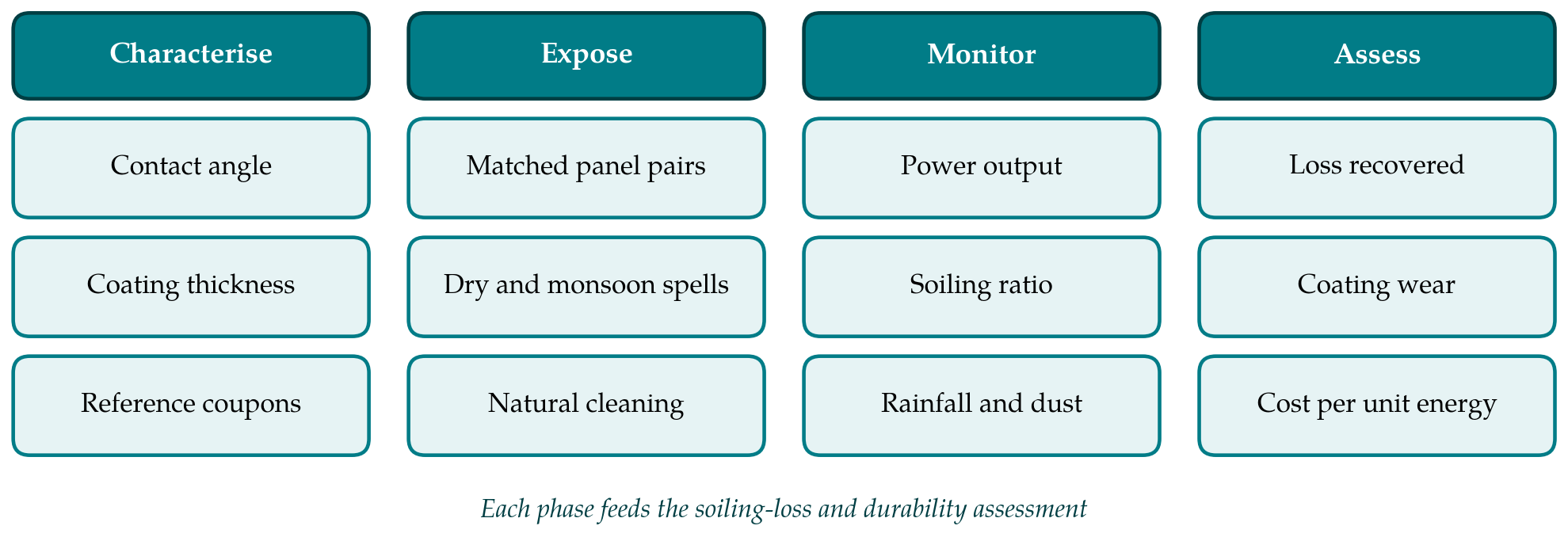
3.1. Phase 1: Characterise the coating
Before any panel is coated, the coating is characterised so that field behaviour can later be related to its starting properties. For a superhydrophobic coating the static contact angle and, more importantly, the roll-off or sliding angle are measured, since low adhesion rather than a high static angle governs self-cleaning. For a photocatalytic coating the relevant property is the induced hydrophilicity under ultraviolet light and the photocatalytic activity. Coating thickness, uniformity and the optical transmission of the coated glass are recorded, because any coating that reduces transmission imposes a fixed loss that the soiling benefit must first overcome.
3.2. Phase 2: Expose matched panels
The core of a fair soiling measurement is the reference. Coated and uncoated modules of the same type are mounted together at the same tilt and orientation and operated identically, so that the only difference between them is the coating. At least a full set of coated and reference modules is needed, and replication is advised because module-to-module variation can rival the soiling effect. A set of small reference coupons kept clean, or cleaned before each reading, provides the zero-soiling baseline against which both coated and uncoated modules are compared, which is the basis of the soiling ratio.
3.3. Phase 3: Monitor output and environment
Electrical output is monitored continuously, and the soiling ratio, the ratio of the output of a soiled module to that of a clean reference under the same conditions, is computed in line with recognised photovoltaic monitoring practice (IEC, 2017). Monitoring the panels alone is not enough: the environmental drivers must be logged too, including plane-of-array irradiance, rainfall, and an indicator of airborne particulate load, so that a recovery of output can be attributed to a rain event or to the coating rather than guessed at. Spectral or temperature effects are separated from soiling by using the clean reference under the same instantaneous conditions.
3.4. Phase 4: Assess recovery and durability
Two questions are answered at the end. The first is performance: over the dry season and across monsoon rain events, does the coated module retain more output than the uncoated one, and by how much, and is that margin larger than the transmission penalty measured in Phase 1. The second is durability: whether the contact angle or photocatalytic activity measured on recovered coupons has declined over the seasons, since a coating that works for one dry season but degrades is a different economic proposition from one that lasts for years. The outcome is expressed as the net energy recovered and, following the economic framing of soiling, as a cost per unit of energy saved against the alternative of washing (Ilse et al., 2019).
4. Fitting the Protocol to Practice
The protocol is designed to run on an operating site rather than in a laboratory, using modules, mounting and monitoring of the kind already present in a utility or institutional array. The added cost is the duplicate instrumented strings, the coupons and the environmental sensors, and the discipline of a fixed reading schedule. A single dry-to-wet cycle gives a first answer on performance; durability needs several years, and the protocol is written so that the same installation can simply continue. Because the reference is measured alongside the coated panels throughout, the protocol tolerates the year-to-year variation in dust and rainfall that makes single-season claims unreliable.
A practical note concerns the choice between the two coating families at the outset. In a site whose soiling is dominated by mineral dust with little organic binder, the photocatalytic route has little to act on, and a low-adhesion surface that sheds particles with rain is the more promising candidate. Where the deposit includes pollen, soot or other organic matter that cements dust into a hard crust, the oxidising action of a photocatalytic coating may matter more. The protocol does not assume one answer: it allows either coating, or both, to be placed in the same paired comparison so that the site itself decides which mechanism pays, rather than the decision being made in advance from a datasheet.
5. Limitations and What Remains to Be Shown
The protocol measures outcomes, not mechanisms, and will not by itself explain why a coating succeeds or fails; that requires the surface analysis of recovered coupons that Phase 4 includes only in part. Its results are specific to the dust and climate of the test site, so a coating that performs well in one monsoon region may not in another with finer or more adhesive dust. The paired-reference design controls for weather but not for rare events such as hail or bird fouling, which must be logged and excluded. Most importantly, the protocol has not been applied. Before it could be recommended as a standard way to judge self-cleaning coatings, it would have to be run at more than one site, with enough replicate modules to establish that the measured soiling difference exceeds module-to-module scatter, and its soiling-ratio method cross-checked against direct gravimetric measurement of deposited dust.
6. Conclusion
Self-cleaning nanocoatings can reduce the soiling losses that limit photovoltaic output in dusty climates, but the two available mechanisms have different and real weaknesses, and field evidence is fragmented because trials are not built to be compared. The protocol proposed here fixes the reference, the instrumentation and the assessment so that a coating can be judged on net energy recovered and on durability across a monsoon cycle rather than on a laboratory contact angle. Its usefulness is an empirical matter that only the multi-site trials described above can settle, and the protocol is offered as a common basis on which operators and researchers could carry them out.
Conflict of interest
To be declared by the author(s) before publication.
Funding
To be declared by the author(s) before publication.