1. Introduction
The FAIR principles, published by Wilkinson et al. (2016), asked that research data be findable, accessible, interoperable and reusable, with emphasis on machines as well as people doing the finding and reusing. They were adopted with unusual speed. Funders wrote them into data management plans, publishers into policies, and the pharmaceutical industry into internal programmes described in surveys such as that of Wise et al. (2019). Guidance on what the principles require in practice followed (Mons et al., 2017; Jacobsen et al., 2020).
Chemistry ought to have found this easy. It has a compact line notation for structures (Weininger, 1988), a standard identifier designed precisely so that two laboratories can agree on what a compound is (Heller et al., 2015), open toolkits for reading and writing chemical formats (O Boyle et al., 2011), and large public archives of structures and bioactivity (Kim et al., 2023; Mendez et al., 2019). A discipline with that infrastructure should be an exemplar.
It is not. Most data generated in an ordinary synthesis and screening project never leave the group in machine-readable form, and much of what is published remains locked in page images, in supplementary documents designed for reading and in spreadsheets whose columns mean whatever their author intended. This article sets out why, and argues that the obstacles are structural rather than technical.
2. What FAIR Asks of a Chemistry Dataset
Stated concretely for a cheminformatics project, the principles ask for a few specific things. Each compound should carry an identifier that resolves and that another group can match to its own records. Each measurement should travel with the conditions that produced it. The files should use formats that software can parse without guesswork, and the terms in them should come from a shared vocabulary. The whole should carry a licence that says what may be done with it, and enough provenance that a reader can judge its quality. Table 1 lists these requirements against the point at which each commonly fails.
| Requirement | Where it breaks in everyday practice | What would ease it |
|---|---|---|
| Provenance of the record | Curation steps undocumented | A published curation sequence (Bento et al., 2020) |
| Discoverable deposit | Data in supplementary files, not indexed | Registered repositories and standards (Sansone et al., 2019) |
| Requirement | Where it breaks in everyday practice | What would ease it |
|---|---|---|
| Resolvable compound identifier | Structures recorded as drawings or internal codes | Standard InChI alongside the drawing (Heller et al., 2015) |
| Machine-readable measurement | Values and units embedded in prose or figures | A tabular deposit required with the manuscript |
| Shared vocabulary for entities | Assay and endpoint named differently by every group | Ontology terms where they exist (Hastings et al., 2016) |
| Explicit licence | No licence, or terms that forbid redistribution | A default open licence stated by the journal |
3. Four Reasons the Gap Persists
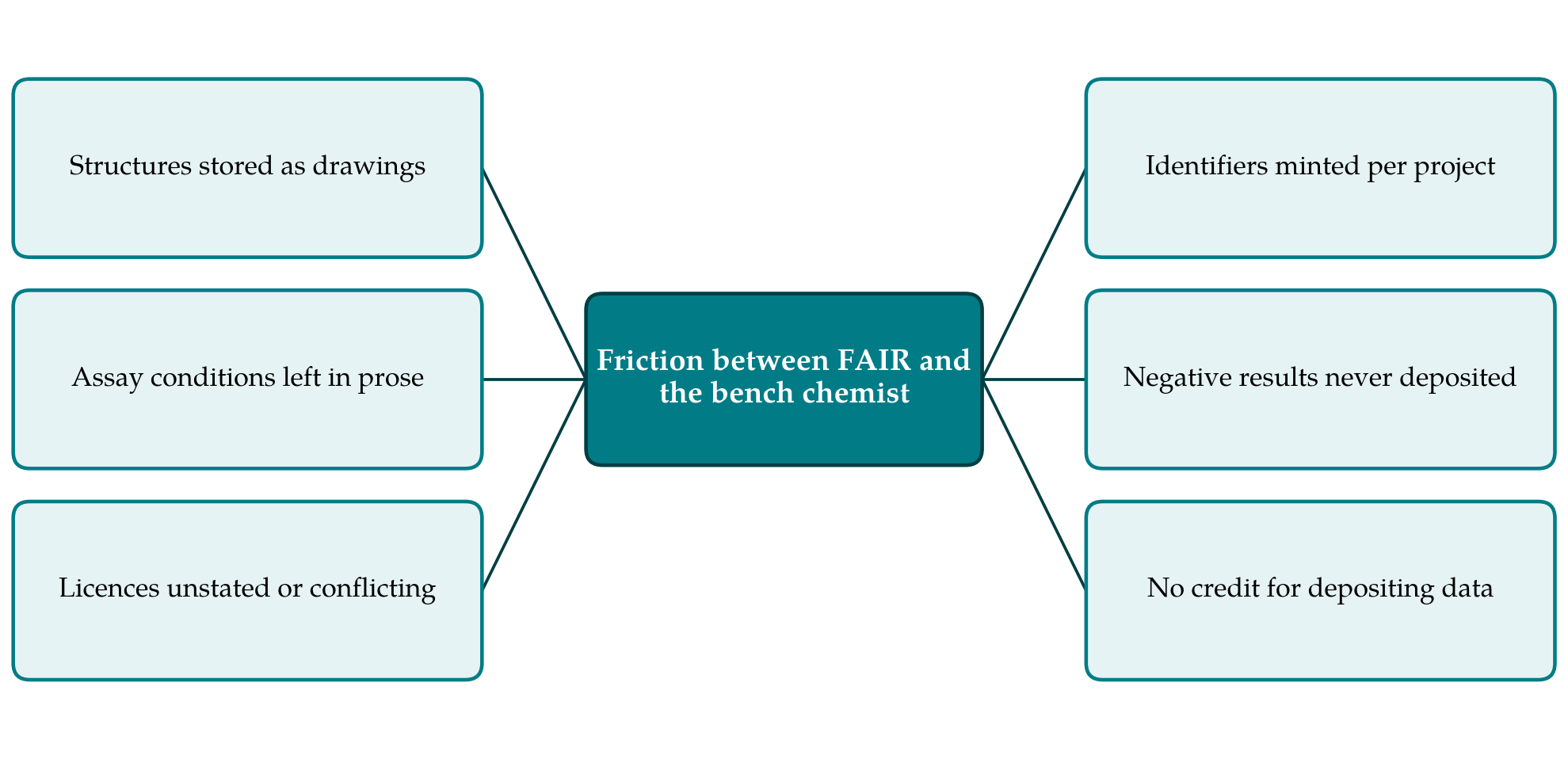
Four arguments explain the distance between policy and practice better than any appeal to the conservatism of chemists. They are summarised in Figure 1 and taken in turn.
3.1. FAIR was written for datasets, chemistry produces decisions
A genome assembly or a climate record is a dataset in the sense the principles assume: a coherent object, produced once, with an obvious boundary. A medicinal chemistry programme produces a stream of small, heterogeneous observations whose value lies in their relation to one another. A single assay result means little on its own; the series it belongs to means a great deal. There is no natural unit to deposit, no obvious moment at which the data are finished, and the object that would be most useful to others, the whole programme with its failures, is the one nobody is preparing to release.
3.2. The hard part of interoperability is semantic
Chemistry solved syntactic interoperability decades ago. Two groups can exchange structures with confidence, and the early argument for marking up chemical information in a structured way (Murray-Rust and Rzepa, 1999) has largely been won at the level of the file format. What they cannot exchange reliably is meaning. An inhibition value depends on the enzyme construct, the substrate concentration, the buffer, the preincubation time and the detection method, and two numbers labelled identically may not be comparable. Aggregation across sources therefore requires judgement, which is why curation remains skilled work (Fourches et al., 2010) and why integration projects such as the one described by Williams et al. (2012) invested so heavily in mapping vocabularies. Making data interoperable in this sense is a scientific task, not a formatting one.
3.3. Openness is least available where data are most valuable
The bioactivity measurements that would most improve public models sit inside companies, and the reasons they stay there are commercial rather than technical. Academic groups face a milder version of the same pressure: data held back until the next paper, or until a patent position is clear. The FAIR principles were careful to say that accessible does not mean open, but in cheminformatics the distinction often resolves into metadata released and measurements withheld, which does little for anyone building models. Precompetitive consortia have shown that some of this can be negotiated, and their limited scope shows how hard the negotiation is.
3.4. The costs and the credit fall on different people
Depositing data properly takes a day or more per paper, and the person who does it is usually a research student with other priorities. The benefit accrues to strangers, later. Nothing in hiring, promotion or grant review currently compensates for that asymmetry, and exhortation does not change an incentive. The reproducibility discussion in the sciences generally (Baker, 2016) and in modelling specifically (Walters, 2013) has converged on the same conclusion: practices that cost individuals and benefit the field spread only when institutions make them cheap, mandatory or rewarded.
4. Counter-Arguments
Three objections deserve a hearing. The first is that the infrastructure is already adequate and the problem is simply adoption. There is something in this: a group that deposits standard identifiers, a tabular data file and a licence has met most of what the principles ask, using tools that cost nothing. But adoption is itself the thing to be explained, and attributing it to inertia stops the analysis exactly where it should begin. The more interesting version of the objection is that the remaining effort, small as it looks from outside, lands on the busiest week of a project.
The second is that mandates will close the gap. Journal and funder requirements have certainly moved practice, and the data availability statement is now routine. What they have produced, though, is often compliance in form: a statement that data are available on reasonable request, or a spreadsheet deposited without a vocabulary or a licence. Mandates raise the floor and do not by themselves produce reusable data.
The third is that large public databases have already solved the problem, since a curator will eventually extract published values into a structured archive. This underestimates what is lost in transit. Extraction recovers the headline numbers and not the conditions, the failed compounds or the assay history, and it places the burden on a small number of curation teams. A discipline that relies on others to make its literature machine-readable has accepted a lossy pipeline as permanent.
5. What Would Actually Help
Three changes would do more than further advocacy. Journals in this field could require a structured data deposit, not a statement, with compound identifiers, measured values, units and conditions in tabular form, and could treat the absence of a licence as an incomplete submission. The cost to authors is modest once it is expected, and the effect on the usable literature would be substantial.
Funders could pay for curation explicitly rather than assuming it as an unfunded obligation, including support for the registries and standards infrastructure that makes deposits discoverable (Sansone et al., 2019). And research groups could adopt a modest internal convention: a standard identifier recorded for every compound at the moment it is made or bought, a fixed vocabulary for assays and endpoints, and curation steps recorded as an ordered list rather than as the word curated. A group that does this finds deposition nearly free at publication, because the work was done as the project ran.
A fourth change is cultural and costs nothing. Supervisors can ask, at the point where a project is designed rather than at the point where it is written up, what will be deposited and in what form. That question is answerable early and almost unanswerable late, because by then the records exist in whatever shape the work happened to leave them. It also makes visible the part of the dataset that is usually lost, namely the compounds that were made and found inactive, which carry information that models need and that no curator can recover from a paper in which they never appeared.
None of this requires new technology. The notations, identifiers, repositories and toolkits exist and are open. What is missing is the alignment between who bears the cost and who receives the benefit.
6. Conclusion
FAIR data practice has not reached routine cheminformatics because the principles assume a kind of research object that this field does not often produce, because the interoperability that matters here is semantic and demands expert judgement, because the most valuable measurements are held for commercial reasons, and because the labour of deposition is unrewarded. Recognising these as structural features rather than as failures of will points to remedies that are within reach: structured deposits required at submission, curation funded as part of research, and conventions adopted inside groups while the work is in progress. Chemistry has the standards it needs. What it lacks is the arrangement of incentives that would make using them the path of least resistance.
Conflict of interest
To be declared by the author(s) before publication.
Funding
To be declared by the author(s) before publication.