1. Introduction
Cassava is propagated from pieces of stem, and whatever viruses the mother plant carried go into the ground with the cutting. This is the first route by which cassava mosaic disease spreads. The second is the whitefly Bemisia tabaci, which acquires the causal begomoviruses from infected leaves and carries them to healthy plants (Legg and Fauquet, 2004). The disease was described in East Africa more than a century ago and was studied in detail at Amani, in what is now Tanzania, in the 1930s (Storey and Nichols, 1938). It is widely regarded as the most damaging virus disease of the crop in Africa (Thresh and Cooter, 2005).
A severe form of the disease appeared in Uganda at the end of the 1980s and spread over the following years through much of East and Central Africa (Otim-Nape et al., 1997; Legg et al., 2006). It was associated with a recombinant virus (Zhou et al., 1997), with unusually severe symptoms and with very large whitefly populations (Legg et al., 2006). The response rested on resistant varieties bred from material first developed at Amani and later at the International Institute of Tropical Agriculture (Hahn et al., 1980). Resistance has reduced losses greatly, but susceptible local varieties remain widely grown for their taste and cooking quality, and the disease persists wherever they do.
This article starts from the observation that the measures recommended against the disease work best when neighbours apply them together. It proposes a framework for organising them at community level. It is a design, built from the published literature, and no application of it is reported.
2. Background
The framework draws on three bodies of knowledge: the epidemiology of the disease, the record of control measures, and what is known about collective management of shared problems.
2.1. Epidemiology relevant to management
Several cassava mosaic begomoviruses occur in the region, including African cassava mosaic virus, East African cassava mosaic virus and the recombinant Uganda variant, and mixed infections produce the most severe disease (Patil and Fauquet, 2009). Plants infected through the cutting show symptoms from the first leaves and yield least. Plants infected later by whiteflies show symptoms only on leaves formed after infection, and the later the infection the smaller the loss. Field studies in West Africa showed that most spread into a new planting came from sources outside it, with incidence highest on the edges facing the prevailing wind (Fargette et al., 1985). Epidemiological modelling that included vector dynamics indicated that the benefit of removing infected plants depends on how much inoculum arrives from outside the field (Holt et al., 1997). Both findings point to the neighbourhood, and not the single plot, as the scale at which infection pressure is set.
2.2. Control measures and why they fall short on single farms
Thresh and Cooter (2005) reviewed the strategies available and grouped them under two headings: host resistance and phytosanitation, the latter meaning the use of virus-free cuttings and the removal, or roguing, of diseased plants. They noted that phytosanitation had seldom been adopted by farmers. The reasons are understandable. Pulling out a growing plant is a visible loss set against an invisible gain. Healthy cuttings are hard to recognise once stems have been cut and bundled. And a household that does everything correctly still receives viruliferous whiteflies from adjacent fields. The comprehensive reviews of Legg et al. (2015) and of the regional pandemics (Legg et al., 2011) reach a similar conclusion: sustained control requires action on planting material at a scale above the farm.
2.3. Collective action and local seed systems
Cassava cuttings move mainly through gifts and exchange among relatives and neighbours, a pattern typical of the local seed systems described by Almekinders et al. (1994). The health of a village's planting material is in that sense a shared resource, which each household can improve or degrade. Ostrom (1990) identified the conditions under which communities manage shared resources successfully, among them clear boundaries, rules made by those who must follow them, monitoring by members, and graduated responses to rule-breaking. Group-based learning of the farmer field school type offers a tested way of building the diagnostic skills such management needs (van den Berg and Jiggins, 2007). The closest published precedent is the work on community phytosanitation against cassava brown streak disease in Tanzania, in which whole communities removed existing cassava and replanted with clean material (Legg et al., 2017).
3. The Proposed Framework
The framework assigns responsibility to a village cassava health group formed from existing farmer organisations. Its work is arranged as six activities that repeat with each planting cycle. Table 1 gives the activities with their technical basis, and Figure 1 shows the cycle.
| Activity | What the group does | Technical or organisational basis |
|---|---|---|
| 1. Agree area and rules | Defines the block of contiguous fields and adopts written rules | Clear boundaries and member-made rules (Ostrom, 1990) |
| 2. Survey | Scores incidence, severity, infection type and whiteflies on each field | Standard survey methods (Sseruwagi et al., 2004) |
| 3. Source and multiply | Obtains tested cuttings of resistant varieties; runs a shared multiplication plot | Cutting-borne infection causes the largest losses |
| 4. Rogue early | Removes plants showing symptoms in the first months after planting | Early removal lowers inoculum within the block (Holt et al., 1997) |
| 5. Select at harvest | Marks symptomless plants in the field as sources of stems | Health cannot be judged once stems are cut |
| 6. Review | Compares survey results across seasons and revises rules | Monitoring by members sustains compliance |
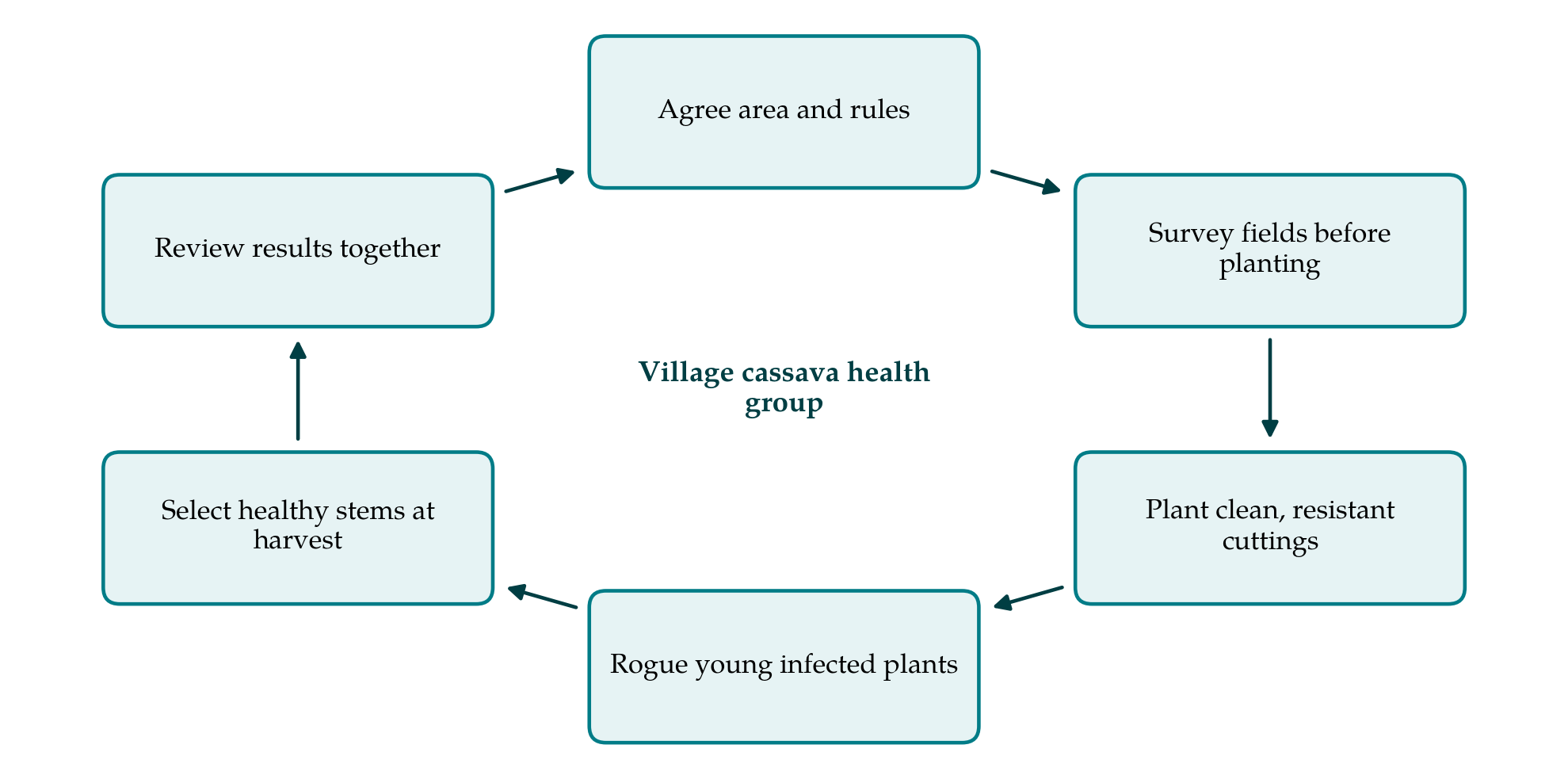
3.1. Activity 1: Agree the area and the rules
The group first decides which fields are included. Because whiteflies move between adjacent plantings, the unit should be a continuous block and should take in as many of the cassava growers within it as possible; a patchwork of participating and non-participating plots defeats the purpose. The group then adopts a short set of rules covering where cuttings may come from, when roguing is done, and what happens when a member does not comply. Rules are written by the members with technical advice, not handed down.
3.2. Activity 2: Survey fields with standard methods
Before the first planting under the scheme, and each season thereafter, trained members walk every field and record the proportion of plants with symptoms, the severity of symptoms on the usual five-point scale, and whether each infected plant was infected through the cutting or by whiteflies, which is judged from whether the lowest leaves show symptoms. Adult whiteflies are counted on the top leaves of a sample of plants. These are the methods standardised for regional surveys by Sseruwagi et al. (2004), and using them allows a village's figures to be compared with district and national data.
3.3. Activity 3: Source and multiply clean cuttings of resistant varieties
The group obtains its starting material from a source able to certify its health, such as a national research station or a registered seed entrepreneur. Varieties are chosen by the members from those with resistance, with attention to the taste, processing and maturity traits that decide whether a variety will be kept. The material is planted in a shared multiplication plot, sited away from old cassava where possible, and inspected closely. Stems from this plot supply members in the next season.
3.4. Activity 4: Rogue infected plants early
In the first months after planting, members remove any plant showing mosaic symptoms and fill the gap with a healthy cutting. Early roguing takes out the cutting-infected plants, which are the main sources of virus for whiteflies inside the block, at the stage when replacement is still worthwhile. Roguing is done on agreed days by members working together across all fields. Joint work makes the practice visible, spreads the labour, and removes the suspicion that one household is bearing a cost others avoid.
3.5. Activity 5: Select healthy stems at harvest
Shortly before harvest, while leaves are still on the plants, members mark vigorous symptomless plants as sources of stems for the next planting. Only marked plants supply cuttings for use or exchange within the group. This simple positive selection costs nothing and deals with the fact that a bundle of leafless stems gives no sign of its health.
3.6. Activity 6: Review each season
At the end of the cycle the group meets to compare the season's survey with earlier ones, to hear from members who found the rules hard to follow, and to change what is not working. The comparison of cutting-borne with whitefly-borne infection is especially informative. A fall in the first shows that the seed measures are working; a persistently high level of the second shows that infection is arriving from outside and that the block needs to be enlarged or neighbouring villages drawn in.
4. Fitting the Framework to Local Conditions
Three matters will differ from place to place and should be settled by the group. The first is who takes part. Cassava is in many communities a crop managed largely by women, while land and group offices are often held by men, and a group that does not include those who actually select and plant the cuttings will make rules that are not followed. The second is the balance between resistant and preferred local varieties. Insisting on complete replacement invites quiet non-compliance; allowing local varieties under stricter selection and roguing may achieve more.
The third is cassava brown streak disease, which is transmitted by the same whitefly and is spread in cuttings in the same way, but is harder to recognise on the leaves. Where both diseases occur, the survey, the sourcing of cuttings and the selection of mother plants should cover both, and the experience reported for brown streak disease is directly relevant (Legg et al., 2017). Modelling of clean seed systems for that disease suggests that their benefit is sustained only if a large proportion of growers take part and infected material is not traded back in (McQuaid et al., 2016).
5. Limitations and What Remains to Be Shown
The framework is proposed and has not been tested in this article. Its central assumption, that coordinated action over a block of fields lowers infection more than the same measures applied by scattered households, follows from the epidemiology but needs field evidence for mosaic disease specifically. A fair test would compare participating communities with similar communities that receive the same resistant varieties without the group organisation, and would follow them for several planting cycles using the standard survey methods. It would also have to record labour, the cost of clean cuttings, and how many households kept to the rules, since a scheme that works only with outside subsidy has not shown that it is community-led.
Other uncertainties are biological. Whitefly populations in parts of the region are now so large that reinfection of susceptible varieties may be rapid whatever is done locally. Resistant varieties differ in how much virus they carry without symptoms. And the minimum size of block needed for a measurable effect is not known. These questions set limits on what the framework can promise.
6. Conclusion
Resistant varieties, clean cuttings and roguing are established measures against cassava mosaic disease, and their weakness on smallholder farms lies less in the measures than in the scale at which they are applied. The framework proposed here moves the unit of management from the household to a village group that sets its own rules, monitors its own fields with standard methods, and controls the source of its planting material. Whether this arrangement delivers lasting reductions in disease at a cost communities will bear is a question for field evaluation, and the design of such an evaluation has been outlined.
Conflict of interest
To be declared by the author(s) before publication.
Funding
To be declared by the author(s) before publication.