1. Introduction
Bacteria attached to a surface and embedded in a self-produced matrix behave differently from the same organisms in suspension. Biofilms underlie many persistent infections and tolerate antimicrobial agents at concentrations far above those that kill free-living cells (Costerton et al., 1999). The matrix of polysaccharides, proteins and extracellular DNA slows penetration and shelters dormant cells (Flemming and Wingender, 2010). Agents that prevent attachment or loosen an established film are therefore sought in medicine, dentistry and food processing.
The thymes are obvious candidates. Species of Thymus and the closely related Thymbra capitata grow wild across the garrigue and phrygana of the Mediterranean, have a long record of use as antiseptics and food preservatives, and yield oils whose antibacterial activity is among the strongest of any aromatic plant (Burt, 2004). A growing number of papers report that such oils inhibit biofilms in vitro. This communication comments on how those reports should be read and how future ones could be made more useful. It contains no original data.
2. Chemical Diversity of Wild Thyme Oils
The genus is chemically polymorphic to an unusual degree (Stahl-Biskup and Sáez, 2002). In Thymus vulgaris of southern France, six chemotypes are distinguished by their dominant monoterpene: the phenols thymol and carvacrol, and the non-phenolic alcohols linalool, geraniol, α-terpineol and thuyanol. They are genetically determined and distributed along environmental gradients (Thompson et al., 2003). Other species add further variation: Thymus mastichina of Iberia is typically rich in 1,8-cineole or linalool, while Thymbra capitata is strongly carvacrol dominant. Harvest season and plant part shift the proportions of the phenols and their precursors, p-cymene and γ-terpinene.
The consequence for antibiofilm studies is direct. The phenolic chemotypes are consistently the most active against bacteria, and an oil from a linalool or cineole plant of the same species may behave quite differently. A result attributed to a species name alone, without a gas chromatographic analysis of the oil actually tested, cannot be interpreted or repeated.
3. What Is Reasonably Established
Thymol and carvacrol are small lipophilic phenols that partition into the bacterial cytoplasmic membrane, increase its permeability and dissipate the proton motive force; the free hydroxyl group is required for this action (Ultee et al., 2002). In an influential study, Nostro et al. (2007) showed that oregano oil, carvacrol and thymol inhibited the growth of staphylococci in preformed biofilms and reduced biofilm formation at concentrations below those that prevented planktonic growth. Interference with bacterial quorum sensing by some essential oils has also been reported (Szabó et al., 2010), which offers one possible route to effects on biofilm that are separate from killing. How far that mechanism applies to thyme oils specifically is uncertain.
Two qualifications apply to this picture. Activity is not uniform across organisms: Gram-negative bacteria with an intact outer membrane, Pseudomonas aeruginosa in particular, are generally less susceptible to essential oils than Gram-positive cocci (Burt, 2004), and a result obtained with staphylococci cannot be carried over to them. A whole oil is also more than its main phenol. Minor constituents such as p-cymene have little antibacterial effect alone, yet they may alter the uptake of the phenols, so that an oil and an equivalent amount of pure thymol need not behave alike.
4. Pitfalls of the Standard Assays
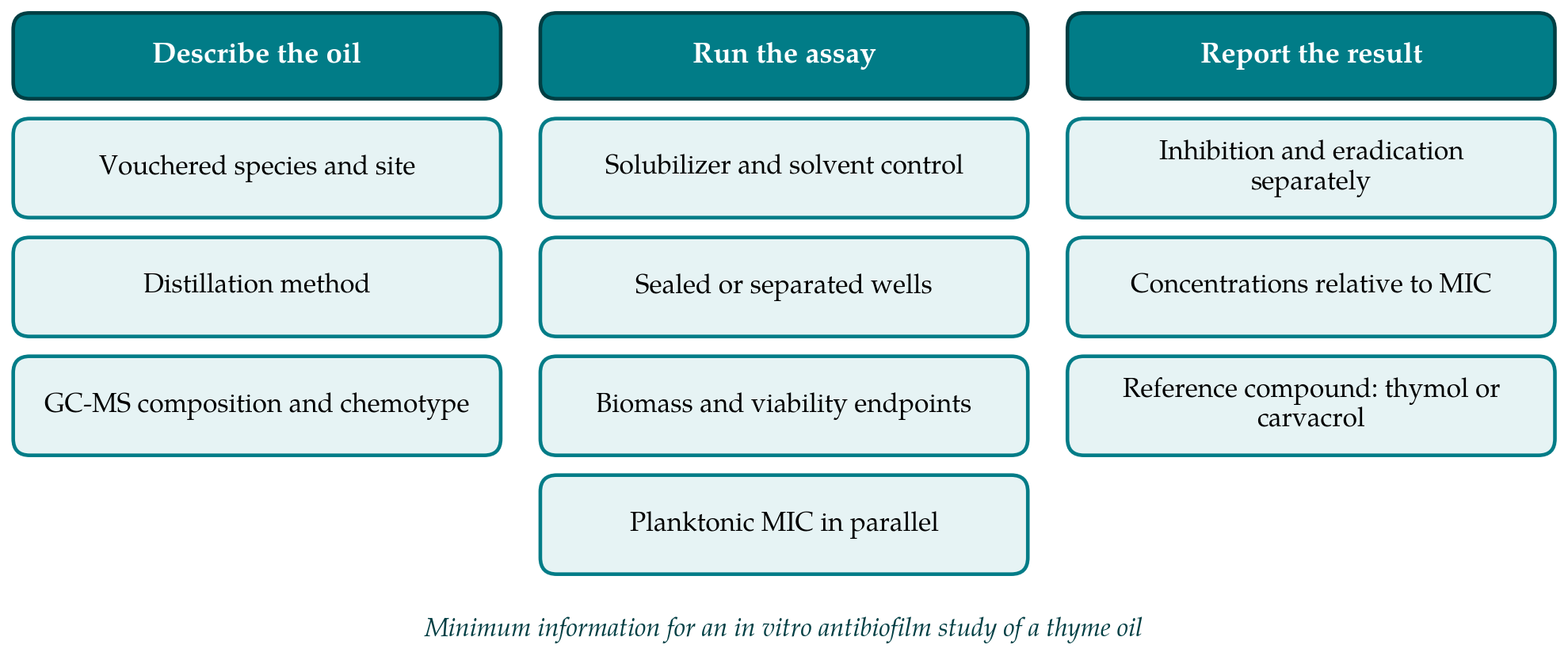
Nearly all studies use the microtitre-plate method, in which biofilm grown on polystyrene wells is stained with crystal violet and the bound dye is measured (Stepanović et al., 2000; O'Toole, 2011). The peg-lid device introduced by Ceri et al. (1999) allows the minimum concentration that eradicates an established biofilm to be determined. Both were designed for water-soluble agents, and essential oils violate their assumptions in several ways. Table 1 lists the main problems and Figure 1 the information a report should contain.
| Pitfall | Consequence | Remedy |
|---|---|---|
| Poor water solubility | Uneven exposure; oil film on well walls | Low, stated level of solubilizer with its own control |
| Volatility | Vapour affects neighbouring wells, including controls | Seal plates; separate treatments; check control growth |
| Crystal violet stains matrix and dead cells | Biomass falls without showing cell death, or the reverse | Add a viability endpoint such as colony counts |
| Oil or emulsion alters optical readings | False increase or decrease in absorbance | Include oil-only blanks; wash consistently |
| Growth inhibition mistaken for antibiofilm action | Any bactericidal dose appears to be antibiofilm | Determine planktonic MIC in parallel; test below it |
| Undefined oil | Result cannot be reproduced | Report GC-MS composition and voucher |
Two of these deserve emphasis. Volatility is peculiar to this class of agent: vapour from wells with a high concentration can suppress growth in adjacent wells, so that untreated controls on the same plate are no longer untreated. The second is the relation to growth inhibition. A concentration that stops bacteria multiplying will necessarily stop them forming a biofilm, and calling this antibiofilm activity adds nothing. A distinct effect is shown only when attachment or matrix production is reduced at concentrations that leave planktonic growth unaffected, or when an established biofilm is killed or dispersed. General guidance on testing natural products makes the same demand for defined endpoints, appropriate controls and realistic concentrations (Cos et al., 2006).
Solubilizers need the same care. Polysorbate 80 and dimethyl sulfoxide are the usual choices, and agar at low concentration is sometimes added to stabilise the dispersion. Surfactants can themselves alter bacterial attachment to plastic and may hold the lipophilic phenols in micelles, lowering the concentration that reaches the cells. The level used should therefore be the lowest that gives a stable dispersion, it should be identical in every well, and a control containing the solubilizer without oil belongs on every plate.
5. Reading and Reporting Results
With these points in mind, three questions can be put to any report. Is the oil defined by species, voucher, origin, distillation and composition? Are inhibition of formation and eradication of mature biofilm distinguished, and each related to the planktonic minimum inhibitory concentration for the same strain? Is there a viability measure alongside crystal violet, and a pure reference compound, thymol or carvacrol, tested in the same run so that the oil can be compared with its main constituent? Where the answers are yes, results from different laboratories begin to be comparable.
Choice of organism also shapes what a study can show. Reference strains from culture collections allow comparison between laboratories, while clinical or food isolates are often stronger biofilm producers and closer to the problem at hand; testing both is preferable. Mixed-species films, which are the rule outside the laboratory, are rarely examined. Exposure time matters as well, since a volatile agent may be largely lost from an open well within hours, and the nominal concentration at the start of an overnight incubation is then a poor guide to the dose the cells experienced.
Even a well-conducted plate assay is a long way from use. Biofilms on polystyrene in rich broth differ from those on tissue, catheters or steel under flow. Phenolic oils irritate skin and mucosa at concentrations not far above those active in vitro, they bind to organic matter, and their odour limits use in food. Claims that wild thyme oils could treat biofilm infections are not supported by in vitro data of this kind, and no such inference should be drawn. Finally, wild populations of some narrowly distributed thymes are under collection pressure, which is a reason to characterise chemotypes carefully and to favour cultivated material once an active type is identified.
6. Conclusion
Oils from Mediterranean thymes rich in thymol or carvacrol have well-founded antibacterial activity, and there is credible laboratory evidence that they affect biofilms. Much of the published work, however, tests chemically undefined oils with assays that essential oils readily confound, and does not separate antibiofilm action from simple growth inhibition. Reporting the composition of the oil, controlling for solubility and vapour, pairing biomass with viability measurements and anchoring concentrations to the planktonic inhibitory level would make the literature considerably more informative.
Conflict of interest
To be declared by the author(s) before publication.
Funding
To be declared by the author(s) before publication.