1. Introduction
For much of the twentieth century Shakespeare was taught in universities as a poet to be read. The argument that the plays are scripts, written for actors and completed only in performance, moved from theatre history into criticism during that century (Styan, 1977) and from criticism into the classroom. In schools it took the form of the active methods associated with Gibson (1998), and theatre companies with education departments have since developed detailed rehearsal-room pedagogies (Banks, 2014; Winston, 2015). The common principle is that students learn the plays by doing what actors do: speaking the lines aloud, moving, making choices and comparing them.
Most of this literature assumes, without saying so, a room of students for whom English is the first language and Shakespeare's English the only obstacle. That assumption fails in a great many universities, both in countries where English is a medium of instruction alongside other languages and in anglophone institutions with internationally recruited or locally multilingual cohorts. Students in such rooms read early modern verse through a second or third language. They also bring resources that monolingual students lack: experience of moving between languages, familiarity with other verse and theatre traditions, and often a first acquaintance with the plays in translation.
This article proposes a module design that treats those resources as central. It describes a semester-long sequence for teaching one tragedy through performance in a multilingual undergraduate class, with the reasoning behind each phase. It is a proposal built from published practice and theory. No cohort has been taught with it for the purposes of this article, and no outcomes are reported.
2. Background
The design draws on three bodies of work that are seldom read together: performance approaches to Shakespeare, the pedagogy of multilingual classrooms, and the use of drama in additional-language teaching.
2.1. Performance approaches to Shakespeare
Gibson's account rests on a few propositions. The play is a script; meaning is made socially, in groups; and physical and vocal exploration should come before, and feed, analytical discussion (Gibson, 1998). Stredder (2009) supplies a large repertoire of exercises for the purpose, and Rocklin (2005) recasts the guiding question for older students: not only what a speech means but what it does, to the person addressed and to the audience. Neelands and O'Hanlon (2011) argue that the approach is as much social as theatrical, because ensemble work gives every student a stake in the interpretation. Two cautions from the same literature are built into the present design. Worthen (1997) warns against the belief that performance recovers an authentic meaning lodged in the text; a staging is an interpretation and must be argued for like any other. Thompson and Turchi (2016) insist that activities need a stated intellectual purpose and that students' own identities shape what they can do with a role.
2.2. Multilingual classrooms
Research on bilingual education has long held that knowledge and academic skills developed in one language are available in another, and that excluding the first language from the classroom wastes them (Cummins, 2000). Translanguaging pedagogy takes the point further. It regards a multilingual speaker as having one integrated repertoire and encourages its planned use in learning (García and Li Wei, 2014). European language policy has moved the same way: the companion volume to the Common European Framework of Reference describes mediation between languages and plurilingual competence as abilities to be taught and assessed, and includes descriptors for responding to creative texts (Council of Europe, 2020). For Shakespeare the implication is direct. The plays have a long performance history in other languages, and Kennedy (1993) has argued that productions outside English, free of reverence for the original words, have often been bolder in exploring what the plays can mean on stage. A student's home-language Shakespeare is part of the object of study.
2.3. Drama in additional-language learning
Language teachers have used drama for decades on the ground that it supplies a reason to speak, a context that supports comprehension and a rehearsal structure that makes repetition purposeful. Kao and O'Neill (1998) set out the case for process drama in the second-language classroom, and Stinson and Winston (2011) survey the growth of the field while acknowledging that it still needs a stronger research base. The linguistic difficulty of Shakespeare should also be kept in proportion. Crystal (2008) argues that only a small share of the vocabulary is truly unfamiliar to a modern reader and that the greater challenges are compressed syntax and words whose meanings have shifted. Those are difficulties that slow, repeated, embodied work on short passages is well suited to address.
3. Design Principles
Four principles govern the proposal. First, depth over coverage: one tragedy is studied for the whole semester, through a limited number of scenes worked in detail, with the rest of the play read and summarised. Macbeth is a sensible default because it is the shortest of the major tragedies and its plot is easily held in mind, though the design does not depend on the choice. Second, every session follows the experiential sequence described by Kolb (1984), from concrete experience through reflection and conceptualisation to renewed experiment, so that analysis grows out of practice. Third, students' languages are used by plan and for a stated purpose, never merely tolerated. Fourth, teaching activities and assessment tasks are aligned with the intended outcomes in the manner recommended by Biggs and Tang (2011): if translation and staging choices are how students learn, they are also what students are assessed on.
4. The Proposed Sequence
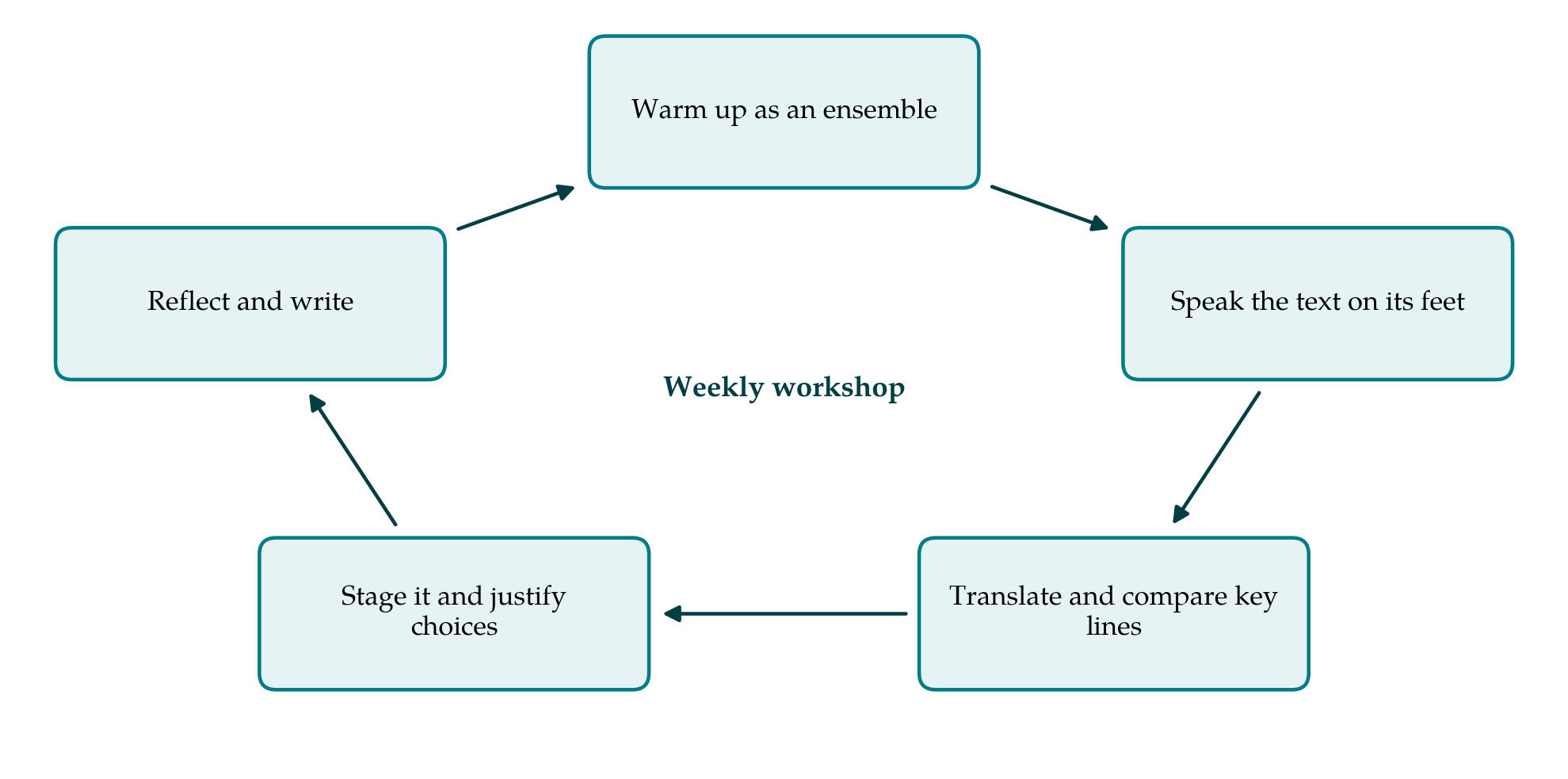
The module is planned in five phases, summarised in Table 1. Within every phase the weekly workshop follows the same cycle, shown in Figure 1, so that students quickly learn the routine and attention can go to the text.
| Phase | Main activity | Use of students' languages | Output |
|---|---|---|---|
| 1. Ensemble and story | Ensemble exercises; whole plot enacted in brief | Plot retold in pairs in any language | None (formative) |
| 2. Voicing the verse | Choral and solo speaking; stress and line endings | Rhythm compared with verse in other languages | Short recorded reading |
| 3. Scene work | Small-group rehearsal of set scenes | Glosses and trial translations of key lines | Annotated script |
| 4. Staging choices | Two contrasting stagings of one scene | Bilingual versions allowed with a rationale | Group performance and statement |
| 5. Reflection | Seminar discussion; individual writing | Translation choices cited as evidence | Critical essay |
4.1. Phase 1: Ensemble and story
The opening sessions establish how the group will work. Simple ensemble exercises, walking the space, passing a line around a circle, speaking in unison, lower the stakes of using the voice in front of others, which matters most for students unsure of their spoken English. The whole plot is then enacted in compressed form, with the teacher narrating and students stepping in to speak a single line for each main event, an exercise of the kind collected by Stredder (2009). Students afterwards retell the story in pairs in whatever language they choose. The aim is that nobody begins scene work without knowing what happens. Ground rules are agreed at this point, including the rule that any language may be used in rehearsal provided that its use is explained to those who do not share it.
4.2. Phase 2: Voicing the verse
The second phase concentrates on sound. Short passages are spoken chorally, then individually, with attention to stress, to the pause or run-on at the line ending and to the difference between verse and prose speakers. Technical terms are introduced only after the thing itself has been heard. Students are then asked to bring a few lines of verse or heightened speech from another language they know and to explain to a partner how its rhythm is organised. The comparison makes the iambic line one system among several and gives multilingual students expert standing early in the course. Where published translations of the play exist in the students' languages, a passage is read aloud beside the English.
4.3. Phase 3: Scene work across languages
The core of the module is small-group rehearsal of set scenes, chosen so that between them they carry the main line of the tragedy. Groups are formed to mix languages where possible. Each session begins with the scene on its feet in English. Groups then select the lines they find hardest or richest and produce a working gloss and at least one trial translation, noting what each version gains and loses. A pun, an ambiguous pronoun or a word with a shifted meaning will usually force a decision that a monolingual reading can pass over. The translations are spoken in the scene so that their effect can be heard. Each student keeps an annotated script that records glosses, translation attempts and blocking decisions with brief reasons.
4.4. Phase 4: Staging choices
In the fourth phase each group prepares two contrasting stagings of one scene and presents both. The contrast may lie in who holds power, in how a soliloquy is addressed, or in language: a group may play a scene bilingually, with characters shifting language to mark intimacy, authority or exclusion. Such choices are permitted only with a rationale grounded in the text. After each showing the audience describes what it saw before saying what it thought, a discipline common in rehearsal-room teaching. The purpose is to make concrete Worthen's point that performance is interpretation: two defensible stagings of the same lines give students a disagreement to analyse.
4.5. Phase 5: Reflection and critical writing
The final sessions convert practice into argument. Seminar discussion returns to critical questions about the tragedy, such as responsibility, ambition and the status of the supernatural, and students draw on what they found in rehearsal. Each then writes an individual essay in English that advances a reading of one scene and uses staging and translation decisions as evidence beside quotation. The essay is the point at which the module meets the conventional expectations of a literature degree, and the earlier phases are designed to give students with less confident academic English something specific and owned to write about.
5. Assessment
Assessment follows the phases. The recorded reading in the second phase and the annotated script in the third are low-stakes tasks intended mainly for feedback. The group performance is marked on the clarity and textual grounding of the rationale, not on acting skill, and each group submits a short written statement in which members' contributions are identified. The individual essay carries the greatest weight. Criteria should be published in advance and should name the use of performance and translation evidence explicitly, so that students do not suspect that the practical work is a diversion from what really counts. Spoken English is not itself graded in a literature module. Where an institution requires a language outcome, the mediation descriptors of the Common European Framework offer wording that can be adapted (Council of Europe, 2020).
6. Fitting the Design to Local Conditions
The design assumes a group small enough to work in a cleared room and a teacher willing to lead practical exercises, but no theatre training or equipment. Large cohorts can be divided into workshop groups that meet in alternate weeks, with lectures carrying context. Where a class shares one language other than English, the comparative element changes character: the published translation tradition in that language becomes a major resource, and care is needed to ensure that English is still spoken enough for the verse to be heard. Where a class has many languages and few shared, glossing into English becomes the common ground and translation is done individually and reported. Teachers should also expect some students to resist physical work on cultural or personal grounds. Roles such as director, dramaturg or translator allow full participation without performing.
7. Limitations and What Remains to Be Shown
The proposal has not been tested. It combines practices that have been described separately, and the evidence base for each is itself uneven: the literature on active Shakespeare consists largely of practitioner accounts, and research on drama in language education is still developing (Stinson and Winston, 2011). Whether the combination works as intended is an open question. An evaluation would need to look at least at the quality of students' critical writing compared with conventionally taught groups, at participation by students of differing English proficiency, and at students' own accounts of whether using their languages helped or felt like a detour.
There are risks in the design as well. Translation exercises can privilege students with strong literacy in a prestigious language over those whose home language is mainly oral or lacks a Shakespeare tradition. Bilingual staging can slide into decoration if the rationale requirement is not enforced. Performance work is time-consuming, and the decision to study a few scenes deeply means that students read less of the canon. And a teacher who does not share the students' languages must be content to assess reasoning about translations that cannot be checked directly. These costs may be worth bearing, but they should be weighed openly by any department that adopts the approach.
8. Conclusion
Performance pedagogy and multilingual pedagogy share a premise: learners understand a text by doing something with it, using all the means of expression they have. The module proposed here joins the two for the teaching of a Shakespearean tragedy. It sequences ensemble work, verse speaking, scene rehearsal, contrasted stagings and critical writing, and it asks students at each stage to treat translation between their languages as a form of close reading. The design is offered as a reasoned starting point for teachers and as a candidate for classroom research. Its merits remain to be demonstrated by those who try it.
Conflict of interest
To be declared by the author(s) before publication.
Funding
To be declared by the author(s) before publication.