1. Introduction
Cucumber grown under glass or plastic is rarely free of powdery mildew for long. The disease in cucurbits is caused mainly by Podosphaera xanthii, known in older literature as Sphaerotheca fuliginea and in some papers as Podosphaera fusca, and less often by Golovinomyces species (Pérez-García et al., 2009). Powdery mildews are obligate biotrophs that grow on the leaf surface, do not need free water to infect, and produce airborne conidia in great numbers (Glawe, 2008). A warm, sheltered crop with a dense canopy suits them well, and control usually rests on repeated fungicide treatments through a long cropping season.
That pattern of use has consequences. Cucurbit powdery mildew has developed resistance to one fungicide group after another, as documented in the review by McGrath (2001). Sooner or later a grower in an area where a product has always worked notices that it no longer does. This note is about that moment. It does not report such a case. It describes how a suspected first observation of tolerant isolates should be examined before it is announced, and what should follow if it is confirmed.
2. Why Protected Cucumber Crops Are Prone to Resistance
The risk of resistance depends on the fungicide, the pathogen and the way the two are brought together (Brent and Hollomon, 2007). All three are unfavourable here. Many of the compounds used against powdery mildew act at a single biochemical site, so that one mutation can confer resistance. The pathogen completes a generation in days and its population on a crop is very large. And the enclosed crop is treated many times, often with a narrow range of products, while few sensitive spores arrive from outside to dilute the survivors.
The record bears this out. Reduced sensitivity to the sterol demethylation inhibitors was found in Dutch glasshouse cucumbers in the early years of their use (Schepers, 1983). Resistance to the strobilurins, or quinone outside inhibitors, appeared in cucumber powdery mildew in Japan within a few seasons of their introduction and was associated with the G143A substitution in cytochrome b (Ishii et al., 2001); it was later found to be widespread in cucurbit crops in Spain (Fernández-Ortuño et al., 2006). The chemistry and mode of action of this group are described by Bartlett et al. (2002). Resistance of the strobilurin type is qualitative: isolates are either sensitive or almost unaffected. Resistance to demethylation inhibitors is quantitative and develops as a gradual shift (Lucas et al., 2015). The two kinds look different in the crop and call for different tests.
3. Tolerance in the Laboratory and Failure in the Crop
Two things are easily confused. One is a measurable loss of sensitivity in isolates tested under controlled conditions. The other is a loss of disease control when the product is used as the label directs, which is what resistance guidance calls practical or field resistance (Brent and Hollomon, 2007). Either can occur without the other. Figure 1 sets out the four combinations and the response each calls for. Poor control with no shift in sensitivity points to the application and not to the fungus. A shift in sensitivity while control still holds is an early warning, and the most useful finding of all, because there is still time to act.
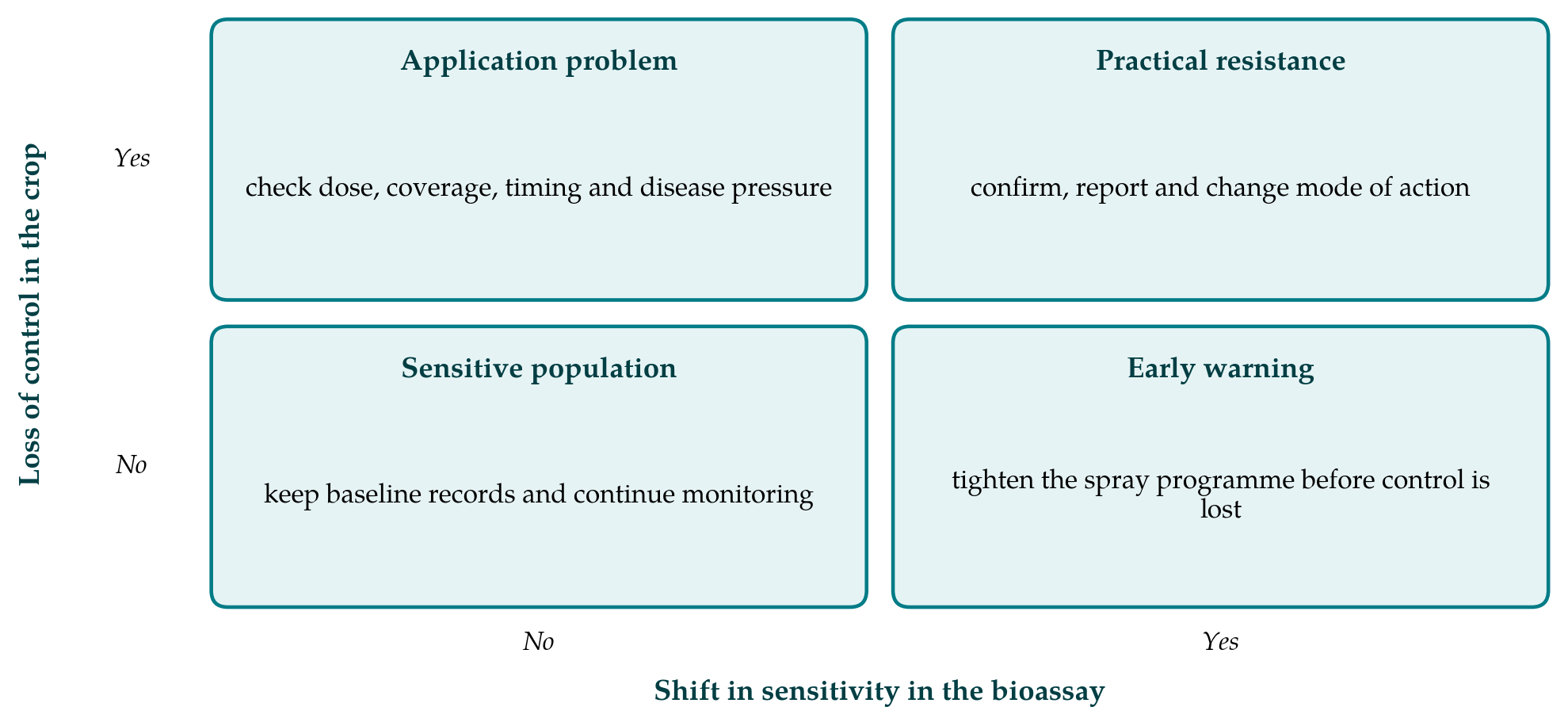
The words used should match the evidence. An isolate that grows at a concentration which stops a reference isolate may properly be called less sensitive, or tolerant, in that test. The term resistant is best kept for cases in which the shift is heritable and large enough to affect control. A first observation should say which of these has been shown.
4. Checks Before a First Observation Is Claimed
Table 1 lists the checks that should be completed, roughly in the order in which they are practicable. The first two need no laboratory. Mildew colonies should be examined to confirm that the pathogen is the expected species, since the cucurbit powdery mildews differ in their response to some fungicides. The spray record should then be read critically: the dose applied, the water volume, the interval since the last treatment, and whether the lower surfaces of the leaves, where colonies often start, were reached. Most reports of failure end at this stage.
| Check | How it is done | What it excludes or establishes |
|---|---|---|
| Identity of the pathogen | Microscopy of conidia; molecular identification if in doubt | A different mildew species with different sensitivity |
| Application record | Review dose, coverage, interval and disease pressure at spraying | Failure caused by the treatment and not the fungus |
| Leaf-disc bioassay | Inoculate treated discs or cotyledons across a range of concentrations | A measured shift relative to a sensitive reference |
| Baseline comparison | Compare with sensitivity data from before the product was used | Natural variation mistaken for a shift (Russell, 2004) |
| Stability | Retest after several transfers without fungicide | A transient, non-heritable response |
| Molecular test | Assay for the known target-site mutation, where one exists | The mechanism, for qualitative resistance |
Because the fungus cannot be grown on artificial media, sensitivity is measured on living tissue. Leaf discs or detached cotyledons of a susceptible cultivar are treated with a series of fungicide concentrations, inoculated with conidia from single colonies, and scored for mildew growth after incubation. Each test must include an isolate known to be sensitive. The result is expressed relative to that reference and, where they exist, to baseline data gathered before the fungicide came into use, since isolates never exposed to a product still differ among themselves (Russell, 2004). For strobilurins a single discriminatory dose separates the two classes cleanly, and the cytochrome b mutation can be sought directly (Ishii et al., 2001). For demethylation inhibitors a full dose-response series is needed.
5. Responding to a Confirmed Case
Once tolerance is confirmed the product concerned, and others with the same mode of action, should be withdrawn from the programme on that holding, because cross-resistance within a group is the rule. Control should pass to compounds from other groups and to multi-site or non-chemical measures, and the number of applications of any single-site group in a crop cycle should be limited. Mixing or alternating modes of action and keeping the number of treatments down are the tactics best supported by theory and experiment (van den Bosch et al., 2014). Hygiene between crops, resistant cultivars and climate management reduce the pressure that makes frequent spraying necessary.
The case should also be reported, to the advisory service and to the manufacturer, with the bioassay data and the reference used. A first observation is of value to others only if they can judge how firm it is. Hollomon (2015) has stressed that monitoring detects resistance early only where sampling is routine, which argues for testing isolates from protected cucumber crops before failures are seen and not after.
6. Conclusion
Protected cucumber production combines a high-risk pathogen with intensive use of high-risk fungicides, and new cases of tolerance are to be expected. Whether a given observation is the first sign of resistance or an application fault can be settled by a short sequence of checks ending in a bioassay against a sensitive reference. Reports that state the species, the method, the reference and the size of the shift allow advisers to respond in proportion, and they protect both growers and the remaining effective products.
Conflict of interest
To be declared by the author(s) before publication.
Funding
To be declared by the author(s) before publication.