1. Introduction
Low level waste makes up most of the volume and a small share of the radioactivity that nuclear power, medicine, research and industry produce. It is disposed of in engineered facilities at or near the surface, or in rock caverns at moderate depth, under safety requirements that are internationally agreed (IAEA, 2011; IAEA, 2014). The engineering is established. Northern Europe has long experience of it: Sweden has operated a repository for short-lived waste in bedrock beneath the seabed at Forsmark since 1988, and Finland disposes of operational waste in rock caverns at its Olkiluoto and Loviisa power plant sites.
The difficulty lies in deciding where a new facility should go. Siting programmes for radioactive waste in many countries were first conducted on a technical model in which experts selected a site and then defended it, and many of those programmes stalled in the face of local opposition. Since the 1990s policy has shifted toward voluntary and participatory approaches, a change that Bergmans et al. (2015) call the participatory turn in radioactive waste management. European law now requires it in outline: the Euratom waste directive obliges member states to give the public the opportunity to participate effectively in decision making on waste management (Council of the European Union, 2011).
What effective participation consists of is left open. An implementing organisation that must plan a siting process finds abundant research and many accounts of individual national programmes, but little that converts them into an ordered plan. This article proposes a framework for that purpose. It describes no actual siting process and reports no data. It sets out, phase by phase, what engagement should be designed to achieve and how its quality might be judged.
2. Background
Three bodies of knowledge inform the design: research on how people judge hazardous facilities, research on participation methods, and the legal and institutional setting of the region.
2.1. Risk perception, trust and fairness
Slovic (1987) showed that lay judgements of risk are shaped by qualities such as dread, unfamiliarity and involuntariness as well as by probability, and nuclear waste scores high on all of them. Kasperson et al. (1992) argued that distrust of the institutions responsible is a central obstacle in siting, and that trust lost is slow to recover. Technical assurance offered by a distrusted body does little to change views. Wynne (1992) added that local people hold knowledge of their own surroundings, and of how institutions have behaved toward them, which experts tend to overlook, and that dismissing it as misunderstanding deepens the divide.
Fairness has both procedural and distributive sides. The Facility Siting Credo assembled by Kunreuther et al. (1993) lists procedural goals, among them broad participation, agreement that the facility is needed, and voluntary acceptance, and found that trust and a sense that the design addresses community concerns were closely tied to successful outcomes. On compensation, Frey and Oberholzer-Gee (1997) reported from a Swiss repository case that offering money reduced stated willingness to host, which they attributed to the crowding out of civic motives. Benefits offered as a price for risk can be read as a bribe. Benefits negotiated as part of a partnership are a different matter.
2.2. Participation methods and their evaluation
Arnstein (1969) distinguished degrees of participation by the power actually transferred to citizens, from token consultation to shared control. Fiorino (1990) gave three reasons for involving lay people in risk decisions: it is right in a democracy, it improves the substance of decisions, and it makes them more legitimate. Rowe and Frewer (2005) classified mechanisms by the direction of information flow into communication, consultation and participation, and their earlier paper proposed criteria for judging a process, including representativeness, independence, early involvement, influence on the outcome, transparency, access to resources and clear definition of the task (Rowe and Frewer, 2000). Krütli et al. (2010) argued from repository siting that the appropriate level of involvement is not constant: it should vary with the phase of the process and the nature of the decision at hand.
2.3. The northern European setting
Several features of the region bear on design. Municipalities have substantial authority over land use, and in the Nordic nuclear countries a host municipality's consent carries legal weight in the licensing of nuclear facilities. The Aarhus Convention guarantees access to environmental information, participation in decisions and access to justice (UNECE, 1998), and the environmental impact assessment directive requires public consultation before consent is given (European Parliament and Council, 2011). The Forum on Stakeholder Confidence of the OECD Nuclear Energy Agency has documented how national programmes adapted to these expectations and how local partnerships between implementers and communities have been organised (OECD-NEA, 2004; OECD-NEA, 2010). High general trust in public authorities is often cited as a regional advantage, but it is an asset that a poorly run process can spend.
3. The Proposed Framework
The framework divides a siting process into six phases. Figure 1 shows their order, and Table 1 sets out the purpose of engagement and suitable mechanisms in each. Following Krütli and colleagues, the intensity of participation rises from information and consultation in the early national phases to collaboration and shared decision making once particular communities are involved.
| Phase | Purpose of engagement | Suggested mechanisms | Record for evaluation |
|---|---|---|---|
| 1. Mandate and rules | Agree need, roles, veto and withdrawal rights | Parliamentary process, national consultation, published charter | Charter and responses to consultation |
| 2. Mapping | Identify who is affected and what concerns them | Stakeholder analysis, open meetings, interviews | Stakeholder map and issues register |
| 3. Area screening | Apply exclusion criteria openly, invite interest | Published criteria and maps, calls for expressions of interest | Criteria, comments received, changes made |
| 4. Local partnership | Investigate sites and impacts jointly | Partnership body, funded independent review, site visits | Terms of reference, minutes, review reports |
| 5. Decision | Reach a legitimate community decision | Council vote or referendum, negotiated host agreement | Decision record and signed agreement |
| 6. Oversight | Sustain trust through construction and operation | Local monitoring committee, open data, periodic review | Monitoring reports and review findings |
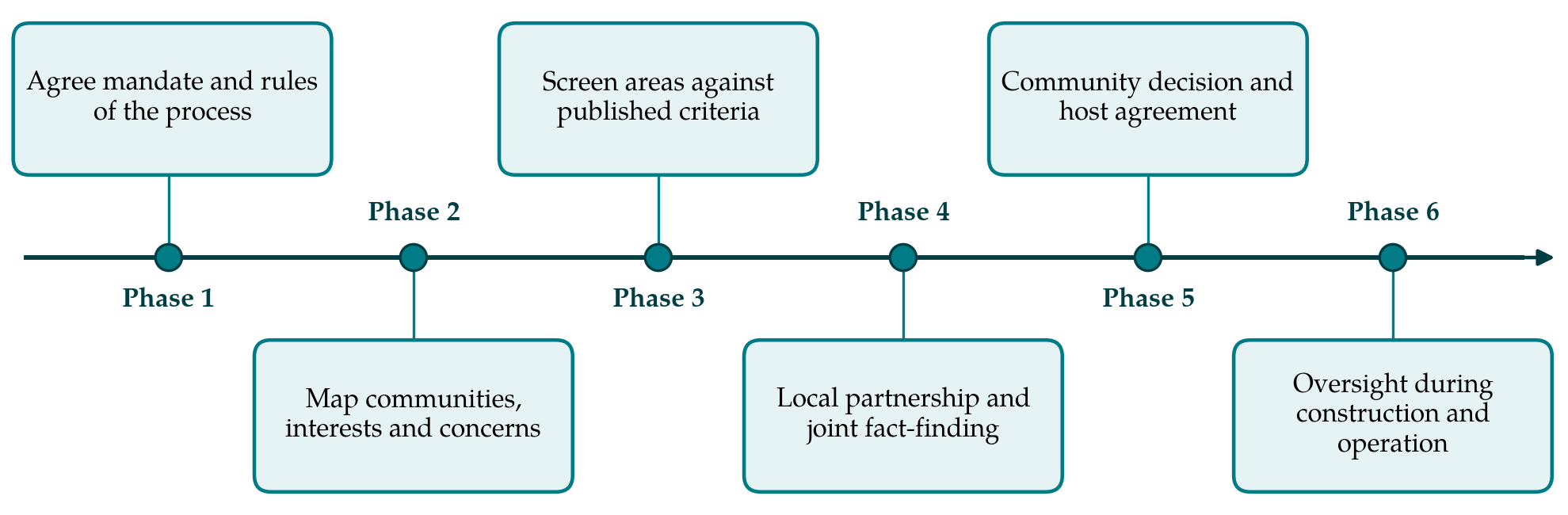
3.1. Phase 1: Mandate and rules
Engagement begins before any map is drawn. The need for a facility, the inventory it would hold and the alternatives should be debated nationally, and the rules of the siting process fixed and published: who takes each decision, whether participation by a community is voluntary, up to what point it may withdraw, and how costs of participation will be met. A written charter of these commitments gives communities something to hold the implementer to. Its absence leaves every later assurance open to doubt.
3.2. Phase 2: Mapping communities and concerns
The implementer identifies those with a stake: municipalities and their neighbours, landowners, businesses that depend on the reputation of local produce or tourism, environmental organisations, and, in the northern parts of the region, Sámi communities and reindeer herding districts whose land use crosses municipal boundaries. Because the Baltic Sea and several land borders are shared, the public in neighbouring states may also have standing under transboundary assessment rules. The output is a register of concerns in the words of those who raised them, which later phases must answer.
3.3. Phase 3: Area screening
Geological, hydrological and land-use criteria that exclude unsuitable areas are published in draft, with the reasoning, and opened to comment before they are applied. Applying published criteria in public protects the process from the suspicion that a site was chosen first and justified afterwards. Within the areas that remain, municipalities are invited to express interest without commitment. A community that hosts an existing nuclear site may come forward readily. The process should nonetheless avoid presuming that familiarity amounts to consent.
3.4. Phase 4: Local partnership and joint fact-finding
In each interested municipality a partnership body is formed with elected representatives, local organisations and residents, supported by a budget that it controls. Its tasks are to follow the site investigations, to commission independent review of the implementer's safety and environmental work, and to develop its own view of the conditions under which the community could accept the facility. Funding independent expertise answers the Rowe and Frewer criterion of access to resources and acknowledges the point made by Wynne about local knowledge. The statutory environmental impact assessment runs within this phase and should be treated as a minimum.
3.5. Phase 5: Community decision and host agreement
The decision is taken by the means the community itself regards as legitimate, whether a council vote or an advisory referendum, on the basis of a draft host agreement. The agreement covers safety conditions, limits on the inventory, local monitoring rights, and development measures. In the light of the crowding-out finding, benefits are best framed as shared investment tied to the community's own plans and agreed through the partnership. A refusal is respected. A process that proceeds after a refusal forfeits its voluntary character for every other community watching.
3.6. Phase 6: Oversight during construction and operation
Engagement does not end with a licence. A local committee with access to monitoring data, the right to question the operator and regulator in public, and a role in periodic safety reviews keeps the commitments of the host agreement visible. For a facility that will receive waste for decades and remain under institutional control long after closure, this continuing relationship is what the community agreed to.
4. Evaluating the Process
An implementer should be able to show, and an outside reviewer to check, that engagement met a declared standard. The framework therefore attaches a record to each phase, as listed in Table 1, and proposes that the process be reviewed at the end of each phase against the criteria of Rowe and Frewer (2000). Useful questions are whether participants were representative of the affected public, whether they were involved before options were closed, whether their input can be traced to changes in criteria, design or conditions, and whether the reasoning behind decisions was published. The review is better carried out by a body independent of the implementer, such as a national advisory council or a university group, and its findings published.
5. Limitations and What Remains to Be Shown
The framework is a proposal drawn from the literature and has not been applied. Whether it produces decisions that are accepted and durable can only be learned from use, ideally with an evaluation designed in advance so that the evidence does not consist only of the implementer's own account. It also assumes conditions that may not hold: a national policy settled enough to give the process a stable mandate, a regulator that communities regard as independent, and time. Voluntary processes are slow, and a programme under pressure to free storage space may be tempted to shorten them.
Two further reservations apply. Participation can be criticised as a means of securing acceptance for a decision already taken in substance, the instrumental use that Fiorino distinguished from the normative and substantive ones. The safeguards proposed here, real withdrawal rights and independent resources, reduce that risk without removing it. And volunteerism tends to draw interest from communities that already host nuclear facilities or have few economic alternatives, which raises a question of distributive justice that process design alone cannot settle.
6. Conclusion
Siting a low level waste repository is as much a problem of institutional conduct as of geology. The six-phase framework proposed in this article arranges what research and international experience recommend into a sequence an implementer can plan against, with engagement purposes, mechanisms and records defined for each phase and explicit criteria for review. It is offered for testing in practice, and for revision in the light of what that testing shows.
Conflict of interest
To be declared by the author(s) before publication.
Funding
To be declared by the author(s) before publication.