1. Introduction
Systemic fungal infections are treated largely with a small group of azole drugs, and the two with the broadest spectrum against moulds, itraconazole and posaconazole, share an awkward property. Both are large, lipophilic weak bases that are practically insoluble in water at intestinal pH. In the Biopharmaceutics Classification System of Amidon et al. (1995) they are class II compounds: permeability is adequate, and absorption is held back by how much drug can dissolve and stay dissolved. For itraconazole the solubility at neutral pH is so low that it is difficult to measure directly, and absorption from a conventional tablet of the crystalline drug would be negligible.
The pharmaceutical response has been to abandon the crystal. An amorphous solid has no lattice to break, so it dissolves to concentrations well above the crystalline solubility, at least for a time (Hancock and Parks, 2000). Dispersing the amorphous drug at the molecular level in a polymer slows its return to the crystalline state. The original itraconazole capsule was built on this idea, with drug and hypromellose deposited from solvent onto sugar spheres, and the later posaconazole delayed-release tablet was made by extruding the drug with an enteric cellulose derivative (Krishna et al., 2012).
Hot melt extrusion has become the preferred solvent-free route to such products. This review brings together the literature on extruded amorphous dispersions of poorly soluble antifungals, with the aim of setting out what is established about formulation, processing and performance, and where the evidence is thin.
2. Scope and Approach
This is a narrative review of the published literature. It draws on foundational papers on the amorphous state and on solid dispersions, on general reviews of pharmaceutical extrusion, and on primary studies in which azole antifungals were extruded with pharmaceutical polymers. Itraconazole receives the most space because it has served for two decades as the model compound of the field, and posaconazole is discussed as the case in which extrusion produced a clear clinical gain. No formal search protocol was followed and no quantitative synthesis is attempted. Findings are reported as their authors described them, and this article adds no experimental data of its own.
3. Why the Amorphous Form Helps and Why It Is Fragile
An amorphous solid has higher free energy, enthalpy and molecular mobility than the corresponding crystal (Hancock and Zografi, 1997). The gain in apparent solubility follows from that excess free energy, and so does the tendency to crystallise. Yu (2001) described the practical consequence: every amorphous product is in a metastable state, and formulation is an exercise in making the route back to the crystal slow enough to outlast the shelf life. Below the glass transition temperature molecular motion is greatly reduced, which is why a high glass transition temperature of the dispersion is treated as a first line of defence. Itraconazole on its own vitrifies easily on cooling, with a glass transition not far above ambient temperature, and its glass shows a liquid crystalline mesophase that complicates thermal analysis (Six et al., 2001).
Solid dispersions have a long history of promise and disappointment. Serajuddin (1999) attributed the scarcity of marketed products at that time to difficulties of manufacture, scale-up and physical stability, and later authors reached similar conclusions while pointing to melt extrusion as the route most likely to overcome them. The physical chemistry that governs every such system, miscibility, molecular mobility and the kinetics of phase separation, has been set out in detail by Baird and Taylor (2012).
4. Choosing the Polymer
The polymer has three jobs. It must dissolve the drug in the melt, immobilise it in the glass, and hold it in supersaturated solution after the dosage form disintegrates. No single material does all three equally well. Table 1 summarises the polymers most often reported in extrusion studies with azole antifungals, with the property that recommends each and the limitation most often noted.
| Polymer | Character | Reported use | Main limitation |
|---|---|---|---|
| Hypromellose | Non-ionic cellulose ether | Itraconazole extrudates Verreck et al., 2003 | High melt viscosity; needs high barrel temperature |
| Hypromellose acetate succinate | Enteric, amphiphilic | Posaconazole delayed-release tablet Krishna et al., 2012 | Thermal degradation at the upper end of its processing range |
| Copovidone | Non-ionic, water soluble | Itraconazole, combined with a methacrylate Six et al., 2004 | Hygroscopic; moisture lowers the glass transition |
| Basic butylated methacrylate copolymer | Soluble in gastric acid | Itraconazole Six et al., 2004 | Low glass transition; limited miscibility at high loading |
| Methacrylic acid copolymer | Enteric, dissolves above pH 5.5 | Itraconazole targeted to the intestine Miller et al., 2008 | Usually needs a plasticiser to extrude |
Miscibility is usually screened before any extrusion is attempted. Greenhalgh et al. (1999) proposed that a small difference between the Hildebrand solubility parameters of drug and carrier indicates likely miscibility, and Forster et al. (2001) applied the same calculation, backed by thermal analysis, to choose excipients for extrusion. Marsac et al. (2006) set the question on a firmer thermodynamic footing by estimating the Flory-Huggins interaction parameter from melting point depression. In the glass, a single composition-dependent transition temperature is taken as evidence of a one-phase system, though Baird and Taylor (2012) caution that a single transition does not prove mixing at the molecular scale, since small domains escape calorimetric detection.
Behaviour in solution matters as much as behaviour in the solid. Brouwers et al. (2009) framed supersaturating formulations in terms of a spring that generates high concentration and a parachute that delays precipitation. Cellulose derivatives are effective parachutes. Friesen et al. (2008) attributed the performance of hypromellose acetate succinate to its amphiphilic character and its ionisation at intestinal pH, which together stabilise drug-rich colloidal species; their work used spray drying, but the argument concerns the polymer and applies to extrudates as well.
5. The Extrusion Process
In a co-rotating twin-screw extruder the drug and polymer are fed as powders, softened by conducted heat and by shear, mixed in kneading zones and forced through a die. Breitenbach (2002) described how the technology moved from plastics into pharmaceutical manufacture, and Crowley et al. (2007) catalogued equipment and materials. Patil et al. (2016) and Repka et al. (2018) review later developments, including continuous processing and in-line analytical tools. Figure 1 sets the stages of the process against the risk that each poses to an amorphous product.
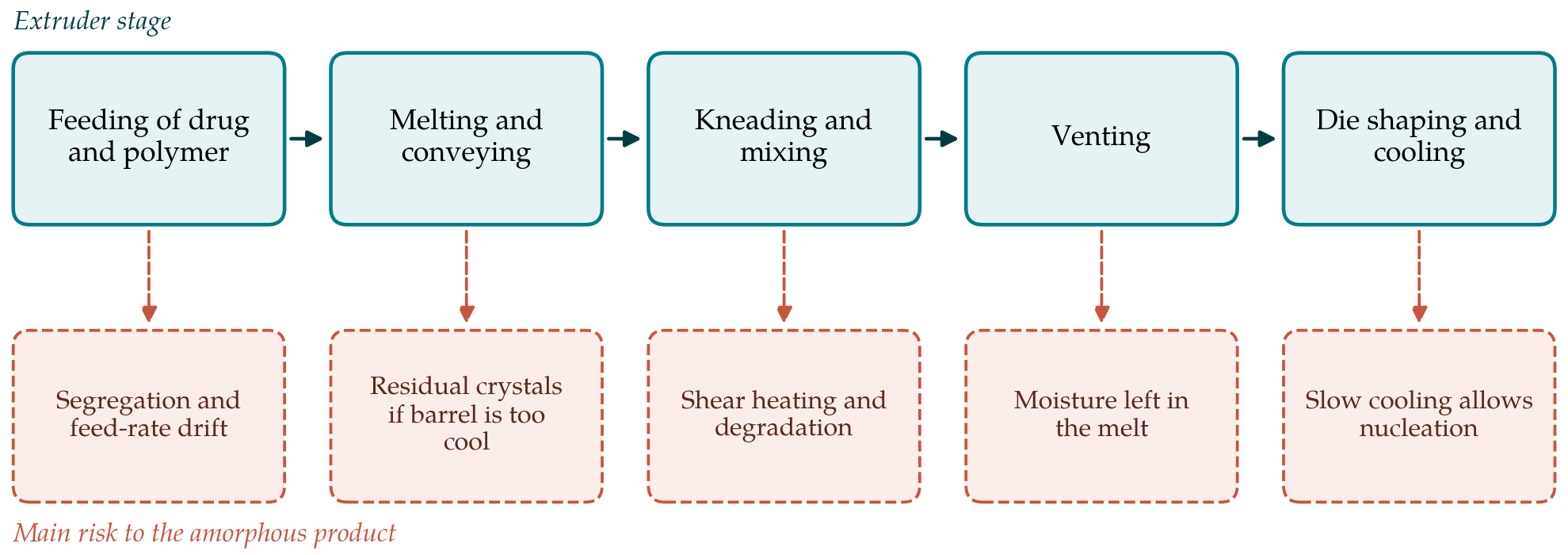
The central question for a high-melting drug is whether it must be melted or can be dissolved. Both itraconazole and posaconazole melt well above the temperature at which several useful polymers begin to degrade. Extrusion below the melting point of the drug is possible because the molten polymer acts as a solvent, but dissolution of crystals in a viscous melt is slow, and whether it reaches completion depends on residence time, on the intensity of mixing and on particle size. Incomplete dissolution leaves crystalline seeds that undermine both the solubility advantage and stability. Raising the temperature or the screw speed removes the seeds at the price of greater thermal and mechanical stress. Thiry et al. (2015) identify barrel temperature profile, screw speed, feed rate and screw configuration as the parameters that require control, and specific mechanical energy as the quantity most useful for comparing machines of different size.
The itraconazole studies from Leuven illustrate these trade-offs. Verreck et al. (2003) extruded the drug with hypromellose and obtained a milled extrudate that was amorphous by diffraction and calorimetry and that released the drug far faster than a physical mixture. Six et al. (2004) combined a methacrylate that dissolves quickly in acid with slower-dissolving copovidone, and reported that the ternary system gave better physical stability and release than either binary dispersion. Miller et al. (2008) took a different view of where supersaturation is needed. They extruded itraconazole with an enteric methacrylic acid copolymer, adding a carbomer to prolong supersaturation, so that the drug was released in the intestine where absorption takes place, and they reported improved absorption in an animal model.
6. Characterisation and Performance Testing
No single technique establishes that an extrudate is a homogeneous amorphous dispersion. Powder X-ray diffraction detects crystallinity only above a threshold of a few per cent, and differential scanning calorimetry can dissolve residual crystals during the heating scan and so hide them. Baird and Taylor (2012) recommend modulated calorimetry alongside spectroscopic and microscopic methods. Polarised light microscopy of the extrudate remains a quick and sensitive check for undissolved drug.
Dissolution testing of amorphous dispersions departs from pharmacopoeial habit. Newman et al. (2012) argued that sink conditions conceal exactly the property of interest, and that tests should be run at doses exceeding the crystalline solubility so that precipitation can be observed. For weak bases such as the azoles, a transfer from acidic to neutral medium imitates the passage from stomach to intestine and reveals how well the polymer sustains supersaturation after the pH change. The dissolved state is itself complex. Ilevbare and Taylor (2013) showed that highly supersaturated solutions of poorly soluble drugs can separate into a drug-rich liquid phase before any crystals form, and the resulting colloids may act as a reservoir that maintains the maximum free drug concentration.
The clinical relevance of this work is clearest for posaconazole. The oral suspension requires food for adequate absorption, which is a serious drawback in patients who cannot eat. Krishna et al. (2012) reported that tablet and capsule formulations based on an extruded dispersion in hypromellose acetate succinate gave markedly higher exposure than the suspension in fasted healthy volunteers. The polymer is insoluble in the stomach, so that release and supersaturation are deferred to the small intestine, the same reasoning that guided the earlier itraconazole work with enteric carriers.
7. Physical Stability on Storage
Crystallisation during storage is governed by the thermodynamic driving force, molecular mobility and the presence of nuclei. Baghel et al. (2016) review how drug loading, drug-polymer interactions and water each bear on these. Water is the most common cause of failure. It is absorbed by hydrophilic polymers, plasticises the glass, and can induce separation into drug-rich and polymer-rich amorphous phases well before crystals appear. Dispersions in the less hygroscopic cellulose esters generally tolerate humidity better than those in povidone-type polymers, which is one reason for their popularity despite a narrower processing window. Protective packaging is part of the formulation in practice. Drug loading sets the other limit: above the solubility of the crystalline drug in the polymer at the storage temperature, the dispersion is supersaturated and stable only kinetically.
8. Gaps and Directions for Further Work
Several questions recur across the literature without a settled answer. The first is prediction of the maximum stable drug loading. Solubility parameters and interaction parameters rank polymers usefully, but the solubility of a drug in a polymer at room temperature cannot be measured directly and must be extrapolated from data collected near the melt. The second concerns dissolution mechanism. At low drug loading the polymer controls release and drug and polymer dissolve together; above a certain loading release becomes drug-controlled and slows sharply. Where that boundary lies for a given pair, and why, is not yet predictable from first principles.
Scale-up is the third gap. Much of the published work on antifungals was done on small extruders with short screws, where residence time and shear history differ from those in production machines, and the literature offers guidance on scaling by specific energy and fill level without firm rules (Thiry et al., 2015). Finally, most studies concern itraconazole. Newer azoles and antifungals of other classes have received much less attention, and it should not be assumed that conclusions drawn from one molecule, with its particular glass-forming ability and basicity, carry over unchanged to the rest. Extruded dispersions also compete with lipid systems, nanocrystals and cyclodextrin complexes, and the choice among them depends on the properties of the individual drug.
9. Conclusion
The literature supports a consistent account. Poorly soluble azole antifungals can be converted by hot melt extrusion into amorphous dispersions that dissolve to supersaturated concentrations, provided the polymer is miscible with the drug, the process dissolves every crystal without degrading drug or carrier, and the product is protected from moisture. Enteric cellulose and methacrylate polymers have proved especially suited to these weak bases because they place supersaturation in the intestine. What the field still lacks are reliable ways to predict loading limits and dissolution mechanism in advance, and published evidence on antifungals other than itraconazole and posaconazole.
Conflict of interest
To be declared by the author(s) before publication.
Funding
To be declared by the author(s) before publication.