1. Introduction
Programming a deep brain stimulator has long meant choosing a contact, an amplitude, a pulse width and a frequency, then waiting to see what happens. The standard algorithms describe a monopolar review of each contact followed by gradual titration against symptoms and side effects (Volkmann et al., 2006). Once set, the device runs unchanged until the next visit. Yet the conditions it treats are not constant. Parkinsonian signs rise and fall with medication, sleep and activity, and tremor in essential tremor is largely absent at rest. A fixed setting is a compromise across states, and it can leave the patient under-treated at one hour and over-treated, with dyskinesia or speech disturbance, at another.
Closed loop stimulation aims to remove the compromise by letting a measured signal govern the output. The principle was demonstrated in a primate model of parkinsonism by Rosin et al. (2011), and the first study in patients followed two years later (Little et al., 2013). This commentary considers the published experience of programming such systems, now that devices capable of chronic sensing are in clinical hands.
2. From Fixed to Adaptive Output
A control loop needs a signal that tracks the clinical state. In Parkinson's disease the leading candidate is oscillatory activity in the beta range recorded from the subthalamic nucleus. Its amplitude falls with levodopa and with stimulation, in proportion to improvement in rigidity and bradykinesia (Kühn et al., 2006), and Little and Brown (2012) set out the case for using it as a feedback variable while acknowledging that it relates poorly to tremor. Later analysis suggested that the duration of beta bursts, more than average power, carries the pathological information, and that adaptive stimulation works by cutting long bursts short (Tinkhauser et al., 2017).
Other signals have been used. Swann et al. (2018) controlled stimulation from a cortical gamma-band signal associated with dyskinesia, reducing output when the signal was present. In essential tremor, Opri et al. (2020) used cortical and thalamic recordings to detect movement and switch thalamic stimulation on only when it was needed. The choice of signal therefore depends on the disorder, on the symptom being targeted and on where electrodes have been placed.
2.1. Two time scales
Two time scales run through this literature and are easily confused. Some systems respond within fractions of a second to individual bursts of activity. Others average the signal over many seconds or minutes and follow the slow swing between the medicated and unmedicated state. The first approach treats the signal as a moment-to-moment cause of impaired movement, the second as a gauge of how much stimulation the present state requires. They are different therapies sharing a name. They need different settings, and a result obtained with one says little about the other.
3. What the Early Reports Describe
The first human study used externalised leads in the days after implantation and a simple rule: stimulate when beta amplitude exceeds a threshold. Motor scores improved more than with continuous stimulation while less current was delivered (Little et al., 2013). An external system that varied voltage in proportion to beta power was then run for eight hours during ordinary activity and medication intake (Arlotti et al., 2018). Fully implanted systems followed. Gilron et al. (2021) streamed neural data from patients at home over long periods and delivered adaptive stimulation outside the laboratory, and a blinded randomised feasibility trial compared chronic adaptive with conventional stimulation in a small number of patients, each programmed against the symptom that troubled them most (Oehrn et al., 2024).
Read for what they say about programming, these reports describe a sequence of decisions that conventional practice does not contain. Table 1 summarises them. Technical notes on the first commercial sensing device add practical detail on signal quality and artefact (Thenaisie et al., 2021).
| Decision | Approaches described | Open question |
|---|---|---|
| Control signal | Subthalamic beta power; cortical gamma; movement-related thalamic or cortical activity | Which signal suits tremor, gait and non-motor symptoms |
| Sensing contacts | Bipolar pair around the stimulating contact; separate cortical strip | How to proceed when no clear peak is recorded |
| Threshold | Single threshold with on-off output; two thresholds with graded output | Whether to set it on or off medication |
| Amplitude limits | Lower and upper bounds taken from conventional programming | How wide the range can safely be |
| Response speed | Fast tracking of bursts; slow tracking of medication cycles | Which time scale gives clinical benefit |
| Assessment | Clinic rating scales; diaries; wearable sensors; device logs | What counts as success outside the clinic |
4. Programming as a New Clinical Task
Figure 1 shows the layers a programmer now has to consider. The lowest is still the conventional one. Before any adaptive mode is enabled, the patient needs a well-chosen contact and known amplitudes at which benefit begins and side effects appear, because these become the lower and upper limits within which the algorithm is allowed to move. An adaptive system inherits the quality of the conventional programming beneath it.
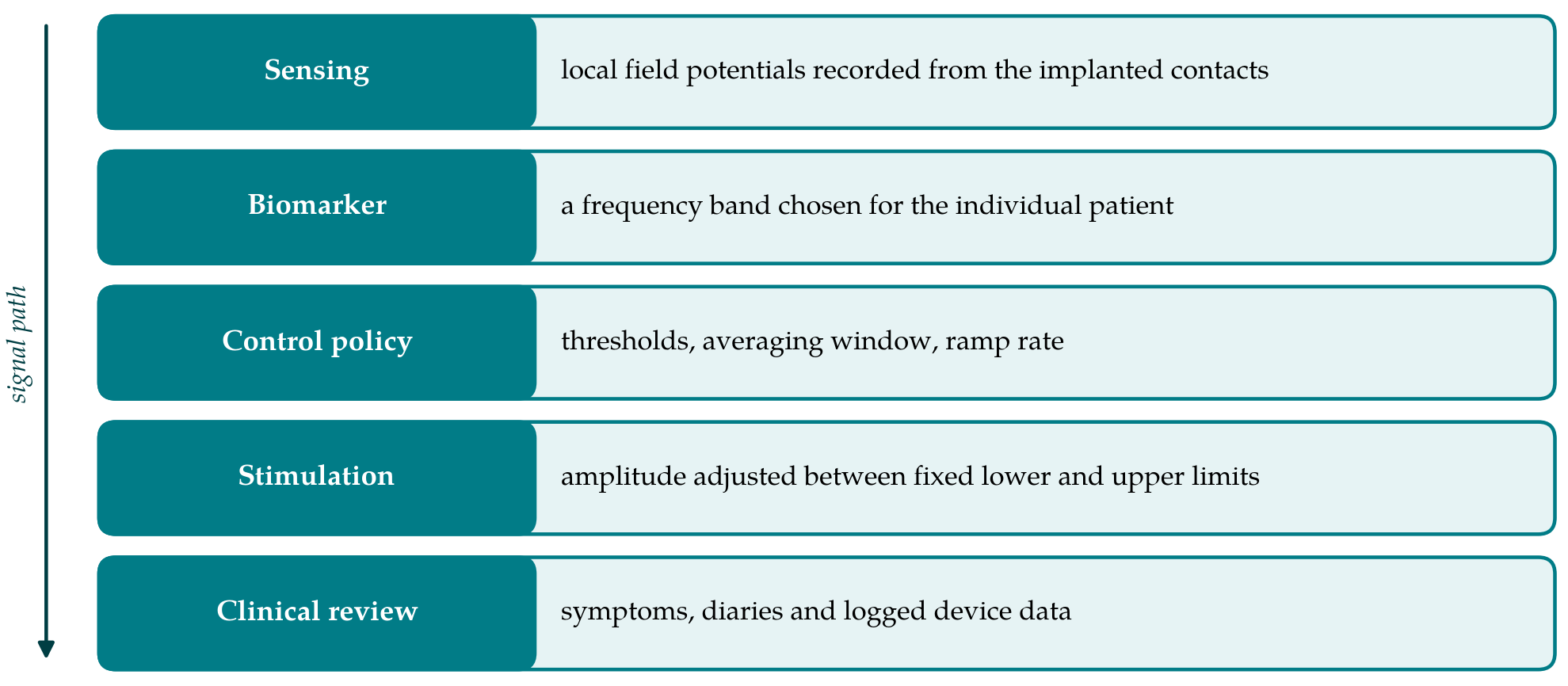
Above that layer the work is unfamiliar. The clinician inspects a power spectrum to find a peak, decides whether it is physiological or an artefact of cardiac activity or movement, and checks that it changes with medication and stimulation in the expected direction. Thresholds are then placed in relation to the range the signal covers over a day, which requires recording across medication cycles and cannot be done from a short clinic sample. The speed of response is a further choice. A stimulator that ramps quickly can follow individual bursts but may produce paraesthesia as amplitude changes, while a slow ramp is better tolerated and follows only the gradual drift of medication state.
Medication complicates each of these steps. Dopaminergic drugs lower beta activity on their own, so a threshold placed while the patient is unmedicated may never be crossed after a dose, and one placed after a dose may hold stimulation at its upper limit for the rest of the day. Adaptive programming and drug adjustment therefore have to be planned together, ideally by the same team, and a change in one calls for a check of the other. Sleep raises a similar issue, since the spectrum recorded at night differs from the waking one and a daytime threshold may behave unpredictably.
Evaluation changes too. The purpose of adaptation is to perform better across the day, so a rating in clinic at one moment is a weak test. The reports cited above lean on diaries, wearable monitors and the device's own log of signal and amplitude, none of which has an agreed standard. Programming becomes iterative over days, with time and expertise that many services do not currently have.
5. Unresolved Questions
Three limits of the published experience should be stated plainly. The numbers are small and the patients were selected in expert centres, often because they had a clear signal. Comparisons with conventional stimulation have mostly been short, and the conventional settings used as the comparator were not always optimised to the same degree. And reports differ in device, signal and algorithm, so their results cannot be pooled.
Safety has received less attention than efficacy. Changes in amplitude can be felt by some patients, and an algorithm that lowers stimulation at the wrong moment could allow symptoms to return, which is why the lower limit is set at a level that still gives some benefit. An artefact mistaken for the control signal could in principle drive stimulation to either limit. The amplitude bounds are the main protection against this, and they should be chosen with that failure in mind.
Several practical questions follow. It is not known what proportion of unselected patients have a usable signal, how stable that signal is over years, or how drug changes and disease progression alter the thresholds. Whether adaptive stimulation helps tremor, freezing of gait or speech is unsettled. The effect on battery life depends on the balance between current saved and power spent on sensing. Larger trials are in progress or recently completed, and their detailed reporting of programming methods will be as valuable as their headline results. Meanwhile, published accounts would be more useful if they stated how the signal was chosen, how thresholds and limits were set, how many sessions were needed and what was done when the first configuration failed.
6. Conclusion
Early reports establish that closed loop deep brain stimulation can be programmed and run chronically in people with movement disorders, and they suggest advantages for some symptoms in some patients. They also show that programming it is a distinct skill, added to conventional programming and dependent on it. The evidence does not yet support a standard method. Clinicians taking up the technique should expect to work from first principles and local experience for some time, and should record what they do in enough detail for others to learn from it.
Conflict of interest
To be declared by the author(s) before publication.
Funding
To be declared by the author(s) before publication.