1. Introduction
A computer-generated character with a name, a wardrobe and a social media feed can now front a fashion campaign. Lil Miquela, who appeared on Instagram in 2016, has modelled for international fashion labels. Shudu, created in 2017 by the photographer Cameron-James Wilson, has been presented as a digital supermodel. Noonoouri, a doll-like figure with oversized eyes, wears couture without any pretence of looking human. India acquired a home-grown example in 2022 with Kyra, widely described in the trade press as the country's first virtual influencer. None of these figures exists outside the image, and all of them have been used to sell things.
The development sits awkwardly with the logic of influencer marketing. Influencers are thought to persuade because followers see them as ordinary people whose recommendations come from experience, an impression that makes them more credible to young audiences than conventional celebrities (Djafarova and Rushworth, 2017; Lou and Yuan, 2019). Reviews of the field place this perceived genuineness close to the centre of how influence works (Hudders et al., 2021; Vrontis et al., 2021). A virtual influencer has no experience to draw on. Whatever she says about a jacket was written by a studio.
This article reviews what the published literature says about that tension and reads it against the circumstances of young fashion consumers in South Asia. The region matters for a plain reason: its populations are young, its fashion markets are growing through mobile-first social platforms, and its brands have started to experiment with synthetic ambassadors while regulators have started to write rules for them. Whether the findings of studies done elsewhere transfer to Dhaka, Lahore or Bengaluru is an open question, and one purpose of the review is to state clearly how open it is.
2. Scope and Approach
The article is a narrative review of the published literature. It draws on work in advertising, consumer research, communication and human-computer interaction, selected for its relevance to three questions: how authenticity has been defined, how audiences respond to virtual endorsers, and what is distinctive about fashion and about South Asia. No claim is made to an exhaustive or systematic search. Where the argument moves from documented findings to inference about the region, the text says so.
A working definition is needed first. A virtual influencer is a fictional, computer-generated character that holds social media accounts, posts in the first person, accumulates followers and is used for commercial endorsement. The category overlaps with brand mascots, avatars of real people and customer-service agents, and the wider literature on digital representations treats these as points on a continuum (Nowak and Fox, 2018). Miao et al. (2022) classify marketing avatars by two properties, the realism of their form and the realism of their behaviour, and argue that problems arise when the two are out of step: a figure that looks human but responds woodenly disappoints more than one that never promised much.
3. Authenticity as a Layered Idea
Authenticity is used in at least five senses in the literature that bears on influencers, and much confusion in commentary on virtual endorsers comes from sliding between them. Table 1 sets the senses side by side with what each would require of a synthetic spokesperson.
| Concept | Core idea | Implication for a virtual endorser |
|---|---|---|
| Indexical authenticity Grayson and Martinec, 2004 | A factual link to an original person, place or time | Unavailable by definition: there is no original person |
| Iconic authenticity Grayson and Martinec, 2004 | Resemblance to what the real thing is expected to look like | Achievable through design, styling and consistent storytelling |
| Brand authenticity Morhart et al., 2015 | Continuity, credibility, integrity and symbolism | Depends on the sponsoring brand keeping the character coherent over time |
| Passionate authenticity Audrezet et al., 2020 | Content driven by inner motivation, not payment | Hard to claim: the character has no inner motives |
| Transparent authenticity Audrezet et al., 2020 | Open, factual disclosure of commercial ties | Fully achievable, and extends to disclosing artificiality |
| Source credibility Ohanian, 1990 | Expertise, trustworthiness and attractiveness of the source | Attractiveness is designed; expertise and trust must be borrowed |
Grayson and Martinec (2004) separate indexical authenticity, a real connection to an origin, from iconic authenticity, which is a matter of fitting an expected likeness. A reconstructed historical site can be iconically authentic without a single original stone. The distinction is useful here because a virtual influencer can never be indexically authentic as a person, yet may be convincingly iconic as a type: the stylish friend, the model off duty. Beverland and Farrelly (2010) add that consumers are not passive judges. People look for authenticity in ways that serve their own goals, and they can find it in objects that others would call fake, provided the object lets them feel connected, in control or virtuous.
Work on human influencers supplies two further senses. From interviews and observation of influencer partnerships, Audrezet et al. (2020) distinguish passionate authenticity, where content appears to spring from the creator's own enthusiasm, from transparent authenticity, where the creator is open about what a brand has paid for. The first is closed to a fictional character. The second is entirely open to it, and indeed is easier for a studio to guarantee than for a freelancer juggling sponsors. Brand authenticity as measured by Morhart et al. (2015) adds continuity and integrity over time, properties that belong less to the character than to the organisation behind it.
Older endorsement theory points the same way. In the source credibility tradition, an endorser persuades through expertise, trustworthiness and attractiveness (Ohanian, 1990). In McCracken's (1989) account, the endorser matters because of the cultural meanings she carries from her other roles into the advertisement and on to the product. A human celebrity arrives loaded with such meanings. A virtual one arrives with only those its makers have written, which gives the brand unusual control and the audience unusually little to go on.
4. What Audience Studies Show
Empirical work on virtual influencers is recent and still small. Three themes recur: reactions to human-likeness, the possibility of parasocial attachment, and the effects of credibility and disclosure.
4.1. Human-likeness and the uncanny
The uncanny valley hypothesis, proposed by Mori in 1970 and available in an authorised English translation (Mori et al., 2012), holds that affinity for an artificial figure rises with human-likeness until the figure is almost but not quite human, at which point it becomes unsettling. Arsenyan and Mirowska (2021) compared the social media presence of a human influencer, a human-like virtual influencer and an animated, cartoon-like one, and reported that the human-like virtual figure drew the least favourable reactions, a pattern the authors read as consistent with the hypothesis. The practical lesson drawn in the avatar literature is that realism is not a simple good, and that an openly stylised character may be the safer design (Miao et al., 2022).
4.2. Parasocial attachment
Horton and Wohl (1956) coined the term parasocial interaction for the one-sided sense of intimacy that audiences form with media performers. The concept was developed for broadcast personalities and has since been applied widely to influencers. Nothing in it requires the performer to be real: readers have long been attached to fictional characters. Research on social responses to computers shows, moreover, that people apply social rules to machines readily and without believing them to be human (Nass and Moon, 2000). Attachment to a virtual influencer is therefore psychologically unsurprising. The interview study by Lou et al. (2023) nonetheless suggests its limits: followers described virtual influencers as interesting and useful for building a brand's image, but as weaker than human influencers at prompting purchases, partly because followers saw little similarity between themselves and a synthetic figure.
4.3. Credibility, disclosure and blame
Experimental work gives a mixed picture. Thomas and Fowler (2021) found that an artificial endorser can produce brand benefits comparable to those of a human celebrity, and also that a transgression by one artificial endorser can damage attitudes toward such endorsers in general. Practitioners interviewed by Moustakas et al. (2020) valued the control and consistency that a synthetic character offers and worried about whether audiences would relate to it.
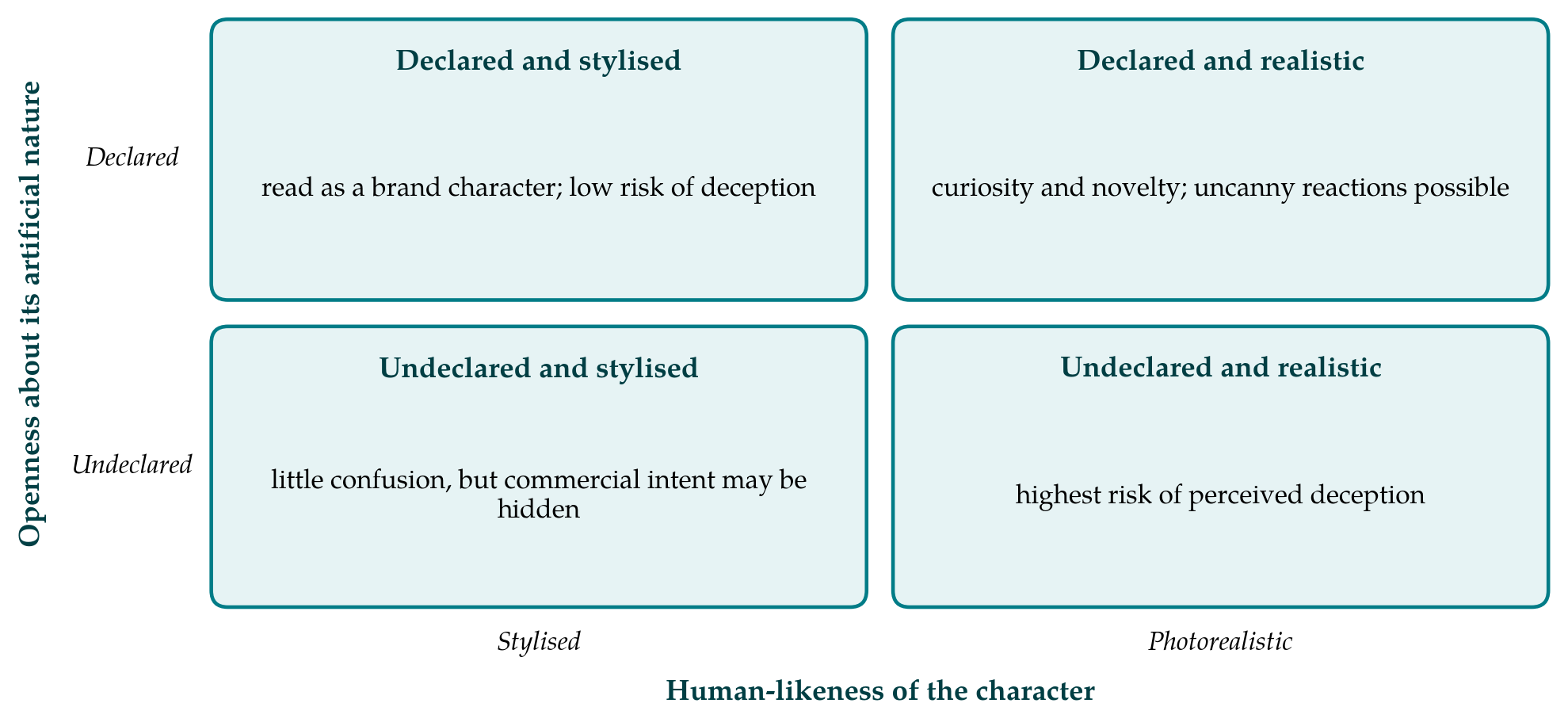
Ethical analysis has concentrated on transparency. Robinson (2020) argues that the central issues are whether audiences know that the figure is artificial, who is answerable for what it says, and whose bodies and identities are being simulated. Figure 1 arranges the first of these against human-likeness. The reading offered there is interpretive: it combines the uncanny valley argument with the transparency strand of authenticity and suggests that the combination of high realism and no disclosure carries the greatest risk of a consumer feeling deceived, while a declared and stylised character is closest to a familiar brand mascot.
5. Why Fashion Suits Virtual Endorsers, and Where It Does Not
Fashion is a visual, symbolic category in which the endorser's main task is to be looked at. Follower numbers and visual appeal shape how Instagram influencers are judged (De Veirman et al., 2017), and a designed character can be given any look a campaign needs. She does not age, miss a shoot or acquire an inconvenient past. From the standpoint of meaning transfer (McCracken, 1989), the brand can script exactly the associations it wants. Campbell and Farrell (2020) note that influencers bundle several functions, among them access to an audience, endorsement and content production, and a virtual influencer performs the content function very efficiently.
The same category exposes the weak point. Clothing is worn on bodies, and much of the value of a human fashion influencer lies in showing how a garment fits, moves and feels on someone the follower resembles. A rendered body has no fit to report. It can also be drawn to proportions and complexions that no customer has, which revives old arguments about idealised images in fashion advertising in a form that is harder to contest, since no real model was retouched. The criticism that greeted Shudu, a dark-skinned digital model made by a white creator, showed how quickly questions of representation attach to synthetic figures.
6. Reading the Evidence for South Asia
Most of the frequently cited audience studies were carried out with North American, European or East and Southeast Asian respondents. Published work focused on South Asian consumers of virtual influencers remains sparse, and what follows is inference from theory and context, offered as such.
Three features of the region seem relevant. The first is cultural orientation. Research on self-construal describes South Asian societies as comparatively interdependent, with the self defined through relationships and group membership (Markus and Kitayama, 1991), and Hofstede (2001) places the region lower on individualism than North America or north-western Europe. If recommendations are valued as signals from a trusted social circle, the relational cues that a virtual figure can offer, such as replying in a local language or marking festivals, may count for more than her technical realism, and their absence may count against her more heavily.
The second is the endorsement culture. Film and cricket celebrities dominate brand endorsement in much of the region, and they carry dense cultural meanings of the kind McCracken describes. A virtual influencer competes with figures who are admired for who they are, and also with a long local tradition of animated and mythological characters, which may make a stylised, declared character feel familiar and unthreatening. The third is regulation. The Advertising Standards Council of India issued guidelines for influencer advertising in digital media in 2021 that require clear disclosure labels and that ask virtual influencers, in addition, to tell consumers that they are not interacting with a real human being (ASCI, 2021). In India at least, transparent authenticity is thus an obligation under self-regulation, and campaigns in the lower half of Figure 1 are non-compliant as well as risky.
Questions of appearance carry particular weight. Debates about complexion and body ideals in South Asian advertising are long-standing, and a designed face is a design decision in a way that a cast face is not. A studio that gives its character lighter skin or narrower features than its audience makes a statement about desirability for which it alone is responsible. Young consumers who are alert to these debates may judge the authenticity of a virtual influencer less by whether she seems human than by whom she appears to have been modelled on.
7. Gaps and a Research Agenda
The clearest gap is evidence from the region itself. Comparative studies that put the same virtual endorser in front of young consumers in several South Asian countries, and that vary language, dress conventions and disclosure wording, would show how far existing findings travel. A second gap concerns measurement. Scales of brand authenticity and source credibility were built for brands and for people, and it is not established that their items mean the same thing when the object is a fictional character. A third concerns time. Almost all published designs capture a first encounter, when novelty is high. Whether attachment survives a year of posts, or a scandal, has scarcely been examined.
Two further topics deserve attention. Generative tools now allow small labels to produce synthetic models cheaply, so that the virtual influencer with a persistent identity shades into anonymous generated imagery, and the authenticity questions change accordingly. And the effect of mandatory disclosure on persuasion is unknown: telling the audience that the figure is not real may reduce trust, or may increase it by removing the suspicion of trickery.
8. Conclusion
The literature gives a usable account of why a synthetic endorser is not simply inauthentic. She cannot be indexically real or sincerely enthusiastic, but she can be iconically convincing, consistent and fully transparent, and audiences are capable of attachment to figures they know to be invented. Studies of audience response suggest curiosity and acceptable brand effects alongside doubts about relatability and weaker purchase influence, with realism a hazard as much as an asset. For young fashion consumers in South Asia the published evidence is too thin to support firm claims. The reasonable expectation, pending regional research, is that declared and culturally grounded characters will fare better than photorealistic strangers, and that the choices made in designing a face will be read as choices.
Conflict of interest
To be declared by the author(s) before publication.
Funding
To be declared by the author(s) before publication.