1. Introduction
For most athletes who tear an anterior cruciate ligament (ACL), the operation is a means to an end. The end is a return to the sport they played before, at the level they played it, without a second injury. Measured against that goal, reconstruction has a more modest record than patients tend to expect. The meta-analysis by Ardern et al. (2014) found that although most people returned to some form of sport, considerably fewer returned to their preinjury level and only about half returned to competitive play. Younger athletes who do go back face a substantial risk of a second ACL injury, to the graft or to the opposite knee (Wiggins et al., 2016).
Graft choice is one of the few variables entirely in the surgeon's hands, and it has changed over the past decade. Bone-patellar tendon-bone and hamstring tendon autografts were for many years the two standard options. The quadriceps tendon, described as a central third graft by Fulkerson and Langeland (1995) and studied in detail by Stäubli and colleagues (Stäubli et al., 1999), was used mainly in revision surgery. It is now offered routinely for primary reconstruction in many centres, on the strength of anatomical and biomechanical arguments and of reviews reporting clinical results comparable with those of the older grafts (Slone et al., 2015).
This article reviews what the published literature says about return to sport after ACL reconstruction with a quadriceps tendon autograft. It asks three things: what properties of the graft and its harvest might affect the return; what comparative clinical studies show; and how the general evidence on return-to-sport criteria applies when the graft has been taken from the extensor mechanism.
2. Scope and Approach
This is a narrative review of the published literature. It draws on anatomical and biomechanical studies of the quadriceps tendon, on comparative clinical studies, registry reports, systematic reviews and meta-analyses of graft outcomes, and on the wider body of work on return to sport after ACL reconstruction irrespective of graft. No formal systematic search was undertaken and no pooled estimates are presented. Where the review reports the direction of a finding, it relies on the conclusions of the cited authors. Much of what is known about returning to sport comes from cohorts in which hamstring and patellar tendon grafts predominated, and the review tries to be explicit about where that evidence is being extended by inference to the quadriceps tendon.
3. The Quadriceps Tendon as a Graft
The quadriceps tendon is a layered structure formed by the convergence of the rectus femoris and the three vasti, and it is thicker than the patellar tendon. Morphometric and mechanical studies found that a central strip provides a graft with a larger cross-sectional area than a patellar tendon graft of the same width and with tensile properties adequate for cruciate reconstruction (Harris et al., 1997; Stäubli et al., 1999). The tendon can be taken as a partial-thickness or full-thickness strip, with a block of bone from the proximal pole of the patella or as an all-soft-tissue graft, and through an open or a minimally invasive incision. These variants are not equivalent, and published series often mix them, which complicates comparison.
Two features of the harvest matter for the athlete. The first is donor site morbidity. Compared with a bone-patellar tendon-bone graft, the quadriceps tendon is associated with less anterior knee pain and less pain on kneeling, a finding reported in a randomised comparison (Lund et al., 2014) and in pooled analyses (Mouarbes et al., 2019). The second is that the graft comes from the extensor mechanism itself. Weakness of the quadriceps is already the dominant impairment after any ACL reconstruction, partly because of arthrogenic inhibition of the muscle after knee injury (Hart et al., 2010), and it is reasonable to ask whether removing part of the tendon adds to the deficit. One comparison of quadriceps recovery after quadriceps tendon and patellar tendon grafts found no clear disadvantage for the former (Hunnicutt et al., 2019), but the question has not been examined in large numbers of athletes.
Whatever its origin, a tendon graft does not behave as a ligament on the day it is implanted. It undergoes necrosis, revascularisation and remodelling over a prolonged period, and human biopsy studies indicate that this process is slower than animal models had suggested (Claes et al., 2011). There is no good evidence that the quadriceps tendon matures faster or slower than other autografts, so the biological argument for patience applies to it as it does to them.
4. Comparative Clinical Outcomes
Before return to sport can be compared across grafts, it helps to know whether the knees themselves differ. Early single-centre series reported satisfactory stability and function at intermediate follow-up (Geib et al., 2009). The systematic review by Slone et al. (2015) concluded that clinical and functional outcomes of quadriceps tendon reconstruction were comparable with those of patellar tendon reconstruction, with less donor site morbidity. The meta-analysis by Mouarbes et al. (2019) reached a similar conclusion against both patellar tendon and hamstring grafts: laxity, patient-reported scores and graft survival were similar, donor site pain was lower than with patellar tendon, and some functional scores favoured the quadriceps tendon over hamstrings. A comparative cohort study likewise found the quadriceps tendon at least equal to hamstring tendon on stability and functional scores (Cavaignac et al., 2017).
Registry data complicate this picture. An analysis of the Danish Knee Ligament Reconstruction Registry reported a higher revision rate after quadriceps tendon reconstruction than after hamstring or patellar tendon reconstruction (Lind et al., 2020). The authors and later commentators have pointed to the early stage of adoption and to surgeon and clinic experience with the technique as possible explanations, since a registry records a graft type together with everything that accompanies its introduction. The finding is a reminder that results from high-volume enthusiasts do not automatically transfer to general practice, and that revision is an outcome which matters directly to an athlete deciding when to go back. Table 1 sets the quadriceps tendon beside the two established autografts on the points most relevant to that decision.
| Feature | Quadriceps tendon | Bone-patellar tendon-bone | Hamstring tendon |
|---|---|---|---|
| Graft dimensions | Thick; size can be chosen at harvest Harris et al., 1997 | Fixed by patellar tendon width | Variable; depends on tendon size |
| Fixation | Soft tissue, or bone block at one end | Bone at both ends | Soft tissue at both ends |
| Donor site complaints | Less kneeling pain than patellar tendon Lund et al., 2014 | Anterior knee and kneeling pain | Generally low |
| Muscle group affected | Knee extensors | Knee extensors | Knee flexors |
| Stability and scores | Similar to both comparators Mouarbes et al., 2019 | Long-standing reference graft | Similar in pooled analyses |
| Open questions | Revision rate in registries Lind et al., 2020 | Kneeling-dependent sports and occupations | Flexor strength deficit |
5. Return to Sport: Definitions and General Evidence
A persistent difficulty in this literature is that return to sport is defined loosely. The consensus statement from the First World Congress in Sports Physical Therapy proposed a continuum of three stages, return to participation, return to sport and return to performance, and urged that studies say which one they mean (Ardern et al., 2016). Many graft studies report only whether patients were playing some sport at follow-up. That figure flatters every graft, because the gap between any sport and the preinjury level of competition is where most of the disappointment lies (Ardern et al., 2014).
The same body of work shows that the decision to release an athlete has historically rested on time since surgery and little else. In their review of the criteria reported by published studies, Barber-Westin and Noyes (2011) found that objective criteria were used in only a small minority. Since then, criteria-based progression has become the stated standard. The usual battery combines isokinetic or isometric strength testing, single-leg hop tests of the kind introduced by Noyes et al. (1991), an assessment of movement quality, and a measure of psychological readiness such as the ACL-Return to Sport after Injury scale (Webster et al., 2008).
Two cohort studies gave this approach much of its authority. In the Delaware-Oslo cohort, athletes who passed a set of strength, hop and self-report criteria before returning to pivoting sport had a lower reinjury rate than those who did not, and later return was protective up to nine months after surgery (Grindem et al., 2016). In professional athletes, failure to meet discharge criteria before returning was associated with a higher risk of graft rupture (Kyritsis et al., 2016). Altered landing mechanics and deficits in postural stability have also been shown to predict a second injury (Paterno et al., 2010).
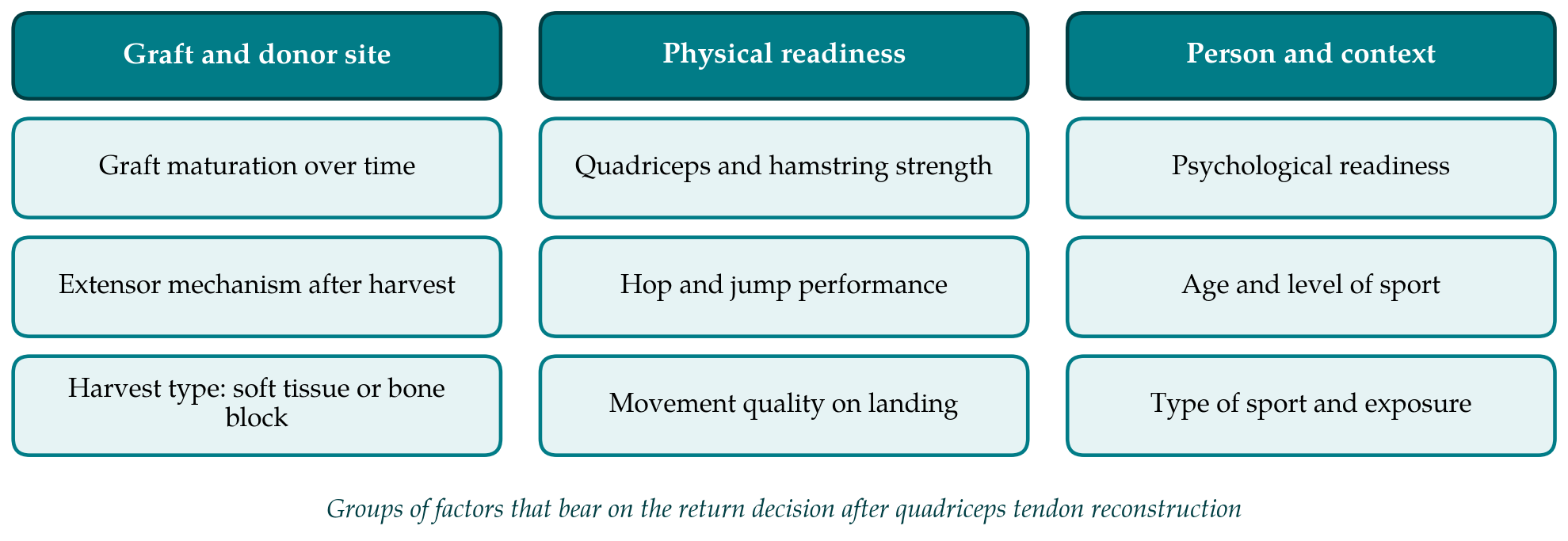
The evidence is less tidy than these studies suggest when taken alone. A meta-analysis by Webster and Hewett (2019) found that passing a return-to-sport test battery did not clearly reduce the overall risk of a subsequent ACL injury: the risk of graft rupture was lower in those who passed, but the risk of injury to the opposite knee was not. The limb symmetry index, on which most batteries depend, can overstate recovery because the uninjured limb weakens during the months of reduced activity (Wellsandt et al., 2017). On biological and functional grounds some authors have argued for delaying return to high-risk sport well beyond the conventional timetable (Nagelli and Hewett, 2017). Figure 1 groups the factors that enter the decision.
6. What Is Known About Return to Sport With the Quadriceps Tendon
Set against the volume of general evidence, graft-specific data are sparse. The systematic reviews of quadriceps tendon outcomes concentrate on laxity, patient-reported scores, donor site morbidity and graft failure, and treat return to sport as a secondary outcome where they report it at all (Slone et al., 2015; Mouarbes et al., 2019). The primary studies that do report it are mostly retrospective cohorts of modest size, with different harvest techniques, different rehabilitation protocols and different definitions of a successful return. Within those limits, the published reports do not indicate that athletes with a quadriceps tendon graft return less often, or later, than athletes with a hamstring or patellar tendon graft. Equally, they do not establish that they return more often. The fair summary is that no difference has been shown, by studies not designed to detect one.
Several features of the graft could plausibly work in either direction. Less kneeling pain should help athletes in sports and occupations that load the front of the knee, and preservation of the hamstrings leaves the dynamic restraint to anterior tibial translation intact. Against this, a slower recovery of knee extensor strength would delay the point at which an athlete meets strength criteria, and extensor strength is the criterion most consistently linked to function and to patient-reported outcome at the time of return (Lepley, 2015). Whether a quadriceps harvest produces such a delay in practice, and whether it differs between soft tissue and bone block techniques, remains uncertain.
7. Implications for Rehabilitation and Testing
In the absence of graft-specific trials, rehabilitation after quadriceps tendon reconstruction follows the same criteria-based principles as after other grafts, with closer attention to the extensor mechanism. Early restoration of full extension and of voluntary quadriceps activation matters after any ACL reconstruction because of arthrogenic inhibition (Hart et al., 2010); after a quadriceps harvest the clinician has an added reason to monitor it. Strength testing before return should measure the quadriceps directly and should not rely on hop distances as a proxy, since athletes can achieve symmetrical hop performance through compensation at the hip and ankle while a knee extensor deficit persists.
The caution about limb symmetry applies with some force here. If the uninjured limb has weakened, a symmetrical score conceals a bilateral deficit (Wellsandt et al., 2017), and comparison with a preoperative value or with normative data for the sport is more informative where it is available. Psychological readiness should be assessed in the same way as for any other graft; fear of reinjury is a common reason for not returning among athletes whose knees are physically ready (Ardern et al., 2014), and nothing suggests that graft type changes this. Finally, the time course of graft maturation gives no ground for an accelerated return on the basis that the quadriceps tendon is a thicker graft (Claes et al., 2011).
8. Gaps and Future Work
Four gaps stand out. First, comparative studies should adopt the staged definitions of the consensus statement and report return to preinjury level and return to performance, not only return to any sport (Ardern et al., 2016). Second, they should describe the harvest precisely, because partial-thickness, full-thickness, soft tissue and bone block grafts may differ in donor site effects and in fixation. Third, quadriceps strength should be reported as an absolute, body-mass-normalised value over time as well as a symmetry index, so that the recovery curve after a quadriceps harvest can be compared with that after other grafts. Fourth, second injuries, to the graft and to the opposite knee, should be reported in relation to exposure after return, since an athlete who never goes back to pivoting sport cannot rupture a graft playing it.
The registry signal on revision needs to be followed as the technique matures and as more surgeons pass through its learning phase (Lind et al., 2020). Randomised comparisons with return to sport as a prespecified outcome, stratified by age and level of play, would settle more than further retrospective series. Young athletes in pivoting sports are the group at highest risk of a second injury (Wiggins et al., 2016) and the group for whom the choice of graft matters most.
9. Conclusion
The quadriceps tendon is a sound autograft for ACL reconstruction on the evidence of laxity, patient-reported outcome and donor site morbidity. On the narrower question of return to sport, the literature neither shows it to be inferior to hamstring and patellar tendon grafts nor demonstrates an advantage, and most of the studies were not designed to tell. Clinicians can reasonably apply the general principles of criteria-based return, with deliberate attention to direct measurement of quadriceps strength and with no shortening of the timetable. The unresolved questions, on revision rates outside specialist centres and on the recovery of the extensor mechanism in athletes, are answerable with studies that define return to sport carefully and follow athletes after they go back.
Conflict of interest
To be declared by the author(s) before publication.
Funding
To be declared by the author(s) before publication.