1. Introduction
On the hill slopes and plateau uplands of Odisha, Jharkhand, Chhattisgarh and neighbouring states, finger millet (Eleusine coracana (L.) Gaertn.) once occupied the unbunded land that could not hold water for rice. It asked for little, stored for years and fed households through the lean months before the paddy harvest. Its retreat over recent decades has several causes that reinforce each other: rice and wheat supplied cheaply through public distribution, the labour demanded by weeding and threshing, low yields from broadcast crops on eroded soils, and the gradual disappearance of the seed itself as fewer families sowed it.
Interest in reversing the decline has grown, and the United Nations marked 2023 as the International Year of Millets. Programmes that promote the crop in tribal areas commonly rely on two measures. One is agronomic: raising seedlings in a nursery and transplanting them in rows, an approach adapted from the system of rice intensification. The other is institutional: a seed bank owned by the village that keeps local varieties in circulation. The first addresses yield and drudgery, the second addresses access to seed. Neither works well alone. Better agronomy applied to poorly adapted seed disappoints, and a seed bank holding varieties nobody finds worth growing empties within a few seasons.
This article sets out a framework that treats the two as parts of one programme. It is written for organisations planning work with upland communities and is methodological in intent. It describes a proposed sequence of activities and the reasoning for each, and it does not report the results of any programme. Where the framework draws on published experience, the source is cited.
2. Background
The design rests on what is known about the crop, about transplanting as a method of establishment, and about seed institutions managed by farmers.
2.1. The crop and its value
Finger millet was domesticated in the highlands of eastern Africa and reached India in antiquity (Hilu and de Wet, 1976). The grain is small, keeps exceptionally well and is notable among cereals for its calcium content, along with dietary fibre and polyphenols (National Research Council, 1996; Shobana et al., 2013; Devi et al., 2014). The plant tolerates poor soils and intermittent drought, which has led to its description as a crop suited to uncertain climates (Gupta et al., 2017). Work on minor millets in India has argued that revival requires attention to the whole chain from seed to processing and consumption, because production alone does not restore a crop that households have stopped eating (Padulosi et al., 2015).
2.2. Line transplanting
Upland finger millet is traditionally broadcast, or transplanted at random from thick nurseries. Both give crowded, uneven stands that can be weeded only by hand. The system of rice intensification showed that young seedlings planted singly at wide, regular spacing, with soil aeration from a mechanical weeder, develop larger root systems and more tillers (Stoop et al., 2002). The same principles have been carried to other crops under the name system of crop intensification, and finger millet is among the cases described, including a farmer-developed practice from Karnataka in which seedlings are set on a square grid (Abraham et al., 2014). The agronomic logic is sound, since finger millet tillers freely when given space. The published accounts are largely field reports, and controlled comparisons on shallow upland soils are still few.
2.3. Community seed banks
Most seed sown by smallholders comes from their own harvest or from neighbours, and such local systems are resilient until a run of bad seasons or a change of crop breaks the chain (Almekinders et al., 1994). A community seed bank formalises local exchange. Members deposit seed of chosen varieties, the bank stores it under better conditions than a household can, and seed is lent at sowing and repaid after harvest. The collection of case histories edited by Vernooy et al. (2015) shows banks serving conservation, access and local seed production in varying proportions, and shows that many fade once outside support ends. The seed security framework separates availability, access and quality as distinct problems calling for distinct responses (Sperling et al., 2008), and integrated views of the seed sector place community institutions beside, not against, the formal system (Louwaars and de Boef, 2012).
3. The Proposed Framework
The framework has six phases spread over about three cropping seasons. Table 1 summarises them. The phases overlap in time, and the order given is the order in which each should begin.
| Phase | Main activity | Led by | Record |
|---|---|---|---|
| 1. Joint diagnosis | Map who grows millet, on which land, with what seed, and why others stopped | Community with facilitator | Village crop and seed profile |
| 2. Varietal selection | Grow local and released varieties side by side; farmers rank them | Farmer groups | Ranking sheets with reasons |
| 3. Transplanting trials | Paired strips of line transplanting and usual practice on the same field | Host farmers | Labour, yield and farmer assessment |
| 4. Seed bank | Agree rules; select, dry, test and store seed; begin lending | Elected committee | Rule book, stock and loan register |
| 5. Processing and demand | Shared thresher and pulveriser; recipes; local institutional buyers | Women's groups | Machine log; sales |
| 6. Shared monitoring | Seasonal review of area, seed flows and problems | Committee and facilitator | Annual review note |
3.1. Phase 1: Joint diagnosis
The programme begins by finding out, with the village, where finger millet stands. Transect walks, seasonal calendars and seed mapping in the tradition of farmer-first research (Chambers et al., 1989) establish which households still grow the crop, which named varieties survive and who holds them, how labour is divided between women and men, and what led others to give it up. The diagnosis decides the balance of the later phases. Where seed is the binding constraint, the bank comes first. Where seed is present but the crop is thought not worth the weeding, agronomy and processing lead.
3.2. Phase 2: Participatory varietal selection
Surviving local varieties and a small number of released ones are grown together on farmers' fields under farmers' management, and men and women rank them separately at flowering, at harvest and after cooking. This is participatory varietal selection as set out by Witcombe et al. (1996), whose central observation was that farmers given a choice adopt varieties quickly and select for traits, such as duration, straw and taste, that station trials weigh lightly. The varieties that rank well, whether old or new, are the ones the seed bank will multiply.
3.3. Phase 3: Line transplanting on farmers' fields
Volunteers plant part of a field by the new method beside a strip under their usual practice. The package is kept simple: a raised nursery, seedlings moved at about three weeks, planting along a marked rope at a spacing wide enough for a hand-pushed weeder, compost at planting, and two or three weeder passes. Spacing is not fixed by the programme. Farmers on shallow slopes may do better with closer rows than those on deeper soils, and the purpose of the strips is to let them find out. Labour days are recorded by task and by who performs them, since a method that raises yield by adding to women's workload at transplanting has not solved the problem it set out to address.
3.4. Phase 4: Establishing the seed bank
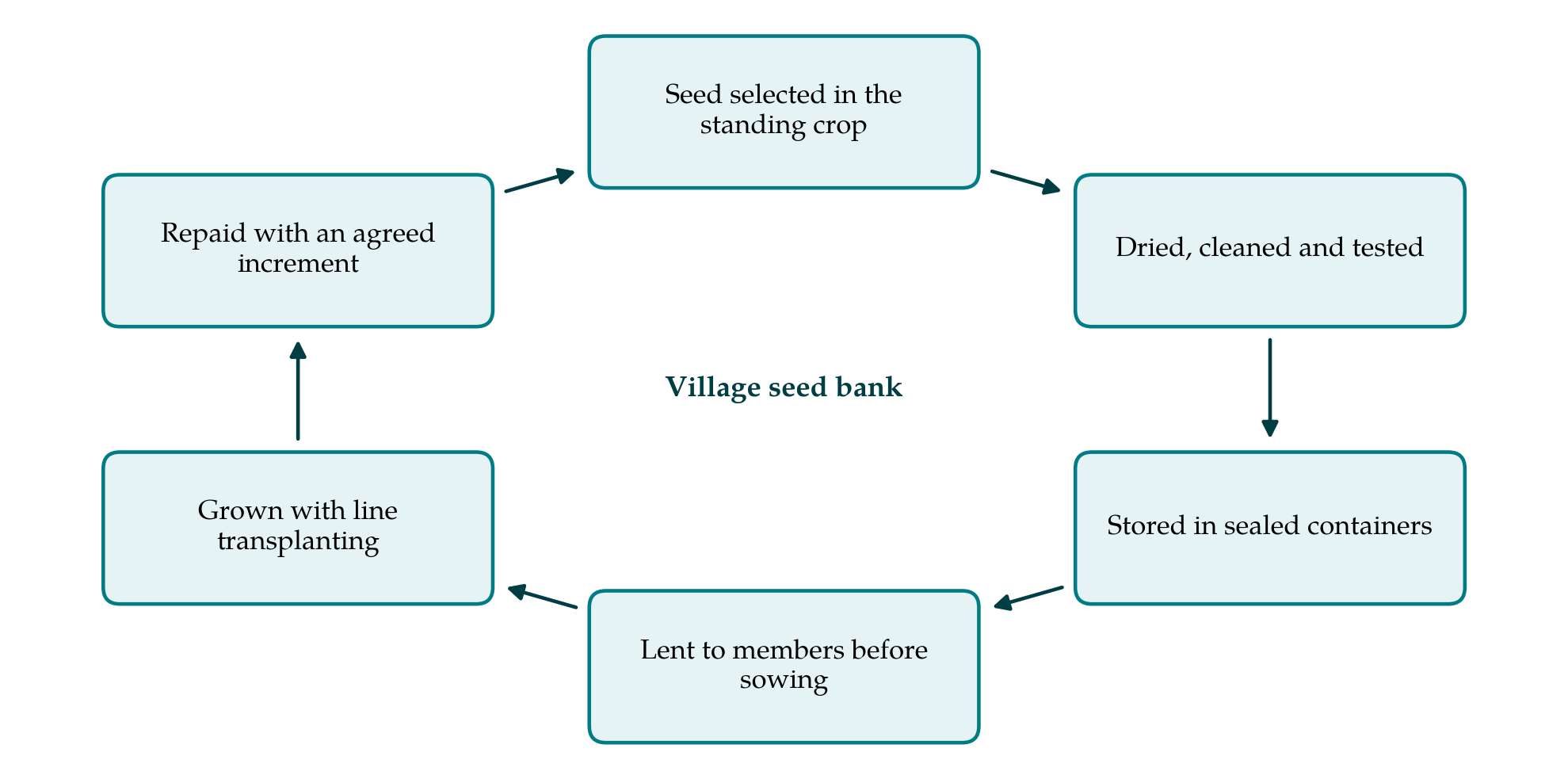
The bank is an institution before it is a building. Members agree in writing who may borrow, how much is repaid, how quality is judged and what follows default. The conditions under which shared resources are managed durably, including clear membership, rules made by users, monitoring by users and graduated sanctions, were identified by Ostrom (1990) and apply directly. Figure 1 shows the cycle through which seed passes. Technically, the task is to keep seed dry and cool. By the rules of thumb of Harrington (1972), storage life roughly doubles for each one per cent reduction in seed moisture and for each five degree Celsius reduction in temperature, a relation later given quantitative form by Ellis and Roberts (1980). Thorough sun drying, sealed containers and a germination test before lending serve the purpose without refrigeration.
3.5. Phase 5: Processing and local demand
Threshing and grinding by hand are among the reasons households gave up the crop, and they fall mainly on women. A small thresher and pulveriser operated by a women's group, with a user fee that covers repair, removes much of that burden. Demand is rebuilt nearest to home first: household consumption, then village institutions such as school meal and child nutrition centres where rules permit, and only then outside markets. This ordering follows the holistic value chain argument of Padulosi et al. (2015) and guards against a programme that raises output for which no buyer exists.
3.6. Phase 6: Shared monitoring
Once a year, after harvest, the committee and facilitator review a short list of indicators together: the number of households growing finger millet and the area, the share established by line transplanting, varieties and quantities held and lent by the bank, repayment, germination of stored seed, and hours of machine use. The review is held in the village in the local language, and its conclusions determine the next season's plan.
4. Fitting the Framework to Local Conditions
Upland tribal villages differ in land tenure, in distance from markets and in how much of the old crop culture survives, and the framework is meant to be bent accordingly. On steep or shifting-cultivation plots, row planting along the contour may be the only feasible form of the agronomic component, and intercropping with pulses or niger should be retained where it is customary. In villages where local varieties are lost entirely, seed must first be brought back from neighbouring communities or from a national gene bank, which lengthens the second phase. Facilitating organisations should plan their own withdrawal from the start, with the committee taking over record keeping by the third season.
5. Limitations and What Remains to Be Shown
This framework is a proposal. It has not been implemented or evaluated in the form described, and its components rest on evidence of uneven strength. The yield advantage of line transplanting in finger millet is reported mainly from programme experience, and its size on poor upland soils, its labour cost and its behaviour in dry years need measurement in designed comparisons. Whether a seed bank outlasts its sponsor is the commonest point of failure in the published cases, and the governance rules proposed here reduce that risk without removing it.
A first application should therefore be planned as a study as much as a programme. It would compare paired strips across enough farms and seasons to estimate the agronomic effect, follow seed loans and repayments through at least three cycles, and record changes in household consumption. Adoption should be judged by what farmers continue to do after support ends, the test that innovations of every kind must pass (Rogers, 2003).
6. Conclusion
Finger millet will return to the uplands only if it becomes easier to grow, easier to process and possible to obtain as seed, and these conditions depend on each other. The framework proposed here links line transplanting to a community seed bank through participatory choice of varieties, adds support for processing, and gives each phase a responsible party and a written record. It draws on established practice in each of its parts. Its worth as a whole is untested, and the measurements that would test it have been indicated.
Conflict of interest
To be declared by the author(s) before publication.
Funding
To be declared by the author(s) before publication.