1. Introduction
Few regions of the Old World offer a cleaner test of isotopic methods for tracing cereal consumption than peninsular India. The staple grains of its early farmers were millets, tropical grasses that fix carbon by the C4 pathway, while the pulses grown beside them and the wheat, barley and rice that arrived from the north and east are all C3 plants. The two pathways leave carbon isotope ratios in plant tissue that do not overlap, and the difference is carried into the bones and teeth of consumers. The same logic first showed the spread of maize into the woodlands of North America (van der Merwe and Vogel, 1978) and has since tracked millet across northern China and the Eurasian steppe (Lightfoot et al., 2013).
The Deccan Plateau has received far less of this attention. Its early village societies are known from substantial excavations, from a detailed archaeobotanical record and from skeletal series that have been studied for health and growth, yet isotopic measurements on the people themselves are few. This is partly a problem of preservation and partly one of interpretation, since the plateau is a grassland in which nearly every food chain contains some C4 carbon.
This review brings together the methodological literature and the regional archaeology to ask what stable isotopes can and cannot establish about millet consumption and residential mobility on the plateau. It reports no new measurements. Its purpose is to state the principles accurately, to identify the confounding factors specific to the region, and to suggest where sampling effort would be best spent.
2. Scope, Terms and Approach
The article is a narrative review of published work and makes no claim to have searched the literature exhaustively. It draws on foundational papers in isotope ecology, on reviews of method, and on the principal excavation reports and syntheses for the Deccan. Studies from neighbouring regions are used where they supply a method or a comparison that the plateau itself still lacks.
A note on chronology is needed. "Bronze Age" is not the usual term in peninsular archaeology. The communities in question belong to the Southern Neolithic of the Karnataka and Andhra uplands, known for its ashmounds of burnt cattle dung (Allchin, 1963), and to the Deccan Chalcolithic of Maharashtra, whose Malwa and Jorwe phases are best documented at Inamgaon (Dhavalikar et al., 1988). Both fall in the third and second millennia BC, overlap with the mature and late phases of the Indus civilisation to the north-west, and used copper and bronze sparingly. The title's term is retained here as a chronological label for that span.
3. Isotopic Principles Relevant to the Plateau
Four isotope systems carry most of the argument. Table 1 summarises what each records, the tissue in which it is usually measured, and the caution that matters most in a Deccan setting. The paragraphs that follow take them in turn.
| System | Usual tissue | What it records | Main caution on the Deccan |
|---|---|---|---|
| Carbon in collagen | Bone or dentine | Mainly the protein part of the diet | Collagen seldom survives in hot, seasonally wet soils |
| Carbon in carbonate | Tooth enamel | The whole diet, including starch | Bone carbonate is easily altered; enamel is preferred |
| Nitrogen | Bone or dentine collagen | Trophic position and protein source | Aridity, manuring and pulses all shift values |
| Strontium | Tooth enamel | Geology of the childhood food catchment | Needs a local map of bioavailable values |
| Oxygen | Tooth enamel | Source of drinking water | Monsoon rainfall varies strongly by season and year |
3.1. Carbon and the C4 signal of millets
Plants that use the C3 pathway discriminate strongly against the heavier carbon isotope during photosynthesis, and C4 plants do so much less. The result is two distinct clusters of δ13C values, with C3 plants centred near -26.5 per mil and C4 plants near -12.5 per mil (Farquhar et al., 1989). Animals inherit the ratio of their food with a small, tissue-specific offset (DeNiro and Epstein, 1978). A person who lived on millet therefore has less negative carbon values than one who lived on wheat, barley, rice or pulses.
The choice of tissue changes what is measured. Controlled feeding experiments showed that the carbon in bone collagen is drawn preferentially from dietary protein, whereas carbon in the carbonate of bone and enamel mineral reflects the diet as a whole (Ambrose and Norr, 1993). Earlier work had already noted that the two fractions differ in a way that depends on diet (Lee-Thorp et al., 1989). The point is central for cereals, which are rich in starch and poor in protein. A diet of millet porridge eaten with pulses and a little C3-fed meat could yield collagen that understates the millet, while enamel carbonate from the same person would record it in full.
3.2. Nitrogen, manuring and aridity
Nitrogen isotope ratios rise by a few per mil with each step up a food chain (DeNiro and Epstein, 1981), and are used to judge how much animal protein a person ate. The size of that step in humans is still debated (Hedges and Reynard, 2007). Three regional factors complicate the reading. Animals in hot, dry environments tend to have elevated values for physiological and soil reasons (Ambrose, 1991). Crops grown on manured ground are enriched in the heavy isotope, so that a manured cereal can resemble meat (Bogaard et al., 2007), a real possibility where cattle were penned in numbers. Pulses, which fix atmospheric nitrogen, pull values the other way.
3.3. Strontium and oxygen as tracers of residence
The ratio of strontium-87 to strontium-86 in rock depends on its age and its original rubidium content. Strontium passes from weathered rock through soil and plants into the skeleton without measurable fractionation, so tooth enamel, which forms in childhood and does not remodel, keeps the signature of the place where a child's food was grown (Bentley, 2006). A person whose enamel differs from the local range moved after childhood. The method depends on knowing that local range, which is best estimated from archaeological fauna of small home range or from modern plants and waters, not from bedrock values alone (Price et al., 2002).
The Deccan is promising ground. Much of Maharashtra lies on the flood basalts of the Deccan Traps, which are geologically young, while the Karnataka and Andhra uplands to the south rest on the ancient granites and gneisses of the Dharwar craton. Old continental crust is typically far more radiogenic than young basalt, so movement between the two provinces should in principle be detectable. Oxygen isotopes in enamel, which follow drinking water, offer a second line, though the composition of monsoon rain depends on how much falls and so varies from year to year (Makarewicz and Sealy, 2015).
4. Crops, Herds and the Problem of Shared Signals
Isotope values mean little without knowledge of what was available to eat. Archaeobotanical work in the southern Deccan has identified a set of native crops taken into cultivation locally: browntop millet, bristly foxtail millet, mung bean and horsegram (Fuller et al., 2004). This is a mixture of C4 cereals and C3 pulses. To it were added, during the second millennium BC, the larger millets of African origin, namely sorghum, pearl millet and finger millet (Weber, 1998), and, in the northern Deccan, winter crops of wheat and barley from the Indus region (Fuller, 2006). The balance between monsoon and winter cropping varied by site and through time.
The herds are the difficulty. The natural pasture of the semi-arid plateau is tropical grassland, dominated by C4 species. Cattle, sheep and goats that grazed it carried C4 carbon in their flesh and milk whether or not any millet was grown. The ashmounds show how many cattle were kept. A person in such a society could acquire a strongly C4 collagen signal from dairy protein alone. Figure 1 sets out the separate routes by which C4 carbon can reach human tissue; only the first column is evidence of millet eating in the strict sense.
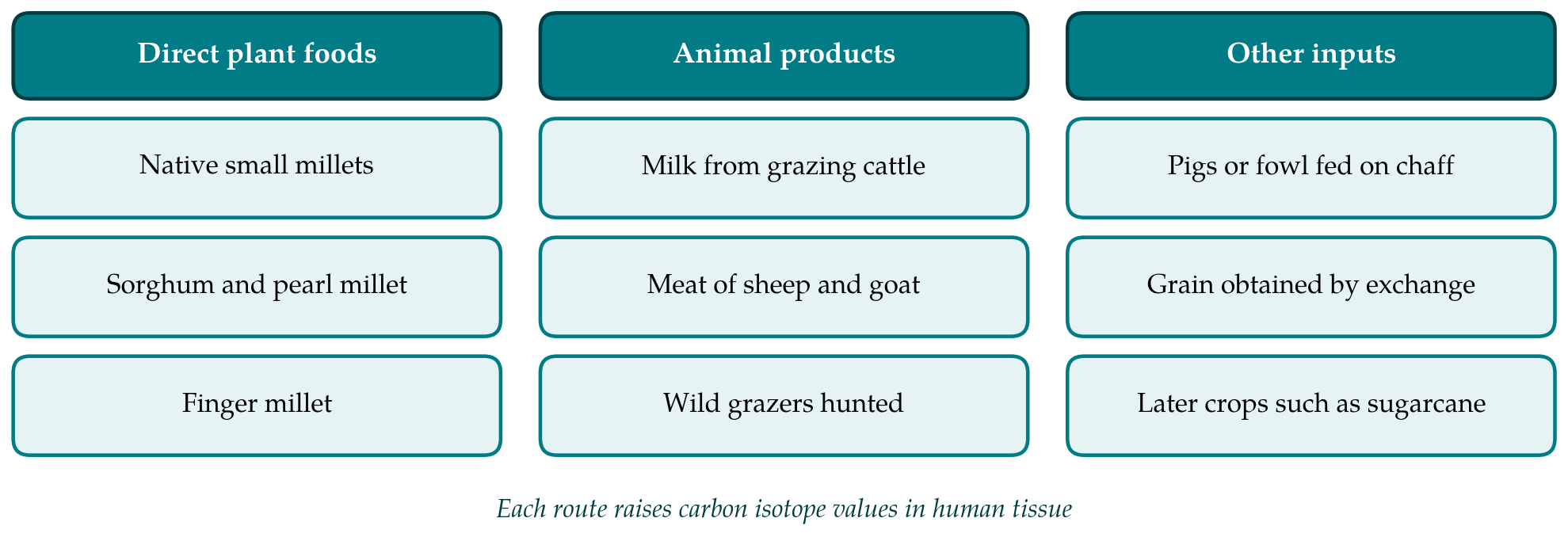
Several strategies help to separate the routes. Comparing collagen with enamel carbonate from the same individuals exploits the routing of protein and whole-diet carbon described above. Measuring the associated fauna shows directly how much C4 carbon the animals carried. Nitrogen values indicate whether the protein was of plant or animal origin, subject to the cautions already given. Mixing models that combine several isotopes and food groups with explicit uncertainty are now available (Fernandes et al., 2014), although their output is only as good as the baseline values supplied to them. None of these steps is possible without a local reference collection of charred grain and animal bone from the same deposits.
5. Preservation and Sampling in a Tropical Setting
Collagen breaks down faster at high temperature, and the alternation of wet and dry seasons speeds its loss. Bone from tropical open-air sites often retains too little for analysis, or retains an altered residue. Quality checks are therefore essential. The atomic ratio of carbon to nitrogen in extracted collagen should fall between 2.9 and 3.6 (DeNiro, 1985), and yield and elemental concentrations provide further tests (van Klinken, 1999). Results that fail these criteria should not be interpreted, however scarce the material.
Tooth enamel is the practical alternative. It is dense, highly mineralised and resistant to exchange with groundwater, and it serves for carbon, oxygen and strontium at once. Its limitation is that it records childhood only. Teeth that form at different ages, from the first molar in infancy to the third molar in later childhood and adolescence, can be compared within one mouth to detect a change of diet or residence during growth. Because early-forming enamel is laid down while a child is still nursing, the choice of tooth must be stated and justified in any study.
Burial practice shapes the sample. In the Deccan Chalcolithic, infants and children were commonly buried in urns beneath house floors, and they dominate the skeletal series. These remains have been used to examine growth and health across the decline of the Jorwe villages (Robbins Schug, 2011). An isotopic study built on the same collections would speak mainly about weaning, childhood diet and the mobility of mothers, which are worthwhile subjects but different from adult subsistence.
6. What the Published Record Shows
For the plateau itself the direct isotopic record on human remains is thin, and this review has not identified a body of measurements large enough to support a regional synthesis. What exists more securely is the indirect evidence. Charred grain shows that millets and pulses were grown. The ashmounds show that cattle were penned in large numbers (Allchin, 1963). At Inamgaon the excavators argued that the later Jorwe occupation saw a move away from farming towards herding and hunting under drier conditions (Dhavalikar et al., 1988). Each of these propositions makes an isotopic prediction that has yet to be tested adequately.
Work elsewhere in South Asia shows that the methods are workable in the region. Strontium and lead isotopes in enamel from Harappa and Farmana were used to argue that many of those buried in Indus city cemeteries had spent their childhoods elsewhere (Valentine et al., 2015). That study also shows how much baseline sampling is needed before a non-local value can be assigned to a source area.
The closest dietary analogue comes from northern China, where broomcorn and foxtail millet were the staples of Neolithic farmers. Human collagen there is strongly enriched in the heavy carbon isotope, and the pigs and dogs that ate household waste share the signal, while wild herbivores do not (Pechenkina et al., 2005). That contrast between domestic and wild fauna is what identifies the grain as the source. On the Deccan the wild grazers also ate C4 grass, so the same test is weaker and must be supported by other lines of evidence.
7. Mobility: Herding Circuits, Marriage and Exchange
Three kinds of movement are plausible for these societies and each would leave a different trace. Seasonal herding between village and pasture would show in the teeth of cattle and sheep more clearly than in people, as sequential samples along a tooth crown record the animal's passage across geological boundaries. Marriage between villages would appear as a minority of adults, probably of one sex, whose enamel differs from the local range. Movement of whole households, such as the abandonment and resettlement proposed for the end of the Jorwe period, would produce cemeteries in which most adults are non-local.
Reviews of strontium work elsewhere warn against simple readings. Foods imported from another geology, including salt and grain, can shift a local person's values, and several regions may share one signature (Montgomery, 2010). A large uniform basalt province is a case in point: a person could travel a long way across the Deccan Traps without leaving a strontium trace. Recent surveys of the field recommend combining isotope systems and sampling several tissues from each individual for that reason (Makarewicz and Sealy, 2015).
8. Gaps and Priorities
The first gap is the baseline. Carbon and nitrogen values are needed for charred millets, pulses and winter cereals from dated contexts, and for cattle, sheep, goat, pig and wild species from the same sites. A map of bioavailable strontium across the boundary between the basalt and the granite country is needed before any human tooth is interpreted. Both tasks can use material already held in excavation archives.
The second is tissue choice. Given the poor odds for collagen, programmes should be planned around enamel carbonate and strontium, with collagen attempted where screening suggests it survives. The third is reporting. Quality indicators, the tooth sampled, pretreatment and the laboratory standards used should be published with every value, so that small datasets from different projects can be combined. The last is the link to archaeobotany and zooarchaeology: isotopes answer questions about proportions, and the candidate foods must come from the excavated record.
9. Conclusion
The Deccan Plateau has the ingredients for a productive isotopic study of early farming life: a C4 staple set against C3 pulses and winter cereals, contrasting rock provinces, and well-excavated village sites with skeletal collections. It also has a pastoral economy on C4 grassland that blurs the dietary signal and a climate that destroys collagen. The published evidence does not yet allow a firm statement about how much millet these communities ate or how far they moved. It does indicate how the question can be answered, through enamel-based sampling tied to a local baseline of plants, animals and strontium.
Conflict of interest
To be declared by the author(s) before publication.
Funding
To be declared by the author(s) before publication.