1. Introduction
An engineer assessing an earth dam for earthquake loading today will usually follow a recognisable sequence. A design ground motion is selected for a specified annual probability of exceedance. The embankment and foundation are checked for liquefaction. If they pass, a permanent displacement is estimated by a sliding-block calculation or a numerical model, and the result is compared with a tolerable value. This is performance-based design in the sense that the criterion is a deformation and not a factor of safety, and it is a great advance on the pseudo-static coefficients that preceded it. The sequence was developed largely in California and Japan, after events such as the near-failure of the Lower San Fernando Dam in 1971 (Seed et al., 1975), and it reflects the problems of those regions.
Most of the world's embankment dams are not in such regions. They stand in areas where damaging earthquakes are infrequent, where no dam has been strongly shaken within living memory, and where the design motion for a high-consequence structure is an extrapolation far beyond the observed record. Guidelines written for worldwide use ask for the same form of demonstration everywhere (ICOLD, 2016). This article argues that the targets used in that demonstration deserve reconsideration for moderate seismicity regions. The position taken is not that such dams are safe and may be left alone. It is that the questions which decide their safety differ from the one the customary target answers.
2. How the Current Targets Arose
The intellectual origin is Newmark (1965), who proposed that the effect of an earthquake on an embankment be judged by the displacement of a sliding mass and not by whether a factor of safety momentarily falls below one. Makdisi and Seed (1978) turned the idea into a practical procedure that accounts for the dynamic response of the embankment, and Seed (1979) set out the reasoning that still frames practice: dams of materials that do not lose strength suffer limited deformations, and the serious hazard lies with loose saturated cohesionless soils. Screening rules followed. Hynes-Griffin and Franklin (1984) calibrated a pseudo-static check, using half the peak bedrock acceleration and a reduced strength, against a tolerable sliding displacement of one metre. Later regression models refined the estimate of displacement and expressed its scatter (Bray and Travasarou, 2007).
Guidelines then attached these methods to hazard levels. International and national documents define a safety evaluation earthquake, for the highest consequence categories commonly a motion with a return period of the order of ten thousand years or a deterministic maximum, under which the dam may be damaged but must not release the reservoir (ICOLD, 2016; FEMA, 2005; ANCOLD, 2019). In practice the requirement not to release the reservoir is translated into a computed crest settlement that must leave freeboard, or a displacement small enough that filters and drains are judged to remain continuous.
3. The Argument
Three observations support the case for different targets where seismicity is moderate.
3.1. The demand is the weakest link
Probabilistic seismic hazard analysis in the form introduced by Cornell (1968) needs a model of where earthquakes occur, how often, and how the ground motion decays with distance. In a stable continental region each of these is uncertain to a degree that has no counterpart at a plate boundary. Faults capable of large earthquakes may have no surface expression and recurrence intervals far longer than the historical catalogue, and the largest events have occurred in places that gave little prior warning (Johnston et al., 1994). At the very low annual probabilities adopted for high-consequence dams, the hazard estimate is governed by assumptions about maximum magnitude and about rare nearby events, and credible alternative models can differ by a large factor in the resulting ground motion.
A displacement computed from such a motion is then compared with a limit stated to the nearest tenth of a metre. The precision is illusory. Sliding displacement is strongly nonlinear in the ratio of yield acceleration to peak acceleration, so uncertainty in the motion is magnified in the answer. The verdict that a dam passes or fails may depend more on which hazard model the analyst inherited than on anything about the dam.
3.2. The record points elsewhere
Reviews of embankment dam performance in earthquakes have reached a consistent conclusion for several decades. Well-built dams of compacted clayey soil on rock or stiff foundations have withstood strong shaking with modest settlement and no loss of the reservoir, whereas hydraulic fill dams and dams on loose saturated sands have suffered slides and failures (Seed et al., 1978). The compilation by Swaisgood (2003) found crest settlement to be a small fraction of dam height in the great majority of cases without liquefaction, increasing with peak acceleration and magnitude. The implication for moderate seismicity regions is direct. If the materials do not lose strength, the deformation under any motion that can plausibly occur there is likely to be within what the dam tolerates, and refining the computed number adds little. If they do lose strength, a sliding-block displacement is the wrong analysis altogether.
3.3. Displacement is a poor proxy for the failure mode
Embankment dams rarely fail by losing their crest to settlement. Historical statistics show internal erosion and overtopping by flood as the dominant causes of failure (Foster et al., 2000). An earthquake can initiate the first of these without any large deformation. Differential settlement and shaking open transverse cracks in the crest and at contacts with abutments and concrete structures, as Sherard (1967) recognised, and whether a crack leads to breach depends on the water level, the erodibility of the core and above all the presence of a filter able to arrest eroded particles. Pells and Fell (2002) compiled observations of earthquake-induced cracking and related its severity to shaking intensity and dam type for exactly this purpose. A dam with a generous computed displacement margin but no filter downstream of a dispersive core may be the more dangerous structure, and the customary target does not distinguish the two.
Table 1 sets the elements of the customary target beside the alternative emphasis proposed here.
| Element | Customary practice | Proposed emphasis |
|---|---|---|
| Demand | Single motion at a very long return period | Range of motions with stated uncertainty; sensitivity of the verdict to the hazard model |
| First question | How large is the computed displacement | Can any zone of dam or foundation lose strength |
| Primary criterion | Crest settlement less than a share of freeboard | Cracks that may form are arrested by filters and drains |
| Role of analysis | Deformation analysis for every significant dam | Detailed analysis reserved for susceptible materials and extreme consequences |
| Post-event state | Seldom addressed explicitly | Freeboard, drawdown capacity and inspection access after the earthquake |
| Expression of result | Pass or fail against a limit | Contribution to the risk of failure alongside flood and static modes |
4. What Should Replace Them
The proposal is to recast the target around three matters, taken in order. The first is susceptibility: whether any part of the embankment or foundation consists of material that can liquefy or soften cyclically. This is a question of geology, construction history and site investigation, and it is far less sensitive to the hazard level than a displacement is. The second is tolerance of cracking: whether the dam has filters, drains and zoning that would stop erosion through a crack of the size that shaking and differential settlement could open. The third is the condition after the event: the freeboard that remains, the ability to lower the reservoir, and the means to detect damage before it develops.
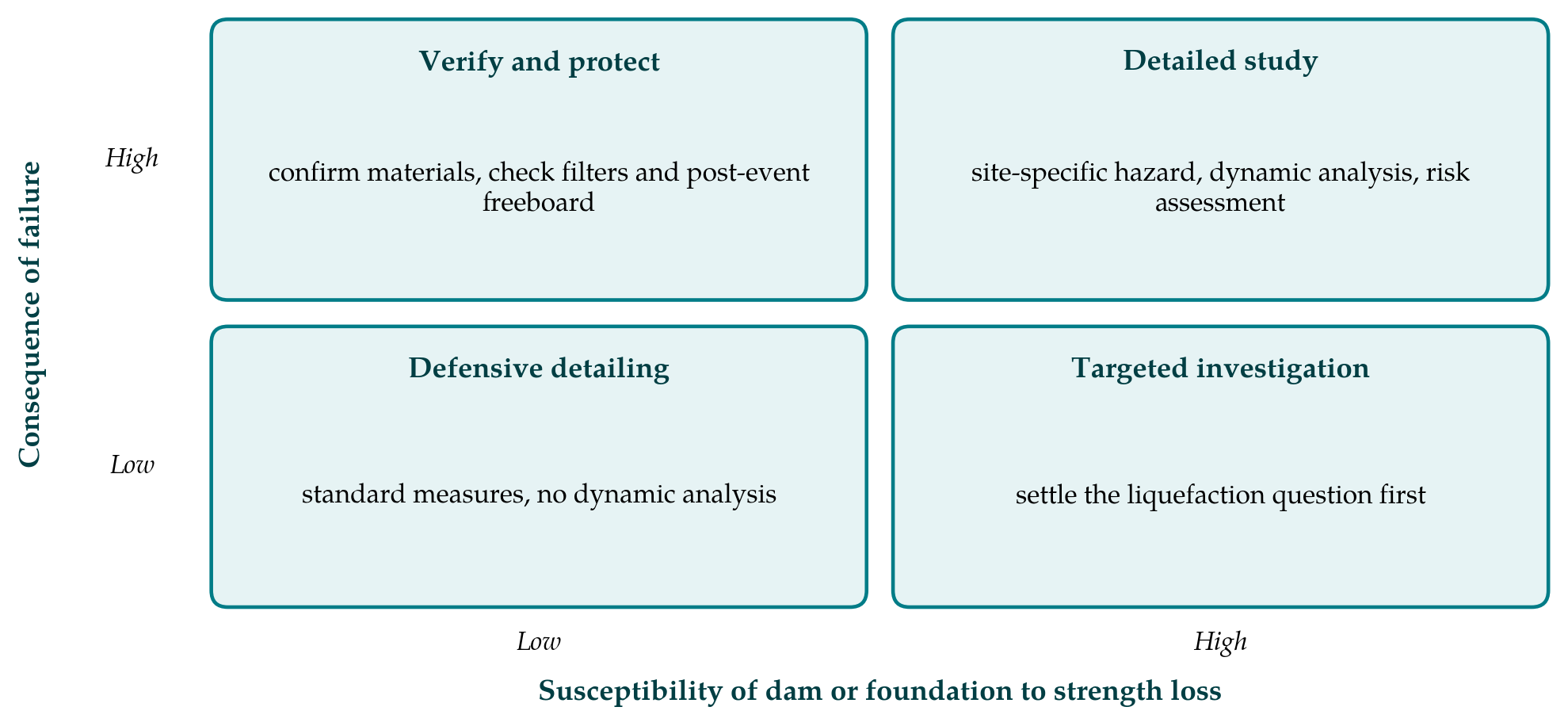
Figure 1 arranges the consequence of failure against susceptibility to strength loss and indicates the kind of effort that each combination warrants. Detailed dynamic analysis keeps its place in the upper right of the diagram. Elsewhere the resources it would consume are better spent on investigation or on defensive measures of the kind long advocated by Seed (1979) and codified in texts on dam engineering (Fell et al., 2015): ample freeboard, wide transition zones, and filters carried to the crest.
Such a scheme fits naturally within risk-informed dam safety management, where seismic failure modes are examined alongside flood and normal-operation modes and the probability of each step from initiation to breach is estimated (USBR and USACE, 2019). In that setting the uncertain hazard is carried as a distribution and does not have to be collapsed into one design motion.
5. Objections
Several objections deserve an answer. The first is that the favourable record comes from regions of high seismicity, where dams were built with earthquakes in mind, and may not transfer to older dams elsewhere that have thin cores, no filters and poorly compacted shells. The point is well taken, and it strengthens the argument: those are deficiencies in crack tolerance and material quality, which the proposed targets examine directly and a displacement limit does not.
A second objection is regulatory. A numerical criterion is easy to audit, whereas judgements about susceptibility and filter adequacy are harder to verify and may be applied unevenly. This is a real cost. It can be reduced by prescriptive requirements for the defensive features, which are as checkable as a displacement, and by peer review of the susceptibility assessment.
A third concerns dams whose failure would be catastrophic. For these, society reasonably demands that even very unlikely earthquakes be considered, and a deterministic check against a maximum credible event has the merit of not depending on recurrence estimates. Nothing here argues against that. The proposal concerns what is checked under the extreme motion, and holds that strength loss and erosion through cracks remain the governing questions at any hazard level. Finally, it may be said that deformation analysis is now inexpensive and does no harm. The harm lies in the confidence it lends: a computed displacement below the limit can close an assessment that has not looked hard at the foundation or the filters.
6. Implications
For guideline writers, the suggestion is to state the performance objective in terms of the failure modes to be prevented and to present displacement limits as one indicator among several, applicable when materials have been shown not to lose strength. For owners of existing dams in moderate seismicity regions, it implies that investigation to establish foundation conditions and the retrofitting of filters and downstream berms will often buy more safety than further analysis. For hazard specialists, it asks that results be reported with their epistemic range, so that the dam engineer can test whether the conclusion survives a change of model. For researchers, the need is for better evidence on crack formation and filter performance under shaking, where the published basis is still largely observational.
7. Conclusion
The customary performance target for earth dams measures something that can be computed and compares it with a limit that can be audited. In regions of moderate seismicity the computation rests on a demand that is not well known, and the limit addresses a mode of failure that history shows to be uncommon. Safety there depends chiefly on whether materials can lose strength and whether the dam can survive being cracked. Targets framed around those two questions, and around the state of the dam after the event, would be less precise in appearance and better matched to the hazard as it is.
Conflict of interest
To be declared by the author(s) before publication.
Funding
To be declared by the author(s) before publication.