1. Introduction
A block of flats differs from an office tower in ways that bear directly on escape. Its occupants include children, older people and people with long-term impairments. They may be asleep. They are not trained, they are not supervised, and the building usually has no fire wardens. Many residential towers have a single stair. For these reasons the fire strategy in several countries has relied on compartmentation: a fire is expected to be contained in the flat of origin, and other residents are advised to remain where they are. British guidance for residential buildings sets this approach out in detail (BSI, 2015).
The fire at Grenfell Tower in London in June 2017 showed what follows when compartmentation fails and a whole building must be emptied down one stair. The first report of the public inquiry recorded the difficulties faced by residents who could not descend unaided and recommended that personal emergency evacuation plans be prepared for residents of high-rise housing whose ability to leave by themselves is compromised (Moore-Bick, 2019). Planning of that kind needs estimates of how long an evacuation would take and where it would be obstructed, and those estimates come from models.
The purpose of this article is to review how well evacuation models serve that need. It considers the types of model in use, the ways in which reduced mobility is represented in them, the data available to support the inputs, and the means of checking that the results deserve confidence.
2. Approach of the Review
This is a narrative review of the published literature on building evacuation, with attention to sources that address tall buildings, dwellings, or occupants with reduced mobility. It draws on reviews of evacuation models, on experimental studies of movement, on official investigations and on standards. The literature was not searched according to a formal protocol, and the selection reflects the judgement that a designer or regulator is best served by the studies on which current practice in fact depends. Sensory and cognitive impairments affect evacuation as surely as mobility impairments do, but they raise different modelling questions and are mentioned only where they interact with movement.
3. Families of Evacuation Model
The oldest approach treats a moving crowd as a fluid. Building on the pedestrian studies of Fruin (1971), Pauls (1987) derived relationships between the usable width of a stair and the flow of people down it from observations of evacuation drills in tall office buildings. The resulting hydraulic model, in which speed falls as density rises and flow is limited by the narrowest element, is still the standard hand calculation (Gwynne and Rosenbaum, 2016). It describes a homogeneous population. An occupant who moves at a fraction of the general speed, or who occupies the full width of the stair, has no place in it except as an adjustment to the average.
Computer models removed that restriction by representing individuals. Gwynne et al. (1999) classified the early models by how they represent space, population and behaviour, and the survey by Kuligowski et al. (2010) remains the most complete catalogue of their features. In broad terms three kinds of movement model are in use. Cellular automata divide the floor into a grid and move occupants from cell to cell according to local rules (Burstedde et al., 2001). Continuous models place occupants in open space and compute their paths from the distances between them or from attractive and repulsive forces, as in the social force model (Helbing and Molnár, 1995; Helbing et al., 2000). Several widely used simulation tools combine a continuous movement model of this kind with predicted smoke conditions, so that visibility and toxic exposure can slow or redirect occupants.
Agent-based models add decision-making to movement: each occupant has attributes and rules that govern when to leave, which route to take and whether to help others. For the present subject this is the most relevant development, since impairment affects decisions as well as speed. Table 1 compares the families in terms of what they can represent for an occupant with reduced mobility.
| Model family | How reduced mobility is represented | Main limitation |
|---|---|---|
| Hydraulic hand calculation | Lower average speed or reduced flow for the whole population | No individuals, no overtaking, no blockage |
| Cellular automaton | Individual speed; larger occupants may fill several cells | Grid fixes body size and step geometry |
| Continuous distance-based | Individual speed and body dimensions | Assistance and devices seldom built in |
| Social force | Individual speed, size and interaction forces | Parameters calibrated on able-bodied crowds |
| Agent-based behavioural | Speed, size, decisions, helpers, devices and lift use | Many inputs lack supporting data |
4. Representing Mobility Impairment
An evacuation is usually analysed as a sequence of phases, shown in Figure 1. Reduced mobility lengthens several of them, and the modelling task differs in each.
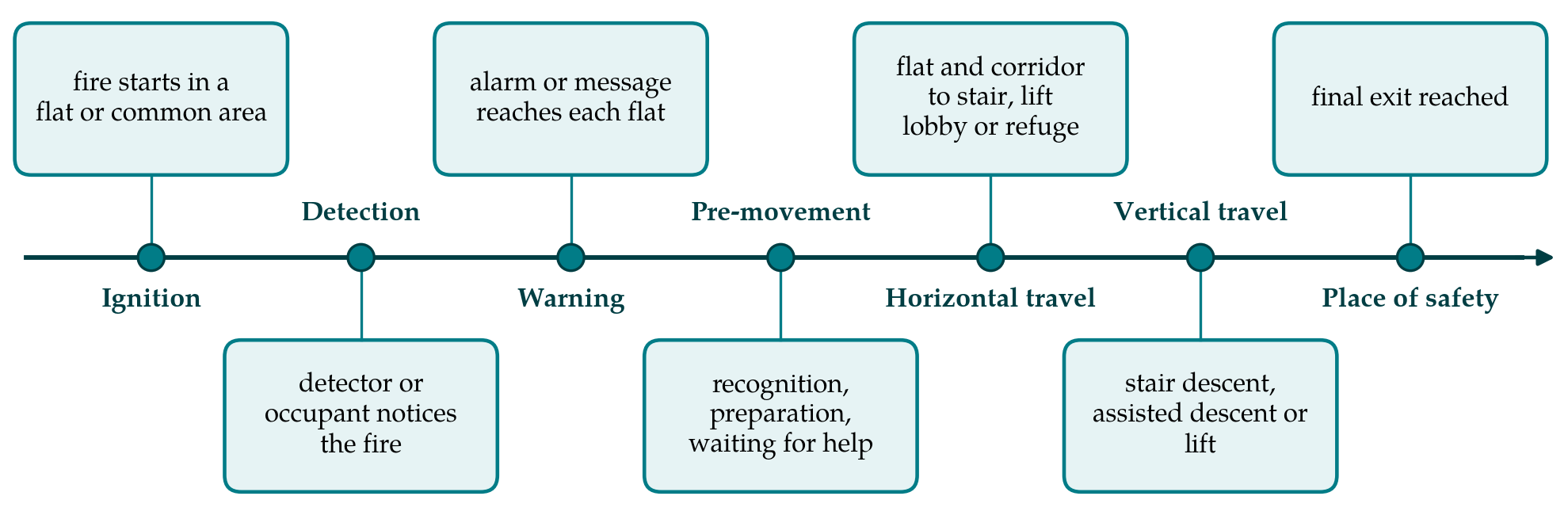
4.1. Movement on the level and on stairs
The most widely used data on the movement of disabled people come from studies carried out in Northern Ireland by Boyce, Shields and Silcock. As part of a wider programme to characterise building occupancies for fire engineering, they measured the speeds of volunteers with a range of impairments and mobility aids on level routes, ramps and stairs (Boyce et al., 1999). The speeds varied widely with the type of aid, and people who could manage stairs at all did so far more slowly than the values assumed for the general population. These measurements are the default inputs in several commercial models. They were taken on short routes in day centres, not on long descents in tall buildings.
More recent measurements come from evacuation drills. Kuligowski et al. (2013) recorded the stair descent of older adults and people with mobility impairments during building evacuation drills and reported speeds for those who walked unaided, used a cane, were helped by another person, or were carried in an evacuation chair. In tall buildings fatigue and the need to rest add to the effect, and a slow descender on a narrow stair delays those behind unless overtaking is possible. The review of high-rise evacuation by Ronchi and Nilsson (2013) identifies fatigue, merging at landings and counterflow with firefighters as behaviours that models represent only crudely.
4.2. Time to start moving
In dwellings the delay before movement begins is often longer than the movement itself. Drills in apartment buildings observed by Proulx (1995) found long and very variable delays, with occupants gathering belongings, seeking information and assisting family members, and recorded stair speeds that reflected a mixed population which included children, older people and residents with movement limitations. Purser and Bensilum (2001) showed that pre-movement times follow skewed distributions whose spread depends on the quality of the warning and the management of the building. The tendency of people to move towards familiar persons and places before leaving, described by Sime (1985), is strong in homes. A resident who needs a helper must wait for one, and that wait belongs to the pre-movement phase in a model although it has little to do with recognition of the alarm (Kuligowski, 2009).
4.3. Assisted descent and movement devices
An occupant who cannot use the stairs must be carried, moved in a device, taken down by lift, or left in a protected space until help arrives. Adams and Galea (2011) measured the performance of trained hospital staff using an evacuation chair, a carry chair, a stretcher and a rescue sheet, including the time to prepare the device and transfer the person into it. Hunt et al. (2015) used the same data to represent the devices explicitly in a simulation model, with the space they occupy on the stair and the number of handlers they require. The results show that preparation time is substantial and that some devices block the stair to other users. The handlers in these trials were trained and fit. In a block of flats the helpers will be relatives, neighbours or firefighters, and no comparable data set exists for them.
4.4. Lifts and refuges
Lifts offer the only means by which many mobility-impaired residents can leave an upper floor without being carried. Experience from the World Trade Center in 2001 strengthened the case: the investigation by Averill et al. (2005) documented occupants with mobility limitations among those descending the stairs and others who waited on intermediate floors for assistance. Simulation has since been used to compare ways of running lifts in an evacuation. Kinsey et al. (2012) examined dispatch strategies for a tall building by simulation and showed that the benefit obtained from lifts depends on the strategy adopted and on human factors such as the willingness of occupants to wait for a lift.
Agent-based studies have compared strategies for disabled occupants directly. Christensen and Sasaki (2008) built a model in which agents carry attributes representing different impairments and respond to the features of the built environment accordingly. Koo et al. (2013) used a model of this kind to compare stair evacuation, assisted evacuation and lift evacuation for people with disabilities in a tall building, and reported that the choice of strategy had a marked effect on the time needed to clear a mixed population. Such results are conditional on input values that are, for residential settings, largely assumed.
5. Verification, Validation and Uncertainty
A model result is only as credible as the checks behind it. Guidance from the United States National Institute of Standards and Technology sets out a series of verification tests for the basic components of an evacuation model, such as speed, flow at doors, movement on stairs and route choice, together with a discussion of validation against experimental data (Ronchi et al., 2013). An international standard now gives a protocol on the same lines (ISO, 2020). These documents include tests for occupants with different speeds and body sizes, but validation data for mixed-ability populations on stairs are sparse, so a model may pass the verification tests and still be unvalidated for the case that matters here.
Uncertainty therefore has to be handled openly. Because behaviour is variable, a single simulation run is one sample from a distribution, and results should be reported as ranges from repeated runs. The more important uncertainty lies in the inputs. The number of residents who will need assistance, where they live in the building, whether a helper is present at night and how long device preparation takes are each capable of changing the answer more than the choice of model. Sensitivity analysis on these inputs is more informative than refinement of the movement algorithm.
6. Gaps and Future Work
The data on which impaired movement is modelled are the weakest part of the field. The principal speed measurements are more than two decades old and were made on a population whose mobility aids, age profile and body size may differ from those of residents today. Powered wheelchairs and mobility scooters, which cannot be carried by one or two helpers, are barely represented. Measurements of long stair descents by people with limited endurance, and of assistance given by untrained helpers, would add most.
A second gap concerns the residential setting itself. Most assisted-evacuation data come from hospitals, and most stair data from offices. Night-time conditions, single-stair layouts, flats used as places of temporary refuge and the interaction between descending residents and ascending firefighters all need study. A third gap is behavioural: whether residents will wait in a lift lobby or refuge when smoke is present, and how the advice to stay or to leave is understood by people who know that they cannot leave unaided. Models can already represent these choices. What is missing is evidence on which to set the parameters.
7. Conclusion
Evacuation models have progressed from flow calculations for uniform crowds to simulations in which each occupant has individual capabilities, makes decisions, receives help and may use a device or a lift. The structure needed to analyse the evacuation of mobility-impaired residents from tall housing therefore exists. The evidence base has not kept pace. Movement speeds rest on a small number of studies, device performance on trials with trained staff, and lift and refuge behaviour on very little. Until better data are collected, results for such buildings are best presented as ranges tied to stated assumptions about who needs help and who is available to give it, and those assumptions deserve the same scrutiny as the model itself.
Conflict of interest
To be declared by the author(s) before publication.
Funding
To be declared by the author(s) before publication.