1. Introduction
A gram or less of powdered bone is now enough to recover a genome from a person who died thousands of years ago. The laboratory methods that made this routine are reviewed by Orlando et al. (2021), and their results have rewritten accounts of population history on every inhabited continent. The speed of that success created an ethical problem that the field did not anticipate. Skeletal collections assembled over two centuries, often under colonial conditions and without the agreement of the people whose ancestors they contain, became a resource for which laboratories competed.
The question at the centre of the resulting debate is simple to state. When researchers wish to remove and destroy part of an ancient person's skeleton to obtain DNA, whose permission is needed? Law usually answers that the museum, the excavator or the state antiquities service decides. A growing body of scholarship answers that descendant or culturally affiliated communities must also agree, and that where such communities exist their refusal should be final.
This article reviews the published literature on that question. It is a narrative review and does not claim to be exhaustive. It concentrates on guidance documents, commentaries by Indigenous and non-Indigenous geneticists and archaeologists, and the handful of published cases around which the arguments have formed.
2. Why Consent Is Contested
Research ethics for human subjects rests on respect for persons, beneficence and justice, expressed in practice as individual informed consent, assessment of risks and benefits, and fair selection of participants (National Commission, 1979). The framework was built for the living. Regulations derived from it generally exclude the deceased from the definition of a human subject, so ancient DNA projects have seldom required review by an ethics board. For decades the working assumption in laboratories was that a permit from the curating institution settled the matter.
Two observations undermine that assumption. First, genomic data are never only about one person. A genome carries information about relatives and, through statistical inference, about living populations that share ancestry with the individual sampled. The harms that can follow, such as stigmatisation, challenges to origin narratives, or the use of results in disputes over land and identity, fall on groups and cannot be managed by individual consent even among the living. The dispute between the Havasupai Tribe and a university over secondary use of blood samples showed how seriously such harms are felt (Garrison, 2013).
Second, the remains themselves have a history. Many were taken from graves in circumstances that the communities concerned regard as theft (Colwell, 2017). Scholars of science and Indigenous studies argue that treating such remains as a neutral scientific resource repeats the original taking, and that genetic accounts of ancestry can be used to displace peoples' own definitions of belonging (Reardon and TallBear, 2012; TallBear, 2013). On this view consent is a matter of authority over ancestors, and the absence of a legal requirement does not make sampling legitimate.
3. Law, Declarations and Professional Codes
The formal instruments are older than the genomic era. The Vermillion Accord adopted by the World Archaeological Congress called for respect for the remains of the dead and for the wishes of local communities and relatives, and for agreement to be reached by negotiation (World Archaeological Congress, 1989). In the United States the Native American Graves Protection and Repatriation Act gave federally recognised tribes rights over remains held by federally funded institutions (United States Congress, 1990). The United Nations declaration of 2007 affirmed the right of Indigenous peoples to the repatriation of their human remains (United Nations, 2007). Figure 1 places these instruments alongside the later documents specific to genomics.
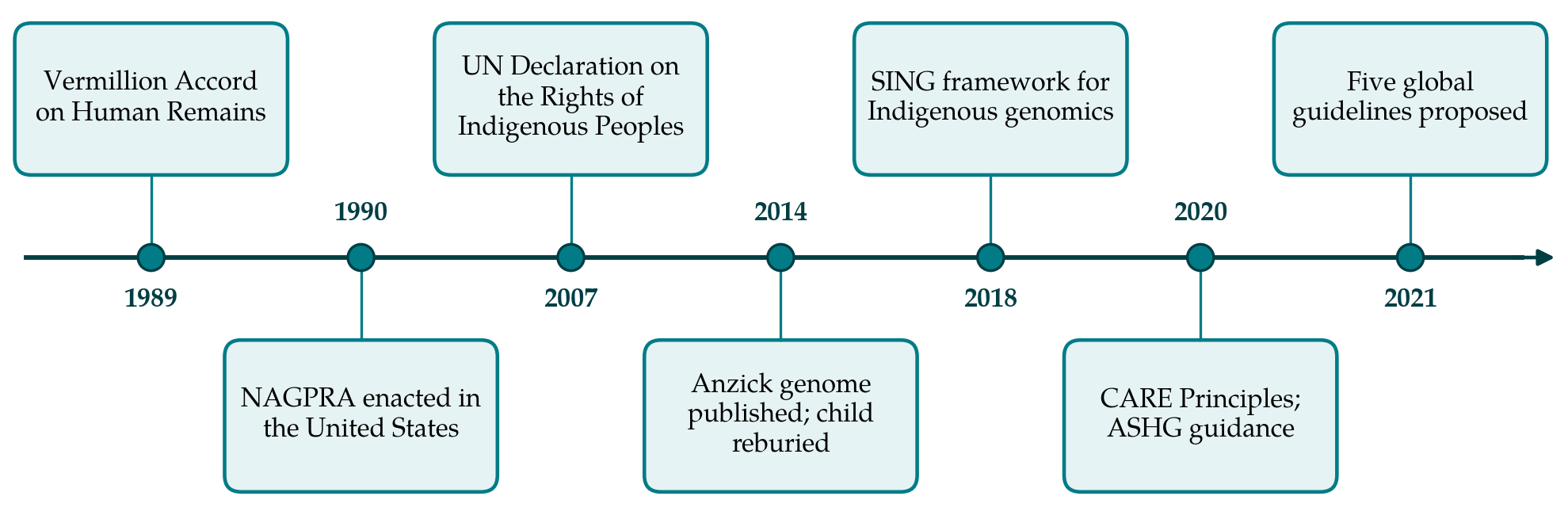
None of these texts was written with DNA in mind, and their reach is limited. The United States statute applies within one country and turns on a legal finding of cultural affiliation. The declaration is not a treaty. Most national heritage laws elsewhere vest authority over archaeological remains in the state and say nothing about descendants. Guidance specific to ancient DNA therefore had to be written by researchers themselves, which is one reason it remains contested.
4. Defining the Descendant Community
The practical objection most often raised against a consent requirement is that the relevant community cannot always be identified. Three situations should be distinguished. In the first, a living community has a documented or legally recognised connection with the dead, as with historic cemeteries or with remains affiliated under repatriation law. Here the literature is close to unanimous that the community's decision should govern.
In the second, the remains are so old that many living groups are equally related to them, or the people now living in the area arrived later. Genetic descent, cultural affiliation and present residence then point to different groups. Writers on African research note that local residents, traditional authorities, national museums and governments may each have a claim, and that these parties do not always agree (Prendergast and Sawchuk, 2018; Gibbon, 2020). In the third situation there is no identifiable community at all, and responsibility falls on the researchers and curating institution to act as stewards.
A further complication is that genetics is sometimes asked to settle the question it depends on. Using DNA to decide which community is the descendant one places laboratory evidence above oral history and self-definition, which is the outcome many Indigenous critics most object to (TallBear, 2013). Several authors therefore recommend that affiliation be treated as a cultural and political relationship, to be worked out through consultation and never read off a genome (Bardill et al., 2018).
5. Cases That Shaped the Debate
Three North American cases recur in the literature. The remains known to scientists as Kennewick Man and to Columbia Plateau tribes as the Ancient One were found in Washington State in 1996 and became the subject of long litigation over whether they could be studied. The genome published in 2015 showed that he was more closely related to present-day Native Americans than to any other population (Rasmussen et al., 2015), and he was reburied in 2017. The case is cited both as an example of DNA assisting repatriation and as an example of two decades in which tribal knowledge was disregarded until genetics confirmed it.
The Anzick child, an infant buried with Clovis artefacts in Montana, was sequenced and published in 2014 (Rasmussen et al., 2014). The research team consulted tribes in the region and the child was reburied the same year, but the consultation took place after the laboratory work was well advanced. Commentators have treated it as a step forward that nonetheless fell short of prior consent (Bardill et al., 2018). A study of elite burials from Pueblo Bonito in Chaco Canyon (Kennett et al., 2017) drew sharper criticism, because the remains were sampled with museum permission and without consultation of the Pueblo and other tribes who regard Chaco as ancestral.
A fourth case is cited as a model. Ancient nuclear genomes from Aboriginal Australian remains held without provenance in museums were compared with genomes of living people, in a project conducted with Aboriginal communities, to show that such remains could be assigned to a region of origin and returned to Country (Wright et al., 2018). Here the research question came from the communities' own priorities, which is the feature that the guidance literature most consistently recommends.
6. Guidance Since 2018
Formal recommendations multiplied after 2018. Table 1 compares the main documents. They agree on much. All call for researchers to learn the regulations and histories that apply to the remains, to engage communities before sampling, to agree a written plan, and to report results back in accessible form. They differ on the status of community consent and on what should happen to the data.
| Document | Origin | Community consent | Data |
|---|---|---|---|
| WAC, 1989 | World Archaeological Congress | Wishes of community respected; agreement by negotiation | Not addressed |
| NAGPRA, 1990 | United States federal law | Tribal rights over affiliated remains | Not addressed |
| Bardill et al., 2018 | Indigenous and allied geneticists | Consultation before any analysis; refusal respected | Terms agreed with community |
| Claw et al., 2018 | SING Consortium | Collaboration and tribal oversight throughout | Community control of access |
| Wagner et al., 2020 | American Society of Human Genetics | Engagement expected; consent where descendants exist | Plan for stewardship agreed early |
| Alpaslan-Roodenberg et al., 2021 | International group of researchers | Stakeholder engagement; no universal consent rule | Open after publication |
| Carroll et al., 2020 | Indigenous data governance network | Authority to control is a core principle | Collective benefit and control |
The framework produced by the Summer internship for Indigenous peoples in Genomics sets out principles for work with Indigenous communities that include understanding tribal sovereignty and regulation, building cultural competency, transparency, capacity building and returning results (Claw et al., 2018). A companion commentary applied the same reasoning to palaeogenomics and argued that ancestors should be treated in the way living research participants are (Bardill et al., 2018). Guidance published through the American Society of Human Genetics took a similar line while acknowledging that circumstances vary (Wagner et al., 2020).
The five guidelines proposed by a large international group in 2021 were written as a minimum that could apply anywhere: follow all regulations where the work is done and where the remains originated, prepare a detailed plan before starting, minimise damage, make data available after publication for re-examination, and engage with stakeholders from the outset with respect for their perspectives (Alpaslan-Roodenberg et al., 2021). The authors argued that a consent model developed for Indigenous peoples in settler states could not be transferred to regions where state and community relations differ, and where privileging one group's claim to ancient remains could feed nationalist narratives. The difference from the earlier documents is thus one of principle and not only of emphasis.
7. Destructive Sampling and Stewardship of Collections
Consent matters more because sampling is destructive and the best material is finite. The dense bone around the inner ear yields far more endogenous DNA than other skeletal elements (Pinhasi et al., 2015), and the petrous portion of the temporal bone quickly became the target of choice. Each person has two. Techniques that drill from the cranial base reduce the visible damage, yet they still consume part of a structure that is also valuable for other kinds of study.
Curators and archaeologists have warned that competition among a few well-funded laboratories encourages sampling of whole collections ahead of any defined research question, and leaves little for future methods or for researchers in the countries of origin (Fox and Hawks, 2019). Proposed remedies include museum sampling policies that require a stated question and evidence of consultation, limits on repeat sampling, and return of unused bone powder and extracts (Austin et al., 2019). These measures concern stewardship, but they give institutions a point at which to ask whether the affected community has agreed.
8. Data After Sampling
Once a genome is sequenced, the ethical questions move from bone to data. The norm in genomics is deposition in public archives at publication, which supports replication and is one of the five guidelines of 2021. For many Indigenous communities unrestricted release is the difficulty, because it removes any say over later uses that were never discussed (Hudson et al., 2020). The CARE Principles, standing for collective benefit, authority to control, responsibility and ethics, were written to sit alongside open-data norms and to assert that governance can remain with the people to whom data relate (Carroll et al., 2020).
Intermediate arrangements are discussed in the literature: controlled-access repositories, data agreements that name permitted uses, and community review of manuscripts before submission. Each has a cost for reproducibility and each depends on a community body with the time and resources to exercise oversight, which returns the discussion to capacity building (Claw et al., 2018).
9. Beyond Settler-Colonial Contexts
Most of the consent literature was written about North America and Australasia. Researchers working elsewhere have described a different set of problems. In much of Africa, samples have been exported to foreign laboratories under permits that did not anticipate genomics, with little involvement of local scholars or communities and little return of results (Prendergast and Sawchuk, 2018). Calls for stronger national permission procedures and for community-authored codes of research conduct respond to that history (Gibbon, 2020).
Archaeologists working in Africa have added that equitable practice concerns researchers as well as descendants: authorship, training, laboratory infrastructure and the setting of research questions should be shared, so that those who curate and live beside the remains are not reduced to suppliers of samples (Prendergast and Sawchuk, 2018). Community consent and scientific equity are separate issues, but the literature increasingly treats them together.
10. Gaps and Open Questions
Several matters remain unsettled. There is no agreed procedure for cases in which communities disagree with one another or with the state, and little published guidance on how long a consultation should run before silence may be taken as anything at all. The position of very ancient remains, for which every living person in a continent may be a descendant, is argued from first principles more than from experience. Evidence on what communities themselves want is limited to a small number of published collaborations, and negative experiences are less likely to be written up.
Enforcement is also weak. Journals and funders are the bodies best placed to require evidence of permissions and engagement, and some now ask for ethics statements in ancient DNA papers, but practice is uneven. Finally, data already released cannot be recalled, so guidance written today governs future sampling far better than it repairs past practice.
11. Conclusion
The literature reviewed here shows a field that has moved in a few years from treating ancient remains as specimens to accepting that sampling them creates obligations to the living. Early engagement, a written plan, restraint in destruction and the return of results are common ground. Whether descendant communities hold a right of refusal everywhere, and who counts as such a community when descent is remote, are not. Those disagreements reflect real differences in history and law between regions. Where an identifiable community stands in a recognised relationship to the dead, the weight of published opinion is that its consent should be sought before the drill touches bone.
Conflict of interest
To be declared by the author(s) before publication.
Funding
To be declared by the author(s) before publication.