1. Introduction
Blended learning, the planned combination of classroom teaching with online activity (Graham, 2006), has been promoted for two decades as a way to make teaching more flexible and more responsive to individual students. Garrison and Kanuka (2004) wrote of its transformative potential in higher education, and the idea has since travelled to schools, where it is now written into national digital strategies. The policy instruments chosen to bring it about have been remarkably uniform. Governments buy laptops or tablets, connect schools to broadband, license a learning platform and offer teachers a short course in using it.
The reasoning behind this approach is that teachers would blend their teaching if only they had the means. This article contends that the reasoning is mistaken, or at least seriously incomplete. In systems where the means are in place, the scarce resource is teacher time, and blended learning as it is usually conceived consumes a great deal of it. The claim is offered as a perspective on existing research. It rests on published studies and on the logic of what blended teaching demands, and no new data are presented.
2. The Access Explanation and Its Limits
The most influential framework for thinking about obstacles to classroom technology is the distinction drawn by Ertmer (1999) between first-order barriers, which are external to the teacher, and second-order barriers, which lie in teachers' beliefs about teaching and about technology. Equipment, time, training and support were all placed in the first category. The grouping was reasonable when it was made, but it has had an unfortunate effect: policy has treated the first-order barriers as one problem and has addressed the member of the group that is easiest to purchase.
Evidence that access alone does not change teaching is long-standing. Cuban et al. (2001) studied two well-equipped secondary schools in Silicon Valley and found that most teachers used computers occasionally or not at all for instruction, and that those who did largely fitted them to existing practice. Cuban (2001) generalised the point in a book whose title, Oversold and Underused, became a summary of the field. At system level, the OECD's analysis of international assessment data found no appreciable improvement in student performance in countries that had invested heavily in school technology (OECD, 2015). Research on the digital divide reached a parallel conclusion from another direction: physical access is only the first of several layers, and skills, purposes and social support determine what access is worth (Warschauer, 2003; van Dijk, 2005).
When access failed to produce the expected change, attention moved to the second-order barriers. Teachers were said to lack confidence, or to hold beliefs about teaching that technology did not fit (Ertmer and Ottenbreit-Leftwich, 2010). There is truth in this. It also locates the problem inside teachers, and it passes over a simpler possibility: that teachers who understand perfectly well what blended teaching involves decline to do it because they cannot find the hours.
3. What Blended Teaching Asks of a Teacher
A blended course is a different design from a classroom course, with online components added for a purpose and classroom time changed in consequence. The meta-analysis by Means et al. (2013), frequently cited in support of blended learning, makes the point indirectly. Blended conditions outperformed face-to-face ones on average, and the authors cautioned that those conditions often included additional learning time and instructional elements that the comparison classes did not receive. The advantage, in other words, may belong to the extra teaching as much as to the medium. Someone has to supply that extra teaching.
The tasks involved can be listed, and Table 1 does so. Some are incurred once, when the course is redesigned. Others recur every week for as long as the course runs. A review of the design challenges of blended learning identified building in flexibility, stimulating interaction, supporting students' regulation of their own learning and fostering an affective climate as the four that designers must solve (Boelens et al., 2017). Each of these is, in practice, a call on the teacher's attention outside the timetabled lesson.
| Task | When it arises | Why it is overlooked |
|---|---|---|
| Redesigning the course sequence | Before first delivery | Treated as a one-off covered by training days |
| Producing or curating online material | Before and during delivery | Assumed to be supplied by the platform |
| Maintaining and updating material | Every term | Links, syllabuses and platforms change unannounced |
| Monitoring online activity | Weekly | Dashboards are presented as saving time, not using it |
| Giving feedback online | Weekly | Comes on top of classroom feedback, not in place of it |
| Troubleshooting and student support | Unpredictably | Falls to the teacher where technical staff are absent |
| Communicating with families | Evenings and weekends | Messaging tools remove the boundary of the school day |
The experience of emergency remote teaching during the pandemic of 2020 made the scale of this work visible. Hodges et al. (2020) insisted at the time that what teachers were improvising in days bore little relation to planned online education, whose careful design normally takes months of preparation and specialist support. Schools that wish to retain blended approaches are asking teachers to do that design work, usually without the months and without the specialists.
4. Why Workload Is the Binding Constraint
Teachers' time was fully committed before blended learning arrived. International survey evidence indicates that classroom teaching accounts for only around half of the hours teachers report working, the rest going to preparation, marking, administration and contact with parents, and that administrative load is among the sources of stress teachers name most often (OECD, 2019). Hargreaves (1994) described the long-run tendency as intensification: more tasks, less time for each, and the erosion of the unscheduled time in which teachers think about their teaching. A reform that adds tasks to such a week competes with everything already in it.
The job demands-resources model gives a general account of what follows. Strain results when the demands of a job rise without a matching rise in the resources for meeting them (Demerouti et al., 2001). Blended learning policies typically supply a resource of one kind, equipment, while raising demands of another kind, time and attention. Research on technostress in other occupations describes the same mismatch, in which technology introduced to raise productivity increases the pace and volume of work and blurs its limits (Tarafdar et al., 2007).
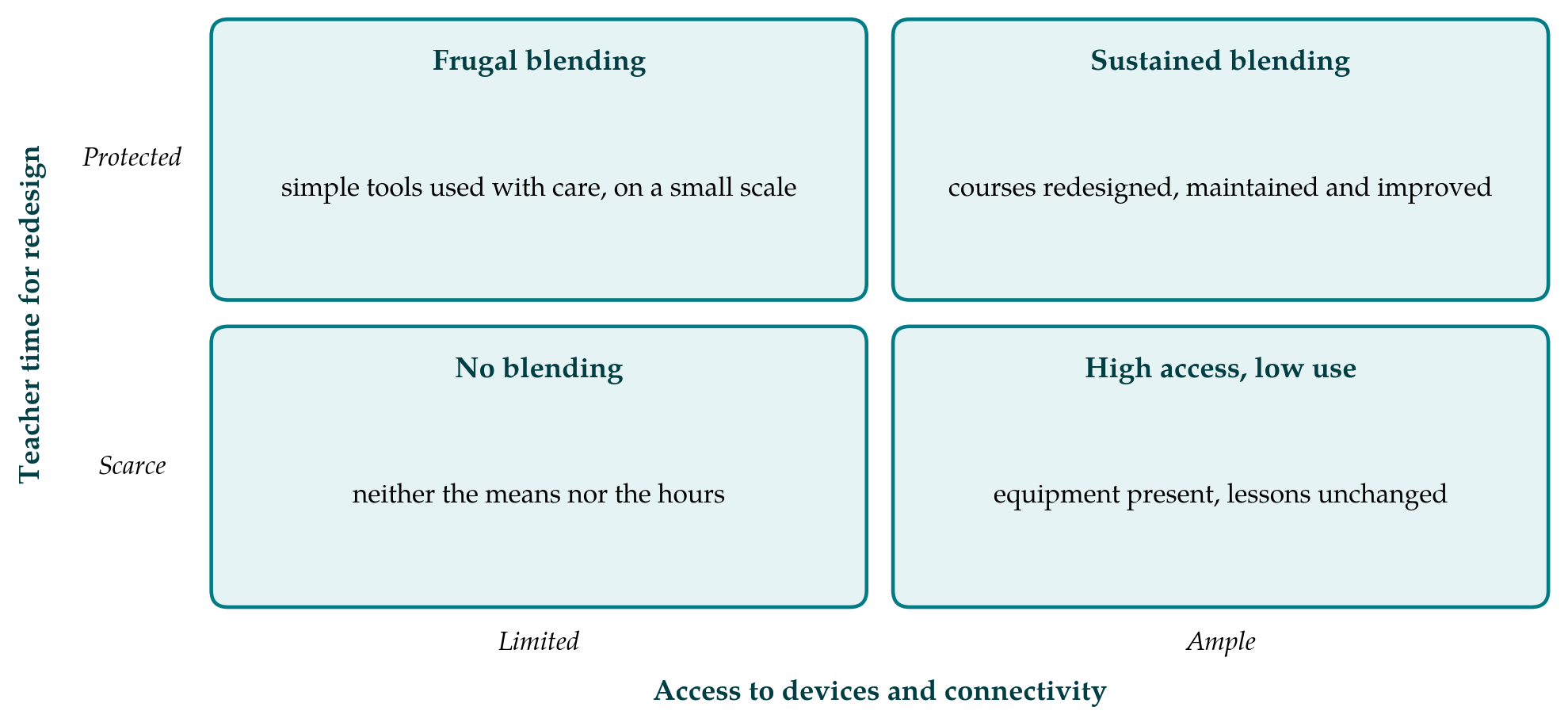
Seen in this way, the pattern of high access and low use needs no appeal to resistance or deficient belief. Teachers ration their effort towards what the system holds them accountable for: covering the syllabus, preparing students for examinations and keeping order. Tyack and Cuban (1995) observed that reforms survive when they can be absorbed into the established routines of schooling and fade when they require those routines to be rebuilt by people who have no slack. Figure 1 sets access against teacher time and shows the four situations that result. Only one of them, with ample access and protected time, yields sustained blended practice. The combination that policy has most often produced is the lower right: equipment in place and lessons unchanged.
5. Objections Considered
Three objections deserve an answer. They are taken in order of weight.
5.1. Access is still the constraint in many places
This is correct, and the argument here should not be read as denying it. Where students have no device and no connection at home, online components cannot reach them, and school closures exposed how many children are in that position. The global monitoring report on technology in education documents the inequality at length (UNESCO, 2023). The claim of this article is conditional: once a threshold of access is met, further investment in access yields little unless teacher time is addressed. It is also worth noting that low-resource systems tend to have the largest classes and the heaviest teaching loads, so that the workload constraint will be waiting for them when the access constraint is lifted.
5.2. Technology saves time once it is adopted
Automatic marking of quizzes, reusable recorded explanations and shared resource banks do save time on particular tasks. Whether they reduce the total is another matter. Time released by automation is readily absorbed by the new tasks listed in Table 1, and material that is reusable in principle needs revision whenever the syllabus, the class or the platform changes. The start-up cost falls on teachers now, while the saving is promised for later and is rarely measured. A teacher weighing that exchange against this week's marking is behaving rationally in postponing it.
5.3. Beliefs and skills matter more than hours
Beliefs and skills plainly matter, and the two accounts are compatible. What the workload account adds is a reason why beliefs and skills so often fail to develop. Learning to teach in a new way requires practice, reflection and exchange with colleagues, and all three take time. Short training courses give teachers knowledge of a tool without the hours needed to rebuild a unit of work around it. A teacher who reports low confidence with blended methods may be describing, accurately, the fact of never having had the opportunity to become competent.
6. Implications for Policy and Research
If workload is the binding constraint, several consequences follow for those who plan blended learning. Time should appear in the budget beside equipment, as reduced contact hours for teachers during the term in which a course is redesigned, or as paid development time outside it. Design work should be shared, through subject teams that build and maintain units jointly, so that each teacher adapts material instead of creating it alone. Something should be taken away when something is added: a school that introduces online homework with feedback might drop a paper-based requirement of equivalent weight. And expectations about availability need to be stated, so that messaging platforms do not lengthen the working day by default.
School leaders have more room to act on this than is often assumed. The timetable is the instrument through which a school states its priorities, and a head teacher who sets aside a shared weekly period for a subject team to build online units is making blended learning possible in a way that no purchase of equipment does. Leaders can also limit the number of platforms in use, since each additional system brings its own logins, notifications and reporting duties, and can decline initiatives that would compete for the same hours. Where teachers see that a new practice has been given time, and that something else has been removed to make room for it, they have reason to believe the practice is expected to last, and are more willing to invest in it.
For researchers the implication is methodological. Evaluations of blended learning report effects on students and seldom report what the intervention cost teachers in hours. Without that figure a positive result cannot be interpreted, since an approach that works when researchers supply the extra labour may not survive in ordinary conditions. Studies should record teacher time on preparation, monitoring and feedback in both the blended and the comparison condition, and should follow implementations beyond the first year, when novelty and external support have gone.
7. Conclusion
Devices and connectivity are necessary for blended learning and, in many classrooms, are no longer what is missing. What is missing is the time in which teachers could redesign their courses and sustain the additional work that online components bring. Treating the matter as one of access has led to well-equipped schools with unchanged lessons; treating it as one of belief has placed responsibility on teachers for a constraint they did not create. Blended learning is a change in the organisation of teachers' work. It will spread when it is resourced as such, and its results should be judged with the cost in teacher hours stated alongside the benefit to students.
Conflict of interest
To be declared by the author(s) before publication.
Funding
To be declared by the author(s) before publication.