1. Introduction
Psoriatic arthritis is an inflammatory disease of joints, entheses, the spine, skin and nails that affects a substantial minority of people with psoriasis (Ritchlin et al., 2017). It is classified for research with the CASPAR criteria (Taylor et al., 2006), and its treatment has been transformed by biologic agents that block tumour necrosis factor, interleukin-17 or interleukin-23. All of these are injected or infused. Janus kinase (JAK) inhibitors are taken by mouth, act quickly and do not provoke anti-drug antibodies, and those advantages made them attractive to patients and prescribers as soon as trial results appeared.
The enthusiasm was checked by safety findings that arose outside psoriatic arthritis. A large randomised trial required by the United States regulator compared tofacitinib with tumour necrosis factor inhibitors in rheumatoid arthritis and found more major adverse cardiovascular events and cancers with tofacitinib (Ytterberg et al., 2022). Warnings followed for every JAK inhibitor licensed for chronic inflammatory disease. Clinicians treating psoriatic arthritis were left to judge how far a result in one drug, one disease and one selected population should govern the use of other drugs in a different disease.
This review weighs the two bodies of evidence against each other. Its purpose is to state what is established about the benefit of JAK inhibition in psoriatic arthritis, what is established about cardiovascular harm, and where inference has taken the place of data.
2. Approach of the Review
The article is a narrative review of the published literature: the main randomised trials in psoriatic arthritis, the tofacitinib safety trial and its secondary analyses, selected observational studies, regulatory communications, and the recommendations of EULAR and GRAPPA. Sources were chosen for their influence on practice and no claim of exhaustive coverage is made. Venous thromboembolism, infection and malignancy are mentioned only where needed for context, because the subject here is arterial cardiovascular risk. The review does not offer dosing advice and should not be read as a substitute for product labelling.
3. Pharmacology of the Class
The four Janus kinases, JAK1, JAK2, JAK3 and TYK2, pair at the intracellular tails of type I and type II cytokine receptors and phosphorylate STAT transcription factors when a cytokine binds (O'Shea et al., 2015). Different receptor families use different pairs. The common gamma-chain cytokines signal through JAK1 and JAK3, interleukin-6 and the interferons depend on JAK1 with a partner, erythropoietin and thrombopoietin rely on JAK2, and interleukin-12 and interleukin-23 use TYK2 with JAK2. A small molecule that occupies the adenosine triphosphate binding site of one or more JAKs therefore dampens several cytokine pathways at once (Schwartz et al., 2017).
That breadth is relevant to psoriatic arthritis, whose pathogenesis centres on the interleukin-23 and interleukin-17 axis with contributions from tumour necrosis factor and interferons (Veale and Fearon, 2018). Interleukin-17 and tumour necrosis factor do not signal through JAKs directly, but the cytokines that sustain the cells producing them do. Selectivity among the agents is relative and falls as the dose rises. Tofacitinib inhibits JAK1 and JAK3 preferentially, baricitinib JAK1 and JAK2, and upadacitinib and filgotinib chiefly JAK1. Deucravacitinib differs in kind: it binds the regulatory pseudokinase domain of TYK2 and leaves the other three kinases largely untouched.
4. Efficacy in Psoriatic Arthritis
Table 1 lists the agents with their targets and the status of their evidence in psoriatic arthritis. Two have completed phase 3 programmes in the disease.
| Agent | Principal target | Trials in psoriatic arthritis | Regulatory position |
|---|---|---|---|
| Tofacitinib | JAK1 and JAK3 | OPAL Broaden and OPAL Beyond (phase 3) | Licensed |
| Upadacitinib | JAK1 | SELECT-PsA 1 and SELECT-PsA 2 (phase 3) | Licensed |
| Filgotinib | JAK1 | EQUATOR (phase 2) | Not licensed for this disease |
| Deucravacitinib | TYK2 (allosteric) | One phase 2 trial | Licensed for plaque psoriasis only |
| Baricitinib | JAK1 and JAK2 | No phase 3 trial in this disease | Not licensed for this disease |
4.1. Tofacitinib
OPAL Broaden enrolled patients with active disease despite a conventional synthetic drug who had not received a tumour necrosis factor inhibitor. Both tofacitinib doses were superior to placebo at three months for the American College of Rheumatology 20 per cent response and for change in the Health Assessment Questionnaire Disability Index, and adalimumab was included as an active reference arm (Mease et al., 2017). OPAL Beyond studied the harder population of patients in whom a tumour necrosis factor inhibitor had failed, and again met both primary end points (Gladman et al., 2017). Neither trial was powered to compare tofacitinib with adalimumab, and skin responses were less consistent than joint responses.
4.2. Upadacitinib
SELECT-PsA 1 was larger and included a formal comparison. In patients with an inadequate response to non-biologic drugs, both upadacitinib doses were superior to placebo for the 20 per cent response at week 12; the lower dose was non-inferior to adalimumab and the higher dose superior on that measure (McInnes et al., 2021). SELECT-PsA 2 confirmed efficacy over placebo in patients refractory to biologic agents (Mease et al., 2021). Adverse events, including infections and laboratory abnormalities, were more frequent with the higher dose, and the lower dose is the one that was taken forward for licensing.
4.3. Other agents
Filgotinib improved joint outcomes over placebo in the phase 2 EQUATOR trial (Mease et al., 2018), and the TYK2 inhibitor deucravacitinib did the same in a phase 2 study (Mease et al., 2022). These results are encouraging and preliminary. Across the class, the trials show benefit for peripheral arthritis, enthesitis, dactylitis, physical function and, to a varying degree, skin. Head-to-head evidence against interleukin-17 or interleukin-23 inhibitors is lacking, and the trials were too short and too small to say anything about uncommon harms.
5. The Cardiovascular Background of Psoriatic Arthritis
Any safety signal has to be read against the risk the disease already carries. A meta-analysis of observational studies found that cardiovascular morbidity is higher in psoriatic arthritis than in the general population (Polachek et al., 2017), and a large population-based cohort reported an increased risk of major adverse cardiovascular events in patients with psoriatic arthritis, psoriasis and rheumatoid arthritis alike (Ogdie et al., 2015). Part of the excess is explained by obesity, diabetes, hypertension, dyslipidaemia and smoking, all of which are common in psoriatic disease, and part is attributed to systemic inflammation. EULAR accordingly recommends regular cardiovascular risk assessment in psoriatic arthritis as in other inflammatory joint diseases (Agca et al., 2017).
Two consequences follow. A drug that controls inflammation might be expected to lower cardiovascular risk, so a neutral effect is not the natural benchmark. And patients with psoriatic arthritis often have exactly the characteristics that defined the high-risk population of the tofacitinib safety trial, even if they are younger on average than patients with rheumatoid arthritis.
6. The Safety Signal
JAK inhibitors raise low-density and high-density lipoprotein cholesterol within weeks of starting treatment, an effect noted throughout their development (Winthrop, 2017). Mechanistic work in rheumatoid arthritis suggested that this partly reflects reversal of the accelerated cholesterol ester catabolism that accompanies active inflammation (Charles-Schoeman et al., 2015), and interleukin-6 receptor blockade produces a similar lipid pattern. The lipid change was the reason regulators asked for a dedicated outcome trial of tofacitinib.
6.1. ORAL Surveillance
ORAL Surveillance enrolled patients with active rheumatoid arthritis despite methotrexate who were 50 years of age or older and had at least one additional cardiovascular risk factor. They were assigned to one of two doses of tofacitinib or to a tumour necrosis factor inhibitor, and the co-primary end points were major adverse cardiovascular events and cancers excluding non-melanoma skin cancer. Over a median follow-up of about four years, both events were more frequent with the combined tofacitinib doses, and the prespecified non-inferiority criterion was not met for either (Ytterberg et al., 2022). Venous thromboembolism and death were also more frequent at the higher dose.
Secondary analyses asked where the excess lay. A post hoc analysis found that the higher rate of cardiovascular events with tofacitinib was concentrated in patients with a history of atherosclerotic cardiovascular disease, with little apparent difference in those without such a history (Charles-Schoeman et al., 2023). Another identified patients aged 65 or older and those who had ever smoked as a subpopulation carrying most of the excess risk, with no detectable difference in the remainder (Kristensen et al., 2023). These are subgroup findings from a trial that was not designed to test them, and they should be regarded as hypotheses that fit the data well.
6.2. Observational and pooled data
Routine-care data give a partly different picture. The STAR-RA study, based on United States insurance claims, found no evidence of increased cardiovascular risk with tofacitinib compared with tumour necrosis factor inhibitors among patients with rheumatoid arthritis overall, while the estimate in a subgroup resembling the trial population pointed towards higher risk without reaching statistical significance (Khosrow-Khavar et al., 2022). An integrated analysis of upadacitinib trials across rheumatoid arthritis, psoriatic arthritis, ankylosing spondylitis and atopic dermatitis reported rates of major adverse cardiovascular events that were broadly similar to those of the active comparators (Burmester et al., 2023). Pooled trial populations are selected and followed for limited periods, so reassurance from them is partial.
7. Regulatory and Guideline Responses
The United States Food and Drug Administration required boxed warnings about serious heart-related events, cancer, blood clots and death for tofacitinib, baricitinib and upadacitinib, and limited their approved use to patients who have had an inadequate response to or cannot tolerate a tumour necrosis factor blocker (FDA, 2021). The European Medicines Agency reviewed the class and concluded that JAK inhibitors should be used in people aged 65 or above, in those at increased risk of major cardiovascular problems, in current or long-term past smokers and in those at increased risk of cancer only when no suitable alternative exists (EMA, 2022). Both agencies applied the findings to all licensed JAK inhibitors for inflammatory disorders, reasoning that a class effect could not be excluded.
Professional recommendations followed the same line. The 2023 update of the EULAR recommendations places JAK inhibitors after failure of a biologic agent, or where a biologic is not appropriate, and asks that relevant risk factors be taken into account (Gossec et al., 2024). GRAPPA lists JAK inhibitors among the options for most disease domains and leaves the choice to the clinician and patient (Coates et al., 2022).
8. Weighing Benefit Against Risk
The practical question is how to apply a signal from older patients with rheumatoid arthritis to an individual with psoriatic arthritis. Figure 1 offers one way to arrange the considerations, with baseline cardiovascular risk on one axis and the benefit expected from a JAK inhibitor over the alternatives on the other. It is a reading of the regulatory and guideline positions described above and has no independent empirical basis.
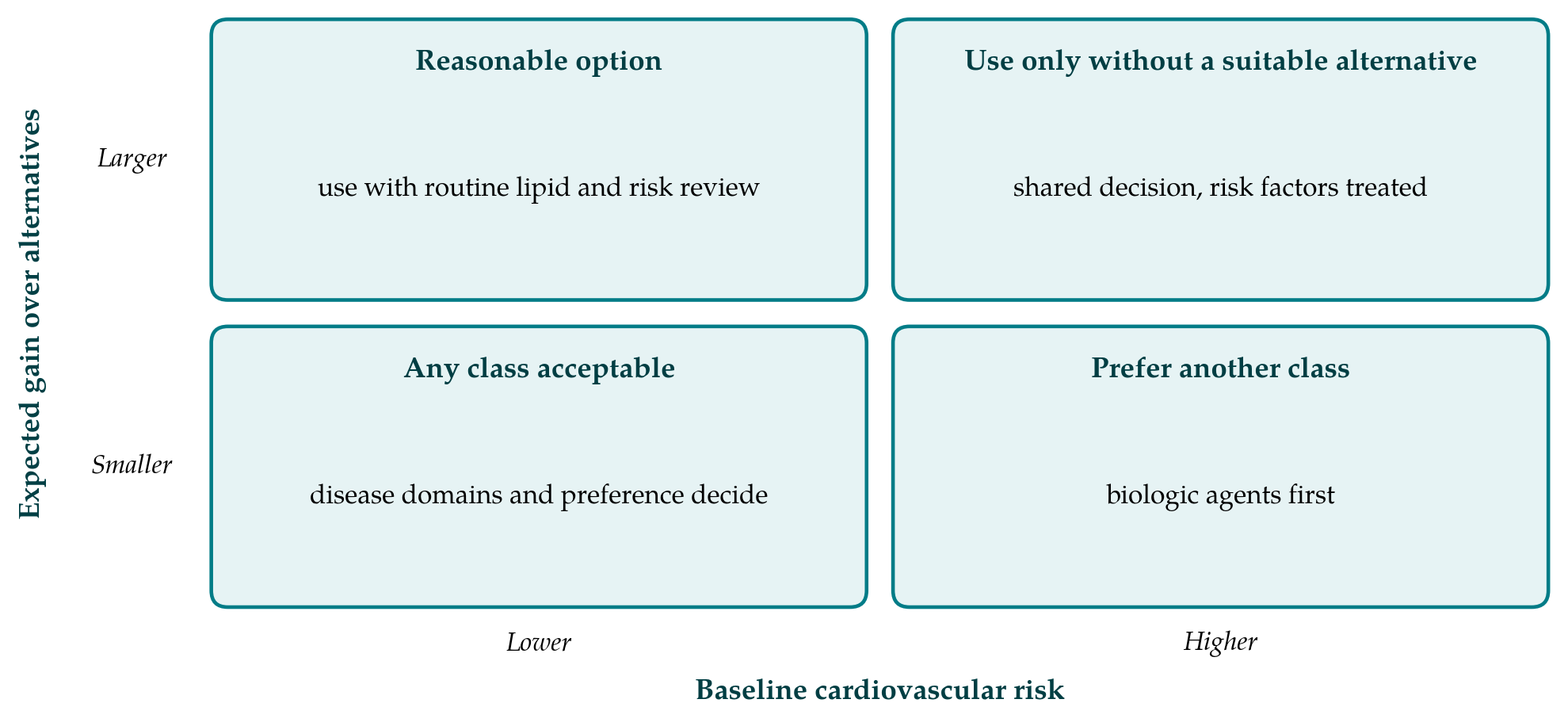
Several arguments favour extending caution to psoriatic arthritis. The lipid effect of JAK inhibition is seen in every indication. Cardiometabolic comorbidity is at least as common in psoriatic disease as in rheumatoid arthritis. And effective alternatives exist in three biologic classes, so that few patients depend on a JAK inhibitor.
Other arguments point the opposite way. The trial population was selected for risk, and the subgroup analyses suggest that patients without atherosclerotic disease, under 65 and without a smoking history contributed little to the excess. The comparator matters as well: tumour necrosis factor inhibitors may themselves reduce cardiovascular events, in which case the trial shows that tofacitinib is less protective and not that it is harmful in absolute terms. Finally, tofacitinib is the least selective of the licensed agents, and it is uncertain whether a JAK1-selective or TYK2-selective drug shares the effect. No cardiovascular outcome trial of a JAK inhibitor has been reported in psoriatic arthritis.
9. Gaps and Future Work
Three kinds of evidence would reduce the uncertainty. Disease-specific registries with adequate follow-up could compare cardiovascular event rates between JAK inhibitors and biologic classes in psoriatic arthritis, provided confounding by indication is handled carefully, since patients given an oral drug after several biologics differ from those starting a first biologic. Mechanistic studies could clarify whether the lipid changes are atherogenic or merely reflect reduced inflammation, and whether platelet or endothelial effects contribute. Long-term extension data for upadacitinib and deucravacitinib will show whether selectivity alters the profile. Until such data exist, statements about class effects in either direction go beyond the evidence.
10. Conclusion
JAK inhibitors work in psoriatic arthritis. Two agents have phase 3 evidence across the main musculoskeletal domains, and one has matched or exceeded adalimumab on a standard response measure. The cardiovascular concern rests chiefly on a single well-conducted trial of tofacitinib in older, higher-risk patients with rheumatoid arthritis, supported by biological plausibility and qualified by subgroup and observational analyses. Applying it to psoriatic arthritis is a reasonable precaution for patients who resemble the trial population and a less certain inference for those who do not. A careful cardiovascular assessment before prescribing, attention to modifiable risk factors, and an open discussion of what is and is not known serve patients better than either blanket avoidance or unqualified reassurance.
Conflict of interest
To be declared by the author(s) before publication.
Funding
To be declared by the author(s) before publication.