1. Introduction
Live oral vaccines perform worse in poor communities than in rich ones. The pattern was first documented for oral poliovirus vaccine and later for oral cholera and rotavirus vaccines, and it survives adjustment for cold chain failure, interference from maternal antibody and the number of doses given (Levine, 2010). Parenteral vaccines show a smaller but detectable version of the same gradient. Because the gap tracks the environment rather than the product, attention has turned to features of the infant host that differ between settings, and the intestinal microbial community is among the most obvious of them.
Two observations make the microbiota a reasonable candidate. The first is developmental timing. The bacterial community of the infant gut assembles in a broadly ordered way over the first two to three years of life, shifting from a milk-adapted community dominated by bifidobacteria towards an adult-like community as solid food is introduced (Backhed et al., 2015; Stewart et al., 2018). The primary immunisation schedule falls inside that window. The second is geography. Community composition differs systematically between infants in high-income cities and infants in rural communities of South Asia, sub-Saharan Africa and South America, and the differences are not small (Yatsunenko et al., 2012).
This article reviews what the published literature actually shows about the relationship between gut microbiota composition and vaccine antibody responses in infancy. It is a narrative review of the field rather than a systematic one, and it is organised around the kinds of evidence available: observational cohorts, intervention trials, and the mechanistic studies that make the association plausible. The aim is to separate what has been established from what has been inferred, and to say which questions remain open.
2. How the Literature Has Approached the Question
Three designs dominate. Observational cohorts profile stool from infants shortly before or around the time of vaccination, usually by 16S rRNA gene sequencing, and relate community features to a later antibody titre or to seroconversion. Intervention trials perturb the microbiota deliberately, with antibiotics, probiotics or micronutrients, and compare vaccine responses between arms. Mechanistic studies, mostly in mice and a few in adult volunteers, ask how microbial signals reach the responding B and T cells at all. Each design answers a different part of the question, and the inferential weight that can be placed on each differs accordingly. Table 1 sets out the main strands with representative sources and the principal limitation of each.
| Strand of evidence | Representative work | What it can show | Principal limitation |
|---|---|---|---|
| Observational cohorts, parenteral vaccines | Huda et al., 2014 | Association of community composition with titre | Confounding by nutrition and enteric infection |
| Observational cohorts, oral vaccines | Harris et al., 2017; Harris et al., 2018 | Taxa associated with seroconversion | Findings differ between sites |
| Enteropathogen and enterovirus studies | Praharaj et al., 2019 | Competing explanations for poor response | Hard to separate from community composition |
| Antibiotic intervention trials | Grassly et al., 2016 | Whether perturbation changes response | Effects on the community are broad and brief |
| Probiotic and supplement trials | Lazarus et al., 2018 | Whether a defined organism helps | Engraftment in an established community is poor |
| Mechanistic work in animals | Lynn et al., 2018 | Causal pathways from microbe to antibody | Mouse immune development differs from human |
| Mechanistic work in adults | Hagan et al., 2019 | Causal effect of depletion in humans | Adults are not infants; parenteral vaccine only |
The review draws on this literature as it stands and does not attempt a quantitative synthesis. The outcome measures are too varied for that: serum IgG or IgA titre, shedding of vaccine virus, seroconversion defined by different cut-offs, and in some reports a memory response after boosting. Where studies agree, the agreement is noted. Where they do not, the disagreement itself is the finding worth reporting.
3. Observational Evidence From Infant Cohorts
The most cited observational work examined Bangladeshi infants whose stool was profiled at six weeks of age and whose responses to the vaccines of the national schedule were measured later in infancy (Huda et al., 2014). A higher relative abundance of Bifidobacterium longum subspecies infantis was associated with stronger antibody and T cell responses to several parenteral antigens, including tetanus toxoid and the oral poliovirus vaccine, while a larger share of Enterobacteriaceae and other potential pathogens went with weaker responses. A follow-up from the same cohort reported that the association persisted into the second year of life, which argues against a purely transient effect.
Rotavirus vaccine has been studied in several settings with less convergent results. In rural Ghana the stool community of infants who seroconverted after a monovalent rotavirus vaccine differed from that of non-responders, with a greater representation of Streptococcus bovis and a lower representation of Bacteroidetes in responders (Harris et al., 2017). A comparable study in Pakistan again found a difference between responders and non-responders, but the taxa involved were not the same (Harris et al., 2018). Whether the discrepancy reflects genuinely different microbial ecologies, different vaccine products and schedules, or the modest sample sizes typical of this literature is not resolved.
Work on oral poliovirus vaccine in South India widened the frame by measuring non-polio enteroviruses alongside the bacterial community (Praharaj et al., 2019). Concurrent enterovirus infection was associated with reduced seroconversion, whereas bacterial community composition contributed little once that was accounted for. The result is a useful corrective. Stool composition in a rural setting carries information about recent and current enteric infection, and an association between a bacterial taxon and a poor vaccine response may be reporting infection rather than any property of the commensal community.
A further confounder is environmental enteric dysfunction, the subclinical small-intestinal inflammation common in children in settings with poor sanitation. It is associated both with an altered microbiota and with impaired oral vaccine take, and it has been proposed as the mediator that links the two (Parker et al., 2018). Growth faltering adds another layer, since persistent immaturity of the gut microbiota is a feature of childhood undernutrition (Subramanian et al., 2014) and undernutrition itself affects the immune response to vaccination. Observational designs are poorly placed to disentangle these, and the main reviews of the area are explicit about it (Zimmermann and Curtis, 2018).
4. Intervention Trials
If the microbiota is causally involved, changing it should change the vaccine response. That prediction has been tested and has largely not been borne out. A double-blind trial in Indian infants examined whether azithromycin given before oral poliovirus vaccine improved seroconversion, on the reasoning that reducing bacterial overgrowth and inflammation in the small bowel would improve vaccine take (Grassly et al., 2016). The antibiotic reduced markers of intestinal inflammation but did not improve the immune response to the vaccine. A factorial trial of probiotic and zinc supplementation alongside oral rotavirus vaccine in the same region likewise did not show the improvement in immunogenicity that the observational work had suggested (Lazarus et al., 2018).
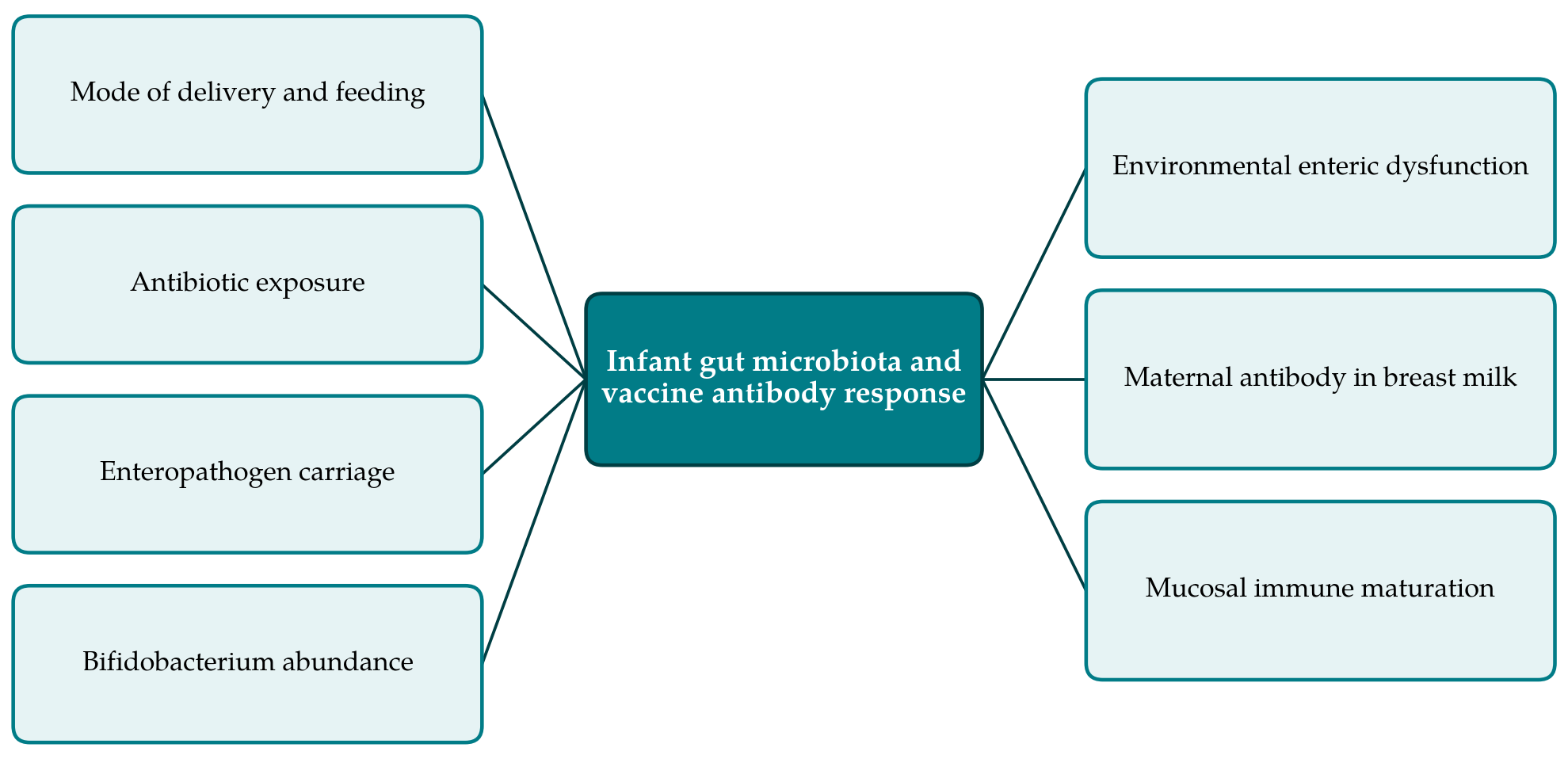
Negative trials of this kind are informative but not decisive. A short course of a single antibiotic alters a community without reconstructing it, and the organisms associated with better responses in cohort studies are not the ones a broad-spectrum agent removes. Probiotic strains given orally to an infant with an established community rarely engraft and are usually cleared within days of the last dose. A trial that fails to change the exposure cannot test the hypothesis about the exposure. Figure 1 summarises the factors that cohort studies and trials have had to contend with, several of which move together in the populations where oral vaccine failure is most common.
5. Mechanistic Plausibility
The mechanistic literature is the strongest part of the case, though almost none of it is in infants. Germ-free and antibiotic-treated mice mount reduced antibody responses to several vaccines, and the reduction can be partly reversed by recolonisation. Early-life antibiotic exposure in mice reduces antibody responses to multiple vaccine antigens, and transfer of the perturbed community reproduces the effect, which points to the community rather than the drug as the proximate cause (Lynn et al., 2018). In a related line of work, flagellin from the commensal community was shown to act through Toll-like receptor 5 to support plasma cell differentiation after influenza vaccination, giving a specific molecular route from a microbial product to an antibody titre (Oh et al., 2014).
Rotavirus is an instructive exception. Antibiotic treatment of mice reduced rotavirus infection and increased rotavirus-specific antibody, the opposite of the usual direction, apparently because the commensal community supports viral attachment and replication in the gut (Uchiyama et al., 2014). For a live oral vaccine, replication in the intestinal epithelium is part of the mechanism of protection, so microbial effects on infection and microbial effects on immunity may push in opposite directions. This may be one reason the oral vaccine literature is less coherent than the parenteral one.
The one controlled human experiment of real relevance was conducted in adults. Volunteers given a broad-spectrum antibiotic course before seasonal influenza vaccination showed reduced antibody responses, most clearly in those with low pre-existing immunity, together with changes in bile acid metabolism and inflammatory signalling (Hagan et al., 2019). The design establishes that depleting the microbiota can impair a human vaccine response, which no observational study can do. It does not establish that the differences in community composition observed between infants in different settings are large enough, or of the right kind, to matter for the vaccines those infants receive.
6. What Is Established and What Is Not
Three statements are supported by the current literature. Gut microbiota composition in infancy differs systematically between settings and over the months in which vaccines are given. Several cohorts report associations between composition and later antibody responses, with a bifidobacterium-rich community the most frequently reported correlate of a stronger response. Experimental depletion of the microbiota can reduce vaccine responses in mice and in adult humans. Taken with the general reviews of factors affecting vaccine immunogenicity (Zimmermann and Curtis, 2019; Valdez et al., 2014), this is enough to treat the microbiota as a genuine candidate variable.
Three further statements are not supported. It is not established that the microbiota explains a substantial share of the gap in oral vaccine efficacy between settings, because enteropathogen carriage, enteric dysfunction and undernutrition remain plausible alternatives and travel together. It is not established which microbial features matter, since the taxa implicated differ between sites and the functional interpretation of a 16S profile is limited. And it is not established that modifying the microbiota improves vaccine responses in infants, because the trials conducted so far have not shown it (Jordan et al., 2022).
7. What Would Advance the Field
Several design choices would help. Shotgun metagenomic rather than amplicon sequencing would allow strain-level and functional resolution, which matters when the candidate organism is a subspecies defined by its ability to use human milk oligosaccharides rather than a genus. Repeated sampling across the schedule would separate the community present at priming from the community present at boosting. Pre-registered analysis plans would reduce the risk that a taxon reaching significance in one small cohort is reported as the finding. Harmonised immunological endpoints, with mucosal IgA measured alongside serum titre, would make cohorts comparable; at present they are often not.
The intervention side needs exposures strong enough to test the hypothesis. Candidates include defined consortia rather than single strains, prolonged rather than brief administration, and interventions aimed at the maternal and neonatal window when the community is still assembling and most open to change. Trials of this kind are demanding, and they should be undertaken only where the observational signal is strong and consistent. For now, the honest summary is that the infant gut microbiota is associated with vaccine antibody responses, that the association is biologically plausible, and that its causal contribution in the settings that matter most remains to be demonstrated.
8. Conclusion
The evidence connecting infant gut microbiota composition to vaccine antibody responses is suggestive rather than settled. Cohort studies report reproducible associations for parenteral vaccines and less consistent ones for oral vaccines, mechanistic work in animals and in adults shows that the community can influence antibody production, and the intervention trials conducted so far have not translated the association into benefit. The practical implication is caution: the microbiota belongs in the list of factors that may contribute to oral vaccine underperformance, alongside enteric infection and undernutrition, and it has not earned a place ahead of them.
Conflict of interest
To be declared by the author(s) before publication.
Funding
To be declared by the author(s) before publication.