1. Introduction
The outlook for large B-cell lymphoma that fails to respond to chemoimmunotherapy was, until recently, very poor. The pooled SCHOLAR-1 analysis found that only a minority of such patients responded to the next line of conventional treatment and that median survival was about six months (Crump et al., 2017). Autologous T cells engineered to express a chimeric antigen receptor (CAR) against CD19 changed that picture. Three products, axicabtagene ciloleucel, tisagenlecleucel and lisocabtagene maraleucel, each produced complete remissions in a substantial fraction of patients with refractory disease in single-arm registration trials (Neelapu et al., 2017; Schuster et al., 2019; Abramson et al., 2020).
The field began with a single case. Kochenderfer et al. (2010) reported regression of advanced follicular lymphoma and prolonged loss of normal B cells in one recipient of anti-CD19 CAR T cells, and the report helped to justify the trials that followed. Case reports retain that function. They are the natural vehicle for a first observation in a rare lymphoma subtype, an unexpected late toxicity, a response after an earlier cellular therapy has failed, or experience with a locally manufactured product. Their weaknesses are equally well known (Vandenbroucke, 2001; Nissen and Wynn, 2014).
This article offers a method for writing one such report well. It concerns the case in which a patient with refractory lymphoma enters a remission that lasts after a salvage cellular therapy, and it sets out what must be documented for readers to accept each element of that description. No case is presented. The procedure is proposed, and it has not been validated against published reports or applied by the author to a particular patient.
2. Background
Salvage cellular therapy in lymphoma covers autologous CAR T cells, which are now the most frequent form, and allogeneic hematopoietic cell transplantation, which remains an option after CAR T-cell failure or where no product is available. Both rest on immune cells as the active agent, and both are followed by a period in which the timing of events is essential to interpretation (June and Sadelain, 2018). A report must therefore be built around dates and intervals.
The general standard for case reports is the CARE guideline, a consensus checklist of thirteen items running from title to informed consent (Gagnier et al., 2014), accompanied by an explanation and elaboration paper with worked examples (Riley et al., 2017). CARE is generic. It says that diagnostic assessment, intervention and outcome should be described, and leaves the specialty to say how. For lymphoma treated with cellular therapy, the content can be supplied from four published standards: the World Health Organization classification for diagnosis (Swerdlow et al., 2016), the Lugano classification for staging and response (Cheson et al., 2014), its companion imaging consensus (Barrington et al., 2014), and the consensus grading of cytokine release syndrome and neurotoxicity (Lee et al., 2019). Table 1 maps these onto the CARE items.
| CARE item | Content specific to this kind of case | Standard or source |
|---|---|---|
| Patient information | Histological subtype, stage, every prior line with dates and best response | Swerdlow et al., 2016 |
| Timeline | Dated sequence from diagnosis to last follow-up, shown as a figure or table | Riley et al., 2017 |
| Diagnostic assessment | Biopsy confirming active disease and target antigen before therapy | Cheson et al., 2014 |
| Therapeutic intervention | Bridging therapy, conditioning regimen, product, cell dose, date of infusion | Neelapu et al., 2017 |
| Follow-up and outcomes | Response by PET-CT at stated time points; toxicity by consensus grade | Barrington et al., 2014; Lee et al., 2019 |
| Discussion | Alternative explanations for the remission and limits of inference | Murad et al., 2018 |
3. The Proposed Procedure
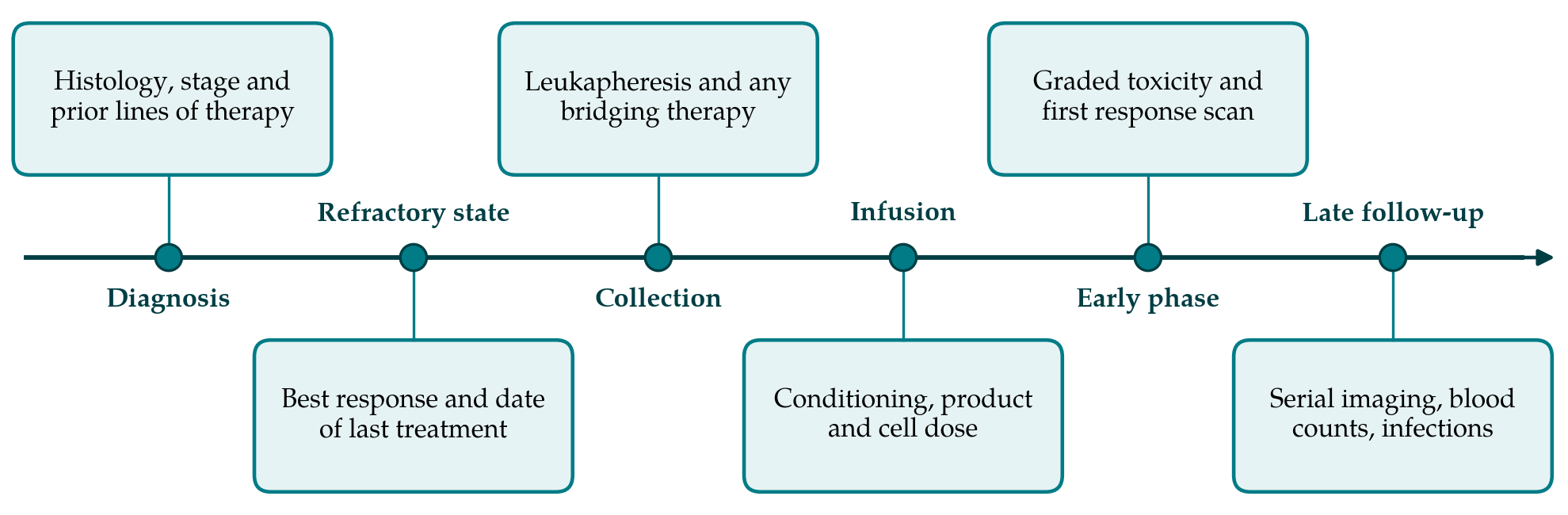
The procedure follows the clinical course in order. Figure 1 shows the phases that the report's timeline should cover, and the six steps below describe what to record in each.
3.1. Step 1: Establish that the disease was refractory
The word refractory carries the weight of the report and is often used loosely. The author should state the definition adopted, for example progressive or stable disease as best response to the most recent regimen, or relapse within a year of autologous transplantation, which were the criteria applied in SCHOLAR-1 (Crump et al., 2017). Each prior line is then listed with its regimen, number of cycles, dates and best response, and the method by which response was assessed. A biopsy taken after the last treatment, confirming viable lymphoma and expression of the target antigen, greatly strengthens the account. Without it, a residual mass that is avid on positron emission tomography could represent inflammation or necrosis.
3.2. Step 2: Describe the product and its administration
A reader must be able to tell exactly what was given. For a CAR T-cell product this means its name or, for an academic product, the construct, including the target and costimulatory domain; the date of leukapheresis; the interval to infusion; the lymphodepleting regimen, most often fludarabine with cyclophosphamide; and the cell dose. Any bridging therapy between collection and infusion, whether corticosteroids, chemotherapy or radiotherapy, is reported with dates, and disease status is reassessed after bridging and before infusion. This last point is frequently omitted and is essential, as step 6 explains. For allogeneic transplantation the equivalent items are donor type, graft source, conditioning intensity and prophylaxis against graft-versus-host disease.
3.3. Step 3: Grade toxicity with consensus scales
Descriptions such as mild or severe cytokine release syndrome cannot be compared between reports. The consensus scale of the American Society for Transplantation and Cellular Therapy grades the syndrome by fever, hypotension and hypoxia, and grades neurotoxicity with a short bedside encephalopathy score together with level of consciousness, seizures, motor findings and signs of raised intracranial pressure (Lee et al., 2019). The report should give the day of onset, maximum grade and duration of each, and the treatment used, such as tocilizumab or corticosteroids. Later events belong in the account as well: prolonged cytopenias, low immunoglobulin levels from loss of normal B cells, and infections, which are common in the months after infusion (Hill et al., 2018). An honest record of harm is part of what makes a favorable outcome credible.
3.4. Step 4: Document response with the Lugano criteria
Response in lymphomas that take up fluorodeoxyglucose is assessed by PET-CT and scored on the five-point Deauville scale, which compares uptake in residual lesions with that of the mediastinal blood pool and the liver. Under the Lugano classification a score of 1 to 3 denotes complete metabolic response (Cheson et al., 2014). The report should give the date and score of every scan and name who read it, and should reproduce representative images from before infusion and from the latest follow-up. Uptake soon after cellular therapy may reflect immune activity and not tumor, so an early equivocal scan is better described as such and repeated than labeled as progression or response (Barrington et al., 2014).
3.5. Step 5: Justify the word durable
No agreed threshold defines a durable remission, and the report should not imply one. What can be said is how long the remission has lasted, counted from a stated starting point to the date of last assessment, and how that compares with the pattern seen in trials. In the long-term follow-up of the ZUMA-1 trial, relapses were concentrated in the first months, and responses that were still present at later time points tended to persist (Locke et al., 2019). A remission of a few months is thus too early to be called durable. The author should give the duration in the title or abstract, state whether any consolidation or maintenance treatment was given during it, and report supporting measures where they exist, such as persistence of CAR T cells in blood or continuing absence of normal B cells.
3.6. Step 6: Weigh alternative explanations
A single case cannot prove that a treatment caused an outcome, but it can show that the obvious alternatives were considered. Four deserve explicit comment. Bridging therapy or radiotherapy may itself have induced the response, which is why disease status immediately before infusion matters. Lymphodepleting chemotherapy has some activity of its own. The diagnosis of refractory disease may have been mistaken if no biopsy was obtained. And follow-up may simply be too short. A tool proposed by Murad et al. (2018) for appraising case reports frames these concerns under selection, ascertainment, causality and reporting, and authors can use its questions as a self-check before submission.
4. Consent, Confidentiality and Presentation
Publication of a case requires the written consent of the person described, or of the next of kin where that is not possible, and journals following the recommendations of the International Committee of Medical Journal Editors will ask for confirmation of it (ICMJE, 2023). Rare lymphomas treated at a small number of centers make individuals easy to recognize. Exact dates can be replaced by intervals from infusion, and details that do not bear on the clinical argument, such as occupation or place of residence, should be left out. CARE also invites a short account in the patient's own words (Gagnier et al., 2014), which is seldom included and is especially apt after a treatment as demanding as this one.
Presentation follows from the procedure. A timeline figure, a table of prior therapies and a panel of paired images carry most of the evidence, and the text can then be brief. The discussion should place the case against the registration trials without suggesting that it adds to their estimates of efficacy.
5. Limitations and What Remains to Be Shown
The procedure set out here is a proposal assembled from reporting guidelines and disease-specific standards. It has not been applied to a set of published case reports to test whether it discriminates well-documented from poorly documented ones, nor has agreement between different users been examined. Both would be straightforward to study. The standards on which it depends are themselves revised from time to time, and authors should check for current versions of the classification and grading systems.
Two broader cautions apply. Cases with good outcomes are more likely to be written up and accepted than those with poor outcomes, so the published record of single cases overstates what a treatment achieves. And a remission in one patient, however well documented, gives no estimate of the probability of remission in the next. Readers who need that estimate should turn to the trials and to registry data. The value of the case report lies elsewhere, in showing that something can happen and in describing precisely how it did.
6. Conclusion
A report of lasting remission after cellular therapy for refractory lymphoma makes four claims: that the disease was refractory, that a defined product was given, that a complete response followed, and that it has lasted. The six steps proposed in this guide attach to each claim the evidence a reader needs, using the CARE checklist as the frame and the Lugano and consensus toxicity scales as the measures. Followed with care, they should yield reports that are shorter, more comparable and more useful to clinicians who face a similar patient. Whether they do so in practice has still to be shown.
Conflict of interest
To be declared by the author(s) before publication.
Funding
To be declared by the author(s) before publication.