1. Introduction
Paraquat dichloride is a non-selective contact herbicide whose toxicology has been understood in outline since the 1970s. It undergoes redox cycling, generating superoxide at the expense of cellular reducing equivalents, and it is taken up by alveolar type I and type II cells through the polyamine transport system, which concentrates it in exactly the tissue least able to tolerate oxidative injury. The consequence is a characteristic course: oropharyngeal and gastrointestinal corrosion early, renal and hepatic injury over the following days, and in those who survive that phase a progressive pulmonary fibrosis that is usually fatal (Dinis-Oliveira et al., 2008; Bismuth et al., 1990).
Two features make paraquat a particular problem for poison centres. The ingested volume needed to cause death is small, so an accident rather than an act of self-harm can be lethal. And the window in which anything useful can be done is short, measured in hours, while the people affected are often far from a hospital able to measure a plasma concentration. Self-poisoning with pesticides accounts for a large share of deaths in rural areas of low and middle income countries (Gunnell et al., 2007), and comparative work on case fatality has placed paraquat among the most lethal of the agents in common use (Dawson et al., 2010).
Poison centres in affected regions handle such calls, but often without a protocol written for this specific agent. General guidance on poison centre functions exists (WHO, 1997), and the clinical literature on management is substantial (Gawarammana and Buckley, 2011), yet the step of turning that literature into a telephone procedure usable at two in the morning by a duty officer is rarely documented. This article proposes such a procedure. It is a proposal assembled from published sources and has not been implemented or evaluated.
2. Background: What the Evidence Supports
Three bodies of evidence shape the protocol. The first concerns prognosis. Plasma paraquat concentration interpreted against time since ingestion has been used to predict survival since the nomogram published by Proudfoot et al. (1979), refined statistically by Hart et al. (1984) and examined prospectively by Senarathna et al. (2009). Urine concentrations carry prognostic information as well (Scherrmann et al., 1987). The practical value of these tools is that they separate those for whom intensive treatment may help from those for whom palliation is the honest course.
The second concerns treatment. Decontamination has a narrow window and the agents used for it have never been shown in controlled studies to change outcome. Immunosuppressive regimens combining a glucocorticoid with cyclophosphamide have been investigated for decades; the systematic review by Eddleston et al. (2003) found the evidence insufficient, and the later Cochrane review reached a similar conclusion about the quality of the available trials (Li et al., 2021). Supplemental oxygen is the one intervention on which the mechanistic argument is clear in the opposite direction: because the injury is oxidative, oxygen given in the absence of significant hypoxaemia is expected to worsen it, and standard toxicological references advise against routine administration (Hoffman et al., 2019).
The third concerns the circumstances of exposure. Accidental ingestion in agricultural households is associated with storage of concentrate in the home and with decanting into drink bottles and cups. Measures that restrict availability and improve storage have been the main recommendation of the prevention literature for twenty years (Konradsen et al., 2003; Wesseling et al., 2001), and they are reflected in the international code on pesticide management (FAO and WHO, 2014) and in the classification of paraquat under the hazard scheme maintained by the World Health Organization (WHO, 2020).
3. The Proposed Protocol
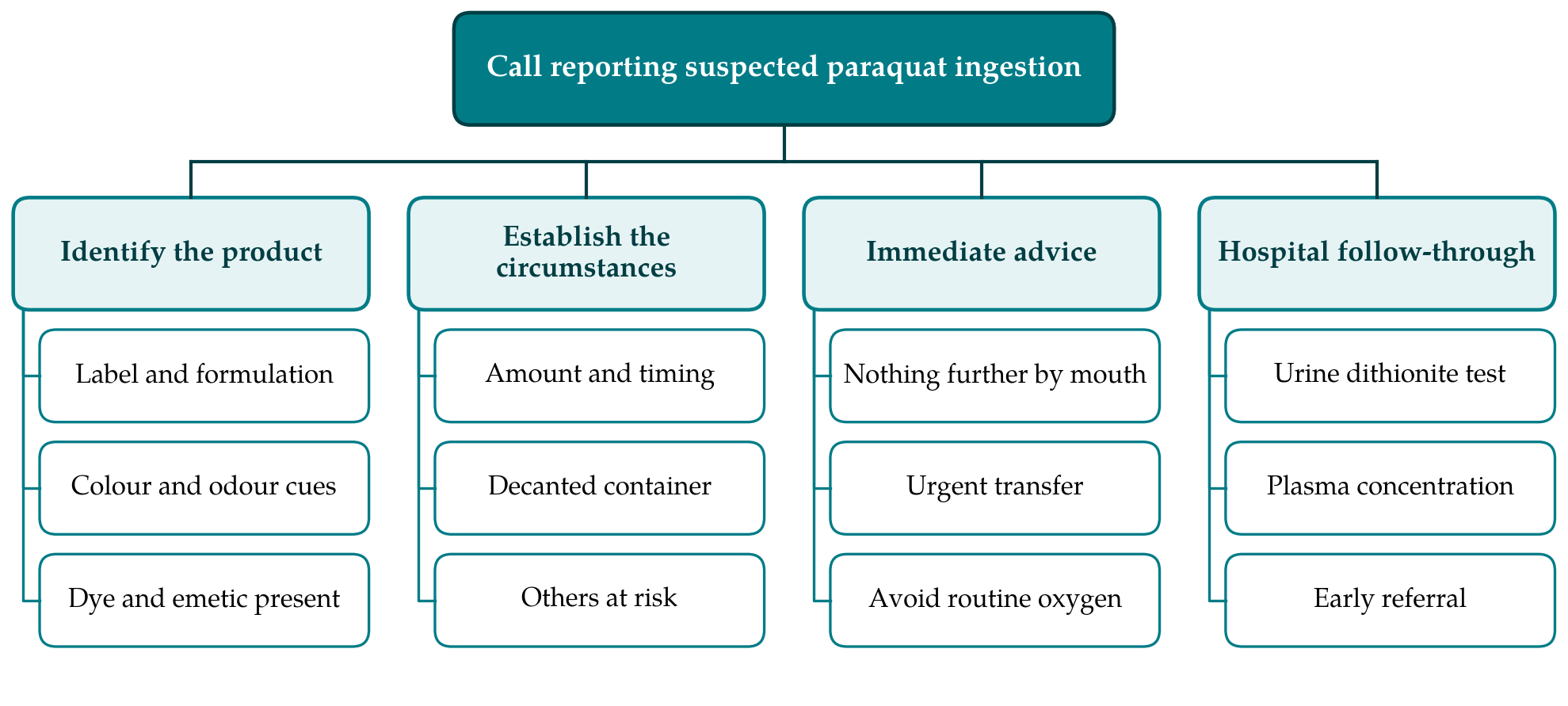
The protocol divides a call into five tasks. Figure 1 shows how the opening enquiry branches, and Table 1 sets out each task with its purpose and the entry it should leave in the record. The tasks are described in turn below. They assume a centre staffed by trained information officers with pharmacist or clinical supervision available, which is the usual arrangement.
| Task | Purpose | Record |
|---|---|---|
| Identify the product | Distinguish paraquat from other herbicides on the label | Product name, registration number, concentration |
| Establish circumstances | Estimate amount and elapsed time; find others at risk | Volume, container, time, people exposed |
| Advise immediately | Prevent further absorption and avoid harmful measures | Advice given and time given |
| Direct investigations | Secure the urine test and plasma sample on arrival | Hospital contacted, tests requested |
| Support the clinicians | Supply prognostic interpretation and management literature | Sources provided (Senarathna et al., 2009) |
| Close the loop | Record outcome, notify surveillance, advise on storage | Outcome, notification, prevention advice |
3.1. Task 1: identify the product
The single most useful question is whether the container or its label can be read aloud. Paraquat products are registered and labelled, and the label carries the active ingredient name and its concentration. Where the liquid has been decanted, which is the common situation in an accidental household ingestion, the label is gone and the duty officer must work from what remains: the colour of the liquid, since formulations are dyed, the smell, since a stenching agent is added, and whether the person vomited quickly, since an emetic is included in many products. These three additives were introduced precisely to make accidental ingestion less likely and more recognisable, and they are useful identifying features even though none of them is conclusive.
3.2. Task 2: establish the circumstances
What matters is the amount, the time elapsed and whether anyone else drank from the same container. Estimates of volume from a distressed caller are imprecise, and the protocol should record the estimate with its basis, for example a mouthful taken and spat out as against a swallow from a cup, rather than converting it prematurely into millilitres. Elapsed time is needed because every prognostic tool depends on it. The question about others is asked because a decanted bottle in a shared kitchen may have been drunk from more than once.
3.3. Task 3: give immediate advice
The advice at this point is narrow and should be scripted. Give nothing further by mouth, do not induce vomiting, arrange immediate transfer to the nearest hospital able to take blood and contact that hospital directly rather than leaving it to the family, and bring the container or whatever remains of it. The protocol should also carry an explicit instruction that oxygen is not to be given routinely during transfer, with the reason stated, because it is the one piece of standard first aid that is likely to be applied by habit and is contrary to the toxicology (Hoffman et al., 2019). Decisions about decontamination belong to the receiving clinicians and should not be initiated by telephone.
3.4. Task 4: direct the investigations
Two investigations should be requested at the point of arrival. The urine dithionite test is simple, inexpensive and available in many district hospitals, and a colour change confirms exposure. A plasma sample taken with the time of sampling recorded allows later interpretation against time since ingestion, where a laboratory able to measure paraquat can be reached (Proudfoot et al., 1979; Hart et al., 1984). The protocol should name the nearest such laboratory and the transport arrangement, because this is the information that is hardest to find at the time and easiest to record in advance.
3.5. Task 5: support the clinicians and close the loop
The centre remains available for the clinical team, with the role of supplying interpretation and sources rather than directing care. Where the prognostic indicators point to an outcome that treatment is unlikely to alter, the honest course, and the one the clinical literature supports, is early attention to symptom control and to communication with the family (Gawarammana and Buckley, 2011). Closing the loop means recording the outcome, notifying whatever national surveillance system exists, and giving the household advice on storage and on never decanting pesticides into drink containers. The surveillance entry is the step most often omitted and the one that makes the centre useful beyond the single call.
4. Fitting the Protocol to a Centre
Three things determine whether the protocol is usable. The first is that it fits on a small number of pages with the scripted advice in a fixed place, since a duty officer will not read prose during a call. The second is that the local information, which laboratories measure paraquat, which hospitals can take blood, which products are registered in the country, is filled in locally and reviewed, because that information changes and a protocol with a stale telephone number is worse than none. The third is training, including rehearsal of calls where the product cannot be identified, which is the common case.
The protocol also needs to sit alongside the centre's general procedures for pesticide calls rather than standing apart from them. Organophosphorus compounds remain the commonest agents in many settings and have an entirely different management (Eddleston et al., 2008), and a duty officer who cannot yet identify the product needs a route that keeps both possibilities open.
5. Limitations and What Remains to Be Shown
This is a proposed protocol and has not been implemented or evaluated. What would need to be shown falls into three parts. Whether the identification questions actually distinguish paraquat from other herbicides in calls where the label is absent, which could be examined against centres' existing call records. Whether the advice given is followed, particularly the instruction about oxygen, which requires follow-up with the transferring services. And whether the protocol changes anything that matters, such as the proportion of cases in which a urine test is done and a timed plasma sample taken, which is a realistic process measure even where mortality is not.
A limitation of a different kind should be stated plainly. Better telephone triage cannot substantially change the outcome of a substantial ingestion of concentrate, because no treatment of proven benefit exists. The measures that have reduced deaths where they have been adopted are regulatory: restricting or withdrawing the most hazardous formulations and limiting household storage (Konradsen et al., 2003). A poison centre protocol is a way of handling the consequences of a policy problem, not a solution to it.
6. Conclusion
Calls about suspected paraquat ingestion give a poison centre little time and few effective options, which is the reason to have the procedure written down in advance rather than assembled during the call. The five tasks set out here, product identification, circumstances, scripted immediate advice, investigations and follow-through, are drawn from the published clinical and prognostic literature and from international guidance on poison centre practice. Their value in service is untested, and the process measures that would test it are within reach of any centre that keeps call records. Prevention through storage and availability remains the part of the problem that matters most.
Conflict of interest
To be declared by the author(s) before publication.
Funding
To be declared by the author(s) before publication.