1. Introduction
A vegetable plot beside a school kitchen is an attractive idea. It promises fresh produce for the daily meal, practical lessons in science and agriculture, and children who go home wanting to grow and eat what they have planted. Governments and development agencies have supported school gardens for decades, and the Food and Agriculture Organization has argued that their main value lies in learning, with food supply a secondary benefit (FAO, 2010). School feeding programmes, for their part, are among the most widespread social safety nets in low-income countries (Bundy et al., 2009), and joining the two seems a natural step.
The evidence that gardens raise children's vegetable intake is less settled than the enthusiasm suggests. Reviews of garden-based interventions describe promising but inconsistent effects, often from small studies with self-reported outcomes (Robinson-O'Brien et al., 2009; Savoie-Roskos et al., 2017). A systematic review that combined quantitative and qualitative studies found that the qualitative accounts were markedly more positive than the measured changes in intake (Ohly et al., 2016). Randomised trials in London primary schools and in rural Nepal reported gains in knowledge or preference but little or no change in how much children actually ate (Christian et al., 2014; Schreinemachers et al., 2017).
Trials answer the question of whether intake changed on average. They are less informative about why it did not, and for a school garden the possible reasons are many: the garden may have failed in the dry season, the harvest may have been sold or taken home, the cook may have had too little to change the meal, or children may have left the vegetables on the plate. This article proposes a case study design for tracing that chain within one rural primary school. It describes a method and reports no findings.
2. Background
Two bodies of work inform the design: research on how children come to accept vegetables, and methodological guidance on evaluating interventions whose effects depend on how and where they are delivered.
2.1. Why a garden might change what children eat
Children's food preferences are learned, and familiarity is the strongest known influence on them (Birch, 1999). Repeated tasting of an initially disliked vegetable increases liking and consumption in experimental studies (Wardle et al., 2003). A garden offers exposure of a particular kind: children see the plant grow, handle it, and taste it in the company of classmates and teachers. Watching peers and adults eat a food, and gaining confidence in preparing it, plausibly make trying it more likely. Early classroom studies in the United States found that garden-enhanced nutrition lessons improved knowledge and preference for some vegetables (Morris and Zidenberg-Cherr, 2002). None of this guarantees a change in intake at the school meal, which also depends on what is served.
2.2. Evaluating interventions that depend on context
A school garden joined to a feeding programme is a complex intervention in the sense used by the Medical Research Council: it has several interacting components, relies on the behaviour of those who deliver it, and is sensitive to local conditions (Craig et al., 2008). The Council's guidance on process evaluation asks three things of such interventions: what was implemented, through what mechanisms it produced change, and how context affected both (Moore et al., 2015). Case study method is suited to exactly these questions. Yin (2018) defines a case study as an empirical inquiry into a contemporary phenomenon within its real setting, relying on multiple sources of evidence that are brought to converge, and guided by propositions stated in advance.
3. The Proposed Design
The design is a single-case study with embedded units of analysis, carried out over one full school year so that both growing and lean seasons are covered. It proceeds in five stages, described below.
3.1. Stage 1: State the propositions and their rivals
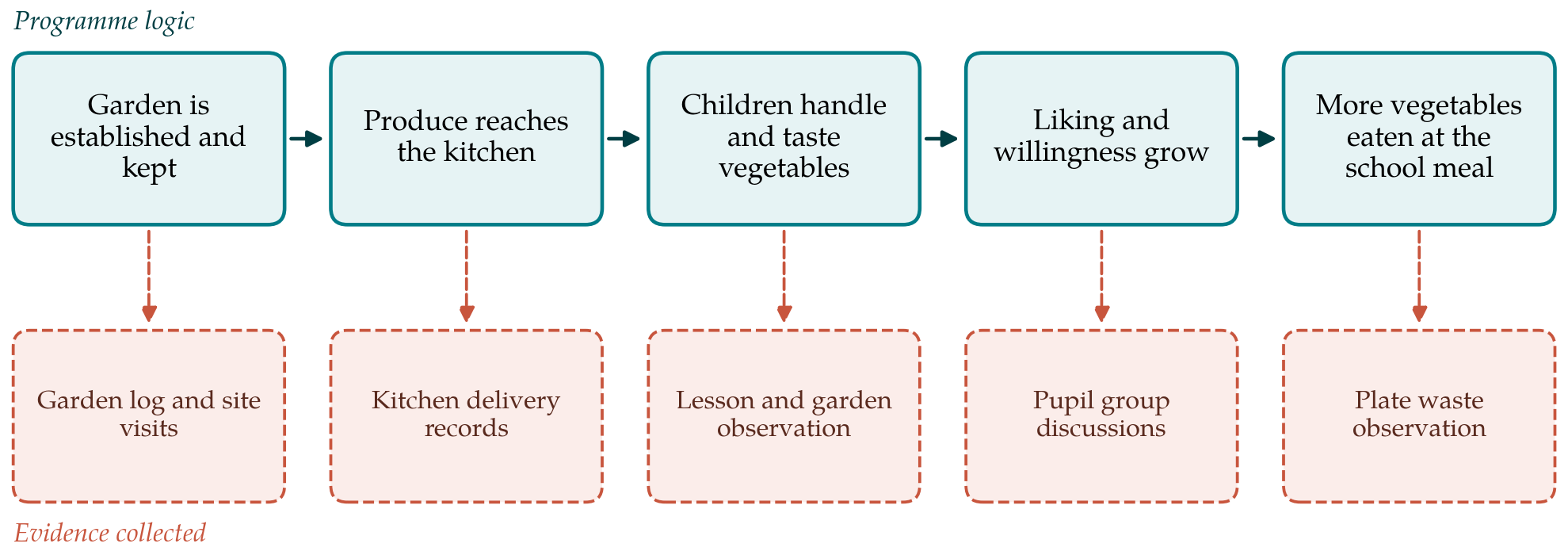
The evaluation begins from a programme logic that runs from garden to plate. Figure 1 sets out the five links and the evidence proposed for each. The central proposition is that vegetable intake at the school meal rises only when every link holds. Three rival explanations are written down at the start, as Yin recommends, so that evidence can be sought for and against them: that any change in intake reflects seasonal market supply and not the garden; that it reflects a change in the feeding programme's menu or budget; and that children's apparent liking is a response to being observed.
3.2. Stage 2: Define and select the case
The case is one rural primary school that operates a cooked midday meal and a garden intended to supply it. Within the school, three embedded units are studied: the garden, the kitchen, and the pupils of two or three selected classes. A single case is justified when it is typical of a wider class of settings or when it offers unusual access (Yin, 2018). Selection should therefore be documented against stated criteria, such as an established feeding programme, a garden already in its second season, and a head teacher willing to open records. The school's size, water source, land and staffing should be described fully enough for readers to judge how far it resembles schools they know.
3.3. Stage 3: Collect five sources of evidence
Table 1 lists the sources of evidence, what each records and the link in the logic it serves. A garden and kitchen log, kept by a teacher and the cook, records what is harvested, in what quantity, and where it goes. Periodic site visits by the evaluator check the log against what is seen. Structured observation of garden lessons records what pupils do. Group discussions with pupils and interviews with the cook, teachers and parents explore liking, habit and obstacles, and are analysed thematically (Braun and Clarke, 2006).
| Source | What is recorded | Link examined | Main weakness |
|---|---|---|---|
| Garden and kitchen log | Crops harvested, quantity, destination | Garden to kitchen | Depends on diligent record keeping |
| Site visits | Condition of plots, water, labour, storage | Garden kept in production | Snapshot on the day of the visit |
| Lesson observation | Pupil activity, tasting, time in garden | Exposure of children | Observer may alter the lesson |
| Pupil group discussions | Liking, familiarity, talk at home | Liking and willingness | Children may say what pleases adults |
| Adult interviews | Menu decisions, costs, obstacles | All links, context | Accounts shaped by role and interest |
| Plate waste observation | Share of served vegetables left uneaten | Intake at the meal | Visual estimate; school meal only |
Intake is the hardest link to measure. Young children cannot report their own diet accurately, and recall methods that work for adults are unreliable below about eight years of age without a parent's help (Livingstone et al., 2004). The design therefore measures consumption at the school meal by direct observation of plate waste: trained observers record the portion of vegetables served and estimate the fraction remaining on each child's plate, a method whose agreement with weighing has long been documented (Comstock et al., 1981). Weighing a sample of plates on each observation day provides a check on the visual estimates. Observers need joint training and periodic calibration against one another for the estimates to be comparable.
3.4. Stage 4: Analyse by pattern matching
Analysis follows a convergent mixed methods logic in which quantitative and qualitative strands are collected in parallel and merged at interpretation (Creswell and Plano Clark, 2018). For each link in the programme logic the evaluator sets out what would be seen if the link held and what would be seen if it did not, then compares the evidence with both patterns. The log and plate waste records are arranged as a time series across the school year, so that periods when garden produce reached the kitchen can be set against periods when it did not. If vegetables served and eaten rise and fall with garden supply, and market prices or menu changes do not account for the pattern, the central proposition gains support. If intake is flat whatever the garden yields, the break in the chain can be located.
3.5. Stage 5: Report with a chain of evidence
The report should allow a reader to trace each conclusion back to the records on which it rests. Yin calls this maintaining a chain of evidence, supported by a case study database kept separate from the narrative. A written protocol, prepared before fieldwork and covering the questions, instruments, observation schedule and consent procedures, makes the study repeatable in another school. Draft findings should be returned to the head teacher, cook and garden teacher for comment on factual accuracy before they are finalised.
4. Fitting the Design to a Rural School
A design that overloads school staff will produce empty logbooks. The garden and kitchen log should fit on a single page per week and use local measures, such as bundles or basins, which the evaluator converts to weight by calibration during visits. Plate waste observation needs a fixed routine: the same classes, the same seating, and observers who arrive often enough before data collection begins for children to lose interest in them. Observation days should be spread across seasons and chosen in advance, not picked for convenience on days when the garden is productive.
Ethical arrangements need early attention. Permission from the education authority and the school, informed consent from parents and assent from children are required, and the protocol should be reviewed by a recognised ethics committee before any fieldwork. Children who eat little at school may be food insecure at home, and the team should agree in advance with the head teacher how such concerns will be handled. Feedback to the community, in the local language, is part of the design and not an afterthought.
5. Limitations and What Remains to Be Shown
The design is proposed and has not been applied or validated. Its feasibility in a school with few staff and no electricity, the reliability of plate waste estimates made by locally trained observers, and the completeness of logs kept over a full year all remain to be demonstrated, ideally in a short pilot before a full study is committed to.
A single case supports analytic generalisation, meaning that findings bear on the programme logic and can be tested in further cases; it does not yield an estimate of effect that applies to schools in general (Yin, 2018). The design measures vegetables eaten at one meal and says nothing reliable about the rest of the child's diet or about nutritional status. Without a comparison school it cannot exclude every rival explanation, although the within-year contrast between periods of supply and no supply goes some way. Earlier controlled studies that did find increased intake after garden-based teaching (McAleese and Rankin, 2007) and trials that did not (Christian et al., 2014) show that results vary, and understanding that variation is the purpose a case study serves.
6. Conclusion
Whether a school kitchen garden adds vegetables to children's diets depends on a chain of ordinary events: plants surviving, harvests reaching the kitchen, cooks using them, and children eating what is served. The case study design proposed here follows that chain in one school over one year, using a simple log, observation of the meal and the accounts of those involved, and tests the result against stated rival explanations. It is offered as a practical complement to trials, for programme managers and researchers who need to know where a garden programme is working and where it breaks down.
Conflict of interest
To be declared by the author(s) before publication.
Funding
To be declared by the author(s) before publication.