1. Introduction
A man referred to an infertility clinic is assessed first by semen analysis, performed according to the laboratory manual of the World Health Organization, now in its sixth edition (WHO, 2021). The test counts spermatozoa and grades their motility and morphology. It was never designed to examine the DNA inside the sperm head, and men with entirely normal results may still father no pregnancy. Interest in sperm chromatin grew from that observation and from the early demonstration by Evenson et al. (1980) that the susceptibility of sperm DNA to denaturation differed between fertile and subfertile males.
Sperm DNA fragmentation, usually abbreviated SDF, refers to single-strand and double-strand breaks in the nuclear DNA of the spermatozoon. Meta-analyses have associated higher fragmentation with miscarriage (Robinson et al., 2012) and with poorer results after in vitro fertilisation and intracytoplasmic sperm injection (Simon et al., 2017). Clinicians who order the test are therefore soon asked a practical question by the couple in front of them: whether the result can be improved. The usual answer is advice about smoking, drinking, weight, heat and supplements.
That advice is reasonable on general health grounds. Whether it is supported by evidence specific to sperm DNA is a separate matter, and it is the subject of this review. The focus is on men attending infertility clinics, because that is where the test is used and where most of the data come from, and because findings in such men cannot be assumed to hold in the general population or the reverse.
2. Scope and Approach
This is a narrative review of the published literature. It draws on landmark laboratory papers, on meta-analyses and large observational studies where they exist, and on the practice guidelines of professional societies. No formal search protocol was applied and no pooled estimates are offered. The aim is to set out what is reasonably established, what is suggested but unproven, and where the literature is too heterogeneous to support a firm statement. Occupational and iatrogenic causes of DNA damage, such as chemotherapy and radiotherapy, lie outside the scope, as does the technical question of sperm selection for assisted reproduction.
3. Measuring Sperm DNA Fragmentation
Four assays dominate clinical use. The sperm chromatin structure assay (SCSA) uses flow cytometry and acridine orange to measure the proportion of cells whose DNA denatures after a mild acid challenge, reported as the DNA fragmentation index (Evenson et al., 1999). The TUNEL assay labels the free 3'-hydroxyl ends of broken strands with a terminal transferase and counts the labelled cells by microscopy or flow cytometry. The sperm chromatin dispersion test infers fragmentation from the absence of a halo of dispersed DNA loops after denaturation and protein removal (Fernández et al., 2003). The comet assay, in alkaline or neutral form, measures DNA migration from single cells during electrophoresis.
These tests do not measure the same thing. TUNEL and the comet assay detect breaks directly, while SCSA and the dispersion test detect susceptibility to denaturation, which is related to breaks but also to chromatin compaction. Thresholds differ by assay and by laboratory. A fragmentation index of about 30 percent in the SCSA has been widely used to mark a group with reduced chances of natural and intrauterine conception (Evenson et al., 1999; Bungum et al., 2007), but that figure does not transfer to other methods. Reviews of the tests have stressed this lack of standardisation for many years (Sakkas and Alvarez, 2010).
The consequence for the present question is direct. A study that reports higher fragmentation in smokers using one assay and a study that finds no difference using another are not necessarily in conflict, and results cannot simply be averaged. Professional guidance reflects the uncertainty. The American Society for Reproductive Medicine concluded that the evidence did not support routine use of the test (ASRM, 2013), and the joint guideline of the American Urological Association and the same society does not recommend it in the initial evaluation of the infertile couple (Schlegel et al., 2021). Other expert groups have set out specific scenarios, including unexplained infertility, recurrent pregnancy loss, varicocele and lifestyle risk, in which they consider testing informative (Agarwal et al., 2016; Esteves et al., 2021).
4. How Lifestyle Could Damage Sperm DNA
The mature spermatozoon is unusually exposed. Its cytoplasm, and with it most of its antioxidant enzymes, is shed during spermiogenesis; its membranes are rich in polyunsaturated fatty acids; and it has very limited capacity to repair DNA. Protection depends on the tight packaging of the genome around protamines and on the antioxidants of seminal plasma. Aitken and De Iuliis (2010) proposed a two-step account in which faulty chromatin remodelling during spermiogenesis leaves some cells poorly protaminated, and these vulnerable cells are then attacked by reactive oxygen species. Other recognised routes include abortive apoptosis in the testis and damage acquired during transit through the epididymis (Sakkas and Alvarez, 2010).
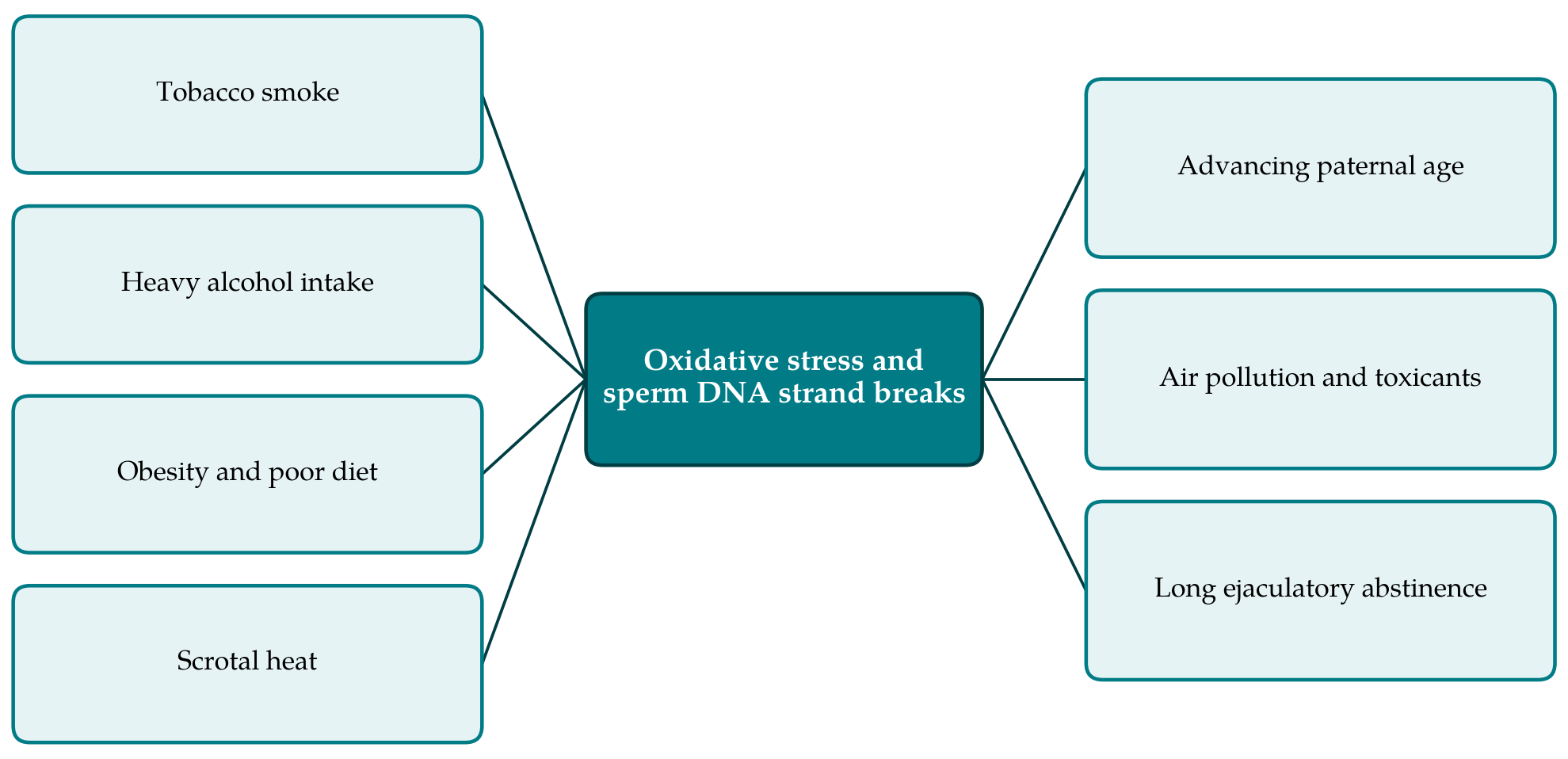
Oxidative stress is the mechanism through which most lifestyle exposures are thought to act. Reactive oxygen species arise from leukocytes in semen, from immature spermatozoa that retain excess cytoplasm and from systemic sources, and their production is increased by smoking, obesity, heat and pollutants (Tremellen, 2008; Wright et al., 2014). Figure 1 summarises this common pathway. The model is coherent and supported by laboratory work, but coherence of mechanism is not evidence of effect in patients, and the sections that follow consider each exposure against the clinical data.
5. Evidence for Individual Factors
Table 1 summarises the exposures most often discussed with patients, the mechanism proposed for each and the general state of the evidence. The paragraphs below give the reasoning behind each entry.
| Factor | Proposed mechanism | State of the evidence | Representative sources |
|---|---|---|---|
| Tobacco smoking | Oxidants and genotoxic compounds reach seminal plasma | Fairly consistent association; mostly cross-sectional | Sharma et al., 2016; Wright et al., 2014 |
| Alcohol | Oxidative metabolism; endocrine disturbance | Semen parameters affected by daily intake; DNA data sparse | Ricci et al., 2017 |
| Obesity and diet | Systemic inflammation, raised scrotal temperature, altered hormones | Association reported; weight-loss studies small | Kort et al., 2006; Håkonsen et al., 2011 |
| Scrotal heat | Impaired spermatogenesis and increased oxidant production | Plausible; exposure poorly measured | Jung and Schuppe, 2007 |
| Paternal age | Accumulated oxidative damage, reduced apoptotic clearance | Consistent rise with age, including in healthy men | Wyrobek et al., 2006 |
| Air pollution | Reactive metabolites of combustion products | Supported by a small number of cohort studies | Rubes et al., 2005 |
| Antioxidant supplements | Scavenging of reactive oxygen species | Low-certainty evidence; a large trial found no benefit | Smits et al., 2019; Steiner et al., 2020 |
5.1. Tobacco
Smoking is the exposure with the largest literature. A meta-analysis restricted to studies using current World Health Organization methods found that smokers had lower sperm counts and motility and poorer morphology than non-smokers, with larger differences in infertile men and in moderate and heavy smokers (Sharma et al., 2016). Studies of DNA fragmentation in smokers are smaller and use a mixture of assays, but most report higher values, and cigarette smoke constituents and their metabolites have been identified in seminal plasma (Wright et al., 2014). What is lacking is good evidence on reversal: few studies have followed men after cessation with repeated measurement of sperm DNA.
5.2. Alcohol
For alcohol the picture is less clear. The meta-analysis by Ricci et al. (2017) found that intake was associated with lower semen volume and poorer morphology, and that the effect was confined largely to daily drinkers, with little sign of harm from occasional consumption. Data on DNA fragmentation specifically are few and inconsistent. Alcohol use is also closely tied to smoking, diet and body weight, so its independent contribution is difficult to isolate in observational data.
5.3. Body weight and diet
Kort et al. (2006) reported that overweight and obese men attending a fertility practice had a higher DNA fragmentation index and fewer normal motile sperm than men of normal weight, and several later studies have pointed in the same direction, although not all. Adipose tissue is a source of inflammatory mediators and of aromatase activity, and suprapubic and thigh fat may raise scrotal temperature, so more than one pathway is plausible. Evidence from weight reduction is limited. In a small cohort of severely obese men enrolled in a residential programme, weight loss was associated with better semen measures (Håkonsen et al., 2011), but the study had no control group and cannot separate the effect of weight from that of diet, exercise and abstinence from alcohol.
5.4. Heat, age and the environment
The testis functions a few degrees below core temperature, and experimental heating reliably suppresses spermatogenesis. The review by Jung and Schuppe (2007) found evidence that prolonged sitting, occupational heat and insulating clothing raise scrotal temperature, but the relation between everyday exposures and semen quality was inconsistent, in large part because exposure is rarely measured directly. Varicocele, which is common in clinic populations and is itself associated with raised fragmentation (Zini and Dohle, 2011), is an obvious confounder of any study of heat.
Age is not a lifestyle choice in the ordinary sense, but the timing of fatherhood is, and age modifies the interpretation of every other factor. In healthy non-clinical volunteers Wyrobek et al. (2006) found that DNA fragmentation rose steadily with age, with no evidence of a threshold. Environmental exposure has been examined in fewer studies. Young men in a Czech district with seasonal air pollution had higher fragmentation after periods of high exposure, without change in conventional semen measures (Rubes et al., 2005), a finding that illustrates how sperm DNA may respond to insults that routine analysis does not register.
The interval of abstinence before sample collection also affects the result. Longer storage in the epididymis prolongs exposure to oxidants, and shorter abstinence has been proposed as a simple means of lowering fragmentation before assisted reproduction (Esteves et al., 2021). The point matters for research as well as practice, because uncontrolled differences in abstinence can create or conceal apparent effects of lifestyle.
6. Whether Changing Behaviour Lowers Fragmentation
An association between an exposure and DNA damage does not show that removing the exposure repairs it. The strongest test of the oxidative model in practice has been antioxidant supplementation. The Cochrane review of antioxidants for male subfertility found that supplements might increase live birth rates, but judged the evidence to be of low certainty because the trials were small and at risk of bias (Smits et al., 2019). The subsequent multicentre randomised trial by Steiner et al. (2020) found that a combined antioxidant preparation did not improve semen parameters or DNA integrity in men with male factor infertility. For smoking cessation, alcohol reduction and exercise, comparable trials with sperm DNA as an outcome are not available.
Two further cautions follow. Spermatogenesis takes roughly ten weeks, so any intervention must be sustained before its effect can be assessed, and single measurements are subject to considerable biological variation within the same man. In addition, the outcome that matters to couples is a healthy child. A fall in fragmentation index is a surrogate, and its relation to live birth after lifestyle change has not been established. Advice to stop smoking, moderate alcohol and lose excess weight can be given with confidence on general health grounds; the claim that it will correct a DNA fragmentation result should be made with more reserve.
7. Gaps and Future Work
Several weaknesses recur across this literature. Most studies are cross-sectional and recruit from clinics, where men with risk factors and men with poor results are both over-represented. Exposure is self-reported. Assays and thresholds vary, and few studies adjust for age, abstinence, varicocele and genital tract infection together. Publication of positive associations is more likely than publication of null results. Each of these problems can be addressed: by prospective cohorts with repeated sampling, by agreed reporting of assay method and abstinence, by objective markers such as cotinine for tobacco exposure, and by trials of structured lifestyle programmes that follow couples to live birth.
There is also a question of who should be tested. If lifestyle counselling is appropriate for all men seeking fertility care, a test is useful only where its result changes management, for example by identifying men for whom varicocele repair, a shorter abstinence interval or a different mode of assisted reproduction should be discussed. That is the logic of the scenario-based recommendations (Agarwal et al., 2016), and it deserves prospective evaluation.
8. Conclusion
Sperm DNA fragmentation is higher, on average, in men who smoke, who are obese and who are older, and a shared oxidative mechanism makes these associations credible. For alcohol, heat and environmental pollutants the evidence is suggestive and incomplete. The literature is weakened throughout by cross-sectional design, by confounding within clinic populations and by assays that do not agree with one another. Whether changing behaviour lowers fragmentation, and whether a lower value brings a better chance of a child, are questions that current studies do not settle. Clinicians can encourage healthier habits while being candid about what the test can and cannot promise.
Conflict of interest
To be declared by the author(s) before publication.
Funding
To be declared by the author(s) before publication.