1. Introduction
The discovery that a conjugated polymer could be doped to metallic levels of conductivity (Shirakawa et al., 1977) opened the possibility of conductors that could be applied to fibres as dyes and finishes are. By the 1990s polypyrrole-coated fabrics were being made on an industrial scale (Kuhn et al., 1995), and De Rossi et al. (1999) showed that such fabrics changed resistance when stretched and could serve as sensors of body movement in garments. Strain sensing has since become one of the standard demonstrations of electronic textiles (Stoppa and Chiolerio, 2014).
Two features of this literature prompt the present note. Most coated-fabric sensors have been built on knitted or elastomeric substrates, chosen for their large extension, and comparatively little has been written about woven cloth. And the property that decides whether a garment sensor is usable, its survival in the wash, is reported far less often than its sensitivity (Rotzler and Schneider-Ramelow, 2021). This communication brings the two points together. It is a commentary on published knowledge and presents no new measurements.
2. Coating Chemistries
Three polymers account for nearly all the work. Polypyrrole and polyaniline are usually formed on the fabric itself by oxidative polymerisation of the monomer from solution or vapour, which deposits a thin layer
that
follows
the
surface
of
each
fibre
(Kuhn
et
al.,
1995;
Li
et
al.,
2005). Poly(3,4-ethylenedioxythiophene), or PEDOT, is more stable in its conducting state than either (Groenendaal et al., 2000) and is most often applied as an aqueous dispersion with poly(styrene sulfonate), PEDOT:PSS, by dipping, padding or printing (Ding et al., 2010; Tseghai et al., 2020). Table 1 compares the three from the standpoint of a washable sensor.
| Coating | Usual application route | Strength | Weakness in washing |
|---|---|---|---|
| Polypyrrole | Polymerised on the fabric from solution or vapour | Thin conformal layer; good adhesion to many fibres | Loses dopant in alkali; conductivity decays in air |
| Polyaniline | Polymerised on the fabric from acidic solution | Low-cost monomer; simple process | Converts to the insulating base form above neutral pH |
| PEDOT:PSS | Dip, pad or print from aqueous dispersion | Stable conducting state; compatible with textile finishing | Uncrosslinked film swells and redisperses in water |
| PEDOT by vapour-phase polymerisation | Oxidant applied first, then monomer vapour | No water-soluble polyanion in the film | More process steps; acid oxidant may weaken cellulose |
| Any of the above with encapsulation | Elastomer or polyurethane overcoat | Shields coating from liquor and abrasion | Stiffens the fabric; may damp the strain response |
3. Strain Response of a Coated Weave
Sensitivity is expressed as the gauge factor, the relative change in resistance divided by the applied strain. In a coated fabric the change has two sources. One is geometric and structural: as the fabric extends, yarns straighten, contact pressure at their crossings changes and conducting paths between neighbouring fibres are made or broken. The other lies in the coating, which is stiffer and less extensible than the fibre beneath it and develops fine transverse cracks that open under strain and close on recovery (Xue et al., 2004; Amjadi et al., 2016).
A woven fabric differs from a knit in both respects. Along warp and weft it extends only by removal of yarn crimp and then by stretching of the yarns themselves, so the working range is a few per cent of strain and not the tens of per cent available from a knitted loop structure. Within that range the response is stiffer, more nearly linear and less prone to the hysteresis that loop rearrangement produces. On the bias, a weave deforms by shear of the yarn intersections and can accommodate much larger extension. These properties suit applications where strains are small and repeatability matters more than range, such as monitoring of breathing through a chest band, posture, or deformation of technical textiles and composites.
4. How Laundering Degrades the Sensor
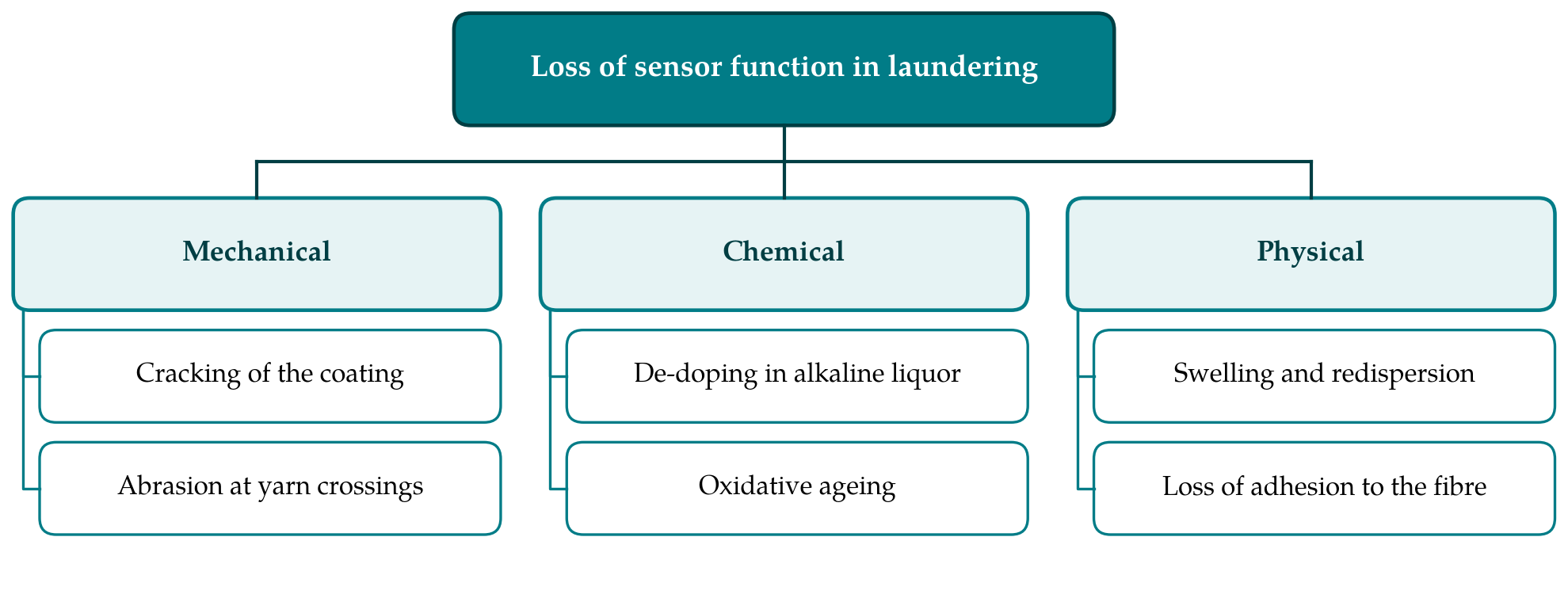
A domestic wash combines water, surfactant, alkalinity, heat and prolonged flexing and rubbing. Figure 1 groups the resulting damage into three routes. The mechanical route is the growth and multiplication of the same cracks that produce the strain signal, together with abrasion of the coating where yarns cross and where fabric rubs on fabric. The chemical route depends on the polymer. Polyaniline is conducting only in its protonated salt form and reverts to an insulating base in the neutral to alkaline conditions of a detergent solution, and polypyrrole likewise loses dopant in alkali and is slowly degraded by oxygen. The physical route is most acute for PEDOT:PSS, in which the water-soluble polyanion lets an untreated film swell and partly redisperse (Tseghai et al., 2020).
A woven construction changes the balance among these routes. Its yarns are held more firmly than those of a knit and move less against each other in the wash, which should reduce abrasion at crossings. The interlacing is also tight, and in a dense weave the coating may not reach the fibres at the centre of each yarn, leaving conduction dependent on a surface layer that is exposed to wear. Rotzler and Schneider-Ramelow (2021) identify mechanical stress as a major cause of washing failures across electronic textiles generally. If that holds for coated sensors, a stable weave has an advantage worth testing.
5. Designing for Washability and Reporting It
The countermeasures follow from the failure routes. PEDOT:PSS can be made insoluble by crosslinking agents added to the dispersion, and its conductivity raised by polar co-solvents, at some cost in flexibility (Tseghai et al., 2020). Adhesion of any coating improves when the fibre surface is cleaned and activated before deposition. An elastomeric overcoat keeps liquor and abrasion away from the conductor, though it stiffens the cloth and has to be thin enough not to mask the strain response. The choice of weave is itself a design variable: float length, yarn twist and cover factor determine how far the coating penetrates and how much the yarns can move.
Reporting practice needs to improve as much as materials do. Washing trials on electronic textiles are carried out under varied and often incompletely reported conditions (Rotzler and Schneider-Ramelow, 2021). A minimum specification would name the washing procedure by reference to the standard for domestic laundering of test textiles (ISO, 2021), state the programme, detergent and number of cycles, and report the gauge factor, linearity, hysteresis and baseline resistance before and after, not baseline resistance alone. A sensor whose resistance has doubled may still be serviceable if its gauge factor is unchanged, and one whose resistance is stable may have lost its sensitivity.
6. Conclusion
Conductive polymer coatings remain the most direct way of turning a fabric into a strain sensor, and their weakness in laundering is understood well enough to be designed against. Woven substrates offer dimensional stability, a small but repeatable working range and restrained yarn movement in the wash, and they have been examined less than knits. Systematic work on coated weaves, with sensor characteristics reported after standardised washing, would show whether that neglect is justified.
Conflict of interest
To be declared by the author(s) before publication.
Funding
To be declared by the author(s) before publication.