1. Introduction
For most of the period after 1990, a government of middling size could treat its security policy and its trade policy as separate files. It could shelter under an alliance with one great power while selling most of its exports to another, and the rules of the World Trade Organization gave it a reasonable expectation that the two would not be linked. That separation has weakened. Export controls, investment screening, subsidy races and the selective use of market access as leverage have made commercial ties a matter of strategy again, and regional trade agreements increasingly carry a geopolitical signature.
The scholarly vocabulary for describing how states respond comes largely from security studies. The classical choice was between balancing against a threatening power and bandwagoning with it (Waltz, 1979; Walt, 1987). From the early 2000s, students of Southeast Asia argued that this menu missed what governments in the region were doing, which was to avoid the choice altogether, and the word they settled on was hedging (Goh, 2005; Kuik, 2008). The term has since travelled well beyond its original setting.
This review asks what the published literature says about hedging by middle powers when the arena is trade and economic alignment. It has three aims: to clarify what the concept means and where authors disagree, to gather what has been written about the economic instruments of hedging, and to identify where the argument still lacks support. The review does not present new evidence, and it does not attempt to classify the present policies of particular governments.
2. Scope and Approach
This is a narrative review of the published literature in international relations and international political economy. It draws on the theoretical works that defined balancing, bandwagoning and hedging, on the conceptual debate over middle powers, and on writing about economic statecraft and regionalism. The selection reflects the works most often treated as reference points in these debates; it is not the product of a formal search protocol, and no claim of exhaustive coverage is made. The discussion is organised by theme, moving from the concept, to the actors, to the economic setting, and then to the conditions and limits of the strategy.
3. Hedging as a Concept
Three strands can be distinguished in the conceptual literature: the alignment debate from which the term emerged, the attempts to define it, and the critiques that followed.
3.1. Origins in the alignment debate
Structural realism expected secondary states to balance against concentrated power (Waltz, 1979), and Walt (1987) refined the expectation by arguing that states balance against threat, of which power is only one component. Schweller (1994) replied that bandwagoning is more common than these accounts allow, because states often align with the stronger side for gain and not out of fear. Asia after the Cold War fitted neither prediction comfortably. Observers of Southeast Asia in particular found governments deepening economic ties with China while keeping or renewing defence links with the United States, a pattern that sat somewhere between the two poles.
Hedging was offered as the name for that middle ground. Medeiros (2005) used it for the mutual insurance policies of the United States and China towards each other. Goh (2005) defined it for smaller states as a set of strategies aimed at avoiding a situation in which a state cannot decide on more straightforward alternatives, and later described how Southeast Asian governments tried to enmesh several major powers in the region at once (Goh, 2008).
3.2. Competing definitions
The most widely used formulation is that of Kuik (2008), who treats hedging as a deliberately two-sided policy: a state pursues returns from a rising power through economic and diplomatic engagement while taking out insurance through indirect balancing and the denial of dominance. In later work he stressed that the opposing measures are meant to offset one another and that domestic legitimation, not threat alone, explains the mix (Kuik, 2016). Tessman (2012) placed hedging in systemic terms, as the behaviour of second-tier states preparing for a change in the distribution of power.
A narrower school objects that these definitions make almost any mixed policy count as hedging. Lim and Cooper (2015) restrict the term to security alignment and define it as sending ambiguous signals about which great power a state would side with; on their reading, trade with a rival of one's ally is ordinary commerce and tells an observer nothing. Table 1 sets the main positions side by side.
| Conception | Core claim | Main criticism | Source |
|---|---|---|---|
| Insurance against uncertainty | A way of avoiding a firm choice among balancing, bandwagoning and neutrality | Defined by what it is not; hard to observe | Goh, 2005 |
| Two-pronged policy | Return-seeking engagement offset by risk-contingency measures | Broad enough to cover most foreign policies | Kuik, 2008 |
| Systemic strategy | Second-tier states prepare for a shift in the distribution of power | Says little about smaller states and regions | Tessman, 2012 |
| Ambiguous alignment | Deliberately unclear signals about security alignment only | Excludes the economic domain by definition | Lim and Cooper, 2015 |
| Risk management | A response to identified security risks, distinct from balancing threats | Requires evidence of leaders' risk perceptions | Haacke, 2019 |
| Level-specific behaviour | Hedging occurs regionally while balancing occurs at system level | Depends on separating the two levels cleanly | Korolev, 2016 |
3.3. Critiques and refinements
A special issue introduced by Ciorciari and Haacke (2019) took stock of the term and found it used as a strategy, a behaviour, an outcome and a synonym for prudence. In the same issue Haacke (2019) proposed tying it to the management of security risks, as distinct from responses to defined threats, and offered indicators for telling hedging apart from balancing. Korolev (2016) argued that the two can coexist because they operate at different levels, with balancing at the level of the international system and hedging within a region. The lesson of these exchanges for the present subject is that any extension of hedging to trade policy inherits an unsettled definition, and that authors should state which one they are using.
4. Which States Are Middle Powers
The second term in the title is no better settled. Holbraad (1984) defined middle powers by their place in a ranking of material capabilities. Cooper et al. (1993) shifted attention to behaviour, describing a characteristic diplomacy of coalition building, mediation and niche specialisation practised by states such as Australia and Canada. Chapnick (1999) sorted the available definitions into functional, behavioural and hierarchical models and doubted that they pick out the same countries. Jordaan (2003) added a distinction between traditional middle powers, which are wealthy, stable and supportive of the existing order, and emerging ones, which are regionally dominant and more inclined to seek reform of that order.
The distinction matters for hedging. An older literature on small states held that their defining feature is the inability to affect the system alone (Keohane, 1969). Middle powers, by contrast, have enough weight to be courted, enough market size to make access to them worth bargaining for, and enough diplomatic capacity to convene others. Those attributes give them something to hedge with. They also mean that the traditional and emerging types may hedge for different reasons: the former to preserve an order from which they benefit, the latter to widen their room for manoeuvre within it.
5. From Security Hedging to Trade Hedging
The economic setting in which hedging now takes place has been described from two directions, one concerned with the erosion of open trade rules and the other with the strategic use of economic ties.
5.1. Fragmentation and the return of economic statecraft
The idea that trade creates exploitable dependence is old. Hirschman (1945) showed how a large state can structure commerce so that smaller partners find it costly to leave, and Baldwin (1985) set out the range of economic techniques available to governments. The newer contribution is the argument of Farrell and Newman (2019) that global networks of finance, data and production have hubs, and that states with jurisdiction over those hubs can use them to observe or exclude others. A discussion note from the staff of the International Monetary Fund describes the possible result as geoeconomic fragmentation, a policy-driven reversal of integration along geopolitical lines (Aiyar et al., 2023).
The weakening of multilateral adjudication adds to the pressure. Since December 2019 the Appellate Body of the World Trade Organization has lacked the members needed to hear appeals, so a losing party can block the adoption of a panel ruling by appealing it into a void. For a great power this is an inconvenience. For a middle power it removes one of the few settings in which a legal argument could offset a disparity of size, and it raises the value of the alternatives: regional agreements with their own dispute procedures, plurilateral stopgaps among willing members, and bilateral understandings with each of the major economies.
Regional trade agreements are the institutional face of this change. The spread of preferential agreements was explained in the 1990s as a wave driven by domestic politics and strategic interaction (Mansfield and Milner, 1999) and by a domino dynamic in which exclusion from one agreement raises the incentive to join it or to form another (Baldwin, 1993). Ravenhill (2010) argued that in East Asia the dominoes were political more than commercial. Critics of preferential trade have long warned that overlapping preferences erode the multilateral system. In the Asia-Pacific the Comprehensive and Progressive Agreement for Trans-Pacific Partnership and the Regional Comprehensive Economic Partnership now sit side by side with different memberships: the first grew out of an initiative once led by the United States, which later withdrew, and the second counts China as its largest economy.
5.2. Positions and instruments of economic hedging
Whether a middle power has reason to hedge economically depends first on where it stands. Figure 1 offers a schematic synthesis of the arguments reviewed above, arranged on two dimensions that recur in the literature: how far a state relies on one great power for its security, and how far its economy is exposed to that power's rival. The figure is an organising device drawn from the literature and not an empirical classification of any country.
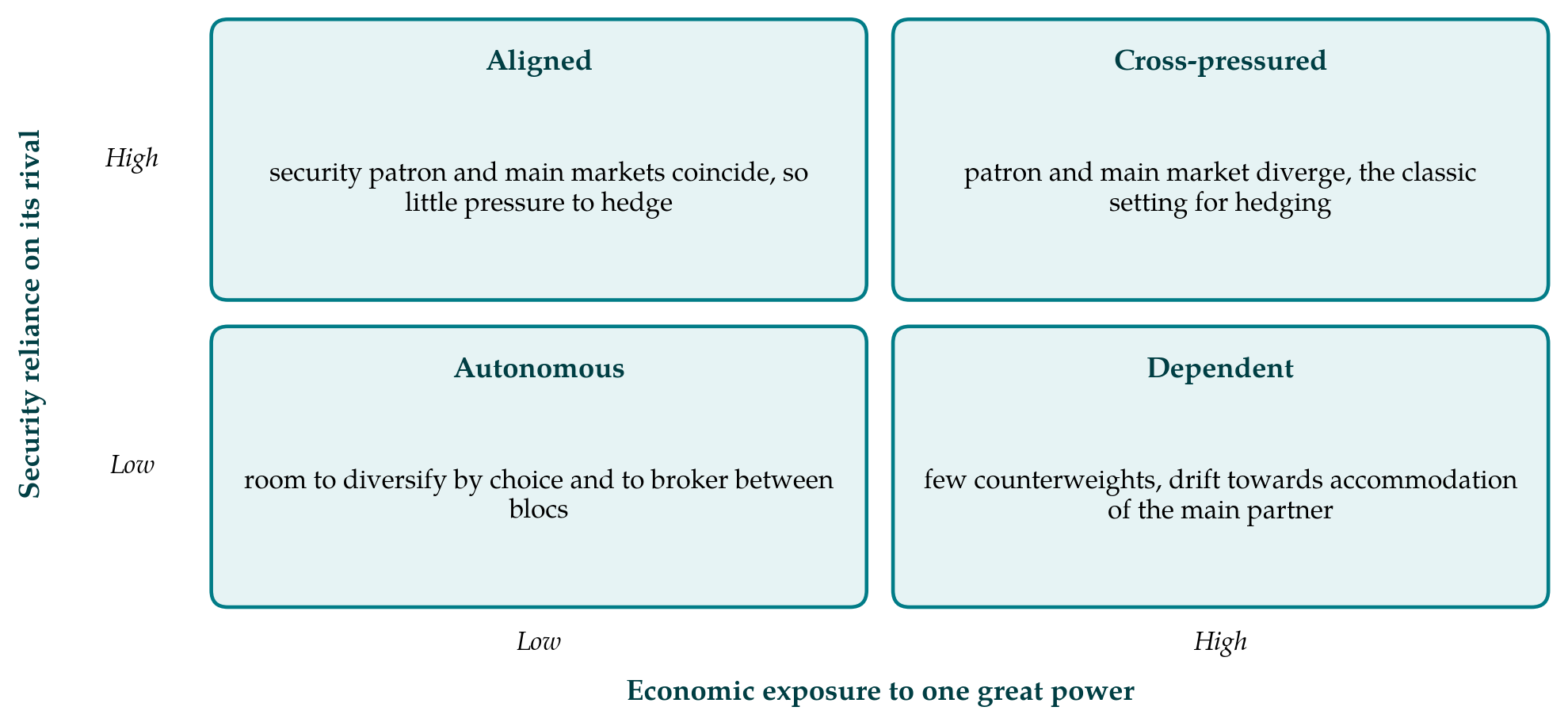
For states in the cross-pressured position, the literatures reviewed here suggest a repertoire of four instruments. The first is overlapping membership: joining agreements with different centres of gravity, as Australia, Japan, Malaysia, Singapore and Vietnam have done by belonging to both of the Asia-Pacific agreements just named. The second is diversification of export markets and suppliers so that no single partner holds a decisive share. The third is selective compliance, in which a state follows a partner's export controls or investment rules in sensitive sectors while keeping ordinary commerce open. The fourth is institutional entrepreneurship, the middle power habit of building plurilateral arrangements that dilute the weight of any one large member (Cooper et al., 1993).
6. Conditions That Enable or Constrain Hedging
Authors broadly agree that hedging is easier when great power rivalry is present but restrained. Kuik (2016) notes that the strategy presupposes the absence of an immediate threat and of an all-out rivalry that forces a choice. Korolev (2016) makes the corresponding structural point: as competition at the system level sharpens, the regional space for hedging contracts. Applied to trade, the implication is that hedging should be feasible in sectors where the great powers tolerate dual ties and difficult in sectors, such as advanced semiconductors or critical infrastructure, that they have defined as matters of security.
Domestic politics is the second condition. For Kuik (2008) the balance between the two prongs follows from how ruling elites justify their authority at home, whether through economic performance, nationalism or autonomy. Trade policy adds organised interests to this picture, since exporters, import-competing industries and firms tied to particular supply chains each have a stake in which bloc's rules prevail (Mansfield and Milner, 1999). A hedging strategy that looks coherent from the foreign ministry may in practice be the sum of sectoral bargains.
The third condition is cost. Hedging in the security literature is often treated as cheap, a matter of signalling. Lim and Cooper (2015) dispute this, arguing that ambiguity carries a price in reduced alliance credibility. The economic equivalent is plain enough: duplicate standards, compliance with incompatible regulatory regimes, and the fiscal burden of reshoring or stockpiling. The literature on weaponized interdependence adds that a middle power's own firms may sit at points in a network where a great power can reach them directly (Farrell and Newman, 2019), which limits what the government can promise to either side.
7. Gaps and Future Work
Four gaps stand out. The first is definitional. Much writing on economic hedging uses the term for any diversification of trade, which is the stretching that Ciorciari and Haacke (2019) warned against. A workable definition would need to specify the risk being insured against and show that the offsetting measures are intended as such. The second is measurement. The security literature has indicators, however contested (Haacke, 2019); there is no agreed equivalent for trade, and membership of several agreements may reflect commercial opportunity as easily as strategy.
The third gap concerns the middle power category. Most cases discussed are Asian, and the distinction between traditional and emerging middle powers (Jordaan, 2003) is seldom carried into the hedging literature, although it predicts different motives. The fourth is durability. If the room to hedge shrinks as rivalry intensifies, then hedging is a description of a phase. What middle powers do when the phase ends, and whether their collective action can prolong it, is a question the existing literature raises without answering.
8. Conclusion
The literature reviewed here gives a clear account of where the idea of hedging came from and a less clear account of what it means once it is moved from security alignment to trade. The concept is most useful when it is held to its original content, a deliberate pairing of opposed measures under uncertainty, and least useful when it becomes a label for keeping options open. Middle powers have the market weight and the diplomatic capacity to hedge across fragmenting blocs, and the overlapping agreements of the Asia-Pacific show the form such a strategy can take. Its costs, its measurement and its staying power are the matters on which further research would add most.
Conflict of interest
To be declared by the author(s) before publication.
Funding
To be declared by the author(s) before publication.