1. Introduction
Per- and polyfluoroalkyl substances are a large family of compounds built on a fully or partly fluorinated carbon chain, usually ending in a carboxylate or sulfonate group (Buck et al., 2011). The carbon-fluorine bond resists hydrolysis, photolysis and microbial attack, so the compounds persist, and the longer-chain acids are retained in the body for months or years rather than hours. Monitoring programmes find them in serum almost universally in industrialised populations, and the question of what they do at the concentrations people carry has occupied regulators for two decades (Fenton et al., 2021).
In rodents the liver is the organ that responds first and most reliably. Repeated oral dosing with perfluorooctanoic acid, perfluorooctane sulfonate and several of their homologues produces increased liver weight, hepatocellular hypertrophy and changes in serum enzyme activities and lipid concentrations, and these findings appear across strains, sexes and laboratories (Lau et al., 2007; ATSDR, 2021). A substantial share of the mechanistic work on those effects has used the vocabulary of oxidative stress: measurements of lipid peroxidation products, of glutathione and of the enzymes that handle reactive oxygen species.
That framing deserves scrutiny. Oxidative stress is a useful concept when it is defined with care, as an imbalance between oxidants and antioxidants leading to disruption of redox signalling and to molecular damage (Sies, 2015), but the assays used to demonstrate it are often indirect and are easily over-read (Halliwell and Whiteman, 2004). This article reviews what subchronic rodent studies of perfluoroalkyl substances have reported about hepatic redox markers, asks how far those reports support a causal account, and considers the additional difficulty that real exposures are to mixtures while most experiments dose one compound at a time.
2. Scope and Approach
This is a narrative review of the published literature rather than a systematic one, and it makes no claim to have screened a defined set of records. The material drawn on falls into four groups: regulatory and agency reviews that summarise the repeated-dose toxicology, among them the profile prepared by the Agency for Toxic Substances and Disease Registry (ATSDR, 2021) and the opinion of the European Food Safety Authority on perfluoroalkyl substances in food (EFSA CONTAM Panel, 2020); guideline repeated-dose studies conducted to protocols such as OECD Test No. 408 (OECD, 2018a) and the rodent toxicity studies published by the National Toxicology Program (NTP, 2019); mechanistic papers on nuclear receptor activation; and the general literature on redox biology and on the measurement of oxidative damage.
Subchronic is used here in its regulatory sense of repeated dosing for roughly ninety days in the rat or mouse, with studies of a few weeks included where they bear on the same endpoints. Studies in fish, invertebrates and cultured cells are cited only where they clarify a mechanism. The review does not attempt to derive a point of departure or to compare potencies across compounds, both of which require the primary data rather than a summary of them.
3. Why the Rodent Liver Is the Target Organ
Three properties of the longer-chain perfluoroalkyl acids explain the hepatic focus. They are not metabolised, so the parent compound is what reaches tissue. They bind extensively to serum albumin and to liver fatty acid binding protein, which concentrates them in hepatocytes rather than in adipose tissue, a pattern that distinguishes them from the classical lipophilic persistent organic pollutants. And they are reabsorbed from the renal filtrate by organic anion transporters, which is why clearance is slow and why half-lives differ so much between species and between the sexes of the rat (Lau et al., 2007; Fenton et al., 2021).
The practical consequence is that liver concentration at a given external dose is poorly predicted by the dose alone. Two studies administering the same milligram per kilogram amount of different homologues may expose the liver to quite different internal concentrations, and comparisons of marker responses that ignore this are of limited value. Regulatory assessments have moved towards serum concentration as the dose metric for this reason (EFSA CONTAM Panel, 2020).
4. Mechanisms That Could Generate a Redox Signal
Perfluoroalkyl carboxylates and sulfonates activate the peroxisome proliferator-activated receptor alpha, with potency that varies by chain length and functional group and that differs between the mouse and human forms of the receptor (Wolf et al., 2008). Activation induces the enzymes of mitochondrial and peroxisomal fatty acid oxidation. Peroxisomal acyl-CoA oxidase generates hydrogen peroxide as a direct product, and a sustained increase in flux through that pathway without a matching increase in catalase has long been proposed as a source of oxidative damage in the rodent liver (Klaunig et al., 2003). Activation of the constitutive androstane receptor and the pregnane X receptor contributes further changes in xenobiotic metabolising enzymes, and work in PPARα-null mice shows that part of the hepatic response to these compounds does not require PPARα at all (Rosen et al., 2008).
A second route runs through the antioxidant response itself. The Keap1-Nrf2 pathway responds to electrophiles and to shifts in thiol status by inducing glutathione synthesis, glutathione S-transferases and NAD(P)H quinone oxidoreductase (Kensler et al., 2007). Induction of these proteins is frequently reported after perfluoroalkyl dosing and is frequently described as evidence of oxidative stress. It is better read as evidence that the cell has detected a change in its redox environment, which is not the same as damage. Figure 1 sets out the processes that have been proposed to connect exposure to the markers that are measured.
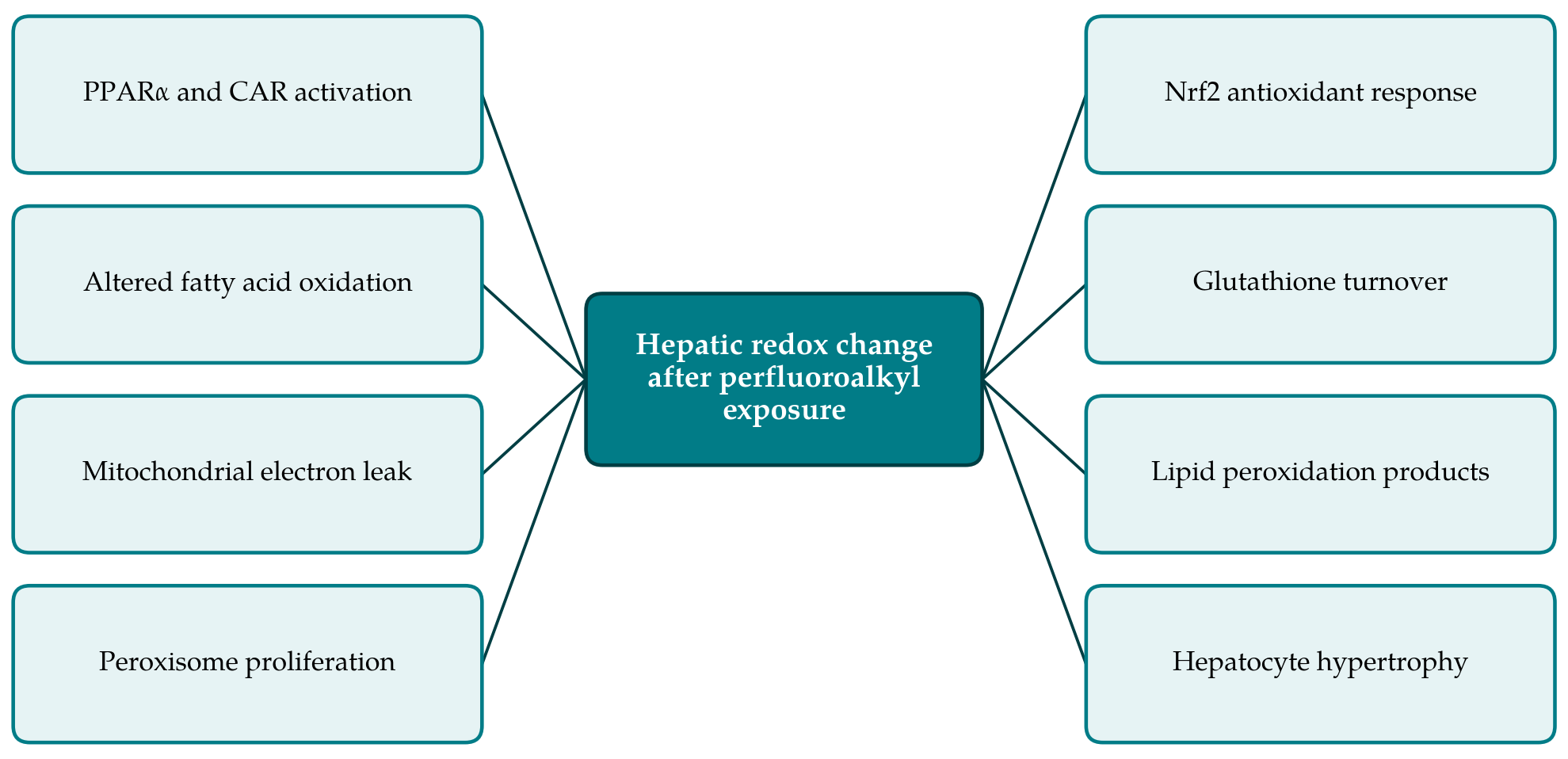
Mitochondrial effects form a third strand. Perfluoroalkyl acids interact with membranes, and in isolated mitochondria the longer-chain compounds uncouple respiration and induce the permeability transition. Electron leak from a partly uncoupled respiratory chain is a plausible source of superoxide. Whether this occurs at the hepatic concentrations reached in a ninety-day feeding study, as against those used in isolated organelle work, is an open question and one that is rarely addressed in the papers that invoke it.
5. The Markers Reported and What They Mean
The endpoints measured in this literature are a small and repeated set. Lipid peroxidation is almost always represented by malondialdehyde, usually by the thiobarbituric acid reactive substances assay. Antioxidant status is represented by total or reduced glutathione, sometimes with the oxidised form, and by the activities of superoxide dismutase, catalase and glutathione peroxidase. Protein and DNA damage appear less often, as protein carbonyls and as 8-hydroxy-2-deoxyguanosine. Table 1 summarises what each class of marker indexes and the main cautions in reading it.
| Marker | What it indexes | Main caution in interpretation |
|---|---|---|
| Malondialdehyde by TBARS | End products of lipid peroxidation | Poor specificity; reacts with sugars and other aldehydes (Halliwell and Whiteman, 2004) |
| Reduced and oxidised glutathione | Thiol redox buffer of the cell | Degrades rapidly after sampling; the ratio matters more than the total (Sies et al., 2017) |
| Superoxide dismutase, catalase | Enzymatic capacity to remove reactive species | Induction and depletion both occur; direction alone is uninformative |
| Nrf2 target gene induction | Cellular detection of an electrophilic or redox shift | An adaptive response, not damage (Kensler et al., 2007) |
| Protein carbonyls | Oxidative modification of protein side chains | Relatively stable, but assay variants give different absolute values |
| 8-hydroxy-2-deoxyguan osine | Oxidative modification of guanine in DNA | Artefactual oxidation during DNA extraction is a known problem |
| Hepatic 4-hydroxynonenal adducts | Secondary products of omega-6 lipid peroxidation | Also a signalling molecule at low concentrations (Ayala et al., 2014) |
Read across the literature, the pattern that emerges is of increased lipid peroxidation products and shifts in glutathione status at doses that also produce clear liver enlargement and hypertrophy, with inconsistent and sometimes opposite movements in the antioxidant enzyme activities. The inconsistency is not surprising. Enzyme activity reflects induction, consumption and inactivation at once, and a single time point at the end of a ninety-day study cannot distinguish them. Where authors have measured a panel rather than one assay, the findings are more interpretable, and the general recommendation that several complementary measurements be made rather than one has been made repeatedly in the methodological literature (Halliwell and Gutteridge, 2015).
6. Mixtures and the Limits of Single-Compound Dosing
Human and wildlife exposure is to mixtures of perfluoroalkyl substances, in proportions that vary with place, diet and time, and almost always alongside other contaminants. Nearly all of the rodent toxicology, by contrast, uses one compound. The gap is a general problem in chemical risk assessment rather than one peculiar to this family (Kortenkamp, 2007), but it is acute here because the members of the family share a mechanism of action to a considerable degree.
Where compounds act through a common pathway, dose addition is the default expectation, and relative potency factor approaches have been proposed for perfluoroalkyl acids on that basis (Bil et al., 2021). Such an approach requires potency estimates for each member on a common endpoint, and the redox markers are a poor choice for that purpose because of the measurement problems described above. Liver weight, hepatocellular hypertrophy and serum lipid changes are better behaved. A second complication is that the compounds differ in half-life by more than an order of magnitude, so a mixture dosed in fixed proportions does not stay in fixed proportions in the liver.
The small number of studies that have dosed defined mixtures have generally found responses consistent with additivity rather than strong synergy, which is reassuring but rests on a thin base. What would help is not more mixture studies of arbitrary composition but studies designed around the mixtures actually found in serum, with internal dosimetry reported for each component.
7. From Rodent Liver to Human Risk
The step from these findings to human risk is contested. Much of the rodent hepatic response is PPARα-dependent, and the rodent is markedly more responsive to PPARα agonists than humans are, a difference that underpins long-standing arguments that the rodent liver tumour response to peroxisome proliferators has limited human relevance (Corton et al., 2018). The counter-argument is that part of the hepatic response to perfluoroalkyl substances persists in PPARα-null mice (Rosen et al., 2008), and that human epidemiology shows associations between serum concentrations and markers of liver injury, chiefly alanine aminotransferase (Costello et al., 2022). Those associations are modest and subject to the usual confounding by body mass and alcohol intake.
For the oxidative stress literature specifically, a further caution applies. Doses producing clear redox marker changes in rodents are generally orders of magnitude above the serum concentrations in general populations. Markers that move only at doses which also enlarge the liver add little to a risk assessment that already uses liver weight and histopathology as its endpoints.
8. Gaps and What Would Improve the Evidence
Four changes would make this body of work more useful. The first is dosimetry: reporting serum and liver concentrations alongside administered dose, which makes studies comparable and allows extrapolation on the metric regulators now use. The second is panels rather than single assays, with at least one measure of lipid peroxidation, one of thiol status and one of the transcriptional response, and with attention to sample handling. The third is time course, since adaptation and damage separate in time and a terminal measurement conflates them. The fourth is design for mixtures, using compositions that reflect measured human serum profiles and testing dose addition explicitly rather than assuming it.
Beyond the redox endpoints, the more informative direction may be to treat the hepatic response as a disturbance of lipid handling in which redox change is one consequence among several. Hepatic steatosis, altered bile acid metabolism and changes in serum cholesterol are reported consistently and connect more directly to the human findings than malondialdehyde does.
9. Conclusion
Subchronic exposure of rodents to perfluoroalkyl substances changes hepatic redox markers, and the mechanisms by which it could do so are reasonably well understood: nuclear receptor driven induction of fatty acid oxidation, peroxisomal hydrogen peroxide production, mitochondrial effects and an Nrf2 response. What the literature does not yet support is the stronger claim that oxidative damage is the proximate cause of the hepatic toxicity, or that the markers add information beyond the conventional endpoints of liver weight and histopathology. Progress will come from internal dosimetry, measurement panels, time courses and mixture designs grounded in what people are actually exposed to, rather than from further single-assay studies at high doses.
Conflict of interest
To be declared by the author(s) before publication.
Funding
To be declared by the author(s) before publication.