1. Introduction
The belt of sal forest, riverine grassland and mixed broadleaved hill forest along the southern foot of the Himalaya holds a rich hawkmoth fauna in which Oriental and Palaearctic lineages meet. The family has a firm taxonomic foundation: the regional monograph of Bell and Scott (1937) remains in use, and the world checklist of Kitching and Cadiou (2000) stabilised the nomenclature. Hawkmoths are large and, for the most part, distinctively patterned, so that many can be identified from a good photograph. For these reasons they feature prominently in the faunal lists that forest departments, universities and amateur recorders now produce for reserves in the foothills.
Nearly all of those lists come from a lamp and a white sheet run for some hours after dusk. The method is cheap, needs little training and yields attractive results. It is also selective in ways that are well documented for moths in general but seldom acknowledged when a list is published. A light trap record is a statement about which species came to a particular lamp on particular nights. This note is concerned with the distance between that statement and a statement about the hawkmoth diversity of a reserve.
2. What a Lamp Samples
A lamp draws moths from a much smaller area than its brightness suggests. Release experiments with marked moths indicate that most individuals respond only within a few tens of metres of a weak light source (Truxa and Fiedler, 2012), and Beck and Linsenmair (2006), working with hawkmoths in Borneo, likewise concluded that the radius of attraction is short. Hawkmoths are powerful fliers that range widely for nectar and host plants, so individuals reaching a sheet may have originated well outside the stand in which it hangs. A list is tied to a point but not necessarily to the vegetation at that point. In the foothills, where forest types change over short distances with slope and drainage, assigning species to habitats from a few trap sites is correspondingly uncertain.
The lamp itself matters. Moths respond most strongly to short wavelengths, and lamps rich in ultraviolet attract more individuals and species than those that emit mainly longer wavelengths (van Langevelde et al., 2011). Mercury vapour bulbs, actinic tubes and the ultraviolet light-emitting diode units now widely carried into the field differ in spectrum and in output (Brehm, 2017). Catches from different lamp types are not interchangeable, and a change of equipment between years can look like a change in the fauna. Table 1 lists this and the other main sources of bias together with the way each can be handled.
| Source of bias | Effect on the record | How to handle it |
|---|---|---|
| Short attraction radius | List reflects a point, with strong fliers drawn from elsewhere | Use several stations; describe each |
| Lamp type | Catch size and composition vary with spectrum and power | Keep one lamp type; state its model |
| Moonlight and weather | Fewer arrivals on bright, cold or windy nights | Record moon phase, cloud and temperature |
| Hour of flight | Species active after midnight are missed by evening sessions | Run from dusk to dawn where possible |
| Day-flying genera | Macroglossum and Cephonodes rarely come to light | Add daytime searches at flowers |
| Similar species | Photographs cannot separate some species pairs | Keep vouchers; dissect or barcode |
Conditions on the night add further variation. That catches fall around full moon has been known since the long trap series analysed by Williams (1936), and later work has confirmed the effect of moonlight together with those of temperature and wind (Yela and Holyoak, 1997). In the foothills the weeks before and during the monsoon combine warm, humid, overcast nights with the main emergence of many species, which is why most records come from that season. The dry and cold months are thinly sampled, and species that fly only then are under-represented in most lists.
3. Which Hawkmoths Are Missed
Not all hawkmoths respond to light alike. Macro-moth families differ in the proportion of individuals that a lamp captures (Merckx and Slade, 2014), and within the Sphingidae there are differences between groups and between the sexes, with males usually predominating at light. Flight time is a second filter. Beck and Linsenmair (2006) showed that hawkmoth taxa arrive at different hours and that a substantial part of the fauna appears late in the night, so that sessions ending before midnight sample a biased subset. The diurnal and crepuscular genera, notably Macroglossum and the clearwing Cephonodes, are recorded at light only occasionally and are better sought at flowers by day.
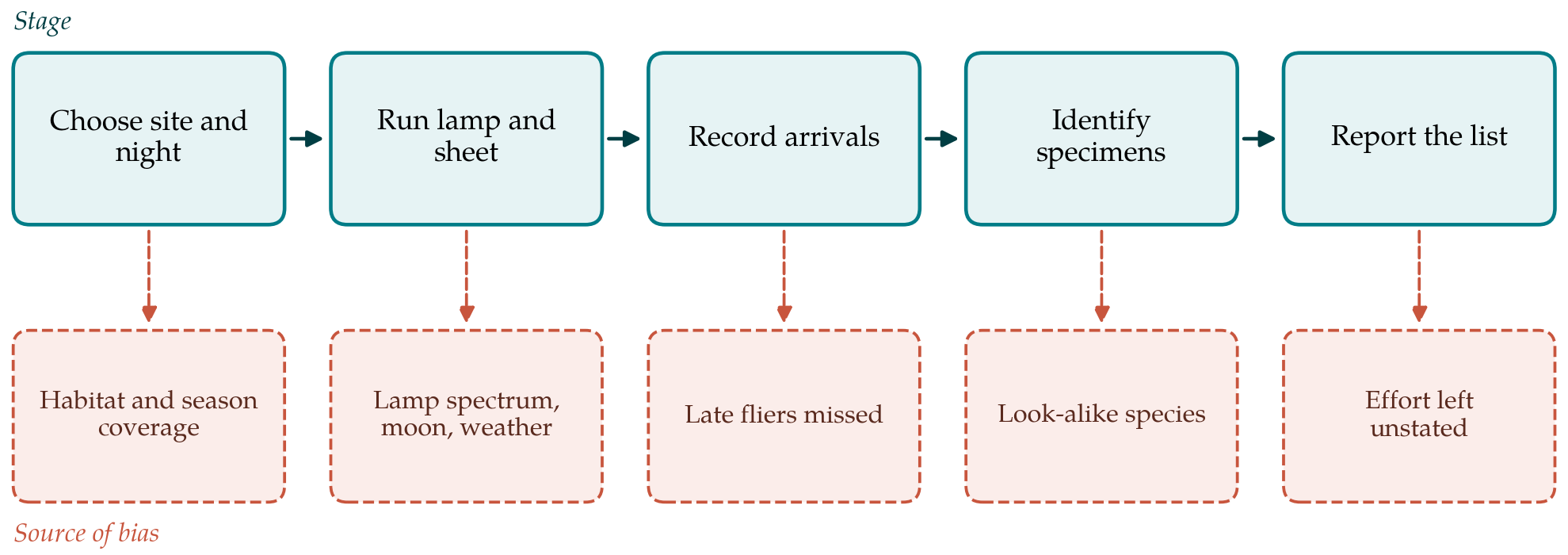
Identification is the last filter, and Figure 1 places it with the others along the path from field night to published list. Several Oriental genera contain species that differ in small details of pattern or only in the genitalia, and worn specimens add to the difficulty. DNA barcoding based on the mitochondrial cytochrome oxidase I gene (Hebert et al., 2003) has proved effective for sorting such complexes in Lepidoptera, but it requires a specimen or at least a leg. A record built entirely on photographs of live moths that were then released cannot be re-examined when the taxonomy changes.
4. Reporting Records So That They Can Be Compared
A species list without a measure of effort cannot be compared with another. The number of species recorded rises with the number of individuals examined and the number of nights worked, and two reserves may differ in their lists simply because one was visited more often (Gotelli and Colwell, 2001). Rarefaction and the associated estimators allow samples to be compared at equal size or equal completeness (Chao et al., 2014), but they need counts of individuals per species per night. Presence-only lists, which are what most foothill records provide, do not permit this.
The remedy costs little. A record should state the coordinates and elevation of each station and describe the surrounding vegetation; the lamp type and power and whether a sheet or a closed trap was used; the dates, the hours of operation and the number of nights; moon phase and weather; the number of individuals of each species on each night, or at least an abundance class; who made the identifications and against which works; and where voucher specimens or tissue are deposited. With that information a later worker can repeat the sampling, pool it with other data, and judge how complete the list is likely to be.
Collecting in protected areas requires permission under the wildlife legislation of each range state, and recorders are sometimes reluctant to seek it. The consequence is a growing body of photographic records with no material behind them. A modest series of vouchers taken under permit and lodged in a public collection would do more for knowledge of the regional fauna than many further unverifiable lists.
5. Conclusion
Light trapping will remain the practical way of recording hawkmoths in Himalayan foothill reserves, and the lists it produces are useful. Their limits should be stated with them. A lamp samples a small area for a few hours under particular conditions, favours some species over others and misses the day-fliers. If records carry the details of lamp, effort, counts and vouchers proposed here, they can be compared between sites and years and corrected as the taxonomy improves. Without those details a list shows only that the named species were present.
Conflict of interest
To be declared by the author(s) before publication.
Funding
To be declared by the author(s) before publication.