1. Introduction
Most of the milk produced in East Africa comes from farms with a handful of cows. A farmer with ten or twenty litres to sell cannot cool it, test it or carry it far, and the collection cooperative exists to do those things collectively. Members deliver to a collection point, the milk is checked, pooled in a cooling tank and sold on in bulk. Accounts of dairy development in Kenya and its neighbours describe this arrangement as the main route by which smallholders reach the formal market (Staal et al., 2008; Muriuki, 2011).
The arrangement is fragile at one point in particular. Milk leaves the udder close to body temperature and is an excellent growth medium, so the hours between milking and effective cooling decide its quality. Studies of post-harvest losses in the region identify spoilage during collection and bulking, together with spillage and rejection at the factory gate, as the principal causes of loss (Lore et al., 2005), and reviews of post-harvest loss research in sub-Saharan Africa note how unevenly such losses have been measured (Affognon et al., 2015). A cooperative that suffers repeated rejections knows that something is wrong and seldom knows what.
This article sets out a protocol for diagnosing cold chain breakdowns in a single cooperative. It offers a method and not a case report, so that a cooperative, an extension service or a processor can carry out the diagnosis for itself. The protocol is proposed, not tested: it has not been applied to a cooperative here, and no findings are reported.
2. Background
Three bodies of established knowledge underlie the design: the microbiology of raw milk, the codes and standards that say what good practice is, and what is already known about how collection chains in the region operate.
2.1. Why time and temperature govern raw milk quality
Milk drawn from a healthy udder contains few bacteria. Contamination comes from teat skin, hands, utensils and containers, and what happens next depends on temperature. At ambient tropical temperatures mesophilic bacteria multiply quickly once the short-lived natural inhibitory systems of fresh milk are exhausted, and lactic acid producers sour the milk within hours. Prompt cooling to refrigeration temperature slows growth sharply, although it does not stop psychrotrophic organisms, whose heat-stable enzymes become a problem when cold milk is stored for days (Cousin, 1982; Walstra et al., 2006). For a collection chain measured in hours, the practical variables are the initial load of bacteria and the length of time the milk stays warm.
2.2. Codes, standards and permitted alternatives to cooling
The Codex code of hygienic practice for milk requires that time and temperature between milking and processing be controlled so as to minimise microbial growth, and leaves the specific limits to national authorities (Codex Alimentarius Commission, 2004). The joint guide of the Food and Agriculture Organization and the International Dairy Federation gives the corresponding advice for the farm: clean equipment, and milk cooled or delivered within a specified time (FAO and IDF, 2011). The harmonised East African standard for raw cow milk sets the grades against which processors accept or reject deliveries (EAC, 2006). Where refrigeration is not feasible, Codex guidelines permit activation of the lactoperoxidase system to extend keeping time during collection, as a stopgap and not a substitute for hygiene or for cooling (Codex Alimentarius Commission, 1991).
2.3. What is known about collection chains in the region
Research in Kenya showed that the quality of marketed milk declines along the chain and that handling practice, container type and time to market explain much of the decline (Omore et al., 2005). Training material written for small-scale traders in Eastern Africa accordingly concentrates on containers that can be cleaned, on speed, and on the simple platform tests by which milk is accepted or refused: appearance and smell, the alcohol test, clot-on-boiling, the lactometer and the resazurin test (Kurwijila, 2006). Risk assessment of unpasteurised milk in the region has added a public health dimension to what might otherwise be seen as a commercial problem (Grace et al., 2008). The policy context matters too, since milk that fails formal channels often finds its way into informal ones (Kaitibie et al., 2010).
3. The Proposed Protocol
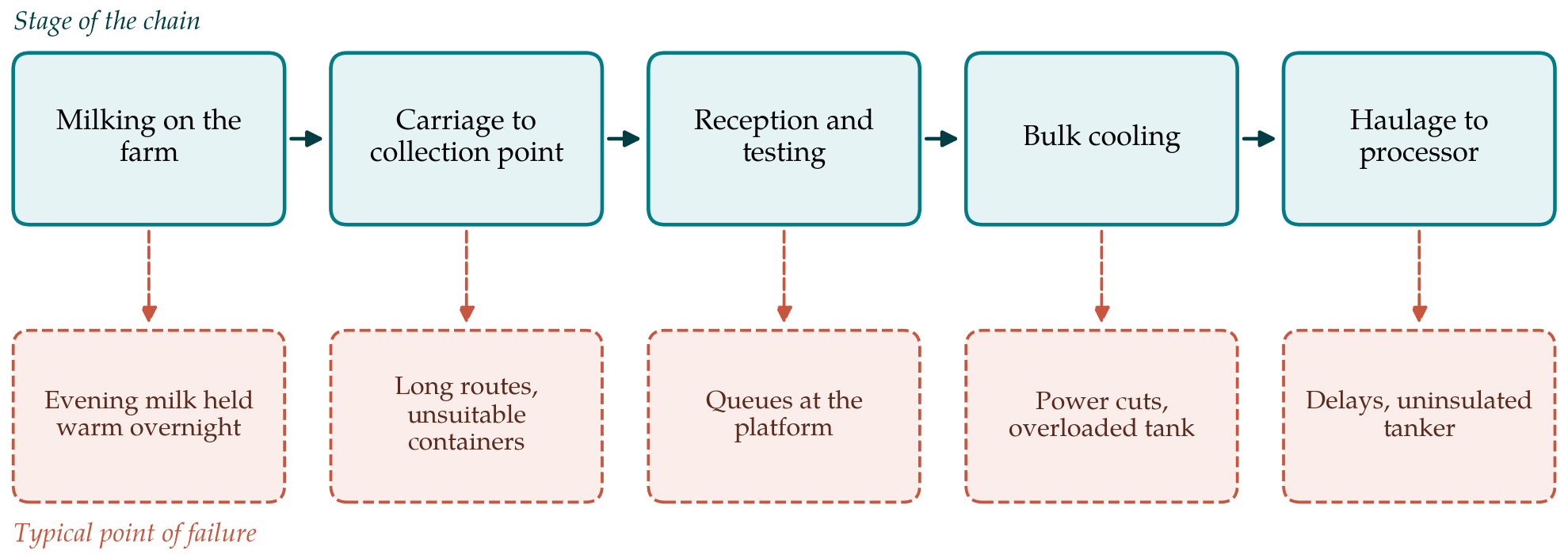
The protocol treats one cooperative as a bounded case and gathers several kinds of evidence about it, following the logic of case study design in which independent sources are compared so that no single one has to be trusted alone (Yin, 2018). Figure 1 shows the chain as a sequence of five stages with the failure most often associated with each; these are the hypotheses the protocol is built to test, not findings. Table 1 lists the steps with the evidence each collects.
| Step | Evidence gathered | Output |
|---|---|---|
| 1. Map the chain | Routes, distances, containers, hand-over points, timetable | Annotated chain map |
| 2. Log time and temperature | Logger traces from farm to processor, morning and evening milk | Cooling curves per route |
| 3. Test at control points | Platform tests and laboratory counts at fixed points | Quality profile along the chain |
| 4. Audit equipment and energy | Tank capacity, cooling rate, power interruptions, cleaning | Equipment and energy report |
| 5. Review records | Intake volumes, rejections, processor quality reports | Seasonal pattern of losses |
| 6. Observe and interview | Practices of farmers, transporters and staff | Account of causes and constraints |
| 7. Analyse failure modes | All of the above, scored by the assessment team | Ranked list of breakdowns |
| 8. Feed back and plan | Discussion with management and members | Agreed corrective actions |
3.1. Step 1: Map the chain
The first task is descriptive. The assessor walks or rides each collection route and records where milk is produced, who carries it, in what, how far and at what hours, where it changes hands and where it waits. Evening milk needs particular attention, because a cooperative that receives only in the morning leaves the evening milking on the farm overnight. The result is a map on which every later measurement can be located.
3.2. Step 2: Log time and temperature
Small battery-powered temperature loggers are placed in a sample of cans at the farm and travel with the milk to the cooling tank; further loggers record tank temperature and, where possible, the tanker's journey to the processor. The sample should cover the longest and shortest routes, morning and evening milk, and the wet and dry seasons, since road conditions and milk volumes change through the year. The traces show how long milk stays warm before it reaches the tank and how fast the tank brings each addition down, which is the direct measure of cold chain performance that rejection figures only imply.
3.3. Step 3: Test milk at control points
Temperature histories need to be tied to quality. At fixed points, namely the farm, arrival at the collection point, the bulk tank before dispatch and delivery to the processor, milk is examined with the platform tests the cooperative already uses and, for a subsample, by total bacterial count in a competent laboratory. Results are read against the grades of the regional raw milk standard (EAC, 2006). The same milk should be followed through the points where feasible, so that a deterioration can be attributed to a segment of the chain.
3.4. Step 4: Audit cooling equipment and energy supply
A cooling tank is designed for a stated volume added at a stated rate. The audit compares that specification with actual use: how full the tank runs, how warm milk is blended with cold, whether the agitator and thermostat work, how the tank is cleaned. Power is recorded separately, by logging interruptions over several weeks and noting whether a generator exists, starts and has fuel. Maintenance history and the availability of spare parts and a technician complete the picture.
3.5. Steps 5 and 6: Records, observation and interviews
Cooperatives keep intake and payment records and receive quality reports from their buyers. A review covering at least one full year shows when rejections cluster, by season, by route or by day of the week. Observation at milking, on the road and on the reception platform, together with structured interviews with farmers, transporters, graders and the manager, explains the patterns: why evening milk is or is not delivered, what transporters are paid for, how graders handle borderline milk. Interviews follow ordinary ethical practice, with consent and without recording names against answers.
3.6. Steps 7 and 8: Failure mode analysis and feedback
The evidence is then organised with two standard quality tools. A cause-and-effect diagram sorts contributing factors under headings such as people, equipment, methods, materials and environment (Ishikawa, 1976). A failure mode and effects analysis lists each way the chain can fail and scores it for severity, frequency of occurrence and likelihood of going undetected, so that the failures can be ranked (Stamatis, 2003; IEC, 2018). The scores are judgements, and the protocol requires that the evidence behind each be written beside it. The ranked list is presented to management and members, who know constraints that an outside assessor does not, and the meeting agrees which failures to address first and who is responsible.
4. Fitting the Protocol to a Cooperative
The protocol is meant to be run by a small team, for example a dairy extension officer and the cooperative's own quality staff, over one season and then repeated in the contrasting season. Its equipment is modest: loggers, a thermometer, the reagents for platform tests and access to a laboratory. Where laboratory counts are out of reach, the resazurin test offers a coarse substitute, with the loss of resolution acknowledged. Costs fall mainly on staff time, and the sample of routes should be sized to what the team can follow properly; a few routes traced well are worth more than many traced carelessly.
Members' cooperation depends on trust. Farmers whose milk is being sampled should be told that the purpose is to find faults in the system and not to penalise individuals, and results should be reported by route or stage and never by name. The corrective actions that follow are likely to be ordinary ones, such as a second daily collection, replacing containers that cannot be cleaned, a maintenance contract or a standby generator, and the value of the protocol lies in showing which of them addresses the largest loss.
5. Limitations and What Remains to Be Shown
No application of the protocol is reported here, and its usefulness is untested. It would need to be shown that the steps can be completed with the resources a cooperative has, that different assessors reach similar rankings from the same evidence, and that acting on the top-ranked failures reduces rejections measurably. The scoring in a failure mode analysis is known to be sensitive to who does it, and the protocol's insistence on documented evidence reduces that weakness without removing it.
The protocol also has boundaries. It examines temperature and time and treats hygiene at milking only so far as it sets the starting load, although poor hygiene can defeat good cooling. It does not address adulteration, antimicrobial residues or animal health. And a diagnosis in one cooperative does not generalise to others with different terrain, power supply or buyers; the method transfers, the findings would not.
6. Conclusion
Cooperatives lose milk and income to cold chain failures that are rarely located with any precision. The protocol proposed here replaces a general complaint with a set of specific, ranked failure points by following the milk with temperature loggers, testing it at fixed points, auditing the cooling plant and its power, reading the cooperative's own records and listening to the people who handle the milk. It rests on established codes and tools and asks for little equipment. Its practical worth has still to be demonstrated, and the natural next step is a documented application in one or more cooperatives across two seasons.
Conflict of interest
To be declared by the author(s) before publication.
Funding
To be declared by the author(s) before publication.