1. Introduction
Deciduous fruit trees of the temperate zone do not simply wait for spring. In autumn their buds enter a state of rest in which they will not grow even if placed in warmth, and that state is lifted only by weeks of exposure to low, non-freezing temperatures. The amount of cold needed, the chilling requirement, differs widely among species and among cultivars of the same species. It was documented for peach cultivars in the middle of the last century by Weinberger (1950), whose count of hours below 7.2 °C remains the most familiar measure of winter chill.
The requirement is an adaptation that prevents growth during mild spells in midwinter. It becomes a liability when a cultivar is grown where winters are too warm to meet it. Growers in the subtropics have dealt with this for generations (Erez, 2000). What is new is that warming winters are bringing the same difficulty to districts where the standard cultivars were once reliably satisfied. Reviews by Campoy et al. (2011), Luedeling (2012) and Atkinson et al. (2013) have drawn attention to the risk for temperate perennial crops in general.
Stone fruits deserve separate attention. The genus Prunus includes crops with some of the highest chilling requirements in commercial horticulture, such as many sweet cherries and apricots, alongside peaches bred for the tropics. Several are self-incompatible and depend on overlapping bloom of two cultivars. Their flower buds are simple, each containing one or two flowers and no leaves, so that a bud lost to poor chilling is a fruit lost. This review considers what is known about chilling shortfalls in these crops and what can be done about them.
2. Approach of the Review
This is a narrative review of the published literature on dormancy and winter chill in stone fruits. It relies on the foundational papers that defined the concepts and the chill models, on regional and global analyses of chill trends, and on the main reviews of dormancy physiology and management. The literature was read selectively and with a horticultural purpose; no systematic search was made and no meta-analysis is offered. Findings for apple and other temperate species are used where they clarify a point of general physiology.
3. Dormancy in Prunus
The terminology now in general use was proposed by Lang et al. (1987). Paradormancy is inhibition of a bud by another organ, as in apical dominance. Endodormancy is inhibition arising within the bud and is the state that chilling removes. Ecodormancy is the condition of a bud that has completed its chilling and is held back only by unfavourable weather. The earlier account of rest by Saure (1985) describes the same sequence in other words. The phases are not sharply bounded. Buds respond to warmth with increasing readiness as chilling accumulates, and additional chilling beyond the minimum reduces the heat subsequently needed for bloom (Couvillon and Erez, 1985).
At the molecular level the process is better understood in peach than in most trees. The evergrowing mutant of peach, which fails to form terminal buds or enter dormancy, carries a deletion in a cluster of six MADS-box genes, the dormancy-associated MADS-box or DAM genes (Bielenberg et al., 2008). Their expression rises with the onset of dormancy and falls as chilling accumulates. Mapping in peach placed major loci for chilling requirement and bloom date in the same genomic region (Fan et al., 2010). Broader reviews set these findings beside work on photoperiod, hormones and cell-to-cell communication in other woody plants (Rohde and Bhalerao, 2007), and a recent synthesis has tried to arrange the known processes into a single conceptual framework (Fadón et al., 2020). No measurable marker yet tells a grower that endodormancy has ended in a given orchard.
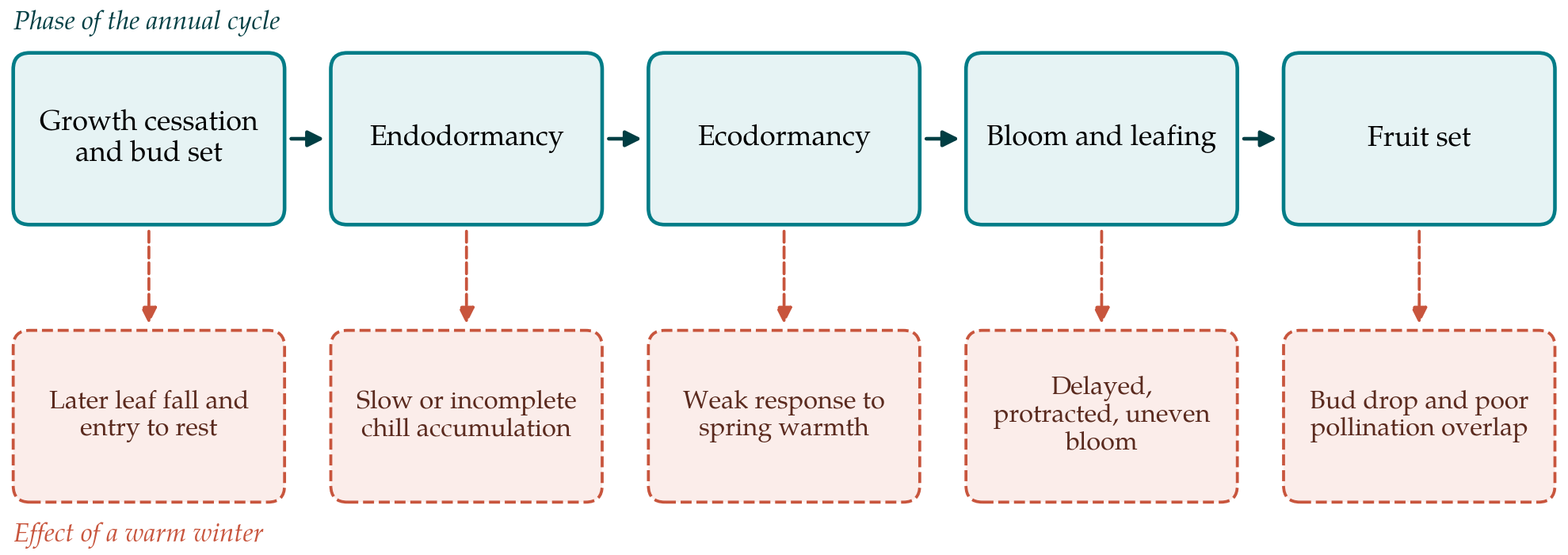
Figure 1 sets the phases of the annual cycle against the disturbance each suffers when the winter is warm. The point of the diagram is that a shortfall is not a single event at bloom. It begins with late entry into rest, continues through slow chill accumulation and a weak response to spring warmth, and ends in the visible disorders of flowering and fruit set.
4. Measuring Chill
Every statement about a chilling shortfall depends on how chill is counted, and the available models do not agree. Table 1 compares the three in commonest use and lists the heat and combined models discussed later. The Chilling Hours model counts each hour below 7.2 °C, in its usual modern form between 0 and 7.2 °C, equally and ignores all others. It is simple and has a long record, but it treats an hour at 7 °C as fully effective and an hour at 8 °C as worthless, and it takes no account of warm interruptions.
| Model | How chill is counted | Treatment of warm periods | Main limitation |
|---|---|---|---|
| Chilling Hours (Weinberger, 1950) | One unit for each hour below 7.2 °C, now usually counted from 0 °C | Ignored | Abrupt thresholds; no weighting by temperature |
| Utah model (Richardson et al., 1974) | Chill units weighted by temperature, with an optimum range | High temperatures subtract units | Negative totals in warm-winter climates |
| Dynamic Model (Fishman et al., 1987) | Chill Portions formed in a two-step process | Warmth destroys only the unfixed intermediate | Parameters derived from a narrow set of peach experiments |
| Heat models used after chill | Growing degree hours above a base temperature | Not applicable | Assume a fixed chill-then-heat sequence |
| Sequential and unified phenology models (Chuine, 2000) | Chill and heat functions fitted jointly to bloom dates | Depends on the fitted functions | Need long phenological records |
The Utah model of Richardson et al. (1974) assigns weights to temperature ranges: full value in the cool middle range, less on either side, and negative values for warm hours. It was developed for peach in a continental climate and performs reasonably there. In mild-winter regions the negative weights can cancel most of the accumulated chill, and totals no longer correspond to tree behaviour.
The Dynamic Model was built on controlled experiments showing that high temperature in a daily cycle cancels recent chilling, while moderate temperature can enhance it (Erez et al., 1979). Fishman et al. (1987) expressed this as a two-step process in which cold forms an unstable intermediate that warmth can destroy; once enough has accumulated it is converted irreversibly to a Chill Portion. The practical form of the model was given by Erez et al. (1990). Comparisons across many climates have shown that the ratios between the models' outputs are not constant from place to place, so a requirement stated in chilling hours at one site cannot be converted reliably for another, and that the Dynamic Model is generally the most consistent of the three in warm regions (Luedeling and Brown, 2011).
Cultivar requirements themselves carry uncertainty. They are usually estimated by forcing cut shoots at intervals through the winter, or by statistical analysis of bloom dates, and are then reported in the units of whichever model the authors preferred. Published values for apricot (Ruiz et al., 2007) and sweet cherry (Alburquerque et al., 2008) show the wide range within each species and, in the cherry case, how the probability of meeting a requirement changes with altitude within one growing region. Requirements determined at one location have not always held at another, which suggests that the models miss part of the biology.
A further source of error is the temperature record itself. Models are run on air temperature from a weather station, but what the bud experiences is its own tissue temperature. On clear winter days buds exposed to the sun are warmer than the surrounding air, while under fog or cloud the two are close, so that winters with the same air temperatures can differ in effective chilling. This is one explanation offered for the good bud break observed after foggy winters, and it is the basis of the cooling treatments described later (Erez, 1995).
5. Evidence That Winter Chill Is Declining
The clearest regional evidence comes from California, where deciduous orchards occupy valleys with mild, foggy winters. Baldocchi and Wong (2008) reported from station records that accumulated winter chill had been decreasing across the fruit-growing regions of the state. Luedeling et al. (2009) extended the analysis with climate projections and concluded that the area able to supply the chill needed by the more demanding species would contract substantially over the present century.
A global assessment using the Dynamic Model found that the largest losses of chill are to be expected in warm growing regions, such as the Mediterranean basin and comparable climates on other continents, while cold regions may see little change or even a gain as freezing hours, which are ineffective for chilling, become cool ones (Luedeling et al., 2011). This asymmetry matters for stone fruits. Much of the world's apricot, almond and early peach production lies in exactly the mild-winter regions where losses are projected to be greatest.
Two cautions apply to all such projections. They inherit the weaknesses of the chill models, none of which was calibrated for the temperature regimes of the future. And a decline in mean chill matters less than a rise in the frequency of years that fall below a cultivar's requirement, since an orchard is judged on its worst seasons as much as its average ones.
6. Symptoms and Consequences of a Shortfall
The disorders of insufficient chilling have been described in detail from warm-winter regions (Erez, 2000; Saure, 1985). Bud break is late and spread over a long period. Terminal buds open first and suppress the laterals, so that shoots are bare along much of their length. Leaf buds, which commonly need more chill than flower buds, lag behind the bloom, and young fruit develop without adequate leaf area nearby. In apricot and some peaches a large share of flower buds abscise before opening, and flowers that do open may have short or malformed pistils.
The consequences for cropping follow directly. Protracted bloom produces fruit of mixed age on the same tree, which complicates thinning, pest management and harvest. In self-incompatible crops such as sweet cherry, many plums and almond, cultivars with different requirements respond differently to a marginal winter, and bloom periods that normally overlap may separate, leaving flowers without compatible pollen. Trees that leaf out poorly also build weaker canopies and carry less reserve into the following year, so the effect of one warm winter can persist.
A less obvious consequence concerns spring frost. Warmer winters are sometimes assumed to advance bloom. Where chilling is ample this is so, because the heat requirement is met sooner. Where chilling is marginal the opposite can occur: endodormancy ends late and bloom is delayed despite the warmth. Bloom date under warming therefore depends on which requirement is limiting, a point made in the reviews of Campoy et al. (2011) and Atkinson et al. (2013).
7. Responses Available to Growers and Breeders
The most durable response is genetic. Breeding programmes in warm regions have produced peaches, nectarines and plums with very low chilling requirements by drawing on germplasm from southern China and selecting under local conditions (Topp et al., 2008). The identification of loci controlling chilling requirement in peach (Fan et al., 2010) opens the way to marker-assisted selection. Progress is slower in cherry and apricot, where low-chill material of commercial quality is scarcer, and low chill is not without cost: such cultivars bloom early and are exposed to frost in regions where cold spells still occur.
Chemical rest-breaking agents are the main short-term tool. Hydrogen cyanamide, mineral oils and several nitrogen compounds can partly substitute for missing chill and concentrate bud break, as reviewed by Erez (1995). Their effect depends on timing in relation to the state of the buds, they can injure buds if applied late, and the use of hydrogen cyanamide is restricted in some jurisdictions on grounds of operator safety. They compensate for a moderate deficit and not for a large one.
Orchard design offers a modest additional safeguard for the self-incompatible species. Pollinizer cultivars are conventionally chosen for genetic compatibility and for bloom overlap in normal years. Under marginal chilling it becomes as relevant that the pollinizer and the main cultivar have similar chilling requirements, so that a warm winter shifts both in the same direction. Planting more than one pollinizer, with requirements on either side of the main cultivar, spreads the risk at some cost in orchard uniformity. Published requirements, such as those for sweet cherry (Alburquerque et al., 2008), make such matching possible in principle, subject to the reservations about transferability already noted.
Cultural measures aim to lower bud temperature or to manage the tree's entry into rest. Overhead sprinkling during warm winter days cools buds by evaporation, and shading has the same purpose (Erez, 1995). Avoiding late vegetative growth, so that trees enter dormancy on time, lengthens the period over which chill can accumulate. In the tropics, growers of low-chill peaches defoliate and prune to synchronise bud break (Erez, 2000). Finally, new plantings can be sited at higher elevation or in cooler districts, an option whose value for sweet cherry is evident from the altitude analysis of Alburquerque et al. (2008), though it is open only to those who can move.
8. Gaps and Research Needs
The largest gap lies in the models. The Dynamic Model captures the cancelling effect of warm interruptions, but its parameters come from a small number of experiments on peach, and it is applied unchanged to species and climates for which it was never tested. Chill and heat are treated as sequential, although the evidence that extra chill lowers the heat requirement (Couvillon and Erez, 1985) shows that they overlap. Models that integrate the two, of the kind proposed for forest trees by Chuine (2000), need long bloom records for calibration, and for most stone fruit cultivars these are not publicly available.
A second gap is the absence of a practical marker of dormancy status. Growers timing a rest-breaking spray, and researchers estimating requirements, still depend on forcing shoots in a warm room. The DAM genes and associated metabolic changes are candidates, but none has been turned into a validated field test (Fadón et al., 2020). Third, the requirements published for many cultivars were determined once, at one site, with one model. Coordinated re-evaluation across sites, with shared protocols and with results reported in Chill Portions, would give growers and modellers a firmer base.
9. Conclusion
Insufficient winter chill is an established cause of poor cropping in stone fruits, and the evidence that chill is diminishing in warm growing regions is consistent across independent analyses. The physiological sequence from warm winter to lost crop is understood in outline, and the genetic control of dormancy in peach is better known than in any other fruit tree. What remains weak is quantification: chill models that disagree, cultivar requirements of doubtful transferability, and no field marker of dormancy release. Low-chill breeding offers the most lasting remedy, with rest-breaking treatments and microclimate management as partial supports. Planting decisions made now will be tested by the winters of several decades, which is reason enough to choose cultivars with a margin of safety.
Conflict of interest
To be declared by the author(s) before publication.
Funding
To be declared by the author(s) before publication.