1. Introduction
A generation ago the university incubator was a facility for academic staff with a patent and a plan to commercialise it. Today the typical tenant is as likely to be an undergraduate team with a prototype application and no intellectual property at all. Campus incubators, summer accelerators, pitch competitions and seed funds have multiplied, and university leaders present them as evidence that the institution produces founders as well as graduates. Wright et al. (2017) describe the result as an emerging ecosystem for student start-ups, with its own support structures, investors and intermediaries.
Research has not kept pace. The literature on business incubation is large, but it was built around technology firms founded by experienced adults, and the literature on university entrepreneurship has concentrated on faculty spin-offs and licensing (Rothaermel et al., 2007). Students fall between the two. They differ from other founders in ways that matter for evaluation: they are young, they have little to lose, their teams dissolve at graduation, and for many the venture is as much a course of learning as a business.
This review asks what is known about whether university incubators improve outcomes for student startups, what the existing evidence leaves out, and how future work could do better. It treats outcomes broadly, covering the venture and the student who founded it.
2. Scope and Approach
The review is narrative. It draws on widely cited reviews and empirical studies of business incubation, on research into university-linked incubators and accelerators, and on evaluations of entrepreneurship education in higher education, selected for their influence and their bearing on students. It does not report a systematic search. Because studies that isolate student-founded ventures within university incubators are few, much of the argument rests on evidence from adjacent populations, and the text says so wherever an inference is carried across.
3. What Incubation Is and How It Has Changed
Definitions matter because the word covers very different things. Hackett and Dilts (2004), in an early systematic review, observed that studies had used incompatible definitions and had seldom specified what the incubator actually did for its tenants. Bergek and Norrman (2008) proposed describing any incubator by three components, namely how it selects, what business support it gives and how it mediates between tenants and the outside world, and insisted that performance can be judged only against the goals a given incubator has set.
Models have shifted over time. Bruneel et al. (2012) distinguish three generations: a first that offered space and shared services, a second that added coaching and training, and a third built around access to networks. The accelerator, a fixed-term and cohort-based programme that ends in a pitch event, is a more recent form (Cohen, 2013; Pauwels et al., 2016). Most student programmes resemble accelerators more than first-generation incubators, since students need little office space and a great deal of guidance. Universities have their own reasons for hosting such programmes, including regional engagement and the triple helix role described by Etzkowitz (2002).
4. Evidence on Venture Outcomes
The central empirical question is whether ventures that pass through an incubator do better than they would have done without it. Three bodies of evidence bear on the answer.
4.1. Incubators in general
The most careful studies compare incubated firms with matched firms outside. Working with Italian data, Colombo and Delmastro (2002) found that firms in technology incubators grew faster and had better access to public subsidies than comparable firms elsewhere, though on other measures the two groups looked alike. Schwartz (2013) followed graduates of German incubators and a control group over many years and found no statistically significant survival advantage for the incubated firms. In a large United States sample, Amezcua et al. (2013) showed that the effect of incubation on survival depended on the founding environment and on the type of support given. Reviews of the field reach a cautious verdict and stress the weakness of theory and the lack of agreed measures (Phan et al., 2005; Mian et al., 2016).
4.2. University-linked incubators
A university link might add value through laboratories, reputation and a supply of student labour, which were the contributions tenants valued in the early work of Mian (1996). The effect on outcomes is less straightforward. Studying firms in the incubator of a large American technical university, Rothaermel and Thursby (2005) found that strong ties to the sponsoring university reduced the likelihood of outright failure and also delayed timely graduation from the incubator. A sheltered firm survives, in other words, but may be slow to stand alone. These studies concern technology ventures with faculty or licensing links, not student teams, and whether the same pattern holds for students is unknown.
4.3. Accelerators and peers
Research on accelerators is closer to the student case. Hallen et al. (2020) compared ventures accepted by accelerators with those that narrowly missed acceptance and concluded that many programmes do improve outcomes, and that the benefit comes mainly from intensive, broad consultation that speeds learning, not from the credential or the cash. That finding implies that the content of a programme matters more than its brand. Peer effects are less benign than is often assumed. Exploiting the random assignment of business school students to sections, Lerner and Malmendier (2013) found that a larger share of peers with entrepreneurial experience lowered the rate of entrepreneurship after graduation, apparently by discouraging weaker ideas. An incubator that talks a student out of a poor venture may have done its job.
5. Evidence on Student Outcomes
If the venture is one unit of analysis, the student is another, and here the relevant evidence comes from entrepreneurship education. A systematic review by Nabi et al. (2017) found that most impact studies measure short-term and subjective outcomes such as attitudes and intentions, and that few follow students into actual venture creation or performance. Programmes can raise intentions, partly through inspiration (Souitaris et al., 2007). They can also lower them: an evaluation of a student company programme in the Netherlands found no gain in self-assessed skills and a fall in the intention to become an entrepreneur (Oosterbeek et al., 2010).
Learning theory gives reason to expect benefits that venture statistics miss. Politis (2005) argues that entrepreneurial knowledge is built by transforming experience, including the experience of failure, and a year spent running even an unsuccessful startup is such experience. Graduates matter more to the stock of new firms than is commonly recognised: Åstebro et al. (2012) show that recent graduates start far more businesses than their professors do and argue that policy should attend to students accordingly. Comparative work on campuses in the United States, India and the Netherlands describes education, stimulation and incubation as successive forms of support (Jansen et al., 2015), and Table 1 lists the outcome measures that evaluations of these forms have used.
| Outcome | Typical indicator | What it captures | Main weakness |
|---|---|---|---|
| Venture survival | Firm still trading after a set period | Persistence of the business | Closure at graduation is not failure |
| Graduation | Exit from the incubator on schedule | Readiness to operate alone | Reflects incubator rules as much as the firm |
| Funding raised | External investment obtained | Investor confidence | Favours a narrow class of ventures |
| Jobs and revenue | Employees and sales | Economic contribution | Slow to appear; hard to verify |
| Intentions and efficacy | Survey scales before and after | Change in the student | Self-reported and short-term |
| Later career | Employment, earnings, later founding | Lasting value of the experience | Needs long follow-up; rarely collected |
6. Blind Spots
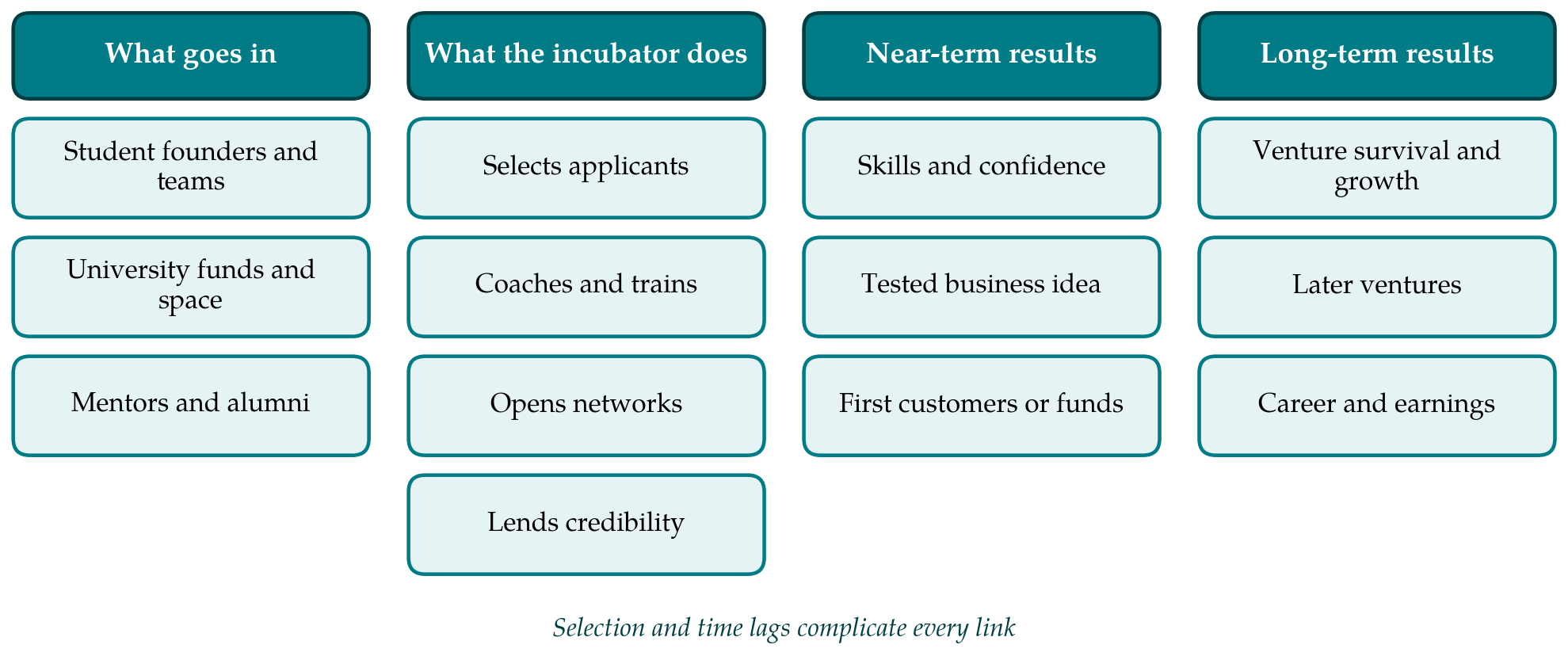
Taken as a whole, the literature gives modest support to the idea that well-designed programmes help ventures and leaves the student case largely unexamined. Figure 1 sets out the chain of reasoning that an evaluation has to follow, from what goes into an incubator to the long-term results claimed for it. Each link in that chain has a characteristic weakness.
6.1. The choice of outcome
Survival is the default measure, and for students it is misleading. A team that winds up its company when its members graduate into jobs has not necessarily failed, and a company kept alive on paper has not necessarily succeeded. Funding raised is easy to count but describes only ventures of the kind investors back. If incubators are educational investments, the proper outcomes include what the student can do afterwards, and those are seldom recorded.
6.2. Selection
Incubators choose their tenants, and applicants choose to apply. Comparing incubated students with other students therefore confounds the programme with the people. The stronger incubator studies use matched controls or acceptance thresholds, but such designs are scarce for campus programmes, where records of rejected applicants are rarely kept. Selection also works in the other direction: an incubator judged on survival has an incentive to admit ventures that would have survived anyway.
6.3. Time horizon and the counterfactual
Most evaluations end within a year or two of the programme, while the effects that matter most, such as a second and better venture or a career shaped by early founding experience, may take a decade to show. The counterfactual is also poorly specified. For an adult founder the alternative to incubation is starting without it. For a student the alternative may be an internship or a graduate job, and the cost of a year spent on a startup that closes includes the experience and earnings forgone.
6.4. Access and geography
Little is known about who gets into campus incubators and who does not. Programmes that select on pitching skill and prior networks may favour students who already have advantages, and international students may face legal limits on self-employment. Studies of student accelerators have begun to treat the surrounding ecosystem as part of the explanation (Breznitz and Zhang, 2019), but nearly all the evidence comes from North America and Western Europe. Universities in Asia, Africa and Latin America have opened incubators in large numbers, under different labour markets and funding conditions, and findings should not be assumed to transfer.
7. Future Directions
Several steps would improve matters without great expense. Incubators could keep records of all applicants, including those turned away, so that near-miss comparisons become possible. Where demand exceeds places, admission among qualified applicants could be decided partly by lottery, which is fair to applicants and yields a clean comparison. Universities hold an asset that independent incubators lack: alumni records, which allow founders and non-founders to be followed for many years at low cost.
Researchers, for their part, should describe the programme being studied in the terms proposed by Bergek and Norrman (2008), so that results from a selective accelerator are not pooled with those from an open co-working space. They should report student-level outcomes alongside venture outcomes, state the comparison group explicitly, and treat a well-founded decision to abandon a venture as a possible success. Qualitative studies of what students learn, and of what happens to teams at graduation, would help to explain the patterns that quantitative work finds.
8. Conclusion
University incubators for students have spread faster than the evidence for them. Research on incubation in general gives grounds for caution about survival effects, research on accelerators suggests that intensive learning is the active ingredient, and research on entrepreneurship education shows that programmes can lower intentions as well as raise them. None of this amounts to a verdict on student incubators, because the studies that would deliver one have largely not been done. The most useful change would be for universities to decide what their incubators are for, to measure those outcomes over a period long enough to matter, and to keep the records that make an honest comparison possible.
Conflict of interest
To be declared by the author(s) before publication.
Funding
To be declared by the author(s) before publication.