1. Introduction
Road freight is the part of the vehicle market in which automation makes the plainest commercial sense. Long-haul trucks spend most of their working lives on motorways, a comparatively orderly environment; driver wages and hours-of-service limits dominate operating cost; and fuel savings from close-following platoons have been demonstrated in a series of national projects (Tsugawa et al., 2016). It is widely expected that high levels of driving automation, in the sense of the SAE taxonomy (SAE International, 2021), will reach motorway freight before they reach general urban traffic (Shladover, 2018).
If that expectation is right, road authorities will soon be asked a concrete question: whether a lane, or a carriageway, can be set aside for automated trucks. The idea of separating trucks is not new. Truck-only lanes and toll truckways were studied in detail in the United States two decades ago (Samuel et al., 2002; Fischer et al., 2003). Automation adds a fresh motive, since separation removes the hardest part of the automation problem, interaction with unpredictable human drivers, and simulation studies of reserved lanes for automated vehicles report gains in flow at sufficient market penetration (Talebpour et al., 2017).
The argument of this article is that the request will come before the standards are ready for it. The documents that govern how a lane is laid out, how thick its pavement is and what loads its bridges carry do not yet contemplate a lane in which no vehicle has a driver.
2. What Current Standards Assume
The assumptions are easiest to see in three places. In geometric design, stopping sight distance in the AASHTO policy is the sum of the distance travelled during a perception-reaction time of 2.5 seconds and a braking distance at a comfortable deceleration, checked from a specified driver eye height to an object of specified height (AASHTO, 2018). Those values rest on measurements of human drivers (Fambro et al., 1997). Crest curves, horizontal sight lines past barriers, and decision sight distance at interchanges all follow from them. Lane width, likewise, reflects the lateral room a human needs to hold a heavy vehicle in lane, and the review of truck characteristics that informs the policy treats the driver as part of the vehicle (Harwood et al., 2003).
In pavement design, traffic is converted to repetitions of load at a point. Both the older empirical method and the mechanistic-empirical procedure that succeeded it take for granted that successive wheels do not track exactly the same line (AASHTO, 1993). The mechanistic-empirical guide makes this explicit by treating lateral wheel position as normally distributed about the wheel path, with a default standard deviation of 10 inches, about 250 mm (AASHTO, 2008). Wander spreads damage. In structural design, the notional live load models for bridges were calibrated to observed mixed traffic, in which heavy trucks follow one another at close spacing only occasionally (AASHTO, 2020).
3. Where Automated Trucks Depart From Those Assumptions
Table 1 sets the main assumptions against the behaviour to be expected of automated trucks running in a lane of their own. Some departures relax a constraint and some tighten it, which is why a simple verdict that automation makes roads "easier" or "harder" to design is not available.
| Design element | Assumption in current standards | Condition with automated trucks |
|---|---|---|
| Stopping sight distance | Human reaction time; driver eye height (AASHTO, 2018) | Sensor range, mounting height and processing delay govern |
| Lane width | Room for human steering error | Precise tracking; narrower lanes conceivable |
| Pavement loading | Wheels wander laterally (AASHTO, 2008) | Channelised wheel paths unless wander is programmed |
| Load timing | Random arrivals with rest between heavy axles | Platoons apply closely spaced groups of axles |
| Bridge live load | Calibrated to mixed traffic (AASHTO, 2020) | Several heavy trucks at short, regular headways |
| Shoulders and refuge | Driver steers a disabled vehicle clear | Minimal-risk manoeuvre needs a defined stopping place |
| Access and egress | Driver merges and weaves by judgement | Transfer zones where control or lane changes |
Pavement loading is the best documented case. A truck that holds the centre of its lane to within a few centimetres concentrates every axle pass on the same strip. Noorvand et al. (2017) modelled this and found that zero-wander positioning accelerates rutting and fatigue relative to human traffic, while a deliberately uniform distribution of positions across the lane could do better than human drivers manage; later analyses of lateral control modes reached compatible conclusions (Chen et al., 2019). The pavement life of a dedicated lane therefore depends on a software setting that no pavement standard currently specifies or even mentions.
Platooning adds a second effect. Closely spaced trucks shorten the rest period between load pulses, which matters for viscoelastic recovery in asphalt, and place several heavy vehicles on a bridge span together more often than the calibration traffic did. Gungor and Al-Qadi (2020) have shown that spacing and lateral position within a platoon can be optimised to limit pavement damage, which again makes infrastructure life a function of operating rules. On sight distance, the governing quantities become sensor range and height and system latency, which may be better or worse than a human's depending on weather and geometry. On refuge and access, a driverless truck that suffers a fault must stop somewhere safe by itself, and vehicles must enter and leave the lane at places designed for the purpose. Reviews of infrastructure needs for automated driving list these matters as open (Farah et al., 2018).
Maintenance practice is affected as well. Automated trucks read lane markings and signs by camera and locate themselves against mapped features, so the condition of markings, the consistency of signing and the accuracy of the map become matters of operational safety. Work zones, which displace lanes and replace permanent markings with temporary ones, are a known difficulty. Maintenance standards for a dedicated lane would need to say how such changes are communicated to vehicles and whether the lane is closed to automated operation while they last.
4. Why the Lanes Are Likely to Come First
Standards move slowly for good reasons. A geometric policy or a bridge specification is revised through committees, balloting and supporting research over cycles of many years, and it changes only when the evidence is thought secure. Deployment decisions are made on a different clock. A freight corridor operator, a port authority or a toll concessionaire can propose converting an existing lane within a single budget cycle, and designation of a lane by signs and markings requires little construction. Policy reviews have noted for some time that infrastructure and regulation trail vehicle technology (Fagnant and Kockelman, 2015; Milakis et al., 2017).
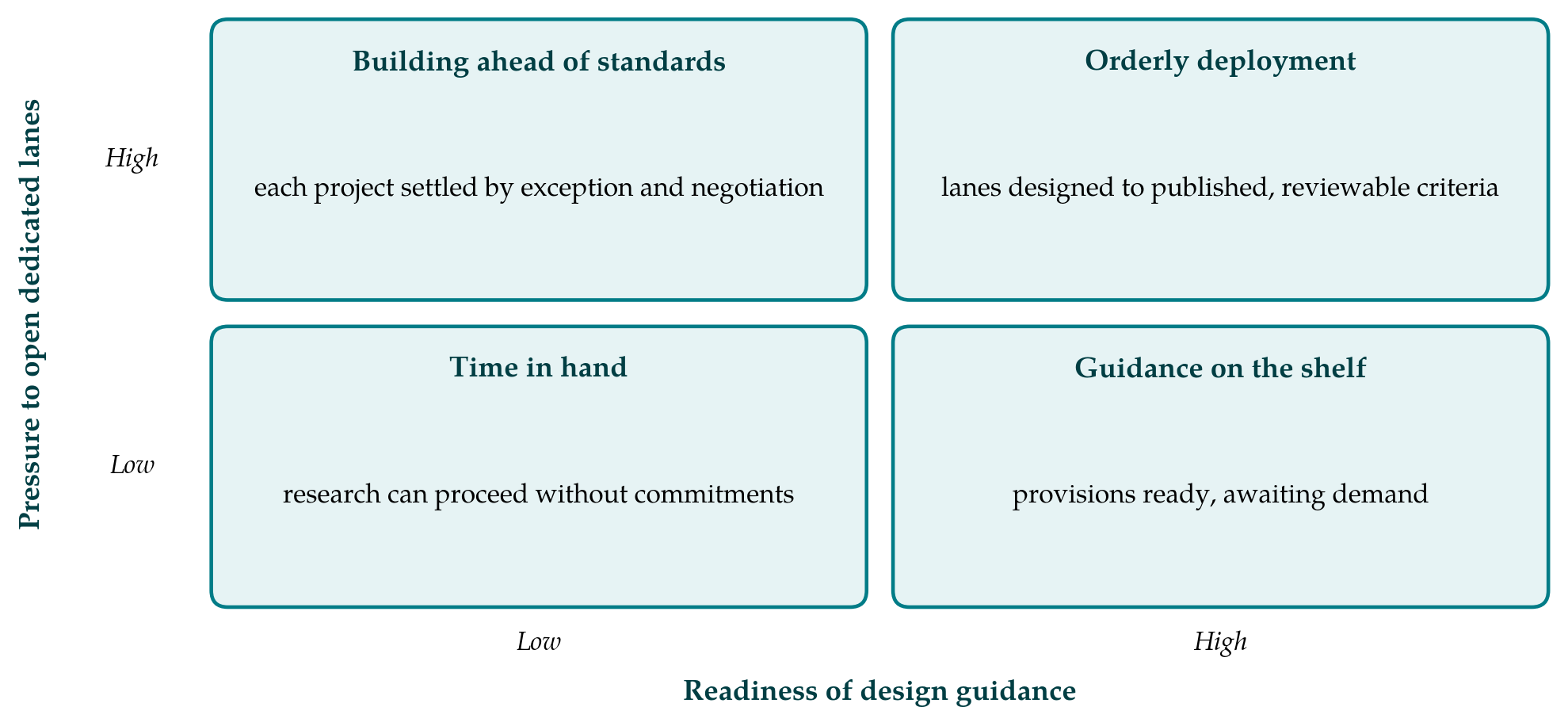
Figure 1 frames the situation as two dimensions: how strong the pressure to open dedicated lanes is, and how ready the design guidance is. The upper-left quadrant, strong pressure with little guidance, is the one this article expects many jurisdictions to enter first. In that quadrant each project is settled by design exception and negotiation between the authority and the operator, the reasoning is recorded unevenly if at all, and the next project starts again from nothing.
5. Counter-Arguments
Three objections deserve a serious answer. The first is that automated vehicles are being engineered to operate on roads as they exist, among human drivers, and that the industry does not want to depend on special infrastructure. That is true of developers' stated aims, and mixed operation will certainly be the general case. But the argument here does not require dedicated lanes to be common. It requires only that some be created, on the busiest freight corridors or at the approaches to ports and terminals, and those are exactly the places where pavements and structures are already most heavily loaded.
The second objection is cost. Earlier studies of truck-only facilities found them hard to finance except where truck volumes were very high (Fischer et al., 2003). A newly built truckway remains expensive. Conversion of an existing lane is not, and it is conversion, on pavements and bridges designed for wandering, randomly spaced human-driven traffic, that raises the sharpest engineering questions.
The third objection is that standards written ahead of experience tend to be wrong and, once written, hard to change. This is the strongest of the three, and it rules out one kind of response: detailed prescriptive dimensions for a facility type that scarcely exists. It does not rule out guidance of another kind.
6. What Standards Bodies Could Do Now
The useful step is interim guidance that is performance-based and short. On pavements, it would require the designer of a dedicated lane to state the lateral position distribution assumed, and the operator to maintain it, treating programmed wander as a design input in the same way as axle load. On structures, it would ask for a check of bridges under a specified platoon configuration, with minimum headways on spans that fail it. On geometry, it would state that sight distance may be verified against documented sensing performance where no human driver is present, while retaining conventional values wherever human-driven vehicles may use the lane, including in emergencies and during maintenance.
On access and refuge, interim guidance would call for defined transfer zones at entry and exit and for stopping places at stated intervals where a vehicle can complete a minimal-risk manoeuvre without blocking the lane. And for every early project it would require a design record: what was assumed, which existing provisions were departed from, and what was observed in service. Such records are the raw material from which durable standards are later written, and without a requirement they are seldom kept. None of this needs new research to begin; it needs the relevant committees to acknowledge the facility type.
There is also a governance point. The variables that now determine infrastructure life, wander settings, platoon spacing and operating speed, belong to vehicle operators, while the asset belongs to the road authority. Agreements for dedicated lanes should therefore place those variables under the authority's specification, and give it the data to verify them.
7. Conclusion
Highway standards encode a model of the driver, and a lane without drivers falls outside it. The commercial case for automated freight on motorways, and the low cost of redesignating an existing lane, make it probable that such lanes will be requested before geometric, pavement and structural documents have anything specific to say about them. Waiting for mature evidence would leave early projects to improvisation, and writing detailed rules now would outrun what is known. A brief set of performance-based interim provisions, coupled with an obligation to document early designs, would let practice and standards advance together.
Conflict of interest
To be declared by the author(s) before publication.
Funding
To be declared by the author(s) before publication.