1. Introduction
Haemorrhage accounts for more maternal deaths than any other direct cause, according to the World Health Organization's systematic analysis (Say et al., 2014). Postpartum haemorrhage is conventionally defined as blood loss of 500 mL or more within 24 hours of birth, with 1000 mL or more regarded as severe (WHO, 2012). The interventions that limit harm are familiar: uterotonic drugs, uterine massage, intravenous fluids, tranexamic acid, examination for retained tissue and trauma, and timely escalation to surgical or radiological measures when these fail. The WOMAN trial showed that tranexamic acid reduces death due to bleeding when given soon after onset, with the benefit declining as the delay lengthens (WOMAN Trial Collaborators, 2017). Speed and sequence therefore matter as much as the content of treatment.
Guidelines set out what should happen (Mavrides et al., 2017; ACOG, 2017). What actually happens on a labour ward at three in the morning is harder to establish. Confidential enquiries and facility-based reviews repeatedly identify delay in recognition and delay in escalation as recurring features of deaths and near misses (WHO, 2004). A ward that wishes to know its own performance needs a way of examining ordinary cases, not only the catastrophic ones.
This article proposes a checklist based method for auditing the response to postpartum haemorrhage from case records. It describes the reasoning behind the design and the steps for applying it. It does not report the results of an audit, and the checklist has not been validated.
2. Background
Three bodies of work inform the method: the tradition of criterion-based audit in obstetrics, the use of bundles and checklists in haemorrhage care, and the evidence on whether audit changes practice.
2.1. Criterion-based audit
Donabedian (1988) distinguished three aspects of care that can be assessed: structure, process and outcome. Outcomes of postpartum haemorrhage such as hysterectomy or death are too rare on a single ward to reveal much, and they depend on case mix. Process, meaning what was done and when, is more informative and more directly within the control of staff. Criterion-based audit compares the process of care recorded in case notes against a short list of explicit, evidence-based criteria, and it has been applied to obstetric emergencies in settings with few resources because it requires little more than records and a trained reviewer (Graham, 2009). The World Health Organization includes it among the recommended approaches for reviewing maternity care (WHO, 2004).
2.2. Bundles and checklists in haemorrhage care
Checklists reduce reliance on memory in tasks where steps are known but easily omitted under pressure (Hales and Pronovost, 2006), and the surgical safety checklist demonstrated their effect on outcomes across diverse hospitals (Haynes et al., 2009). In obstetrics, the consensus bundle on obstetric haemorrhage of the National Partnership for Maternal Safety organised care into readiness, recognition and prevention, response, and reporting and systems learning (Main et al., 2015). A World Health Organization technical consultation defined a first response bundle and a bundle for refractory bleeding (Althabe et al., 2020). The E-MOTIVE trial then tested early detection with a calibrated drape together with a bundle of uterine massage, oxytocic drugs, tranexamic acid, intravenous fluids, examination and escalation, and found a lower risk of the composite of severe haemorrhage, laparotomy or death from bleeding than with usual care (Gallos et al., 2023). These sources supply the content from which audit criteria can be drawn.
2.3. Whether audit changes practice
The Cochrane review of audit and feedback found that it generally produces small to moderate improvements in professional practice, with larger effects when baseline performance is low, when feedback comes from a supervisor or colleague, when it is given more than once and in both verbal and written form, and when it includes explicit targets and an action plan (Ivers et al., 2012). An audit that ends with a report filed in an office should not be expected to change anything. The method below builds feedback and re-audit into the design for that reason.
3. The Proposed Method
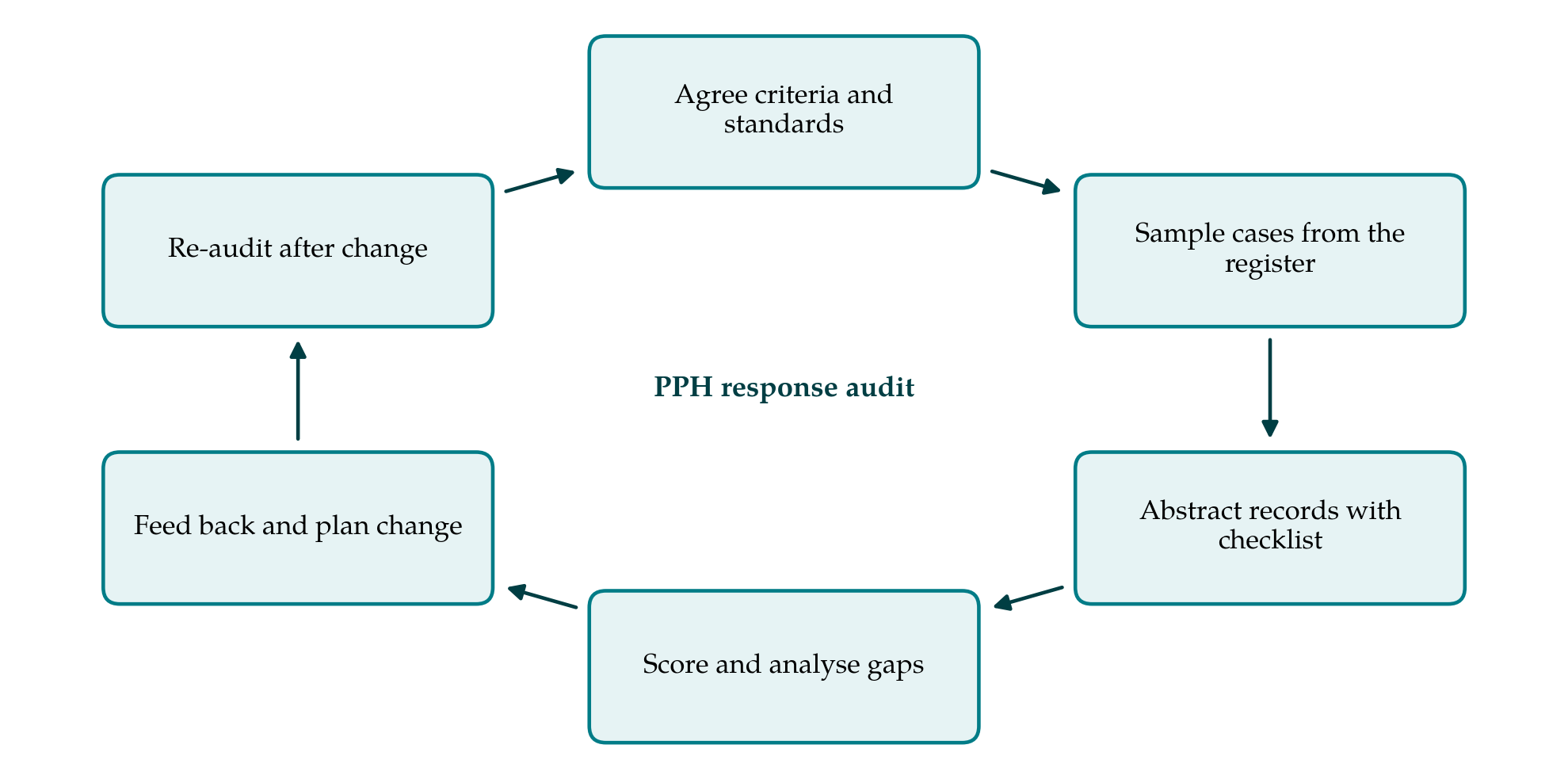
The method has six stages arranged as a cycle, shown in Figure 1. Each is described in turn.
3.1. Stage 1: Agree criteria and standards
A small multidisciplinary group, including midwives, obstetricians, an anaesthetist and a member of the blood bank staff, selects the criteria. Each criterion should be supported by guidance that the unit already accepts, should be verifiable from the record, and should refer to something staff can change. The criteria are grouped into the six domains set out in Table 1. The group also sets the standard for each, meaning the proportion of cases in which the criterion ought to be met. For core first-response actions the standard will normally be all cases; for criteria with legitimate exceptions it may be lower, and the exceptions should be written down.
| Domain | Example criteria | Source of criteria |
|---|---|---|
| Recognition | Blood loss measured, not only estimated; observations charted at onset | Mavrides et al., 2017; Gallos et al., 2023 |
| Communication | Help called; senior midwife, obstetrician and anaesthetist informed, with times | Main et al., 2015 |
| First response | Uterine massage, uterotonic, intravenous access and fluids, tranexamic acid | WHO, 2012; Althabe et al., 2020 |
| Search for cause | Placenta checked; genital tract examined; bladder emptied | ACOG, 2017 |
| Escalation | Blood requested; second-line measures or theatre when bleeding continues | Mavrides et al., 2017 |
| Documentation | Timed record of events, cumulative loss, debrief with the woman | Main et al., 2015 |
3.2. Stage 2: Sample cases
Cases are identified from the birth register using the unit's own threshold for recording a haemorrhage. All cases in a defined period are preferable to a selection, because selection invites the choice of memorable cases. If the number is too large, a random or systematic sample is drawn from the list. The audit should state how cases were found, since bleeds that were never recognised will not be in the register, and under-recognition is itself a failure the audit cannot see directly. Visual estimation is known to underestimate larger losses (Bose et al., 2006), so a ward that relies on it will register fewer cases than one that measures.
3.3. Stage 3: Abstract records with the checklist
Two abstractors who were not involved in the care review each record independently for the first batch of cases. For every criterion they mark met, not met, or not applicable, and a fourth option, not recorded, when the notes are silent. Keeping not recorded separate from not met is essential, because the two call for different remedies. Where the record gives clock times, the abstractors note the time of birth, recognition, call for help, first uterotonic, tranexamic acid and arrival of senior staff, from which intervals can be derived. A short written guide defines each criterion and gives worked examples of borderline entries.
Agreement between the two abstractors is then calculated for each criterion using the kappa statistic, which corrects for agreement expected by chance (Cohen, 1960) and is commonly interpreted against the descriptive bands suggested by Landis and Koch (1977). Criteria with poor agreement are redefined or dropped before the remaining cases are abstracted by a single reviewer.
3.4. Stage 4: Score and analyse
Results are summarised by criterion, as the proportion of applicable cases in which it was met, and set beside the agreed standard. A single overall score per case is tempting and should be avoided, because it hides which actions are being missed and implies that all criteria carry equal weight. Intervals are summarised by their median and range. The proportion of items not recorded is reported for each criterion as a finding in its own right. The analysis is descriptive, and comparisons between shifts or staff groups should be made only where numbers are adequate and never in a form that identifies individuals.
3.5. Stage 5: Feed back and plan change
Findings are presented to the staff who provide the care, in a meeting and in a one-page written summary, by someone they regard as a colleague. Following the evidence on effective feedback, the summary names the two or three criteria furthest from standard, proposes a target for each and records who will do what (Ivers et al., 2012). Typical responses include a haemorrhage box with drugs and a prompt card, a pre-printed record sheet with time fields, drills, or a change in how blood loss is measured.
3.6. Stage 6: Re-audit
The same checklist is applied to a new sample after the changes have had time to take effect. Criteria, definitions and sampling are kept constant so that the two rounds can be compared. If the work is written up, the SQUIRE guidelines for reporting quality improvement provide a suitable structure (Ogrinc et al., 2016).
4. Fitting the Method to a Labour Ward
The method is intended to be within reach of a district hospital. It needs a register, case notes, a few hours of protected time and a checklist of about twenty items. In units with electronic records, timings may be extracted automatically and the abstraction is quicker. In units with sparse paper notes, the first round will mainly reveal what is not written down, and the most useful first change may be a structured haemorrhage record that makes the next round possible. Criteria must match local resources. A criterion on tranexamic acid or blood products is meaningless where they are not stocked, although their absence is a structural finding that should be reported to those responsible for supply.
The audit must be conducted as a review of the system. Experience with maternal death reviews shows that staff disengage when findings are used for blame (WHO, 2004). Anonymised abstraction, reporting in aggregate, and agreement in advance about how any serious individual concern would be handled protect both staff and the credibility of the exercise.
5. Limitations and What Remains to Be Shown
The method is proposed and has not been validated. Its central weakness is that it audits the record and not the event. Care that was given and not written down counts against the ward, and a tidy record written afterwards may conceal delay. Recorded times are often rounded or reconstructed. Direct observation or video review would be more accurate, but they are costly, intrusive and impractical for an unpredictable emergency. The audit also sees only recognised cases and says nothing about haemorrhages that were missed.
A pilot would need to establish that the criteria can be abstracted with acceptable agreement between reviewers, that the proportion of not recorded entries is low enough for results to be interpretable, that the time required is sustainable, and that staff find the feedback credible. Whether repeated cycles improve the measured process, and whether such improvement is accompanied by better outcomes for women, are separate questions that would need a controlled evaluation.
6. Conclusion
The response to postpartum haemorrhage is a sequence of simple actions whose value depends on timeliness, and a labour ward can examine its own delivery of them with modest means. The checklist method proposed here takes its criteria from accepted guidance, separates what was not done from what was not recorded, checks the reliability of abstraction, and ties the findings to feedback and re-audit. It is offered as a starting point for local testing and refinement.
Conflict of interest
To be declared by the author(s) before publication.
Funding
To be declared by the author(s) before publication.