1. Introduction
In December 2022 a magazine article announced that the college essay was dead (Marche, 2022). The occasion was the public release of a conversational program able to produce, in seconds, several hundred words of orderly prose on almost any topic a teacher might set. The technology behind it, large language models built on the transformer architecture and trained to predict the next word across enormous bodies of text, had been developing for some years. What changed was access: a student no longer needed skill or money to use it.
Humanities teachers felt the shock most because their teaching leans hardest on the essay. A history, literature or philosophy course typically asks students to read, to form a view and to defend it in continuous prose written outside class. That exercise is how the disciplines have both taught and examined. This article argues that the two functions have now come apart, that the right response is to hold on to the first and rebuild the second, and that abandoning the essay would give up the thing most worth keeping.
2. What the Essay Has Been For
The word comes from Montaigne, who called his writings attempts or trials, and who presented them as a record of a mind testing itself against a subject (Montaigne, 1958). Adorno (1984) defended the form on similar grounds: the essay proceeds without a fixed method, stays close to its object and resists the demand that thought arrive at a system. On this understanding an essay is not a container into which finished conclusions are poured. It is the place where they are reached.
Research on composition gave the idea an empirical footing. Emig (1977) argued that writing is a distinctive mode of learning because it is slow, leaves a visible record, and obliges the writer to connect and order ideas. Flower and Hayes (1981) described composing as a recursive process of planning, translating thought into language and reviewing, in which goals are revised as the text develops. Bereiter and Scardamalia (1987) distinguished novice writers, who tell what they know in the order it comes to mind, from experienced writers, whose struggle to fit content to a rhetorical purpose transforms what they know. The transforming kind of writing is what humanities teaching hopes to induce.
The essay set as coursework always did a second job. It gave the teacher an object to grade and the institution evidence that learning had occurred. The two jobs were held together by an assumption so obvious that it went unstated: a competent essay could only come from a student who had done the thinking.
3. What Has Changed
That assumption has failed. A language model produces text by estimating which words are likely to follow which, and Bender et al. (2021) stressed that such a system manipulates linguistic form without access to meaning in the way a speaker has it. The output is often accurate and sometimes invented, and the system does not track the difference. Hicks et al. (2024) proposed that the right description is the one Frankfurt (2005) gave of speech produced without concern for truth, as distinct from lying, which requires knowing the truth and concealing it.
For teaching, the important fact is simpler than any account of how the tools work. Fluent, organised, grammatical prose on a set topic is no longer evidence of anything about the person who submits it. The product has been decoupled from the process. Everything else follows from how teachers respond to that decoupling.
4. The Argument: Keep the Process, Rebuild the Proof
The position taken here is that essay writing should remain at the centre of humanities education, because its educational value lay in the process and the process is untouched, and that the take-home essay should cease to be the main instrument of assessment, because its evidential value lay in the product and that is gone. Table 1 separates the functions the essay has served and indicates how each stands.
| Function of the essay | Effect of generative tools | Possible response |
|---|---|---|
| Working out a position | Unaffected if the student writes; bypassed if not | Protected time for drafting; writing in class |
| Practising argument and evidence | Tool supplies the outward form of argument | Students critique and repair machine drafts |
| Developing a voice | Output tends towards a uniform register | Personal, local and reflective prompts; reading aloud |
| Showing knowledge of texts | Summaries are plausible and may be wrong | Close reading of set passages; oral questioning |
| Certifying individual attainment | Finished text no longer proves authorship | Assess drafts, notes and oral defence |
| Ranking students | Differences in polish are flattened | Fewer, richer assessments; less weight on prose finish |
The practical consequence is a shift in what teachers look at. Figure 1 arranges kinds of written work by two properties: how far the work relies on a generative tool, and how visible the student's own reasoning is to the teacher. The conventional take-home essay sits in the lower left. It relies on no tool and shows no reasoning beyond the final text, and it is therefore indistinguishable, from where the marker sits, from the outsourced essay in the lower right. The upper row is where teaching can still see thinking.
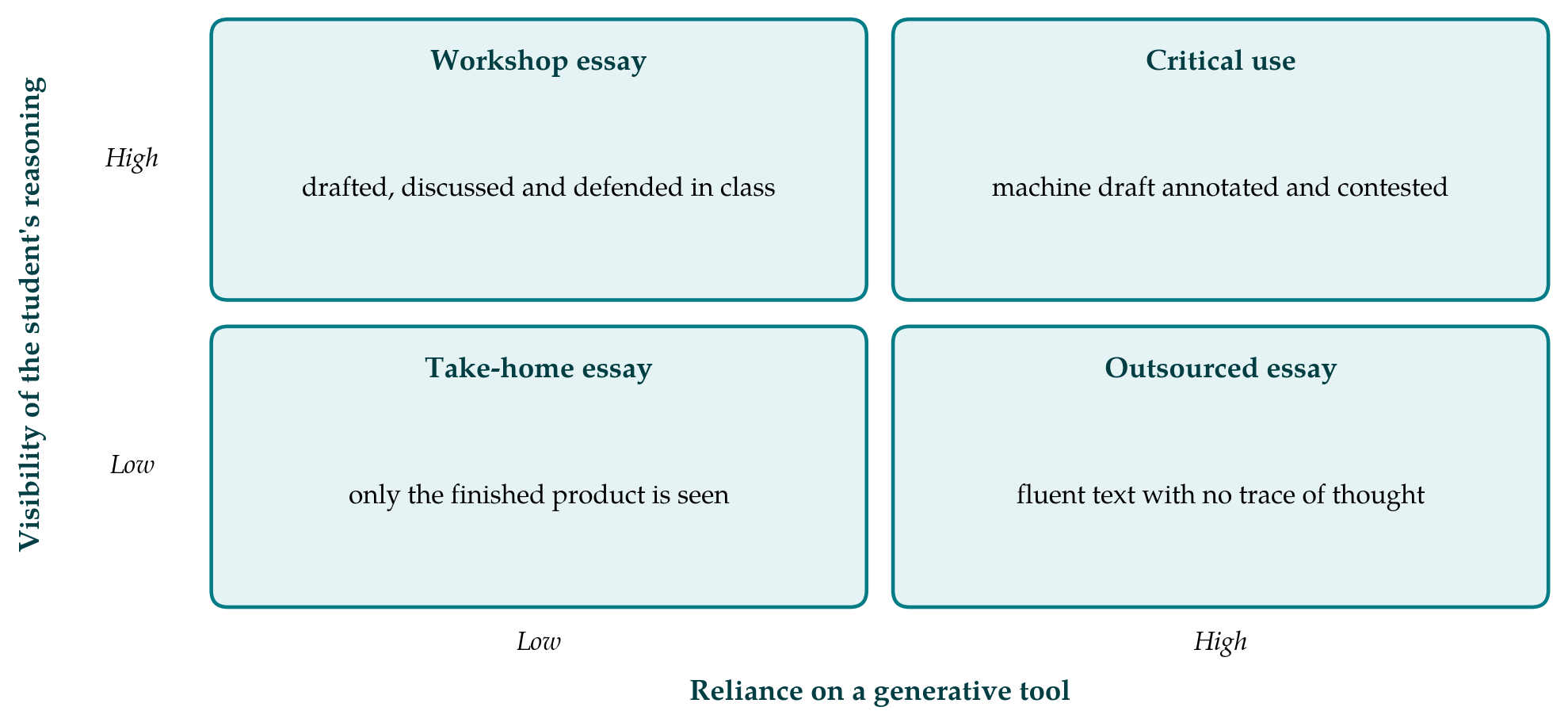
The upper left of the figure describes a familiar practice: writing done in stages, with plans, drafts and revisions discussed in class and the finished piece defended in conversation. The upper right describes a newer one, in which students are given or generate a machine draft and are assessed on what they do with it: where they find it thin, wrong or evasive, and how they would argue differently. Both keep the essay. Neither treats the final document as sufficient evidence.
5. Three Objections
The argument meets objections from opposite directions.
5.1. It is only another calculator
The first objection holds that every writing technology has been greeted as the ruin of thought and that this one will be absorbed like the rest. The lineage is real. In the Phaedrus, Socrates relates a myth in which writing itself is condemned as a drug that will produce forgetfulness and the appearance of wisdom without its substance (Plato, 1995), and Ong (1982) noted that the same complaints were later made against print and computers. Philosophers have argued that notebooks and devices can properly count as parts of a person's cognitive equipment (Clark and Chalmers, 1998).
The analogy fails at one point. A calculator performs an operation that the student has usually already learned and that is a step towards something else. In a humanities course the composing of an argument is not a step towards the goal. It is the goal. Handing it to a machine resembles sending someone else to the gymnasium. The lesson of the earlier technologies is that tools change what is worth teaching, not that nothing needs to be learned unaided first.
5.2. Detection will restore the old order
A second view holds that software can identify machine-written text and so preserve the take-home essay as it was. The evidence does not encourage reliance on this. Liang et al. (2023) found that several widely used detectors frequently misclassified essays written by non-native speakers of English as machine-generated, while simple rewording allowed generated text to pass. A regime built on such tools would accuse some of the students least able to defend themselves and would teach all of them that the relationship with their teacher is adversarial. International guidance has likewise advised institutions to rethink assessment instead of depending on detection (UNESCO, 2023).
5.3. The school essay was already dead
The third objection is the most interesting because it concedes the facts and denies the loss. Critics of writing instruction have long said that the formulaic school essay rewards compliance with a template and trains students to produce imitations of thought (Warner, 2018). If a machine can write it, the argument runs, it was never worth writing. There is force in this. An assignment that a language model completes to a high grade was probably asking for surface features. The right inference, though, is that the template should go and the essay in Montaigne's sense should return, since an attempt at understanding by a particular person cannot be delegated without ceasing to be that.
6. Implications for the Classroom
Several implications follow. More writing should happen where it can be seen: in class, by hand or on screen, in short sustained periods, with the teacher present as reader and not as invigilator. Assessment should attach to the stages of work, to notes on reading, outlines, drafts and responses to criticism, so that what is graded is the development of a position. This is an application of the principle that assessment tasks should require the very activity the course intends students to learn (Biggs, 1996). Oral examination, long standard in some university traditions, deserves wider use beside written work.
Students also need to be told why the effort matters. Research on learning indicates that conditions which make practice harder and slower often produce more durable learning, a finding summarised under the name of desirable difficulties (Bjork and Bjork, 2011). A tool that removes the difficulty of composing removes the occasion for that learning, and students who understand this are better placed to decide when to use it. Finally, the tools themselves belong in the syllabus as objects of criticism. Reading a machine's account of a poem against the poem is a good exercise in close reading, and it trains the scrutiny of plausible prose that Nussbaum (2010) placed among the capacities a democracy needs from the humanities.
None of this is free. Seen writing takes class time from content. Staged assessment and oral defence are costly in large courses and for teachers on insecure contracts. In-class writing can disadvantage students who need longer, including those working in a second language, and adjustments must be designed in from the start. These are reasons to argue for resources, and they are not reasons to go on grading documents whose origin cannot be known.
7. Conclusion
Generative text tools have ended the essay as a self-certifying product. They have not ended the essay as a practice, and the argument of this article is that the practice was always the point. A classroom that brings writing into view, grades the path as well as the destination, and teaches students to read machine prose critically can keep what Montaigne meant by an essay. The future of the form depends less on the tools than on whether institutions are willing to pay for the slower kinds of teaching that make thinking visible.
Conflict of interest
To be declared by the author(s) before publication.
Funding
To be declared by the author(s) before publication.