1. Introduction
Low back pain is the leading cause of years lived with disability worldwide, and in the great majority of people who have it no specific structural cause can be identified (Hartvigsen et al., 2018). The label "non-specific" is a statement of that ignorance. It covers pain between the lower ribs and the gluteal folds that is not attributable to fracture, malignancy, infection, inflammatory disease or nerve root compromise, and it is called chronic when it has lasted twelve weeks or more (Maher et al., 2017). Many people with the condition look beyond conventional care, and cupping is among the therapies they most often find.
In Unani medicine cupping belongs to ilaj bit tadbeer, the regimenal therapies that act by modifying the body's processes without drugs: massage, exercise, baths, leeching, venesection and others. Two forms are distinguished. Wet cupping, hijamat bil shart, combines suction with superficial scarification to draw blood. Dry cupping, hijamat bila shart, applies suction alone. This review concerns the dry form, which avoids the infection and bleeding risks of scarification and is the easier of the two to study with a sham.
The aim is to give Unani practitioners and researchers a clear account of where the evidence stands for dry cupping in chronic non-specific low back pain, and of what would improve it.
2. Scope and Approach
This is a narrative review of the published literature. It draws on clinical guidelines for low back pain, systematic reviews of cupping, individual randomised trials that are informative because of their design, and the methodological literature on outcomes and reporting. It does not attempt a new pooled estimate. Where the sources disagree, the review describes the disagreement and the likely reasons for it. Wet cupping is mentioned only where reviews did not separate the two forms.
3. Dry Cupping in Unani Theory and Practice
Classical Unani texts treat cupping at length. In the first book of the Canon, Ibn Sina discusses the sites, timing and indications of cupping and distinguishes cupping with scarification from cupping without it (Gruner, 1930). The rationale given is humoral. Dry cupping is said to divert morbid matter from a deeper or more important part to the surface, a process called imala, to warm a cold part, to disperse trapped vapours and to relieve pain. Pain in the back is commonly ascribed to cold and moist derangement or to the accumulation of phlegmatic matter in the muscles and joints, and the cups are placed over or beside the painful region.
Technique varies more than the classical descriptions suggest. Cups may be of glass, plastic, bamboo or silicone. Negative pressure may be produced by flame, by a hand pump or by an electrical device. Cups may be left in place, moved across oiled skin, or applied and released rhythmically. The number of cups, the duration of each application and the number and spacing of sessions differ between practitioners and between trials (Aboushanab and AlSanad, 2018). This variety matters for evidence, because a pooled result across such different procedures is hard to interpret.
4. Where Cupping Sits in Current Care for Low Back Pain
Guideline care for chronic non-specific low back pain has moved away from passive treatments and medicines. The recommended first line is advice to remain active, education, exercise therapy and, where needed, psychological approaches or multidisciplinary rehabilitation (Foster et al., 2018; Kamper et al., 2015). The guideline of the American College of Physicians advises that non-pharmacological treatment be tried first for chronic pain and lists exercise, multidisciplinary rehabilitation, acupuncture, mindfulness-based stress reduction, tai chi, yoga, spinal manipulation and several others (Qaseem et al., 2017). Cupping is not among the therapies it names. A Unani practitioner who offers cupping is therefore offering something outside current guideline recommendations, which is a reason to hold it to an honest standard of evidence and to use it alongside, and not in place of, activity and exercise.
5. Proposed Mechanisms
Several physiological explanations have been proposed, and Figure 1 sets them beside the classical rationale and the outcomes by which a trial would judge them. The first draws on the gate control theory of Melzack and Wall (1965): strong stimulation of large-diameter afferents from skin and muscle may inhibit transmission from nociceptive fibres in the same spinal segments. The second invokes counter-irritation. A noxious stimulus applied at one site reduces the response of dorsal horn neurones to pain elsewhere, a phenomenon first described in the rat as diffuse noxious inhibitory controls (Le Bars et al., 1979) and studied in humans as conditioned pain modulation.
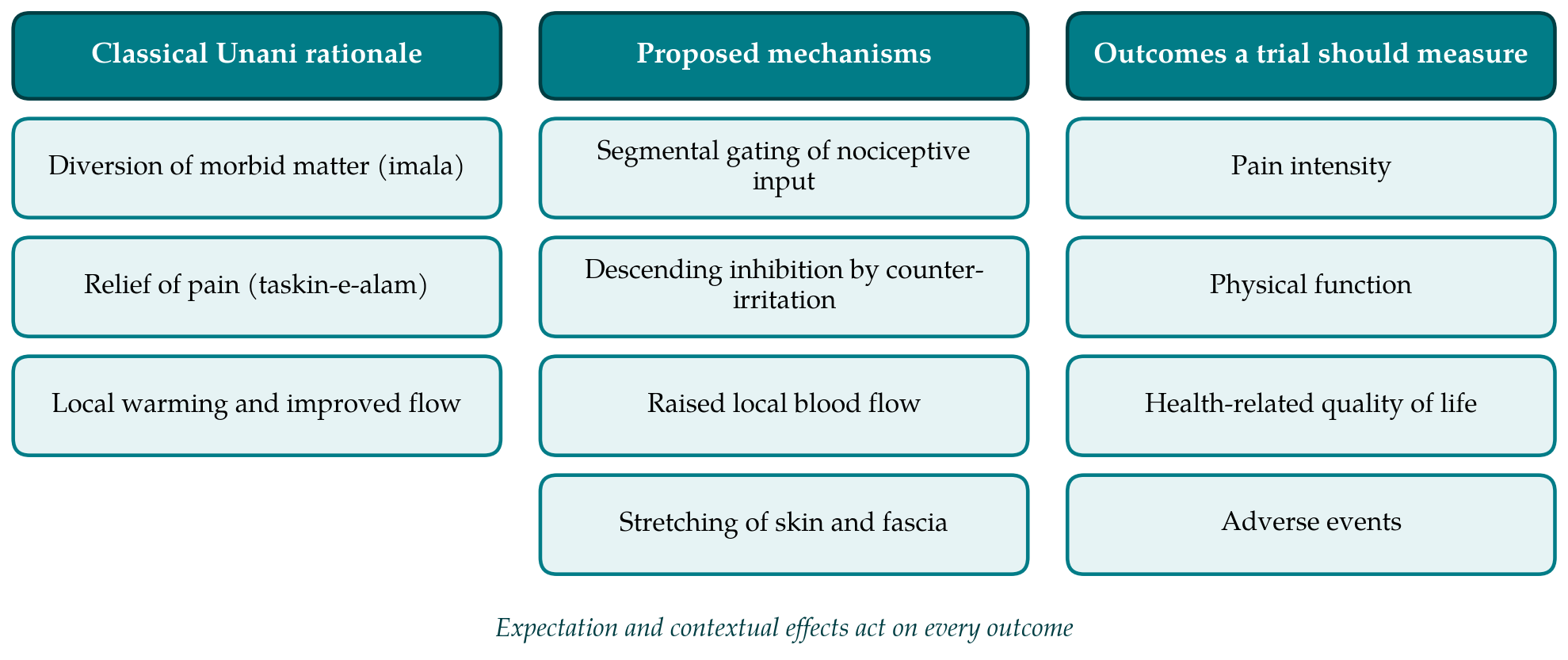
Other proposals are local. Suction lifts and stretches the skin and the underlying fascia, raises blood flow in the area and causes the capillary leakage that produces the familiar circular marks. A review of the mechanisms concluded that no single theory accounts for the reported effects and that most of the proposed pathways rest on indirect evidence (Al-Bedah et al., 2019). Experimental work in chronic neck pain has reported changes in pressure pain thresholds after cupping (Lauche et al., 2012), which is compatible with a real sensory effect but does not show that the effect is large enough, or lasts long enough, to matter clinically. None of these mechanisms has been shown to mediate improvement in low back pain.
6. Evidence From Systematic Reviews
The systematic reviews tell a consistent story. An early review of cupping for pain of any kind found a small number of randomised trials, most of them favourable and most of them of poor quality, and concluded that the evidence was encouraging but not convincing (Kim et al., 2011). A much larger review covering many conditions reached a similar verdict: cupping appeared to be of benefit, but nearly all the included trials were judged to be at high risk of bias (Cao et al., 2012). A meta-analysis restricted to chronic back pain reported lower pain scores after cupping than after comparison treatments, while noting that the trials were heterogeneous and that better designed studies were needed (Moura et al., 2018).
Three weaknesses recur and are summarised, with the other strands of evidence, in Table 1. The comparators were usually waiting list, usual care or medication, none of which controls for the considerable ritual of a cupping session. Participants and therapists could not be blinded, and the outcomes were self-reported pain, which is the kind of outcome most sensitive to expectation (Hróbjartsson and Gøtzsche, 2010). And follow-up was short, often ending with the last treatment, although chronic low back pain fluctuates over months.
| Strand of evidence | What it indicates | Main limitation | Representative sources |
|---|---|---|---|
| Classical texts | Long-standing use for pain; humoral rationale | Not a test of effect | Gruner, 1930 |
| Mechanistic studies | Plausible sensory and circulatory effects | Indirect; clinical relevance unshown | Al-Bedah et al., 2019 |
| Systematic reviews | Short-term pain reduction against inactive comparators | Small trials, high risk of bias | Cao et al., 2012; Moura et al., 2018 |
| Sham-controlled trials | Little or no advantage over a credible sham | Few trials; sham may not be inert | Teut et al., 2018; Silva et al., 2021 |
| Safety reports | Mostly transient skin marks | Harms poorly recorded in trials | Aboushanab and AlSanad, 2018 |
| Guidelines | Exercise and education first; cupping not listed | Reflect the evidence available | Qaseem et al., 2017 |
7. Trials With a Sham Control
The question that the reviews leave open is whether suction itself does anything beyond the effect of receiving an elaborate, hands-on treatment. Answering it needs a sham. A device was developed for the purpose: a cup that looks and feels like an ordinary one but has a small hole through which the negative pressure escapes shortly after application (Lee et al., 2010). An alternative is to apply minimal suction that holds the cup in place without visibly drawing up the skin.
Two trials in chronic low back pain are particularly instructive. A three-armed German trial compared pulsatile dry cupping, cupping at minimal pressure and a control group that received only rescue medication. Both cupping groups reported less pain than the control group after the treatment period, and the difference between full and minimal cupping was not clear (Teut et al., 2018). A Brazilian trial compared dry cupping with sham cupping using cups that released their pressure, and found that real cupping was not superior to sham for pain, function or the other outcomes measured (Silva et al., 2021). Read together, the two suggest that much of the improvement seen against untreated controls reflects the context of treatment. They do not prove that cupping is inert. A sham that touches and warms the skin may itself have some effect, and two trials using particular protocols cannot speak for every form of practice.
8. Safety
Dry cupping is generally regarded as safe when done by a trained practitioner. The expected effects are circular erythema and bruising that fade over days. Blistering can follow prolonged or strong suction, and burns are a recognised hazard of fire cupping. Caution is advised in people who take anticoagulants or have bleeding disorders, over broken or infected skin, and in pregnancy over the abdomen and lower back (Aboushanab and AlSanad, 2018). Trials have recorded adverse events poorly, so the true frequency of minor harms is uncertain. The more serious risk is indirect: a patient with back pain from a serious cause may be cupped repeatedly while diagnosis is delayed. Screening for the recognised warning features of serious spinal disease belongs before any course of cupping.
9. Gaps and Directions for Unani Research
The most useful next step is better reporting. The STRICTOC statement, an extension of CONSORT for cupping trials, asks authors to specify the type of cupping, the cups, the method and strength of suction, the sites, the retention time, the number and frequency of sessions and the practitioner's background (Zhang et al., 2020). The TIDieR checklist does the same for interventions in general (Hoffmann et al., 2014). A Unani trial should add how the patient's temperament and the humoral diagnosis were assessed and whether they changed the treatment, since individualisation is central to Unani practice and is invisible in most reports.
Outcomes need the same discipline. An international panel has agreed a core set of domains for trials in non-specific low back pain: physical functioning, pain intensity, health-related quality of life and number of deaths (Chiarotto et al., 2015). A task force of the United States National Institutes of Health has recommended a minimum dataset and a standard definition of chronicity (Deyo et al., 2014), and consensus thresholds exist for judging whether a change in pain or function is large enough to matter to patients (Ostelo et al., 2008). Trials that use these measures, follow participants for months, include a credible sham, and test whether participants could tell which treatment they received would settle more than another dozen small comparisons with usual care. Pragmatic trials that add cupping to guideline-based exercise would answer a different and equally practical question: whether it helps patients stay active.
10. Conclusion
Dry cupping has a long history in Unani regimenal therapy and a coherent classical rationale. The clinical evidence shows that people with chronic non-specific low back pain often feel better after it than after no treatment, and that the advantage shrinks or disappears when the comparison is a credible sham. Its specific effect is therefore unproven, its harms are mostly minor, and it should not displace the exercise and education that guidelines place first. For Unani researchers the task is clear: describe the intervention fully, measure the agreed outcomes over an adequate period, and control for the context of treatment.
Conflict of interest
To be declared by the author(s) before publication.
Funding
To be declared by the author(s) before publication.