1. Introduction
Low-lying atolls and coastal villages in the Pacific are among the places where the effects of a warming climate are most directly felt. Assessments by the Intergovernmental Panel on Climate Change describe the exposure of small islands to rising seas, saltwater intrusion into soils and freshwater lenses, coral bleaching and more intense tropical cyclones (IPCC, 2022). Writers from the region have responded in poetry, performance and prose. The best known instance is the Marshallese poet Kathy Jetñil-Kijiner, who addressed the opening of the United Nations Climate Summit in 2014 and whose first collection followed three years later (Jetñil-Kijiner, 2017).
Short stories have received less critical attention than poetry in this connection, and when they are cited it is often a single story lifted out of its book to illustrate a point about displacement. That habit loses what a collection does as a whole: the way one story's flooded garden is answered by another's funeral or church meeting or airport farewell. It also tends to assimilate Pacific writing to an outside script in which islanders appear as the world's first climate refugees, a framing that people in Tuvalu and elsewhere have resisted (Farbotko and Lazrus, 2012).
This article proposes a method for reading one collection, complete, as climate testimony. It is written for literary scholars and for teachers who want a disciplined procedure that respects both the literary character of the stories and the claims of the communities from which they come. No collection is analysed here. The procedure is described so that others may try it, criticise it and improve it.
2. Background
The method rests on three strands of earlier work, each of which supplies a question that the others do not ask.
2.1. Testimony and its listeners
Felman and Laub (1992) argued that testimony is an event between a speaker and a listener and that the listener shares responsibility for what is heard. Beverley (1989), writing on Latin American testimonio, described a narrator who speaks as a member of a group under pressure and whose account asks for a response and not only for appreciation. Both models were built on first-person, factual narration, and neither fits fiction directly. Craps (2013) has warned in addition that trauma theory formed around European events travels badly and can miss harm that is collective, continuing and bound up with colonial history. The method below keeps the question of address from this tradition and sets aside its assumption of a single shattering event.
2.2. Slow harm and the limits of fiction
Nixon (2011) gave the name slow violence to damage that unfolds gradually and out of sight, and he asked what narrative forms could make such damage perceptible. Ghosh (2016) argued that the realist novel, built around the probable and the individual life, has struggled with climate. DeLoughrey (2019) replied from the standpoint of island literatures that writers in the Caribbean and Pacific have long used allegory to connect local catastrophe with planetary process, and that for peoples who lived through nuclear testing and colonial extraction the end of a world is not a new idea. Whyte (2017) makes a parallel point for Indigenous peoples generally. These arguments suggest that the short story collection, with its gaps and repetitions, may register slow harm in ways a single plot cannot.
2.3. Oceanian framings and research ethics
Wendt (1976) called for a literature that would imagine a new Oceania on its own terms. Hau'ofa (1994) rejected the picture of small, isolated islands in a far sea and described instead a sea of islands joined by voyaging, kinship and exchange. The history of the region's prose fiction has been charted by Subramani (1985) and Keown (2007). On research practice, Smith (1999) set out why inquiry involving Indigenous peoples must answer to them, and Vaioleti (2006) described talanoa, open and reciprocal conversation, as a Pacific approach to research. Social scientists have meanwhile shown how knowledge about climate in the islands is shaped by unequal power (Barnett and Campbell, 2010). A reading method for this material has to take those lessons as conditions, not as an appendix.
3. The Proposed Method
The method has seven steps, shown in order in Figure 1. They are described in turn below, and the written output expected from each is listed afterwards in Table 1.
| Step | Purpose | Written output |
|---|---|---|
| 1. Place the book | Establish publisher, language, readership and authorial relation | One-page publication profile |
| 2. Map the collection | See the book as a unit with order and echoes | Story-by-story table with cross-links |
| 3. Voice and address | Identify speakers, listeners and collective pronouns | Annotated list of narrative situations |
| 4. Environmental time | Separate sudden events, gradual change and remembered baselines | Coded passages with observer and knowledge type |
| 5. Form and language | Show how orality, humour and code-switching carry meaning | Close readings of selected passages |
| 6. Public record | Contrast the stories with scientific and political language | Short comparative note |
| 7. Return and account | State position and invite response | Positionality statement and record of responses |
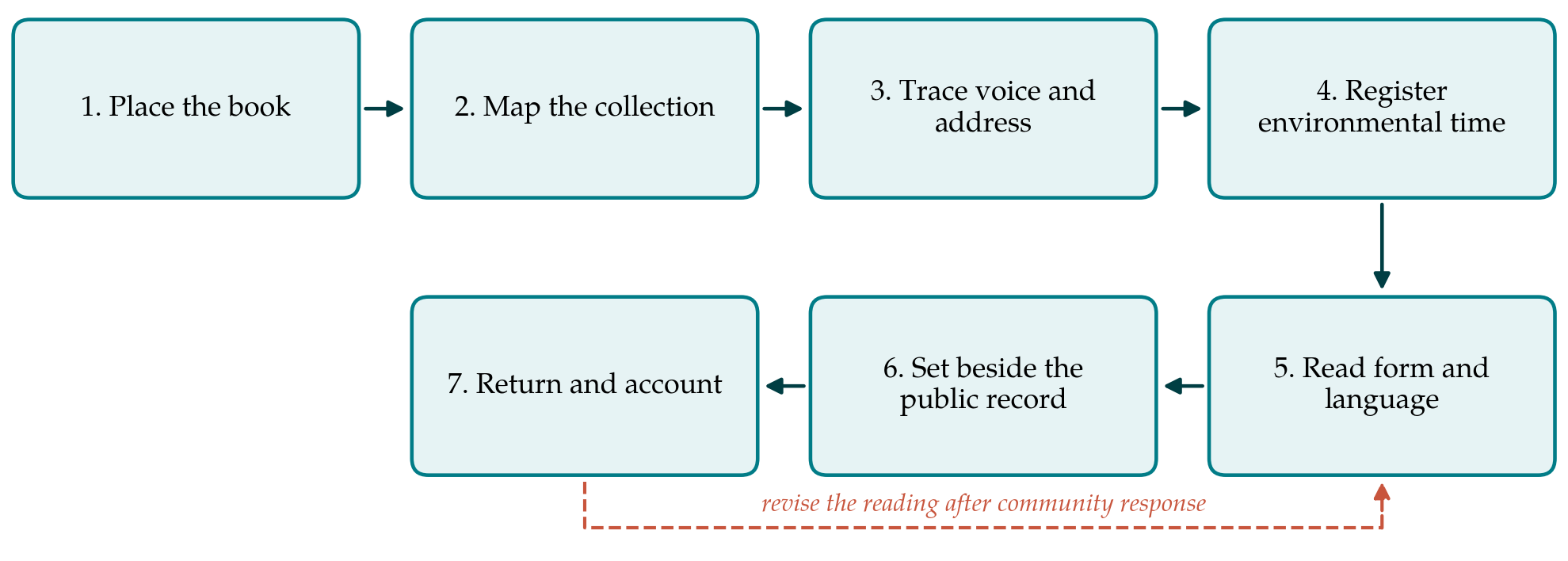
The steps are ordered so that description comes before judgement. The first two treat the book as a made object, the next three attend to what the stories say and how they say it, and the last two turn outward to the public world and to the people concerned. A reader may move back and forth between them, but none should be skipped.
3.1. Step 1: Place the book
The reader first establishes what kind of object the collection is: who published it and where, in which language or languages, with what editorial apparatus, and for which readers. A book issued by a regional university press for local schools makes a different address from one produced by a metropolitan publisher with a glossary. The reader also records the author's stated relation to the places written about, using only what the author has made public.
3.2. Step 2: Map the collection
Each story is listed with its setting, narrator, time span and central event, and the links between stories are noted: recurring characters, places, objects and phrases. The theory of the story cycle (Ingram, 1971) is useful here, since it treats the collection as a unit whose meaning depends on order and echo. The map shows where environmental matter is concentrated and where it is absent, and absence is recorded as carefully as presence.
3.3. Step 3: Trace voice and address
For every story the reader asks who speaks and who is spoken to. A grandmother instructing a child, a migrant writing home, a pastor addressing a congregation and a narrator turned toward an overseas reader each establish a different testimonial relation. Shifts between first person singular and plural are marked, because the move from I to we is where fiction comes closest to the collective voice that Beverley described.
3.4. Step 4: Register environmental time
Passages that concern weather, sea, soil, food plants and animals are identified and sorted by the kind of time they record: sudden events such as a cyclone or king tide, gradual change such as salt in a taro pit or a retreating shoreline, and remembered baselines against which characters measure the present. The reader notes who in the story observes the change and by what knowledge, whether from fishing, gardening, navigation, scripture or science.
3.5. Step 5: Read form and language
The fifth step returns the stories to literature. The reader examines how oral storytelling conventions, humour, genealogy, song and code-switching between English and island languages carry environmental meaning. Satire deserves particular notice. A tradition of comic fiction about development and aid runs through Pacific writing, and a story may testify by mockery as readily as by lament. Titles, epigraphs and the placing of the final story are read with the same care, since a collection often states its attitude to its own material at its edges.
3.6. Step 6: Set the stories beside the public record
Scientific assessments, government statements and regional declarations are then read alongside the collection. The purpose is context and contrast. The record is not used to check whether a story is accurate, since fiction makes no such promise; it is used to see what the stories know that reports omit, and what public language they adopt, bend or refuse. Statements by Pacific governments, churches and campaigners are especially relevant, because they supply phrases and images that fiction may echo or resist, among them the insistence of island activists that their peoples are fighting and not drowning.
3.7. Step 7: Return and account
Finally the reader states their own position and shares the reading with people who have a stake in it, through a seminar, a community forum or correspondence with the author where that is welcome. Responses are recorded and the reading is revised in their light. Table 1 summarises the purpose and output of all seven steps.
4. Fitting the Method to Practice
The method is designed to be usable by a single researcher or a seminar group. The first five steps require only the book and a notebook, and the mapping and coding can be done in a spreadsheet. The categories in step 4 should be kept few and plain, so that two readers working separately can compare results and discuss where they differ. The sixth step depends on access to public documents, most of which are freely available. The seventh takes the longest and cannot be hurried. Where direct exchange with a community is not possible, the reader should say so and should seek out published responses by Pacific critics and reviewers as a partial substitute.
The outputs listed in Table 1 are working papers and not the finished essay. A published reading would draw on them selectively, and it should say which steps shaped its argument and which yielded little. Reporting the unproductive steps matters, because a method improves only when its users record where it failed them. An appendix giving the story map and the coding categories allows another reader to test the interpretation against the same book.
In teaching, the steps divide naturally across a term, with students responsible for individual stories at steps 2 to 4 and the group working together thereafter. A class reading from outside the region should give time early on to Hau'ofa and Wendt, so that the stories are met within an Oceanian frame before the vocabulary of crisis arrives.
5. Limitations and What Remains to Be Shown
This article sets out a procedure and does not demonstrate it. Its usefulness depends on questions that only application can answer. One is whether the mapping and coding steps yield readings that differ in substance from those a skilled critic would reach unaided. A second is whether independent readers using the categories of step 4 agree closely enough for the categories to be worth keeping. A third is whether authors and communities find the resulting accounts recognisable and of use. Until trials of that kind are reported, the method should be treated as a structured suggestion.
There are limits of principle as well. A story is an invented thing, and to call it testimony is to use the word by extension. The method guards against treating fiction as evidence, but the pull in that direction is strong wherever literature is enlisted in a public cause. One book also cannot stand for a region of great linguistic and cultural variety, and nothing here licenses generalising from a single collection to Pacific writing at large. Lastly, the method privileges the printed collection in English, and much Pacific storytelling lives in other languages and in performance.
6. Conclusion
A short story collection can hold many small acts of noticing in relation to one another, and that capacity suits the dispersed and gradual character of environmental change in the islands. The seven steps proposed here ask the reader to attend to the whole book, to the relations of speaking and listening it sets up, to the different tempos of harm it records, and to the obligations that reading such work creates. Whether the procedure earns its place is for those who try it, and those whose stories are read by it, to judge.
Conflict of interest
To be declared by the author(s) before publication.
Funding
To be declared by the author(s) before publication.