1. Introduction
A bank branch in a rural district is expensive to run and far from most of the people it is meant to serve. Agent banking replaces the branch with a local retailer, who accepts deposits and pays out withdrawals on the bank's behalf using a telephone or a card reader connected to the bank's systems. The model spread from Brazil and Kenya in the 2000s and was described early on as a way of reaching customers whom conventional distribution could not serve at a profit (Lyman et al., 2006; Mas and Siedek, 2008).
Southeast Asia has adopted the model unevenly. Indonesia created a legal basis for bank agents in 2014, the Philippines for cash agents in 2017, and other countries in the region have rules of their own. Account ownership has risen, yet the Global Findex survey continues to record a large distance between holding an account and using it (Demirgüç-Kunt et al., 2022). Programmes have generally been designed around the individual saver or the recipient of a government transfer. The owner of a small rural business has different needs, and a bank that treats her as one more basic account holder is likely to find the account unused.
This article proposes a framework for onboarding rural microenterprises through an agent network. It is written for a commercial or rural bank in the region that already has permission to appoint agents. The framework is a proposed procedure, built from published evidence and regulation. It has not been applied in the field for the purposes of this article and no results are reported.
2. Background
The design rests on three bodies of knowledge: how agent networks work and are regulated, what is known about the finances of very small firms, and why people adopt or ignore a new service.
2.1. Agent networks and their regulation
The experience of M-PESA in Kenya established several operating principles: agents must be numerous and close to customers, they must be able to convert electronic value to cash without running short of either, and the first product must meet a need that customers already feel (Mas and Morawczynski, 2009). Studies of the same system found that households with access to it coped better with shocks to income, because help from relatives could reach them cheaply (Jack and Suri, 2014), and that access was associated over time with a movement of women out of farming and into business (Suri and Jack, 2016).
In Indonesia, the financial services authority permits banks to appoint individuals and legal entities as agents under the programme known as Laku Pandai, which is tied to a basic savings account with no minimum balance (Otoritas Jasa Keuangan, 2014). In the Philippines, the central bank allows banks to engage cash agents to accept and disburse cash and to assist with account opening (Bangko Sentral ng Pilipinas, 2017), and it has defined a basic deposit account with simplified requirements (Bangko Sentral ng Pilipinas, 2018). The rules differ in who may be an agent, which services are allowed and how far identification can be simplified, but all hold the bank responsible for the conduct of its agents.
2.2. The finances of microenterprises
Very small firms and the households that own them share one purse. Financial diaries kept by poor households show incomes that are low and also irregular, managed through many small informal arrangements (Collins et al., 2009). Experimental evidence indicates that the returns to additional capital in microenterprises can be high (de Mel et al., 2008), and that giving market vendors access to a simple savings account raised their business investment (Dupas and Robinson, 2013). The evidence on microcredit is more sober: across six randomised evaluations, average effects on income and consumption were modest (Banerjee et al., 2015). A review of research on saving reaches the conclusion that small frictions, such as distance, fees and paperwork, deter use more than their size would suggest (Karlan et al., 2014). The lesson for product sequence is to begin with safekeeping and payments and to treat credit as a later step.
2.3. Adoption
Research on the diffusion of innovations holds that people take up a new practice when its advantage over the old one is visible, when it fits existing habits, when it can be tried at low cost and when respected peers are seen to use it (Rogers, 2003). For a rural trader, the perceived usefulness of an account and the ease of using it both depend heavily on the agent, who is the only face of the bank that she will meet.
3. The Proposed Framework
The framework has seven stages. Figure 1 shows their order and the return loop from evaluation to design, and Table 1 gives the output and a suggested indicator for each. The stages are described below in turn.
| Stage | Main output | Suggested indicator |
|---|---|---|
| 1. Map the segment | Profile of trades, cash cycles and payment partners | Share of target enterprises profiled |
| 2. Select and equip agents | Trained agents located where enterprises trade | Distance from enterprise to nearest agent |
| 3. Open accounts | Entry-level accounts opened at the agent | Time and documents needed to open |
| 4. Sequence products | Payments first, then savings, then credit | Accounts active after three months |
| 5. Liquidity and conduct | Float rules, supervision visits, mystery shopping | Transactions refused for lack of float |
| 6. Recourse and protection | Disclosed tariff and a working complaints channel | Complaints resolved within the set period |
| 7. Monitor and evaluate | Regular reporting and a planned evaluation | Evaluation design agreed before launch |
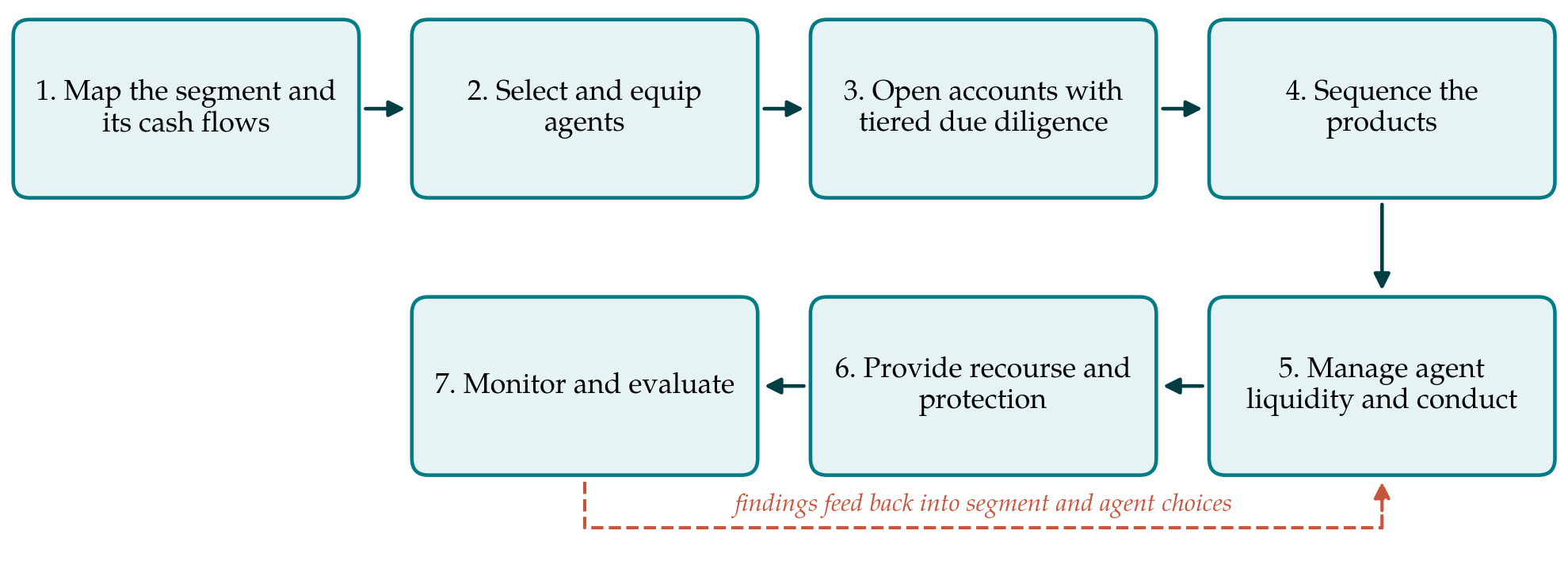
3.1. Stage 1: Map the segment and its cash flows
The bank first decides which enterprises it means to reach and learns how money moves through them. In a given district this means identifying the main trades, the days and places on which cash is received, the suppliers who must be paid and how payment is made at present, and the seasons of surplus and shortage. Value chains with a regular buyer or supplier, such as a dairy cooperative, a rice mill or a wholesaler of consumer goods, are promising starting points, because one relationship with the larger party can bring many small ones onto the same payment rail.
3.2. Stage 2: Select and equip agents
Agents should be chosen from businesses that the target enterprises already visit: input dealers, wholesalers, market-side shops. Selection criteria include a fixed place of business, sufficient cash turnover to meet withdrawals, a clean record and standing in the community. The bank supplies the device, signage showing its name and the tariff, and training in the product, in identification procedures and in the handling of complaints. The commission must make the work worthwhile for the agent at realistic volumes, and it should reward active accounts in preference to accounts merely opened.
3.3. Stage 3: Open accounts under tiered due diligence
Many owners of microenterprises lack business registration and some lack standard identity documents. The international standards on money laundering allow simplified due diligence where risk is demonstrably lower, for example for accounts with caps on balances and transaction values (FATF, 2017), and guidance on digital identity explains how national identity systems can be relied upon remotely (FATF, 2020). The bank should therefore offer an entry-level account that the agent can open with the national identity document alone, within limits set by local rules, and a route to a full business account as documentation and transaction history accumulate.
3.4. Stage 4: Sequence the products
The first use offered should solve a problem the enterprise already has. Paying a supplier or receiving payment from a buyer without travelling with cash is the most likely candidate. Safekeeping of daily takings follows naturally once the owner is visiting the agent in any case. Credit comes last and is offered on the strength of the transaction record that the first two products create, in small amounts with repayment matched to the cash cycle identified in the first stage. The order reflects the evidence summarised above: savings and payments have reliable if modest benefits, while credit helps some borrowers and harms others.
3.5. Stage 5: Manage agent liquidity and conduct
An agent who cannot pay a withdrawal destroys trust quickly. The bank needs rules for the float each agent holds, a means of rebalancing it through a branch, a master agent or a cash delivery service, and data to anticipate market days and harvest payments. Conduct needs equal attention. Unauthorised fees, the sharing of customer credentials and the splitting of transactions to earn commission are familiar risks. Routine analysis of transaction data, unannounced visits and mystery shopping are the standard controls, and the agency contract should allow suspension.
3.6. Stage 6: Provide recourse and protection
Customers who are new to formal finance are poorly placed to detect or challenge errors. Each transaction should produce a confirmation in a form the customer can keep, fees should be posted at the agent's premises in the local language, and a complaints line that does not depend on the agent should be advertised there. The bank remains liable for the agent's acts, and customers should be told so plainly.
3.7. Stage 7: Monitor and evaluate
Monitoring uses the indicators in Table 1 and is reported monthly by district and by agent. Evaluation is a separate matter. If the bank wishes to know whether onboarding changes anything for the enterprises, it must compare them with similar enterprises that were not onboarded, and the comparison is credible only if it is planned beforehand. A phased rollout, in which the order of villages or markets is set by lot, gives a comparison group at little extra cost (Duflo et al., 2007).
4. Adapting the Framework to National Settings
The stages are general, and their content depends on local rules and conditions. Where regulation ties agents to a specific basic account, as in Indonesia, the entry product is largely given and the bank's choices lie in agent selection and in the path to a fuller account. Where agents may only handle cash, account opening must be completed through the bank's own application or staff, and the agent's role in the third stage is confined to assistance. Network coverage, the reach of the national identity system, the languages spoken and the presence of competing mobile wallets all affect the design. The framework assumes at least basic mobile coverage at the agent's premises.
5. Limitations and What a Pilot Should Show
The framework is a proposal and has not been tested. Much of the evidence behind it comes from East Africa and South Asia, and it cannot be assumed that results carry over to the archipelagic and upland settings of Southeast Asia, where distances, crops and trading customs are different. The economics for agents are uncertain: thin volumes in sparsely settled areas may not cover the agent's cost of holding float. The framework also says little about enterprises run by people without any identity document, who remain outside even a simplified regime.
A pilot in one or two districts would need to establish four things before wider use: that enterprises use the accounts for business payments and do not simply hold them, that agents remain active and solvent after the initial period, that complaints and fraud stay at a level the bank can manage, and that the cost per active account is one the bank can sustain without subsidy.
6. Conclusion
Agent banking gives banks in Southeast Asia a legal and practical means of reaching rural businesses, and it has so far been used mostly for personal accounts. The seven-stage framework proposed here starts from the cash flows of the enterprise, relies on agents the enterprise already deals with, opens accounts under proportionate due diligence and introduces payments and savings before credit. Its merit is an open question until it has been piloted with an evaluation designed in advance, and it is offered as a starting point for that work.
Conflict of interest
To be declared by the author(s) before publication.
Funding
To be declared by the author(s) before publication.