1. Introduction
Survey research across many countries has recorded two developments side by side. The proportion of people who say they sometimes or often avoid the news has risen since the question was first asked in the Reuters Institute Digital News Report, and among younger users of video-led platforms attention goes more readily to personalities, influencers and independent creators than to journalists or news organisations (Newman et al., 2023; Newman et al., 2024). The first trend is usually told as a story of loss for journalism. The second is told either as a threat to it or as a hint about what it might do differently.
The two are rarely studied together. Work on news avoidance has grown quickly and now has its own definitions, typologies and book-length treatments (Skovsgaard and Andersen, 2020; Toff et al., 2023). Work on creators comes mostly from studies of influencer culture and platform politics, where the interest lies in fame, authenticity and persuasion more than in what audiences come to know about public affairs (Abidin, 2018; Lewis, 2020). A young adult who has stopped opening news applications but watches a creator explain a court ruling in ninety seconds sits in both literatures at once.
This article reviews what is known about that person. It asks why young adults turn away from news, what creator-led explainer content offers that conventional news output often does not, and how far the published evidence supports the common claim that the one compensates for the other.
2. Scope and Approach
The article is a narrative review of published scholarship in journalism studies, political communication and platform studies, together with the main industry survey series in the area. It does not claim exhaustive coverage and no formal search protocol was applied; sources were chosen because they are widely cited, conceptually influential or directly concerned with adults in their late teens and twenties. "Creator-led explainer" is used here for video or audio content in which a named individual, working outside or at the edge of a news organisation, sets out the background to a current issue for a general audience on a platform such as YouTube, TikTok or Instagram. Commentary whose main purpose is partisan mobilisation is treated only where it bears on the argument.
3. News Avoidance and Its Causes
Avoidance is easy to name and hard to measure. People who say they avoid news may still consume a good deal of it, and people who consume very little may never have decided to avoid anything. The literature has therefore spent some effort on definition before explanation.
3.1. Deliberate avoidance and low consumption
Skovsgaard and Andersen (2020) distinguish intentional avoidance, which rests on a dislike of news, from unintentional avoidance, which arises when people simply prefer other content and the media environment lets them follow that preference. The second kind restates an older argument. In a high-choice environment, those with little interest in public affairs are no longer exposed to news by default, so differences in motivation translate into differences in exposure and knowledge (Prior, 2007). The distinction matters for young adults, who grew up with abundant choice and for whom scheduled bulletins and a household newspaper were seldom part of the daily routine. Edgerly (2022) shows that low consumption is tied to attitudes as well as habits, notably a low sense of being able to make sense of the news and a weak belief that it is relevant.
Avoidance is also selective. Qualitative work in five countries describes people taking breaks from news as a way of managing attention and feeling, and returning when events demand it (Villi et al., 2022). Young adults interviewed by Aharoni et al. (2021) avoided particular topics and particular devices or applications, so that avoidance was aimed at the material carrier of news as much as at its content. The people described in these studies are often attentive citizens who find that continuous exposure leaves them worse off.
3.2. Reasons young adults give
The reasons reported across surveys and interviews are consistent. News is said to lower mood, to repeat itself, to dwell on a few subjects, to be untrustworthy or biased, and to leave the audience with a sense of powerlessness (Newman et al., 2023; Toff et al., 2023). A further reason is more prominent among the young: stories are hard to follow. News is typically written as an increment to a story the reader is assumed to know already, and a reader who arrives without that background finds little to hold on to. Costera Meijer (2007) observed that young people regarded news as important and at the same time as something that did not speak to them. Commissioned research for the Reuters Institute later described young audiences as wanting news to be useful and interesting to them personally, and not only what they are told they ought to know (Galan et al., 2019). Table 1 groups the main reasons and the sources that describe them.
| Reason for avoidance | How the literature describes it | Explainer feature said to respond | Representative sources |
|---|---|---|---|
| Emotional cost | News is negative and wearing; breaks protect mood | Lighter tone, humour, a calm guide | Villi et al., 2022; Newman et al., 2023 |
| Overload | Too much, too often, with heavy repetition | One finite piece on one question | Aharoni et al., 2021; Villi et al., 2022 |
| Low news efficacy | Stories assume background the reader lacks | Background first, then the development | Edgerly, 2022; Galan et al., 2019 |
| Distrust | News seen as biased or serving other interests | Disclosed viewpoint, visible person | Toff et al., 2023; Lewis, 2020 |
| Powerlessness | Nothing can be done with what is learned | Community in comments, practical framing | Palmer and Toff, 2020 |
| No habit or need | Belief that important news will arrive anyway | Content delivered inside the feed | Gil de Zúñiga et al., 2017; Toff and Nielsen, 2018 |
3.3. Environment, identity and habit
Individual reasons sit inside conditions that individuals do not choose. Comparative analysis finds that levels of avoidance differ between countries in ways related to press freedom and political context, and that within countries avoidance is more common among younger people, women and those with fewer resources (Toff and Kalogeropoulos, 2020). Toff et al. (2023) argue that consistent avoiders are distinguished less by any single complaint than by the absence of a surrounding community in which following the news is expected and talked about. Palmer and Toff (2020) make the complementary point that a news habit is sustained by a felt civic duty and by belonging to such a community.
Social platforms add a belief that searching is unnecessary. Toff and Nielsen (2018) describe folk theories through which people explain how information reaches them, among them the conviction that anything important will surface unprompted. Gil de Zúñiga et al. (2017) call this the news-finds-me perception and associate it with less active news seeking and lower political knowledge over time. Studies of incidental exposure show news met in moments of leisure, mixed with entertainment and personal updates and often not followed beyond the headline (Boczkowski et al., 2018). Exposure of this kind is unevenly distributed, because feeds are assembled from the choices of the user, of contacts and of ranking systems, and those already interested receive and engage with more of it (Kümpel, 2020).
4. The Creator-Led Explainer as a News Form
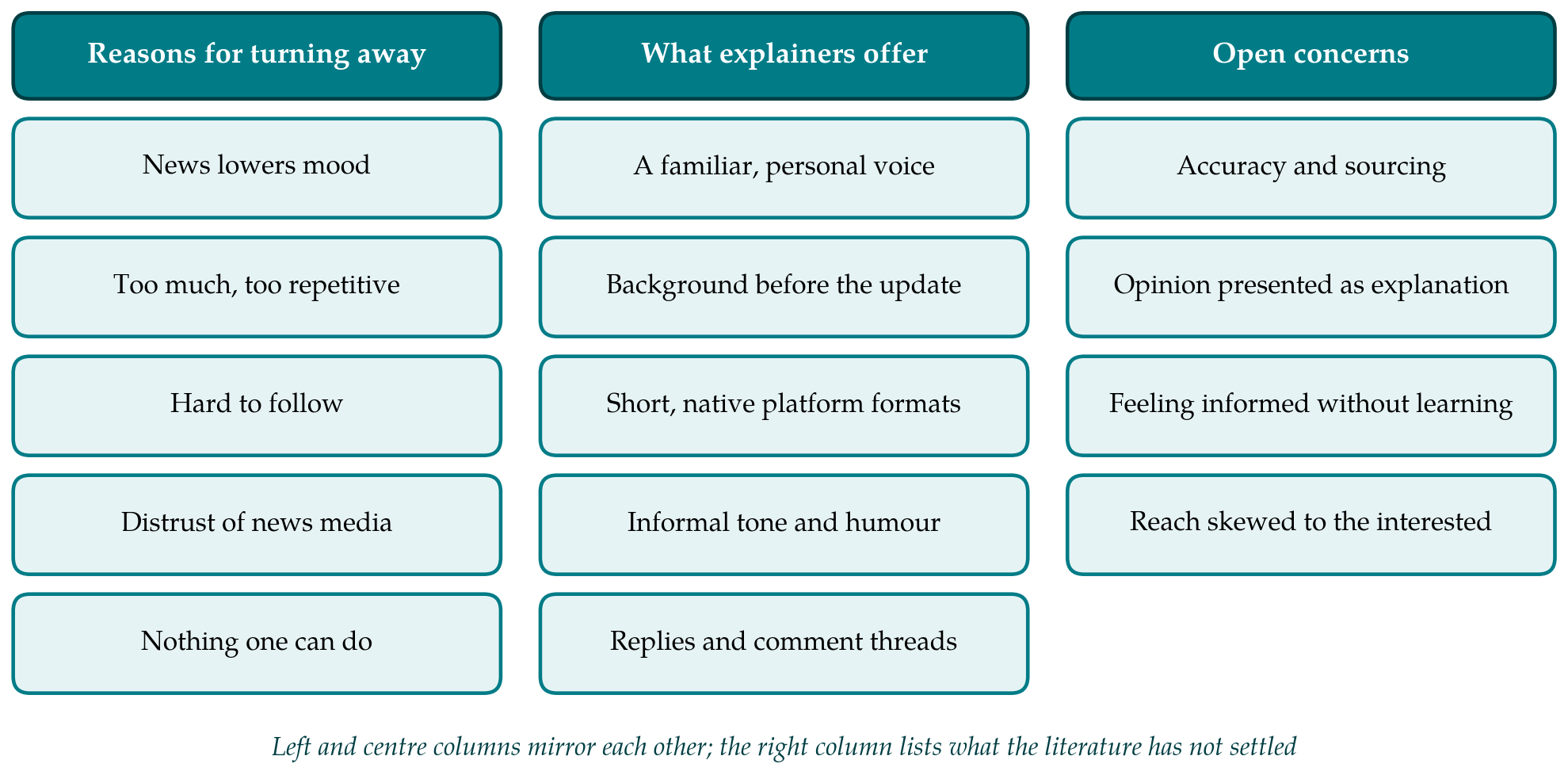
Creators who explain current affairs occupy a position that journalism studies has only recently begun to describe. They are not citizen witnesses, since they seldom report at first hand, and they are not columnists in the newspaper sense, since their authority rests on a relationship with followers and not on an institution. Recent editions of the Digital News Report treat them as a distinct category of news source and note their prominence among younger users of video platforms (Newman et al., 2024). Figure 1 sets the features commonly attributed to their work against the reasons for avoidance summarised above, and adds the concerns that remain open.
4.1. A person in place of an institution
The oldest concept applied to creators is parasocial interaction, the sense of acquaintance that audiences form with media performers who address them directly (Horton and Wohl, 1956). Platform video intensifies the conditions Horton and Wohl described: direct address to camera, regular appearance, disclosure of personal detail and replies to comments. Abidin (2018) shows how internet celebrities cultivate this closeness as deliberate work. Lewis (2020), studying political YouTube, identifies authenticity, relatability and accountability to the audience as practices through which creators claim to be more credible than mainstream news, and warns that the same practices serve reactionary commentators as well as careful explainers. For an audience that distrusts institutions, a visible individual with a declared point of view can seem easier to assess than a brand claiming neutrality.
4.2. Context, format and tone
Explainers reverse the usual order of a news item. They begin with what the issue is and why it is in contention, and reach the latest development last, which directly addresses the complaint that news is hard to follow. They are also finite. A single video on a single question has an end, where a live feed does not. Uses and gratifications research has long held that audiences select media to satisfy identifiable needs, including surveillance of the environment, diversion and material for conversation (Katz et al., 1973). An explainer that is informative, mildly entertaining and easy to pass on to friends meets several of these needs at once. Edgerly (2017) found young adults describing strategies for learning about current events that centred on search and social media, with news organisations as one resource among several.
Format matters as well. News organisations that have moved onto TikTok have had to adopt its conventions of vertical video, sound, captions and humour, with mixed comfort (Vázquez-Herrero et al., 2022; Newman, 2022). Creators work in these conventions natively. Young people in the Netherlands interviewed by Swart (2021) were aware that algorithms shaped what they saw and adjusted their behaviour in response, which suggests that following a creator can be a deliberate way of securing a supply of manageable news inside a feed otherwise given over to entertainment.
5. What the Evidence Does Not Yet Show
The match between reasons for avoidance and features of explainers is close, and it is tempting to conclude that creators are solving a problem journalism has failed to solve. Four reservations stand in the way. The first concerns substitution. Qualitative research in Germany found that young people use non-journalistic sources because they fit daily routines, yet still turn to journalistic ones when reliability matters (Wunderlich et al., 2022). Creators may therefore add to a thin news diet without replacing it, and the audience for explainers may consist largely of people who were never strong avoiders. The pattern of unequal engagement on social platforms points the same way (Kümpel, 2020).
The second concerns learning. Whether audiences come away from short explainers knowing more, and retain it, has seldom been tested directly. The news-finds-me literature gives grounds for caution, since a feeling of being informed can grow without a matching gain in knowledge (Gil de Zúñiga et al., 2017). The third concerns accuracy and independence. Creators are not bound by editorial codes, many depend on sponsorship and platform payments, and the line between explanation and advocacy is theirs to draw (Lewis, 2020). The fourth is conceptual. Much of the evidence on appeal comes from self-report, and stated preferences for depth and context do not always predict what people watch.
6. Implications for Newsrooms and for Research
For news organisations the literature supports some modest conclusions. Supplying background as a matter of routine, limiting repetition, giving reporters a recognisable presence and being open about how a story was put together respond to reasons for avoidance that audiences themselves state. None of this requires imitation of creator mannerisms. Copying a format without the relationship that gives it meaning is the risk that studies of publishers on TikTok describe (Vázquez-Herrero et al., 2022). Partnerships between newsrooms and established creators, in which verification is supplied by one side and reach by the other, are being tried and deserve documentation (Newman, 2022).
For researchers three tasks stand out. Panel designs that measure avoidance, creator use and knowledge in the same people over time would show whether explainers draw avoiders back or serve the already attentive. Content analyses of explainer output, using agreed measures of sourcing and correction, would replace anecdote on accuracy. And comparative work outside the countries that dominate the literature is needed, because the role of creators depends on how far news media are trusted and free in the first place (Toff and Kalogeropoulos, 2020).
7. Conclusion
Young adults who avoid news describe it as draining, repetitive, hard to enter and distant from them. Creator-led explainers are built, by design or by instinct, around the opposite qualities: a known voice, background before novelty, a bounded piece and a tone that does not demand resilience. The correspondence explains the appeal. It does not establish that explainers inform their audiences well or that they reach those who have withdrawn most completely, and on both points the published record is still sparse. Journalism has reason to learn from the form and equal reason to test the claims made for it.
Conflict of interest
To be declared by the author(s) before publication.
Funding
To be declared by the author(s) before publication.