1. Introduction
Ionic liquids are salts that melt below about 100 °C, and many are liquid at room temperature. They consist of a bulky organic cation, commonly imidazolium, ammonium, pyridinium or phosphonium, paired with an inorganic or organic anion. Because the ions are large and asymmetric, the lattice energy is low and the salt remains fluid, with negligible vapour pressure, wide liquid range and good thermal stability. These properties made ionic liquids attractive first as solvents for synthesis and catalysis (Welton, 1999), and the number of possible cation and anion combinations encouraged the idea that a liquid could be designed for each task.
Their use in tribology dates from the report by Ye et al. (2001) that imidazolium tetrafluoroborate salts lubricated a range of metal and ceramic pairs effectively. A large body of work followed, summarised in several reviews (Zhou et al., 2009; Minami, 2009; Bermúdez et al., 2009; Somers et al., 2013). Much of the early research treated ionic liquids as neat lubricants or base fluids. That approach has a clear place where volatility cannot be tolerated, as in vacuum, but for general lubrication it runs into the price of the fluids and their uncertain behaviour towards common engineering metals.
Using an ionic liquid as an additive changes the proposition. At a treat rate of a few per cent or less the cost penalty is contained, the bulk properties remain those of a familiar base oil, and the ionic liquid has only to perform at the surface. Zhou and Qu (2017) reviewed this line of work, and later surveys have placed it within the wider chemistry of the field (Cai et al., 2020). The present article concentrates on two matters within it: the mechanisms by which ionic liquid additives form protective films, and the compatibility problems that stand between laboratory results and formulated products.
2. Scope and Approach of the Review
This is a narrative review of the published literature and not a systematic one. It relies on the principal review articles in the field and on the primary papers most often cited for particular findings, selected for their relevance to additive use in hydrocarbon and synthetic base oils. Ionic liquids as neat lubricants, as additives to water or to greases, and as thin films in micro-devices are referred to only where they explain behaviour in oil. The review reports mechanisms and qualitative findings and does not tabulate friction or wear values, since those depend closely on the test method and are not comparable between laboratories.
3. From Neat Lubricants to Additives
The first generation of tribological ionic liquids paired alkylimidazolium cations with tetrafluoroborate or hexafluorophosphate anions. They gave low friction and wear in bench tests, but both anions hydrolyse in the presence of moisture, releasing hydrogen fluoride (Swatloski et al., 2003), and corrosion of steel and other metals was observed (Bermúdez et al., 2009). Attention moved to more hydrolytically stable fluorinated anions such as bis(trifluoromethylsulfonyl)imide and then to halogen-free anions based on phosphates, sulfonates, carboxylates and borates (Somers et al., 2013). Additives for the ionic liquids themselves were also explored to control corrosion and wear (Kamimura et al., 2007).
Early additive studies used polar base fluids or accepted that the ionic liquid would be present as a dispersion. Jiménez et al. (2006) examined alkylimidazolium salts both neat and as additives in steel and aluminium contacts and found that small additions could reduce friction and wear relative to the base oil alone. The obstacle to wider use was solubility: the common imidazolium salts are essentially immiscible with non-polar hydrocarbon oils. A step forward came with phosphonium cations carrying long alkyl chains paired with organophosphate anions, which were shown to be fully miscible with hydrocarbon base oils and non-corrosive towards the test metals (Yu et al., 2012; Qu et al., 2012). Most subsequent work on engine and gear oil applications has built on this family and its relatives (Xiao, 2017).
4. Film Formation Mechanisms
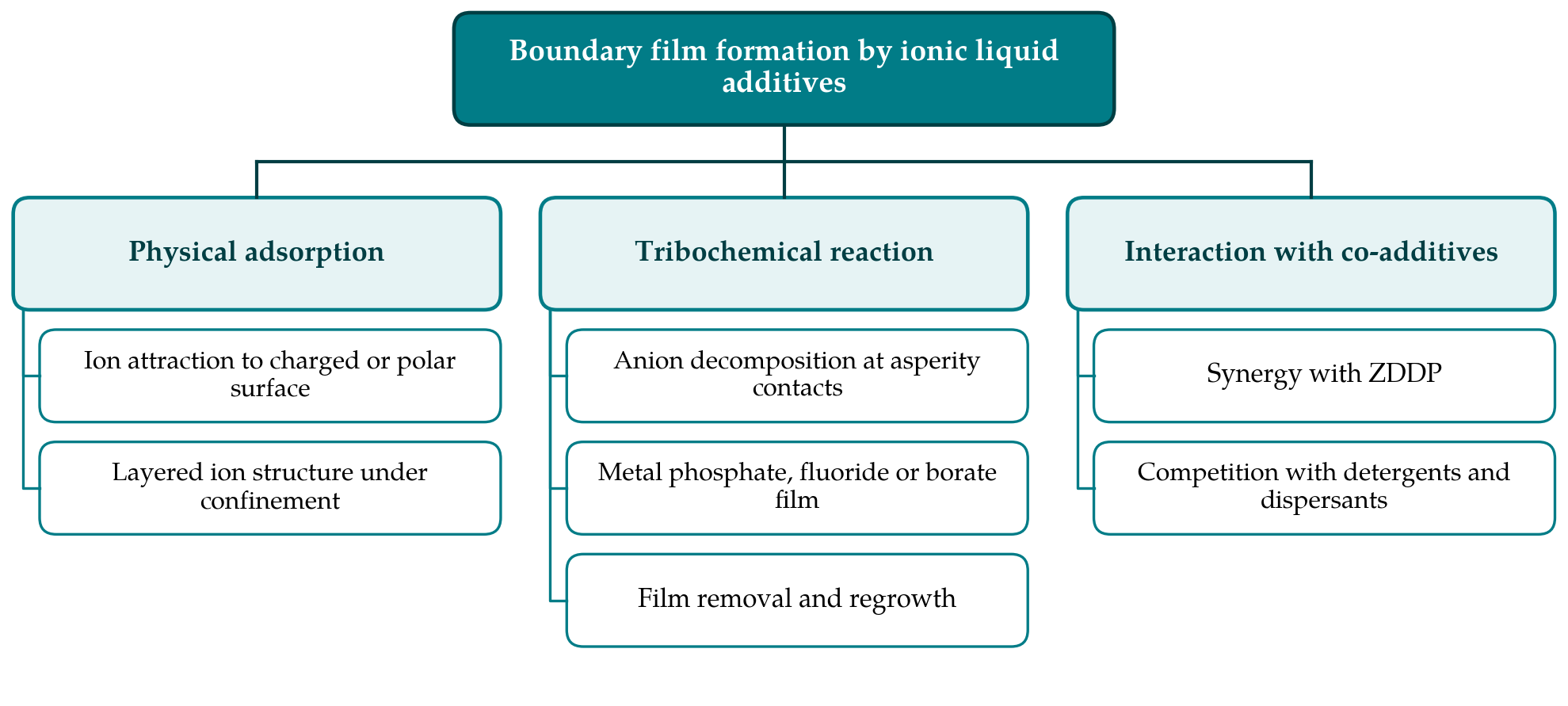
Explanations of how ionic liquid additives protect rubbing surfaces fall into three groups, shown in Figure 1: physical adsorption of ions, tribochemical reaction to form an inorganic film, and interaction with other surface-active additives. The three are not alternatives. Adsorption brings the additive to the surface, reaction converts part of it to a durable film, and co-additives alter both steps.
4.1. Adsorption and interfacial ordering
Ions are attracted to charged or polar solid surfaces, and metal surfaces under rubbing present fresh oxide and nascent metal sites with which anions in particular interact strongly. Force measurements on neat ionic liquids confined between atomically smooth surfaces show that the ions arrange into discrete layers extending several ion diameters from each wall, and that these layers resist being squeezed out (Atkin and Warr, 2007; Perkin, 2012). Such ordered layers can carry load and shear at low friction, which is the basis for proposals to use ionic liquids as molecularly thin lubricants (Palacio and Bhushan, 2010).
How far this picture carries over to a dilute solution in oil is less certain. The measurements were made on neat liquids and ideal surfaces, whereas an additive at low concentration must compete with base oil molecules and with other polar species for rough, chemically heterogeneous steel. The common assumption is that the polarity of the ion pair enriches it at the metal surface, as happens with conventional polar additives, and that the adsorbed layer gives some protection under mild conditions while also supplying the reactant for film growth. Direct evidence for the structure of that layer in a hydrocarbon medium remains limited.
4.2. Tribochemical reaction films
Under boundary conditions, where asperities touch, surface analysis of worn tracks consistently finds elements from the anion bound in inorganic compounds. With fluorine-containing anions, metal fluorides are detected; with phosphorus-containing anions, metal phosphates; with borate anions, boron oxides and related species (Minami, 2009; Zhou et al., 2009). The inference is that the anion decomposes under the combined action of contact stress, shear, frictional heating and freshly exposed metal, and that the products react with the surface.
For the oil-miscible phosphonium organophosphates, Qu et al. (2012) characterised the boundary film formed on ferrous surfaces by electron microscopy and surface spectroscopy and described a thin layer containing phosphates and oxides of iron, with wear debris incorporated. The cation appears to contribute less to the film itself. Its role is to confer oil solubility and to influence how readily the ion pair reaches and remains at the surface, and the length and symmetry of its alkyl chains affect both solubility and tribological performance (Barnhill et al., 2014).
The resemblance to zinc dialkyldithiophosphate (ZDDP) is plain. ZDDP forms a pad-like glassy phosphate film that is continually worn and replenished (Spikes, 2004). Comparison of an oil-miscible ionic liquid with ZDDP under the same conditions found anti-wear protection of a similar order, with differences in film composition and morphology (Qu et al., 2014). In both cases protection depends on a balance between the rate at which the film forms and the rate at which it is removed, and a film that forms too aggressively amounts to corrosive wear.
4.3. Interaction with other additives
A finished lubricant contains detergents, dispersants, antioxidants, viscosity modifiers and friction modifiers besides the anti-wear agent, and many of these are surface active. The most striking reported interaction is with ZDDP itself. Qu et al. (2015) found that combining a phosphonium alkylphosphate ionic liquid with ZDDP gave lower friction and wear than either additive alone at the same total phosphorus content, and attributed the effect to an exchange of anions between the two additives that altered the composition of the species arriving at the surface and of the resulting film. Synergy of this kind is encouraging, but it also shows that an ionic liquid cannot be assumed to behave in a full formulation as it does alone in base oil.
5. Compatibility Challenges
Whether an ionic liquid can serve as a practical additive depends on more than its anti-wear action. Table 1 lists the main compatibility issues raised in the literature, each discussed below.
| Issue | Origin | Approaches reported | Sources |
|---|---|---|---|
| Oil solubility | Ionic character; mismatch with non-polar hydrocarbons | Long-chain phosphonium or ammonium cations; lipophilic anions | Yu et al., 2012; Barnhill et al., 2014 |
| Hydrolysis and corrosion | Moisture-sensitive fluorinated anions release acid | Halogen-free or hydrolytically stable anions; corrosion inhibitors | Swatloski et al., 2003; Kamimura et al., 2007 |
| Co-additive interactions | Ion exchange and competition for the surface | Testing in full formulations; exploiting synergy | Qu et al., 2015 |
| Thermal and oxidative stability | Decomposition of ions at sustained high temperature | Choice of cation and anion; conventional antioxidants | Somers et al., 2013 |
| Environmental profile | Toxicity and persistence vary widely with structure | Screening of candidate ions; avoiding halogens | Pham et al., 2010 |
| Cost and supply | Multi-step synthesis; limited production scale | Use at low treat rates; simpler ions | Plechkova and Seddon, 2008 |
5.1. Solubility in base oils
An additive must stay dissolved over the whole temperature range of use and throughout storage. Ionic liquids with small, charge-dense ions are held together by strong Coulombic forces and separate from hydrocarbons. Miscibility has been achieved by diluting the charge within large ions bearing long alkyl groups, which makes the ion pair behave more like a neutral, oil-like molecule (Yu et al., 2012; Zhou and Qu, 2017). Structure matters in detail: Barnhill et al. (2014) showed that the alkyl chain arrangement of the phosphonium cation governs both solubility and tribological effect. Solubility in a single base oil does not guarantee stability in a blend containing polar additives, nor at low temperature, and these aspects are less often reported.
5.2. Hydrolysis, corrosion and material compatibility
The hydrolysis of hexafluorophosphate and tetrafluoroborate anions is well documented (Swatloski et al., 2003) and was the main reason for abandoning them in lubrication. Halogen-free anions avoid hydrogen fluoride but are not automatically benign, since any anion reactive enough to form a film can attack the metal if the reaction is not self-limiting. Lubricants in service take up water and acidic combustion or oxidation products, so stability has to be shown under those conditions and not only in dry laboratory air. Compatibility with non-ferrous metals, elastomer seals and coatings is also required of any additive (Rudnick, 2017), and for ionic liquids the published information on these points is thin.
5.3. Formulation, emissions and cost
Engine oils are subject to limits on phosphorus and sulfur because these elements impair exhaust after-treatment catalysts, a constraint that has shaped ZDDP use for many years (Spikes, 2004). Phosphorus-containing ionic liquids fall under the same limits, so their case rests on doing more per unit of phosphorus or on working together with reduced levels of ZDDP. Environmental claims need similar care. Ionic liquids were at one time described collectively as green because they do not evaporate, yet their aquatic toxicity and biodegradability vary greatly with structure (Pham et al., 2010). Cost remains a real barrier: industrial use of ionic liquids has grown (Plechkova and Seddon, 2008), but lubricant additives are commodity chemicals and an ionic liquid must justify its price at the treat rate needed.
6. Gaps and Directions for Research
Three limitations recur in the literature. First, most mechanistic work has been done with one ionic liquid in one base oil on steel, in short bench tests. Fully formulated oils, aged oils, and contacts involving coatings, aluminium alloys or copper alloys are much less well covered. Second, film formation has largely been inferred from analysis of surfaces after the test. In situ observation of film growth and removal, of the kind that clarified ZDDP behaviour, would show how quickly ionic liquid films form and how they respond to changes in load and temperature. Third, the adsorbed state of ion pairs in non-polar media is poorly characterised, which leaves the link between molecular structure and surface activity largely empirical.
Progress on compatibility calls for evidence of a different kind from that which established the anti-wear effect: long-duration oxidation and deposit tests, seal and corrosion tests, storage stability, and engine or rig trials with complete formulations. Halogen-free and phosphorus-free chemistries deserve particular attention because they sidestep the two most obvious regulatory and corrosion concerns.
7. Conclusion
Ionic liquids can function as anti-wear and friction-reducing additives in lubricating oils, and the mechanism is understood in outline: polar ion pairs concentrate at the rubbing surface, and the anion reacts under boundary contact to give a thin inorganic film whose composition reflects the anion chemistry. Oil-miscible phosphonium salts overcame the solubility barrier that confined earlier ionic liquids to polar fluids, and reported synergy with ZDDP suggests a route to lower-phosphorus formulations. The open questions are mostly about compatibility. Hydrolytic stability, corrosion, behaviour in complete additive packages, environmental acceptability and cost have each been addressed for particular compounds, but not yet with the breadth that the lubricant industry expects of a new additive class. Until that evidence exists, ionic liquid additives are best regarded as a promising and partly proven option.
Conflict of interest
To be declared by the author(s) before publication.
Funding
To be declared by the author(s) before publication.