1. Introduction
A cactus in the Sonoran Desert and a stonecrop on a European wall share a way of photosynthesis that most plants do not use. Both open their stomata mainly at night, fix carbon dioxide into malic acid with the enzyme phosphoenolpyruvate carboxylase, store the acid in large vacuoles, and release the carbon dioxide again next day for assimilation by Rubisco while the stomata are shut. Because the gradient driving water loss is much smaller at night, the water spent per unit of carbon gained is a fraction of that in C3 plants (Osmond, 1978; Nobel, 1988).
Textbook accounts often stop there, and leave the impression that a plant either has CAM or does not. The research literature has long told a more interesting story. Dodd et al. (2002) titled their review of the pathway "plastic, fantastic", and Cushman (2001) described it as a plastic photosynthetic adaptation. The amount of carbon fixed at night, the timing of stomatal opening and even the presence of the cycle can change within a plant as conditions change.
That flexibility has acquired a practical edge. Observations and model projections agree that drought is becoming more severe over many dry regions as the climate warms, although its measurement remains contested (Dai, 2013; Trenberth et al., 2014). Succulents are commonly assumed to be the plants best placed to cope. This review examines how far the known plasticity of CAM justifies that assumption.
2. Approach of the Review
This is a narrative review of the published literature on the ecophysiology, development and molecular regulation of CAM in succulent plants. It draws on the main reviews of the field and on the experimental papers that those reviews treat as decisive, and it makes no claim to a systematic search. The term succulent is used in the functional sense of Ogburn and Edwards (2010), for plants that store usable water in living tissue, and the discussion is confined to terrestrial and epiphytic species. Submerged aquatic plants with CAM are left aside because their problem is the supply of carbon and not of water.
3. The CAM Cycle and Its Variants
Osmond (1978) divided the daily course of gas exchange in a well-watered CAM plant into four phases. Phase I is nocturnal uptake and acid accumulation. Phase II is a brief burst of uptake at dawn, when both carboxylases are active. Phase III is the long middle of the day, with stomata closed and malate being decarboxylated. Phase IV is a period of direct C3 fixation in the late afternoon, once the acid store is exhausted and if water allows the stomata to reopen. The framework remains in use because the relative length of the phases is the first thing to change under stress.
Around this full cycle lie several variants, set out in Figure 1. In CAM cycling the stomata stay closed at night and open by day as in a C3 plant, and the nocturnal rise in acidity comes from refixing respired carbon dioxide. In CAM idling, described first in droughted Opuntia basilaris by Szarek et al. (1973), the stomata remain closed around the clock and the plant recycles its own carbon. Facultative CAM denotes species that use C3 photosynthesis when watered and engage the full cycle under stress (Winter and Holtum, 2014).
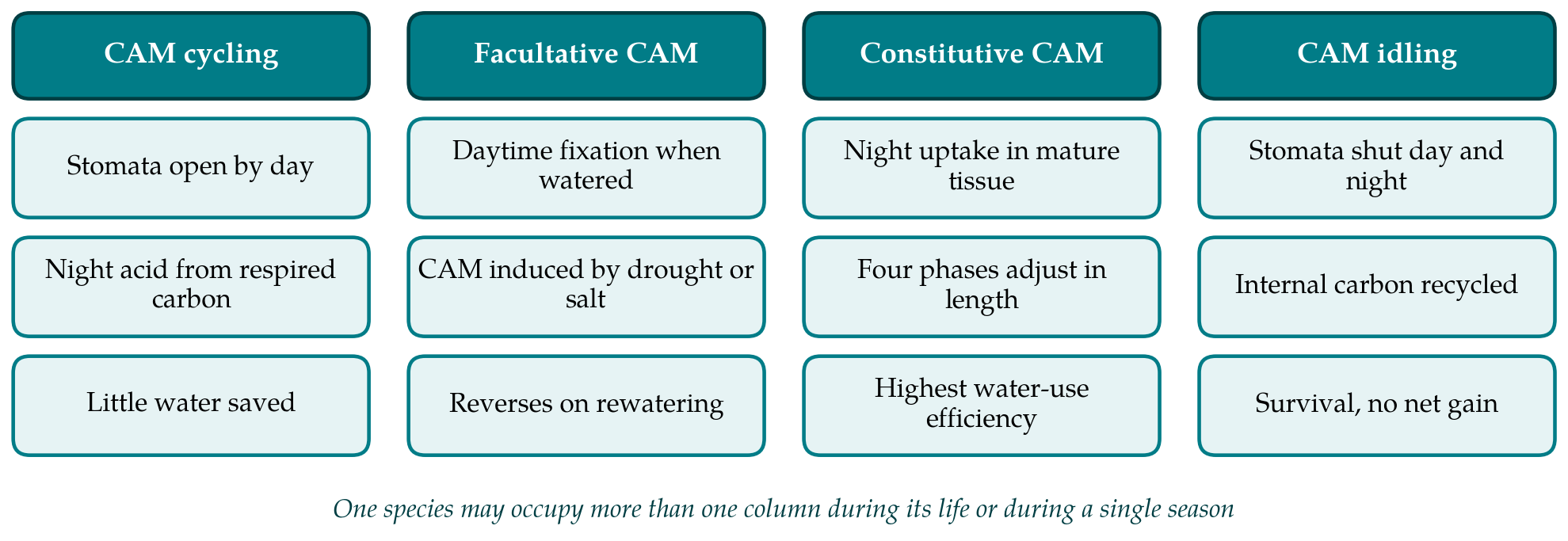
Whether these modes form a smooth continuum or distinct states is debated. Silvera et al. (2010) argued for a continuum along which lineages have moved during evolution. Winter et al. (2015) pointed out that carbon isotope ratios across large samples of species fall into two clusters with few intermediates, which suggests that a plant relying mainly on night fixation is a different kind of organism from one that only supplements C3 uptake. Both views accept that expression within a species is adjustable.
4. Evidence for Plasticity
The case that CAM responds to the environment rests on experiments of three kinds: induction and reversal in facultative species, the separation of developmental from environmental effects, and adjustment of the phases in species that always use the cycle.
4.1. Induction and reversal in facultative species
The founding observation was made on the annual halophyte Mesembryanthemum crystallinum, in which salt treatment brought on nocturnal acid accumulation (Winter and von Willert, 1972). The species became the standard model for work on induction (Cushman and Borland, 2002). The clearest demonstrations of true reversibility came later from perennial and annual species in Clusia, Talinum, Calandrinia and Portulaca, where continuous records of gas exchange show night uptake appearing as the soil dries and vanishing within days of rewatering (Winter and Holtum, 2014). In Talinum triangulare the change is accompanied by a burst of altered gene expression that also reverses (Brilhaus et al., 2016).
4.2. Development or environment
An increase in CAM as a plant ages can be mistaken for a response to stress, since older plants in pots are also drier. Winter et al. (2008) addressed the confusion by following seedlings of Clusia, Kalanchoë and Opuntia from germination under controlled water supply. In the constitutive species the cycle developed with tissue age whatever the conditions, although drought hastened and strengthened it. In Clusia pratensis it appeared only under drought and was lost on rewatering. The distinction matters for forecasting, because a programmed developmental shift cannot be brought forward indefinitely by a harsher climate.
4.3. Flexing the phases in constitutive species
Agaves, cacti and most leaf succulents of the Crassulaceae use CAM throughout adult life, and their plasticity lies in the proportions of the four phases. With ample water, phases II and IV lengthen and a substantial share of the daily carbon may be taken up directly in the light. As the soil dries, phase IV is lost first, then phase II, and night uptake itself declines until the plant is idling (Dodd et al., 2002; Lüttge, 2004). The sequence is reversed after rain. Nobel (1988) documented how quickly agaves and cacti resume uptake after a rainfall event, aided by shallow roots that respond to brief wetting of the surface soil.
4.4. What the facultative habit is for
Herrera (2009) raised an awkward point: in many facultative species the carbon gained at night under drought is small, too small to sustain growth. She proposed that the benefit lies in survival and reproduction, since the cycle keeps the photosynthetic apparatus supplied with carbon dioxide behind closed stomata, limits damage from excess light and allows seed to be set from a plant that would otherwise die. The argument applies with equal force to idling in constitutive species. It shifts the measure of success under drought from productivity to persistence.
5. Succulence as the Partner of CAM
CAM without stored water would be of limited use. The vacuoles that hold malic acid overnight also hold water, and many succulents have in addition a colourless water-storage tissue that gives up its water to the photosynthetic cells as drought proceeds (Griffiths and Males, 2017). This capacitance uncouples the plant from the soil for weeks or months. Ogburn and Edwards (2010) stress that succulent species differ widely in strategy: some store large volumes and spend them slowly, others are small, fill quickly from light rain and tolerate deep dehydration of the tissue. Table 1 sets these traits beside the forms of metabolic plasticity already described, with the time over which each operates.
| Form of plasticity | What changes | Time scale | Source |
|---|---|---|---|
| Phase adjustment | Daytime uptake in phases II and IV is curtailed | Days | Dodd et al., 2002 |
| Induction of CAM | C plant begins net uptake at night 3 | Days to weeks | Winter and Holtum, 2014 |
| CAM idling | Stomata close fully; respired carbon is recycled | Weeks to months | Szarek et al., 1973 |
| Draw-down of stored water | Storage tissue supplies the photosynthetic cells | Weeks to months | Griffiths and Males, 2017 |
| Root response to rain pulses | New absorbing roots form after wetting | Hours to days | Nobel, 1988 |
| Developmental increase in CAM | Night fixation strengthens as tissue matures | Months | Winter et al., 2008 |
6. Regulatory Basis
CAM uses enzymes that every plant possesses. What distinguishes it is their timing and abundance, and the evolutionary step from C3 photosynthesis may therefore be shorter than the physiology suggests (Edwards, 2019). Genome sequences support this view. In pineapple, genes of the CAM pathway carry regulatory elements associated with the circadian clock (Ming et al., 2015), and the genome of Kalanchoë fedtschenkoi revealed convergent changes shared with other CAM lineages (Yang et al., 2017).
For plasticity the more telling evidence comes from facultative species sampled through induction and recovery. In Talinum, transcripts of the carboxylation and decarboxylation enzymes and of starch metabolism rise during drought together with those of abscisic acid signalling, and fall back on rewatering (Brilhaus et al., 2016). Such results indicate that the switch is under the control of the ordinary drought-signalling network. They have encouraged proposals to introduce inducible CAM into C3 crops and to grow CAM species on land too dry for conventional agriculture (Borland et al., 2014).
7. What Intensifying Drought Changes
The plasticity reviewed above evolved under droughts of a particular character: seasonal, broken by rain pulses and accompanied by cool nights. Climate change alters each of these. Longer intervals between rains extend the period of idling, during which the plant lives on reserves. Idling preserves the plant but yields no net carbon, and stored water is finite. A succulent can lose a large proportion of its water and recover, yet each extension of the dry season leaves less time for growth and for replacing reserves.
Night temperature is a second concern. Nocturnal uptake in agaves and cacti is greatest on cool nights and declines as nights warm (Nobel, 1988), and night-time warming is a consistent feature of the observed climate trend. Higher night temperatures also raise respiration and reduce the humidity advantage on which the water economy of CAM depends. Reyes-García and Andrade (2009) drew attention to how little field evidence exists on the combined response of CAM plants to rising carbon dioxide, warming and altered rainfall.
The third issue is the life stage at which plasticity is weakest. Seedlings have little stored water and, in constitutive species, incompletely developed CAM, and establishment in desert succulents is typically confined to runs of wet years and to the shade of nurse plants. A climate with fewer such years narrows the window for recruitment even where adults persist. The global assessment of the cactus family found close to a third of species threatened with extinction, chiefly from land conversion and collection (Goettsch et al., 2015). Climatic stress falls on populations that are already reduced.
8. Gaps and Future Work
Most of what is known about CAM plasticity comes from potted plants studied for days or weeks. Records of gas exchange and acid accumulation through whole drought cycles in the field are few, and almost none follow the same individuals across years. The contribution of facultative CAM to lifetime fitness, the question posed by Herrera (2009), is still open. Winter (2019) has emphasised how many succulent lineages remain uncharacterised, particularly small-statured species with weakly expressed CAM. Experiments that combine warmer nights with drought, and that include seedlings, would address the conditions that projections make most relevant.
9. Conclusion
CAM in succulents is a set of adjustable behaviours: phases that lengthen and shorten, a cycle that some species engage only when needed, and a closed idling state that buys time. Joined to water storage, these give real protection against drought of the kind the plants evolved with. They do not confer immunity to droughts that are longer, hotter at night and poorer in the rain pulses on which recovery depends. Succulents should be regarded as tolerant within limits that are not yet well measured, and measuring those limits in the field is the task that most needs attention.
Conflict of interest
To be declared by the author(s) before publication.
Funding
To be declared by the author(s) before publication.