1. Introduction
Spent lithium-ion batteries are both a waste problem and a metal resource. Recycling routes and their limitations have been reviewed by Harper et al. (2019) and, with emphasis on the chemistry, by Lv et al. (2018). In the hydrometallurgical route the cathode material is leached, typically in mineral or organic acid with a reducing agent, and the resulting solution is treated by precipitation and solvent extraction to separate cobalt, nickel and manganese (Chagnes and Pospiech, 2013). Lithium follows these steps in the aqueous phase and is usually recovered last, as the carbonate, from a liquor that by then contains much sodium. Recovery at that point is incomplete (Swain, 2017).
Regulation has raised the stakes. The European Union's batteries regulation sets a target for lithium recovery from waste batteries of 50 per cent by the end of 2027 and 80 per cent by the end of 2031 (European Union, 2023). Meeting figures of that order calls for separation steps aimed at lithium itself and not only at the more valuable transition metals.
Deep eutectic solvents are one of the options under study. This article does not report tests of any solvent. It proposes a procedure by which candidate solvents can be screened in a consistent order and against stated criteria, so that results from different laboratories can be compared.
2. Background
Two bodies of knowledge underlie the procedure: the nature of deep eutectic solvents and the established practice of solvent extraction.
2.1. Deep eutectic solvents
The term was introduced by Abbott et al. (2003) for mixtures of choline chloride and urea, which at a 1:2 molar ratio are liquid at room temperature although both components are high-melting solids. Mixtures of choline chloride with carboxylic acids behave similarly. The general picture is of a hydrogen bond acceptor and a hydrogen bond donor whose interaction lowers the melting point, and reviews describe the range of compositions and uses (Smith et al., 2014). The definition has been tightened by Martins et al. (2019), who argue that the name should be kept for mixtures whose melting point lies well below that predicted for an ideal mixture, a test that many so-called deep eutectic solvents have never been put to.
In battery recycling these liquids have been used in two distinct ways. Hydrophilic mixtures such as choline chloride with ethylene glycol can dissolve cathode oxides directly, as Tran et al. (2019) showed. That is leaching. The present article concerns the second use, liquid-liquid extraction from an aqueous leachate, which requires a solvent immiscible with water. Hydrophobic deep eutectic solvents of this kind were introduced by van Osch et al. (2015), who combined decanoic acid with quaternary ammonium salts, and were soon applied to the removal of alkali and transition metal ions from water (van Osch et al., 2016). Mixtures designed for lithium, in which a β-diketone is paired with a neutral organophosphorus donor, have also been described (Hanada and Goto, 2021).
2.2. Solvent extraction principles
Extraction performance is expressed through a few standard quantities (Rydberg et al., 2004). The distribution ratio D of a metal is its total concentration in the organic phase divided by that in the aqueous phase at equilibrium. The separation factor between two metals is the ratio of their distribution ratios. The percentage extracted depends on D and on the phase volume ratio, and should never be quoted without the latter. For lithium there are two possible strategies: extract the transition metals and leave lithium in the raffinate, or extract lithium away from everything else. The lithium ion is small, strongly hydrated and a hard acid in the sense of Pearson (1963), so that it is extracted only by hard oxygen donors and usually from neutral or alkaline solution. Any screening scheme has to state which strategy a candidate is meant to serve.
3. The Proposed Screening Procedure
The procedure has seven steps, arranged so that inexpensive tests remove unsuitable candidates before costly ones are run. Figure 1 shows the sequence and Table 1 gives, for each experimental tier, the quantity recorded and the grounds for rejection. Thresholds are left to the user, since they depend on the flowsheet in view; what the procedure fixes is that they be set before testing begins.
| Tier | Test | Quantity recorded | Reject if |
|---|---|---|---|
| Physical | Contact with metal-free aqueous phase | Viscosity, density, component loss to water | Slow disengagement or marked leaching |
| Single metal | Shake test with each metal alone | Distribution ratio against pH | No pH window separates lithium |
| Mixed feed | Synthetic leachate; repeated loading | Separation factors; capacity; mass balance | Selectivity lost or phases unstable |
| Stripping | Contact loaded solvent with strip liquor | Fraction stripped; solvent composition | Metal cannot be recovered cleanly |
| Reuse | Several extraction and stripping cycles | Change in distribution ratio per cycle | Performance declines steadily |
| Real feed | Leachate from actual battery material | All of the above | Behaviour departs from synthetic feed |
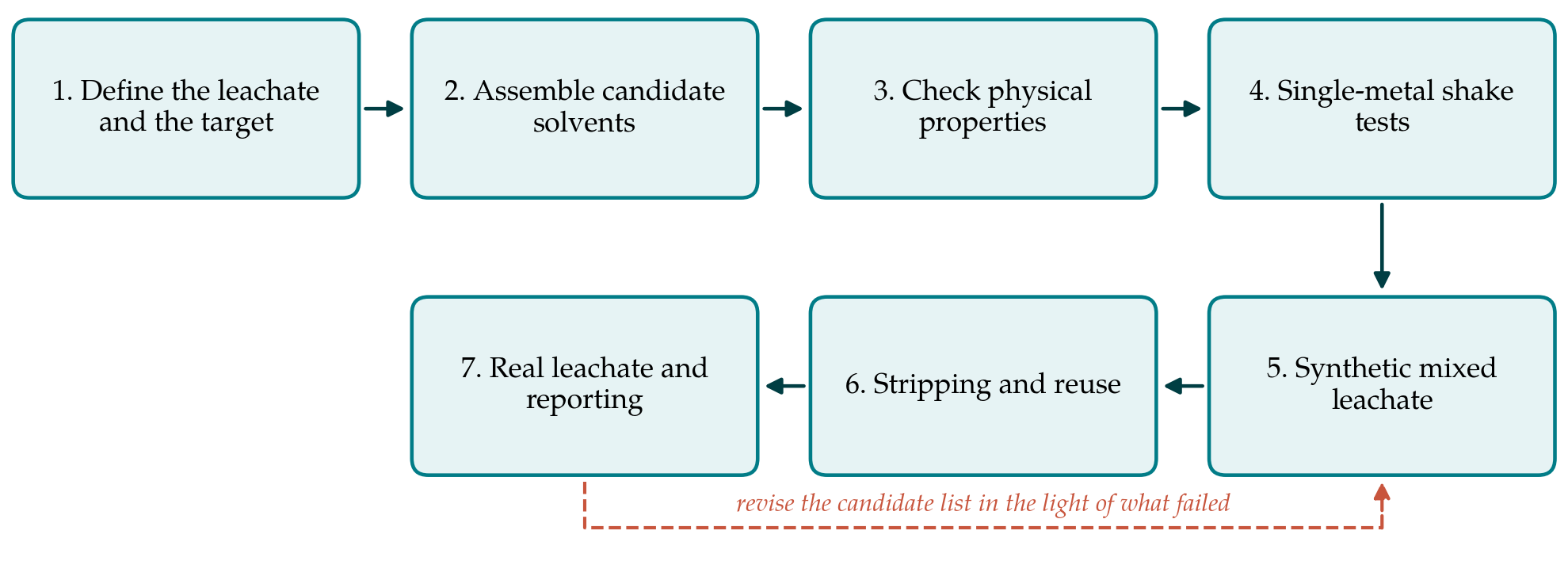
3.1. Step 1: Define the leachate and the target
The composition of the feed determines everything that follows. The user records the cathode chemistry or mixture assumed, the leaching acid and its residual concentration, the pH, and the expected concentrations of lithium, cobalt, nickel and manganese together with the impurities aluminium, copper and iron and any sodium introduced by neutralisation. The point in the flowsheet at which the solvent would act is stated, as is the strategy, lithium-selective or lithium-rejecting.
3.2. Step 2: Assemble candidates on stated grounds
Candidates are chosen for reasons that can be written down: an acidic component able to exchange protons for metal ions, a neutral oxygen donor to complete the coordination of lithium, a long alkyl chain for hydrophobicity. Where resources allow, a computational prescreen with a model such as COSMO-RS (Klamt, 1995) can rank mixtures by predicted mutual solubility with water. Each candidate is prepared at a defined molar ratio, and its melting behaviour is checked so that it is known to be a liquid mixture and, if the name is to be used, a deep eutectic in the stricter sense.
3.3. Step 3: Check physical properties and phase stability
A solvent that cannot be handled is rejected before any metal is added. Viscosity and density are measured at the working temperature, since a viscous phase of density close to that of water will not disengage. The candidate is then contacted with metal-free aqueous solution at the pH of the feed, and both phases are analysed for the solvent components. This test is essential. The components of a hydrophobic eutectic mixture partition into water to different extents, so that the organic phase after contact may no longer have the composition that was prepared (Florindo et al., 2019). Loss of a component also contaminates the raffinate, and a mixture that sheds one of its constituents at this stage is set aside whatever its promise as an extractant.
3.4. Step 4: Single-metal shake tests
Each metal of interest is extracted separately from a solution matching the ionic background of the feed. Equal volumes are shaken at controlled temperature until equilibrium, the time to equilibrium having been established in a preliminary run. Both phases are analysed, for example by inductively coupled plasma optical emission spectrometry after digestion or stripping of the organic phase, so that the mass balance can be closed and not inferred by difference. The equilibrium pH is measured, not the initial one. Plotting the distribution ratio against equilibrium pH for each metal shows at once whether a window exists in which lithium is separated from the rest.
3.5. Step 5: Synthetic mixed leachate
Candidates that pass are tested on a synthetic solution containing all the metals at the concentrations defined in Step 1. Competition for the extractant, changes in ionic strength and co-extraction often erode the selectivity seen with single metals. The variables that matter most, usually pH, phase ratio, temperature and the molar ratio of the solvent components, are best explored with a factorial design instead of one factor at a time, so that interactions are detected with a manageable number of runs (Montgomery, 2017). Loading capacity is determined by repeated contact of the same solvent with fresh feed, with attention to the appearance of a third phase or a precipitate.
3.6. Step 6: Stripping and reuse
An extractant that will not release the metal is of no use. The loaded solvent is contacted with a strip solution, commonly dilute acid, and the fraction of each metal returned to the aqueous phase is measured. The solvent is then analysed for its own components and returned to extraction for several cycles. A steady fall in distribution ratio, a drift in component ratio or a rise in viscosity is a ground for rejection.
3.7. Step 7: Real leachate and reporting
The few remaining candidates are tested on leachate prepared from actual spent cathode material, which contains fluoride and phosphate from the electrolyte salt, organic residues from the binder and trace metals absent from synthetic solutions. Results are reported in a fixed form: feed composition, solvent composition and water content, phase ratio, temperature, equilibrium pH, distribution ratios with their replicate scatter, separation factors and mass balance closure.
4. Fitting the Procedure to Practice
The procedure is written for a laboratory with ordinary equipment: a thermostatted shaker, a viscometer, a pH meter and access to elemental analysis. The early tiers are quick, and most candidates are expected to fail there. Two additional considerations belong alongside the technical tiers. One is hazard. A mixture is not benign because it is called a deep eutectic solvent, and the toxicity, biodegradability and flammability of each component should be looked up and recorded, in the spirit of the questions Jessop (2011) posed for green solvents generally. The other is the benchmark. Every campaign should include a conventional extractant in a hydrocarbon diluent, tested under identical conditions, because a new solvent has to be judged against what industry already uses.
Record keeping deserves the same attention as the chemistry. Each candidate should carry a single identifier through all tiers, with the supplier and stated purity of every component, the water content of the mixture as prepared, and the date of preparation, since hygroscopic mixtures change on standing. Candidates rejected at an early tier are reported together with the reason. Negative results of this kind are rarely published, yet they are what would let another laboratory avoid repeating the same unproductive tests, and a screening campaign that lists only its successes gives a misleading impression of how selective the screen was.
5. Limitations and What Remains to Be Shown
The procedure is proposed and has not been validated here. Its ordering of tiers rests on the judgement that phase stability and component leaching eliminate more candidates, more cheaply, than selectivity tests do; that judgement should be checked by running a set of candidates through the tiers in more than one order. Whether rankings obtained with a synthetic leachate hold for real ones is likewise an empirical matter. Shake tests give equilibrium data and say nothing about behaviour in mixer-settlers or columns, where viscosity and interfacial properties govern throughput. Nor does the procedure address cost or life-cycle impact, which need separate analysis once a candidate has survived. An interlaboratory comparison on a shared synthetic feed would be the most direct test of whether the scheme delivers the comparability it aims for.
A further limitation concerns the feed itself. Cathode chemistries are changing, with nickel-rich layered oxides and lithium iron phosphate taking a growing share, and a leachate defined today may not represent the material arriving at recyclers some years from now. Iron phosphate cathodes in particular give leachates rich in iron and phosphate and poor in cobalt and nickel, for which the balance between the lithium-selective and lithium-rejecting strategies may be quite different. The procedure accommodates this through Step 1, but rankings obtained for one feed should not be carried over to another without repeating the mixed-feed tier.
6. Conclusion
Selective recovery of lithium is the weak point of hydrometallurgical battery recycling, and hydrophobic deep eutectic solvents are plausible candidates for improving it. The staged procedure described here defines the feed and target first, rejects unstable or unworkable mixtures early, measures distribution ratios against equilibrium pH with closed mass balances, and insists on stripping, reuse, a real feed and a conventional benchmark. It is offered as a framework for consistent testing, and its usefulness remains to be demonstrated in the laboratory.
Conflict of interest
To be declared by the author(s) before publication.
Funding
To be declared by the author(s) before publication.