1. Introduction
Early in 2017 a British newspaper investigation showed advertisements for household-name brands running before extremist videos on YouTube, and a long list of advertisers suspended their spending. The episode gave the trade a term it has used ever since. Brand safety refers to keeping advertising away from content that would embarrass or damage the advertiser, and the fact that it needs a name at all is a consequence of how digital advertising is bought. Most display and video inventory is now traded programmatically, through automated auctions that match an advertisement to an impression in the time it takes a page to load (Wang et al., 2017; Choi et al., 2020).
A second development has run alongside the first. The third-party cookie, a small identifier set by a domain other than the one the user is visiting, was for two decades the main means by which advertising intermediaries recognised a browser from one site to the next. It has been steadily restricted by browser makers and constrained by privacy regulation. It has not been abolished: Google announced in 2024 that Chrome would not remove it outright as previously planned. Decline is the accurate word, and it is the one used in the title.
The two subjects are usually discussed apart, one as a matter of reputation and the other as a matter of privacy and targeting. This review considers them together. Its question is what happens to brand safety when the buyer knows less about who is looking at the page.
2. Approach of the Review
This is a narrative review. It draws on academic work in marketing, information systems, computer science and media studies, and on regulatory and industry reports that document how the advertising supply chain operates. Sources were chosen for their bearing on the question, and no systematic search protocol is claimed. Industry practice in this area changes quickly, so the review concentrates on mechanisms and arguments that do not depend on any one vendor or product.
3. How Automated Buying Creates Placement Risk
In real-time bidding, a publisher's supply-side platform sends a bid request to an exchange, which invites demand-side platforms acting for advertisers to bid. The request describes the impression: the page address or application, the format, and whatever is known about the user. The advertiser's platform decides in milliseconds whether to bid and how much. Nobody on the buying side looks at the page. Where a media planner once bought a named title, the programmatic buyer purchases audiences or outcomes across many thousands of sites, and discovers where the advertisements ran from a report afterwards, if at all.
The economics of this arrangement reward any page that attracts an auction. Braun and Eklund (2019) describe how advertising technology made hoax news profitable, and Ahmad et al. (2024) show that large numbers of companies have ended up funding misinformation sites through automated placement, often without their managers being aware of it. The chain between advertiser and publisher is long and partly opaque. A study commissioned by British advertisers found that only about half of what advertisers spent reached publishers and that a material share of the remainder could not be attributed to any identified intermediary (ISBA and PwC, 2020). A later study for American advertisers drew attention to sites built chiefly to harvest advertising, which absorbed a notable share of the impressions examined (ANA, 2023). Gordon et al. (2021) treat such leakage, together with fraud and weak measurement, as structural inefficiencies of the market.
Does adjacency harm the advertiser? Experimental and field evidence suggests that it can. Bellman et al. (2018) tested the effect of controversial video content on the pre-roll advertising shown with it, and Shehu et al. (2021) found that advertising on low-quality websites was less effective than the same advertising on better ones. The industry has refined its vocabulary accordingly. The framework issued by the Global Alliance for Responsible Media separated a safety floor, content unfit for any advertising, from suitability, a graded judgement of risk that differs between brands (GARM, 2020). The alliance was wound up in 2024, but the distinction between safety and suitability has outlived it.
4. The Retreat of the Third-Party Cookie
Measurement studies established how pervasive cross-site tracking had become by the middle of the last decade (Englehardt and Narayanan, 2016), and the practice drew criticism from scholars and regulators alike. Figure 1 marks the main steps in the cookie's retreat. Apple's Safari began limiting cross-site tracking in 2017 and blocked third-party cookies entirely in 2020. Mozilla's Firefox blocked third-party tracking cookies by default from 2019. The General Data Protection Regulation, applicable from May 2018, made consent the usual legal basis for advertising cookies in the European Union (European Union, 2016), and the United Kingdom's regulator questioned whether real-time bidding as practised could meet the law's requirements (ICO, 2019). On mobile devices, Apple's App Tracking Transparency policy required applications from 2021 to ask permission before tracking users across other companies' services.
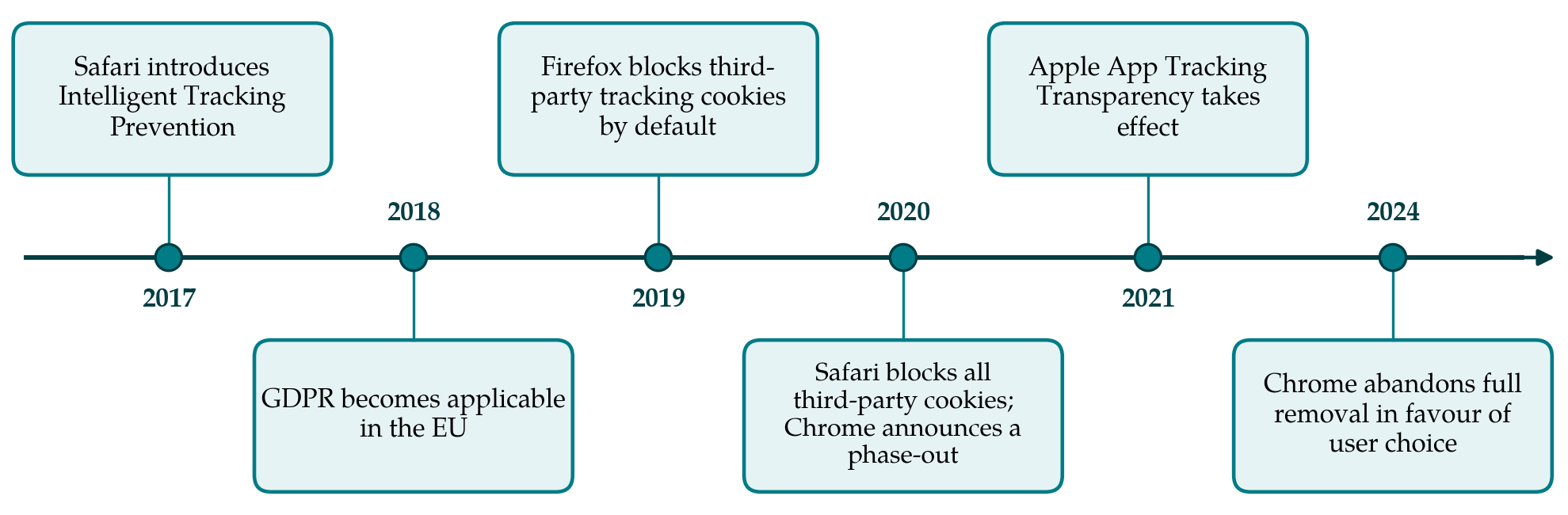
Google announced in 2020 that Chrome would phase out third-party cookies and proposed a set of replacement interfaces under the name Privacy Sandbox, among them a Topics interface that exposes coarse interest categories inferred in the browser. The timetable slipped repeatedly under scrutiny from the British competition authority, whose market study had already described the concentration of the sector (CMA, 2020). In 2024 the company changed course and said it would leave the decision to users. The result is a divided environment. A large part of browsing, including that done in Safari and Firefox, already takes place without third-party cookies, while the remainder still carries them where users have consented.
5. What the Cookie Did for Brand Safety, and What It Did Not
The cookie's main function was to identify audiences, and its effect on placement risk was indirect and mostly adverse. Behavioural targeting lets an advertiser follow a desirable user to whatever page that user visits (Boerman et al., 2017). Once the audience is the unit of purchase, the page becomes incidental, and cheap impressions on marginal sites look attractive because the same person is reached at a lower price. In this sense the cookie loosened the tie between advertisement and editorial environment that had made the choice of title a form of quality control.
Cookies also supported functions that protect brands. Frequency capping, attribution and some forms of fraud detection rely on recognising a browser across requests, and verification vendors used cookies among other signals. Their loss weakens those functions unless substitutes are found. The economic value of the identifier to publishers is itself debated. Johnson et al. (2020) found that impressions from users who had opted out of behavioural advertising sold for substantially less, whereas Marotta et al. (2019) estimated that the presence of a cookie added only a little to a publisher's revenue once other factors were controlled. Earlier work on European privacy rules found that restricting data use reduced advertising effectiveness, though less so on sites whose content was closely matched to the product (Goldfarb and Tucker, 2011a). That last finding anticipates the present argument: where the content does the targeting, less depends on the identifier.
6. Safeguards With Weaker Identifiers
Four families of safeguard are available to an advertiser who can no longer rely on the cookie. Table 1 summarises them, and the paragraphs below take each in turn.
| Safeguard | How it works | Reliance on cookies | Main limitation |
|---|---|---|---|
| Keyword blocklists | Bids are withheld when listed words appear in the address or text | None | Ignores meaning; blocks legitimate news and minority topics |
| Semantic contextual analysis | Language and image models classify the page against a content taxonomy | None | Classifier error; weak coverage of video, audio and smaller languages |
| Inclusion lists and private deals | Buying is confined to vetted publishers or negotiated marketplaces | None | Narrow reach, higher prices, effort to maintain |
| Supply-path controls | Declared-seller files and supply chain records expose who is selling | None | Verifies the seller, not the content |
| Independent verification | A third party checks placements before the bid or after delivery | Partial | Limited access inside closed platforms; cost |
| Replacement identifiers and browser interfaces | First-party or consented identifiers and on-device topics restore some targeting | Substitute | Uneven adoption; no direct bearing on content |
6.1. Contextual analysis
Contextual advertising selects the page instead of the person, and so needs no cross-site identifier (Zhang and Katona, 2012). Its crudest form is the keyword blocklist, which refuses any page containing a listed word. More recent systems use language models and image recognition to assign pages to categories of a shared content taxonomy and to estimate sentiment. Evidence that matching advertisement to content can be effective is long-standing: Goldfarb and Tucker (2011b) found that contextually matched display advertising raised purchase intent, although combining a close match with a highly visible format undid the gain. For brand safety the important point is that the classification which decides whether a page is relevant is the same one that decides whether it is suitable. Renewed investment in contextual targeting therefore improves the raw material of brand safety, and exposes it to the same classification errors.
6.2. Supply-path controls and verification
A second set of measures concerns who is selling. The ads.txt specification lets a publisher list the sellers authorised to offer its inventory, so that buyers can reject impostors (IAB Tech Lab, 2017), and companion records describe the chain of intermediaries behind a bid request. A longitudinal study found that the standard spread quickly among major publishers while leaving gaps in compliance (Bashir et al., 2019). Such controls depend on domains, not cookies. They establish that the seller is who it claims to be, which guards against spoofing, but they say nothing about what is on the page. Independent verification fills part of that gap by classifying pages before a bid or auditing placements afterwards. Its reach is limited inside the large closed platforms, where outside vendors see only what the platform allows. Buyers have also begun to shorten the path itself, dealing with fewer exchanges and preferring routes that connect directly to the publisher, on the reasoning that every intermediary removed is one fewer place for inventory to be misdescribed.
6.3. Replacement identifiers
Publishers and intermediaries have promoted alternatives to the cookie: identifiers derived from a logged-in email address, audience segments declared by the publisher from its own first-party data, and the browser interfaces proposed by Google. These restore some targeting and measurement. Their relevance to brand safety is indirect. First-party audiences tend to be sold by established publishers through direct or curated deals, which carries a quality benefit of its own, and a market that rewards a publisher's relationship with its readers gives less encouragement to anonymous sites built for arbitrage.
6.4. Closed platforms
A large part of digital advertising is bought inside closed platforms that own both the inventory and the buying tools: search engines, social networks and video-sharing services. These environments never depended on third-party cookies, because their users are logged in, and the cookie's decline leaves their targeting largely intact. Their brand safety problem is of a different kind. The content is uploaded by users in volumes that no team could review beforehand, and the advertiser's protection consists of the platform's own moderation, its exclusion settings and such outside measurement as it permits. The boycott of 2017 and the campaign of 2020 in which many advertisers paused their spending on Facebook were both directed at platforms of this type and not at the open exchange. An advertiser who answers weaker identifiers on the open web by moving budget into closed platforms exchanges one kind of exposure for another, and gives up the ability to choose the publisher.
7. The Costs of Avoidance
Brand safety practice has costs that fall on others. Blocklists that exclude words such as those connected with violence, disease or sexuality remove advertising from serious journalism about those subjects; during 2020 news publishers complained widely that coverage of the coronavirus pandemic was being blocked in this way. Griffin (2023) argues that the move from safety to suitability has given advertisers a growing and largely unaccountable influence over which content platforms reward, with a bias toward the bland. Moderation and classification at scale are error-prone for reasons that Gillespie (2018) sets out at length, and the errors are not evenly distributed: terms that describe minority identities are also the terms most likely to appear on crude exclusion lists. A shift to contextual buying after the cookie makes these judgements more consequential, because more money follows them.
Avoidance is costly to the advertiser as well. Every exclusion shrinks the pool of eligible impressions and raises the price of what is left. The website quality findings of Shehu et al. (2021) suggest that reputable environments are worth paying for, which makes the indiscriminate blocking of news a doubtful economy: the brand forgoes attentive readers in a trusted setting in order to avoid a risk that a more careful classification would have shown to be small.
8. Regulation and Open Questions
Law now reaches parts of the problem. The European Union's Digital Services Act prohibits advertising based on profiling that uses special categories of personal data, bars profiling-based advertising directed at minors, and requires very large platforms to keep public repositories of the advertisements they carry (European Union, 2022). These rules push in the same direction as browser restrictions, and the repositories give researchers a view of placement that was previously unavailable.
Several questions remain open. Independent evidence on the accuracy of contextual classifiers, by language and by format, is scarce, and almost nothing is published on connected television and audio, where the buyer often cannot see programme-level information. The consequences of machine-generated content for classification are only beginning to be studied. It is not known whether a market with weaker identifiers moves spending toward reputable publishers or toward the closed platforms whose logged-in data are unaffected. And the brand harm from adjacency has been measured in a handful of settings; its size relative to the cost of avoidance is still a matter of judgement.
9. Conclusion
The decline of the third-party cookie does not create the brand safety problem and does not solve it. Placement risk arises from automated buying across a long and partly opaque supply chain, and the audience-first logic that the cookie made possible aggravated it by making the page incidental. As user identification weakens, the page returns to the centre of the buying decision. That is favourable to brand safety, provided that content can be classified accurately and fairly, and that provision is the weak point. Advertisers who replace audience data with crude exclusion will protect themselves at the expense of journalism and of voices already at the margins. Those who invest in knowing where their advertising runs, through shorter supply paths, vetted inventory and verification they can audit, are likely to find that privacy constraints and brand protection are compatible aims.
Conflict of interest
To be declared by the author(s) before publication.
Funding
To be declared by the author(s) before publication.