1. Introduction
Aquaculture has reduced the share of fishmeal in its feeds for three decades, yet the sector as a whole still draws heavily on the reduction fisheries that supply it (Tacon and Metian, 2008). The pressure is economic as much as ecological: the supply of forage fish is close to fixed, and every new tonne of compound feed has to be formulated around that limit. Plant proteins have absorbed most of the substitution so far, and their strengths and weaknesses are well documented (Gatlin et al., 2007). Attention has since turned to a wider set of novel ingredients, among which insect meals are the most advanced commercially (Naylor et al., 2021).
Nile tilapia is an instructive test species for these ingredients. It feeds low in the food chain, eats insects and their larvae in the wild, and is farmed in exactly the tropical and subtropical regions where organic by-products suitable for insect rearing are abundant and imported fishmeal is expensive (El-Sayed, 2006). Commercial grow-out feeds for tilapia already contain little fishmeal. The fry and juvenile stages are a different matter: protein requirements are highest, feed particles are small, and formulators have been reluctant to give up an ingredient that is palatable, digestible and balanced in amino acids. The question of replacement therefore matters most in the juvenile phase.
This article reviews the published evidence on replacing fishmeal with insect protein in diets for juvenile Nile tilapia. It asks what the candidate meals contain, how tilapia have performed on them, which properties of the meals explain the differences between trials, and what stands between the experimental result and routine use.
2. Scope and Approach
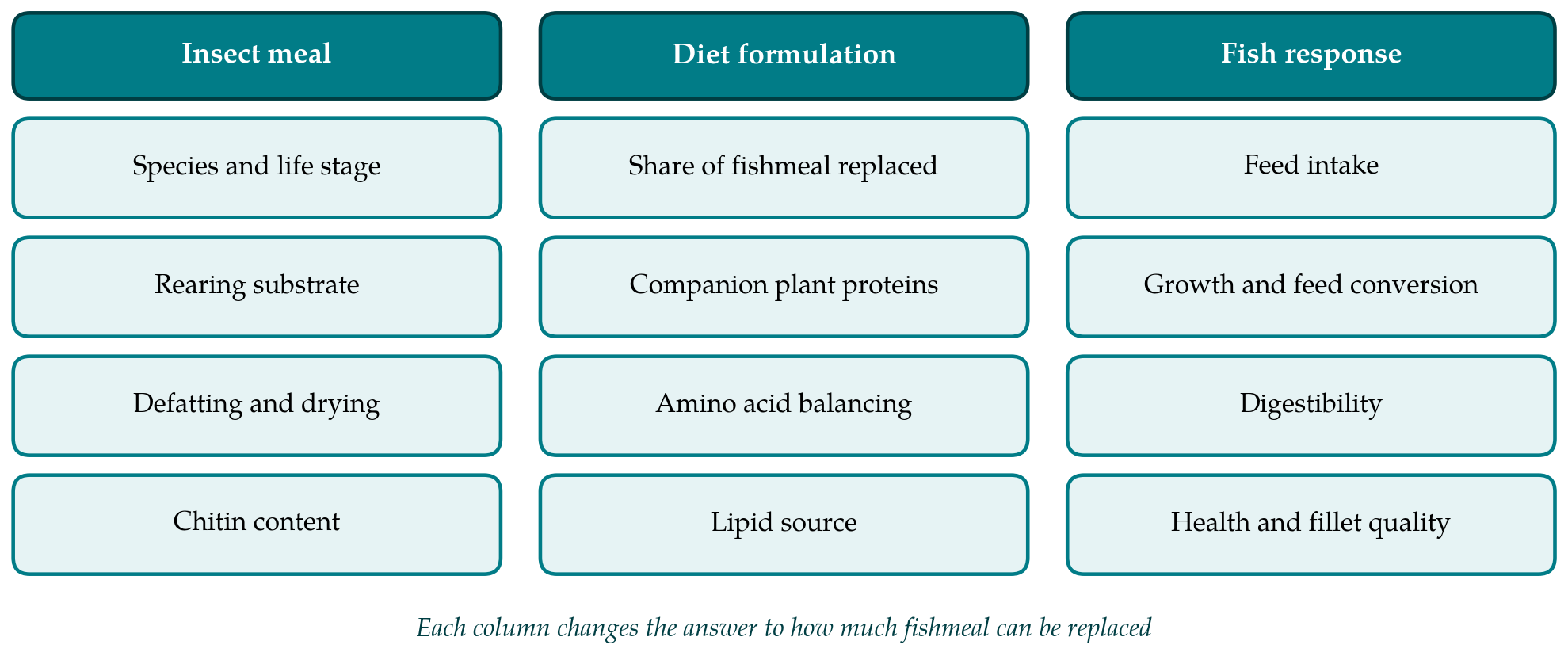
The review is narrative. It draws on the principal general reviews of insects in animal and fish feeds (Makkar et al., 2014; Henry et al., 2015; Nogales-Mérida et al., 2019), on feeding trials with tilapia, and on work with other farmed fish where it clarifies a mechanism. Standard sources on fish nutrition supply the requirement values against which the meals are judged. No formal search protocol was applied and no pooled estimate is offered. Where trials disagree, the disagreement is reported and the likely reasons are discussed. The factors that organise the discussion are summarised in Figure 1.
3. What Juvenile Tilapia Require
Tilapia need the same ten indispensable amino acids as other fish, and the quantitative requirements of the Nile tilapia were established in the classic dose-response work of Santiago and Lovell (1988). Lysine and the sulphur amino acids are those most often limiting in practical diets. Dietary protein needs fall as the fish grows, so that a diet adequate for a market-size fish is deficient for a fingerling (NRC, 2011). The essential fatty acid requirement differs from that of marine carnivores in a way that favours insect ingredients: tilapia perform well on linoleic acid and other fatty acids of the n-6 series and do not depend on a dietary supply of long-chain n-3 fatty acids to the same extent (El-Sayed, 2006; NRC, 2011).
Two consequences follow. A candidate protein for juvenile tilapia must first be judged on its digestible lysine and methionine, not on crude protein. And the low content of long-chain n-3 fatty acids in terrestrial insects, which is a serious drawback in salmonid and marine fish diets, is a lesser concern for the growth of tilapia, although it still bears on the fatty acid profile of the fillet offered to the consumer.
4. Composition of the Candidate Meals
Three insects account for most of the work with fish: the black soldier fly, Hermetia illucens, the yellow mealworm, Tenebrio molitor, and the housefly, Musca domestica. Silkworm pupae, a by-product of sericulture, and various crickets and locusts make up most of the remainder. Their general features are set out in Table 1. Insect meals are protein-rich, but the range is wide, and the fat content of unprocessed larvae can be high enough to dilute the protein considerably (Makkar et al., 2014). Defatting concentrates the protein and yields a meal closer to fishmeal in its proximate composition.
| Insect meal | Nutritional features | Main constraints | Representative sources |
|---|---|---|---|
| Black soldier fly larvae | High protein; fat rich in lauric acid; mineral-rich cuticle | Composition follows the substrate; low long-chain n-3 fatty acids | Spranghers et al., 2017; Devic et al., 2018 |
| Yellow mealworm larvae | High protein and fat; fat mainly oleic and linoleic acids | Reared largely on cereal by-products; methionine may be limiting | Sánchez-Muros et al., 2016 |
| Housefly maggots | Amino acid profile close to that of fishmeal | Usual substrates raise hygiene and legal questions | Ogunji et al., 2008 |
| Silkworm pupae | By-product of silk reeling; high in protein and fat | Supply tied to sericulture; fat is prone to oxidation | Makkar et al., 2014 |
| Crickets and locusts | High protein; substantial chitin | Costly to rear; amino acid profile further from fishmeal | Barroso et al., 2014 |
The amino acid comparison made by Barroso et al. (2014) across a broad set of species remains the most useful single reference. Meals from flies were closest to fishmeal in their pattern of indispensable amino acids, while beetles and grasshoppers lay closer to soybean meal. Across the group, methionine and lysine tend to be lower than in fishmeal when expressed against protein, and the review of Henry et al. (2015) reaches the same conclusion. This does not make the meals unsuitable. It means that a formulation which removes fishmeal has to restore those amino acids from another ingredient or from crystalline supplements, as is routine with plant proteins.
The lipid fraction is more distinctive. Black soldier fly larvae store a fat dominated by lauric acid, a medium-chain saturated fatty acid, while mealworm fat is closer to a vegetable oil. Insects reared on terrestrial plant material contain little or no eicosapentaenoic or docosahexaenoic acid. The fatty acid profile is, however, the most plastic part of the insect. Larvae fed fish offal accumulate long-chain n-3 fatty acids (St-Hilaire et al., 2007). Ash and calcium vary in the same way, as the comparison of prepupae grown on different organic wastes by Spranghers et al. (2017) shows.
5. Chitin and the Measurement of Protein
The cuticle of an insect is built on chitin, a polymer of N-acetylglucosamine. Chitin contains nitrogen, and the conventional calculation of crude protein, nitrogen multiplied by 6.25, counts that nitrogen as protein. Janssen et al. (2017) showed that the conventional factor overestimates the true protein of larvae of the black soldier fly, the yellow mealworm and the lesser mealworm, and proposed a factor of 4.76 for whole larvae. The correction is seldom applied in feeding trials. Where diets are formulated to equal crude protein on the conventional basis, the insect diets contain less true protein than the fishmeal control, and a growth difference attributed to the ingredient may in part be an artefact of formulation.
Whether fish digest chitin is a separate question. Chitinolytic activity has been reported in the digestive tract of a number of fish, and some of it originates from gut bacteria, but the capacity of that activity to break down intact cuticle at practical inclusion levels has not been established (Henry et al., 2015). High dietary chitin has been associated with reduced nutrient digestibility in several species. At low levels, chitin and its derivatives may act on the gut microbiota and on innate immunity (Ringø et al., 2012), and this possibility is one basis for the suggestion that insect ingredients could benefit animal health beyond their nutrient content (Gasco et al., 2018). For tilapia the evidence on either side is thin, and the claim of a health benefit should be treated as a hypothesis.
6. Feeding Trials With Tilapia
The earliest controlled work used housefly maggot meal. Ogunji et al. (2008) fed fingerlings diets in which maggot meal replaced graded proportions of fishmeal and found no adverse effect on growth, together with blood indicators that gave no sign of a stress response to the ingredient. The result was consistent with long experience of maggot meal in African pond culture, where it has been used as a farm-made supplement, and it established that a dipteran meal could carry a large part of the protein in a juvenile tilapia diet.
Black soldier fly meal has since received the most attention. Devic et al. (2018) included it at graded levels in nursery diets, displacing fishmeal together with other ingredients, and reported that growth, feed conversion and survival were maintained across the range tested. The authors placed the result in a commercial setting in West Africa, where locally produced larvae meal was being assessed against imported fishmeal, and that framing is useful: the relevant comparison for a farmer is between whole formulations at their delivered cost, not between ingredients in isolation.
The mealworm evidence is more qualified. Sánchez-Muros et al. (2016) evaluated Tenebrio molitor meal as a fishmeal substitute for tilapia and found that the fish accepted it readily, but that performance depended on how much fishmeal was removed and on the other protein sources in the diet. The study illustrates a general point. A replacement trial does not test an insect meal alone. It tests a formulation, and when fishmeal is taken out the balance of amino acids, fatty acids and minerals changes with it.
Work on other species gives context. A meta-analysis of growth responses across farmed fish found that the outcome depended on the insect species and on the level of inclusion, with growth tending to fall as the share of insect meal in the diet rose (Hua, 2021). Even so, complete replacement of fishmeal by black soldier fly larvae meal has been achieved without loss of performance in Atlantic salmon during the seawater phase, using a carefully balanced diet (Belghit et al., 2019). Since tilapia are less demanding than salmon, the limits observed in some tilapia trials probably reflect the formulation and the quality of the meal more than any intrinsic unsuitability of insect protein.
7. Why Results Differ Between Trials
Four sources of variation recur in the literature. The first is the meal itself. Larvae of the same species reared on different substrates differ in fat, fatty acid profile and ash, and the product of one producer is not interchangeable with that of another (Spranghers et al., 2017). The second is processing: whether the larvae were defatted, how they were killed and dried, and how finely the meal was ground. Heat damage to lysine and lipid oxidation are familiar problems in animal protein meals, and there is no reason to suppose insect meals are exempt.
The third is the design of the diets. Some trials replace fishmeal alone, others replace fishmeal and soybean meal together; some hold lipid constant by adjusting added oil, others let it rise with the insect fat. Few balance the diets on a digestible amino acid basis, because digestibility coefficients for insect meals in tilapia are scarce. The fourth is the control. A control diet in which fishmeal is already a minor ingredient leaves little to replace, and a finding of no difference from such a control says less than it appears to (Nogales-Mérida et al., 2019).
8. Safety, Regulation and Environmental Claims
An ingredient is usable only if it is lawful and safe. The risk profile prepared by the European Food Safety Authority concluded that the hazards of insects as feed depend chiefly on the substrate and on handling, and it drew attention to the possible transfer of heavy metals and other contaminants from substrate to larvae (EFSA Scientific Committee, 2015). In the European Union, processed protein from seven named insect species has been permitted in feed for aquaculture animals since July 2017, on condition that the insects are reared on feed-grade materials; manure and catering waste are excluded (European Commission, 2017). Rules elsewhere vary, and in many tilapia-producing countries the matter is not regulated in any specific way.
The environmental argument for insects, that they convert low-value organic matter into protein, was set out influentially by van Huis et al. (2013). Life cycle assessments support it only conditionally. The assessment of mealworm production by Oonincx and de Boer (2012) found a favourable land requirement but a substantial energy demand, and the analysis of black soldier fly production by Smetana et al. (2019) showed that the result turns on the substrate and on the source of energy for heating and drying. The substrates that give the best environmental profile, true wastes, are those most likely to be restricted on safety grounds.
9. Gaps and Priorities for Future Work
Several gaps limit what can be concluded for juvenile tilapia. Apparent digestibility coefficients for protein, individual amino acids and energy are needed for the main meals, measured on defined products, so that diets can be compared on a digestible basis. Trials should report the composition of the insect meal in full, including chitin, fatty acids and the rearing substrate, and should state protein using a conversion factor appropriate to insects alongside the conventional one. Feeding periods need to be long enough, and replication sufficient, to detect the modest differences that matter commercially.
Beyond growth, very little is known about the effect of insect-based diets on the health of tilapia under farm conditions, on fillet composition and sensory quality, or on performance through to market size after an insect-based juvenile diet. Economic analysis is rarer still. Insect meals have generally been priced above fishmeal, and their case in tilapia feeds rests on local production at lower cost, which is an empirical matter for each region.
10. Conclusion
The published evidence indicates that insect meals, those from flies in particular, can replace a substantial part of the fishmeal in diets for juvenile Nile tilapia without harming growth when the diets are balanced for limiting amino acids. It does not yet show that fishmeal can be removed entirely as a matter of routine, and it does not support general claims of health benefit. The variability of insect meals, the overstatement of their protein by the conventional nitrogen factor and the weakness of many control diets explain much of the inconsistency between trials. Better characterised ingredients and diets formulated on digestible nutrients would settle most of what is still in doubt.
Conflict of interest
To be declared by the author(s) before publication.
Funding
To be declared by the author(s) before publication.