1. Introduction
Over roughly two decades menstrual hygiene management has moved from a subject that the water and sanitation sector preferred not to mention to a recognised public health issue (Sommer et al., 2015). The working definition that guided this change describes what a person needs: clean material to absorb or collect blood, privacy to change it as often as necessary, soap and water to wash, and a means of disposal. A later and broader definition of menstrual health adds access to information, to care for discomfort and disorders, and freedom from stigma (Hennegan et al., 2021).
Nothing in either definition is specific to schoolgirls, yet schools are where the programmes and the studies have been concentrated. A systematic review of interventions found the evaluated work to be dominated by education outcomes among adolescents (Hennegan and Montgomery, 2016), and operational guidance still devotes most of its detail to schools (UNICEF, 2019). Sommer et al. (2016) pointed out the gap for working women in low- and middle-income countries and called it overlooked. The description still fits, and it fits wealthy countries as well.
This Perspective takes the position that menstrual hygiene at work belongs to occupational health, should be handled through that discipline's established methods, and has been left out for reasons that do not survive examination.
2. The Argument
The case can be stated briefly and then defended in parts. Work imposes a place and a timetable. A person who menstruates brings to that place a bodily need that recurs on most working days of roughly one week in four for several decades. Whether the need can be met with dignity is decided by the toilets, the water, the bins, the breaks and the attitudes that the workplace provides. Those are conditions of work, and conditions of work that affect health and wellbeing are the subject matter of occupational health.
2.1. A predictable need shaped by working conditions
Qualitative research across many low- and middle-income countries describes a consistent set of difficulties: nowhere private to change, no water in the cubicle, no bin, fear of leaks and of being seen, and silence that prevents anyone from asking for improvement (Hennegan et al., 2019). The workplace versions of these difficulties are easy to list. Garment and electronics factories may have few toilets for large numbers of women and may restrict when they can be used. Agricultural labourers, construction workers, street vendors and transport crews often have no toilet at all. Health workers and teachers may be unable to leave a ward or a classroom. Women in jobs historically held by men may find that facilities were never designed with them in mind.
The need is not confined to hygiene. Painful periods are common, and a meta-analysis of studies in young women found that dysmenorrhoea was frequently associated with reduced concentration and absence from class (Armour et al., 2019). Heavy bleeding and other menstrual disorders are widespread and poorly documented in low-income countries (Harlow and Campbell, 2004). A workplace that allows no rest, no access to analgesia and no flexibility turns a manageable symptom into lost work.
2.2. Consequences that occupational health already recognises
The best documented consequence is reduced capacity to work. A large survey of women in the Netherlands found that menstruation-related symptoms were associated with considerable lost productivity, and that most of the loss came from working while unwell, not from staying at home (Schoep et al., 2019). The same survey found that few women told their employer the reason when they did take leave. Both findings are characteristic of a problem that is real and concealed.
Effects on physical health are less certain and should be stated with care. A hospital-based study in Odisha, India, reported that women using reusable cloth had more symptoms and laboratory signs of urogenital infection than women using disposable pads, and that the conditions in which they washed and changed were also related to infection (Das et al., 2015). A systematic review of the wider literature judged the evidence linking menstrual practices to reproductive tract infection to be suggestive but weak, with few studies and inconsistent methods (Sumpter and Torondel, 2013). It is reasonable to say that being unable to change absorbents for a long shift is plausibly harmful and certainly unpleasant. It is not established that workplace conditions cause infection.
The psychological consequences rest on firmer ground. Menstruation carries stigma in most societies: it is treated as something to be hidden, and visible signs of it bring shame (Johnston-Robledo and Chrisler, 2013). Management research has begun to treat it, with maternity and menopause, as a taboo that shapes women's experience of employment and their standing with colleagues (Grandey et al., 2020). Constant vigilance against leaks and exposure is a load on attention that an employer can lighten by ordinary means.
2.3. Standards that already apply
Occupational health law has addressed sanitary facilities for a long time. The Hygiene (Commerce and Offices) Convention of the International Labour Organization requires sufficient and suitable sanitary conveniences and washing facilities, properly maintained (ILO, 1964). The Occupational Safety and Health Convention places a general duty on employers to ensure that workplaces under their control are safe and without risk to health (ILO, 1981). Neither text mentions menstruation, and neither needs to. A toilet without a door that locks, water, soap and a covered bin is not suitable for a workforce that includes women. Table 1 sets out the common gaps, what they lead to and the measures that would close them.
| Gap at the workplace | Likely consequence | Employer measure |
|---|---|---|
| Too few toilets, or none on site | Long intervals without changing; workers go home | Provide toilets in proportion to the female workforce |
| No lock, water or soap in the cubicle | Changing avoided; hands and reusable products not washed | Lockable cubicles with water and soap inside |
| No disposal bin | Used products carried, flushed or hidden | Covered bins emptied on a schedule |
| Restricted or timed toilet breaks | Leaks, anxiety, reduced fluid intake | Allow breaks on request without penalty |
| No products available on site | Improvised materials; unplanned absence | Stock pads or other products at no or low cost |
| Silence and ridicule | Symptoms concealed; needs never raised | Train supervisors; name the topic in welfare policy |
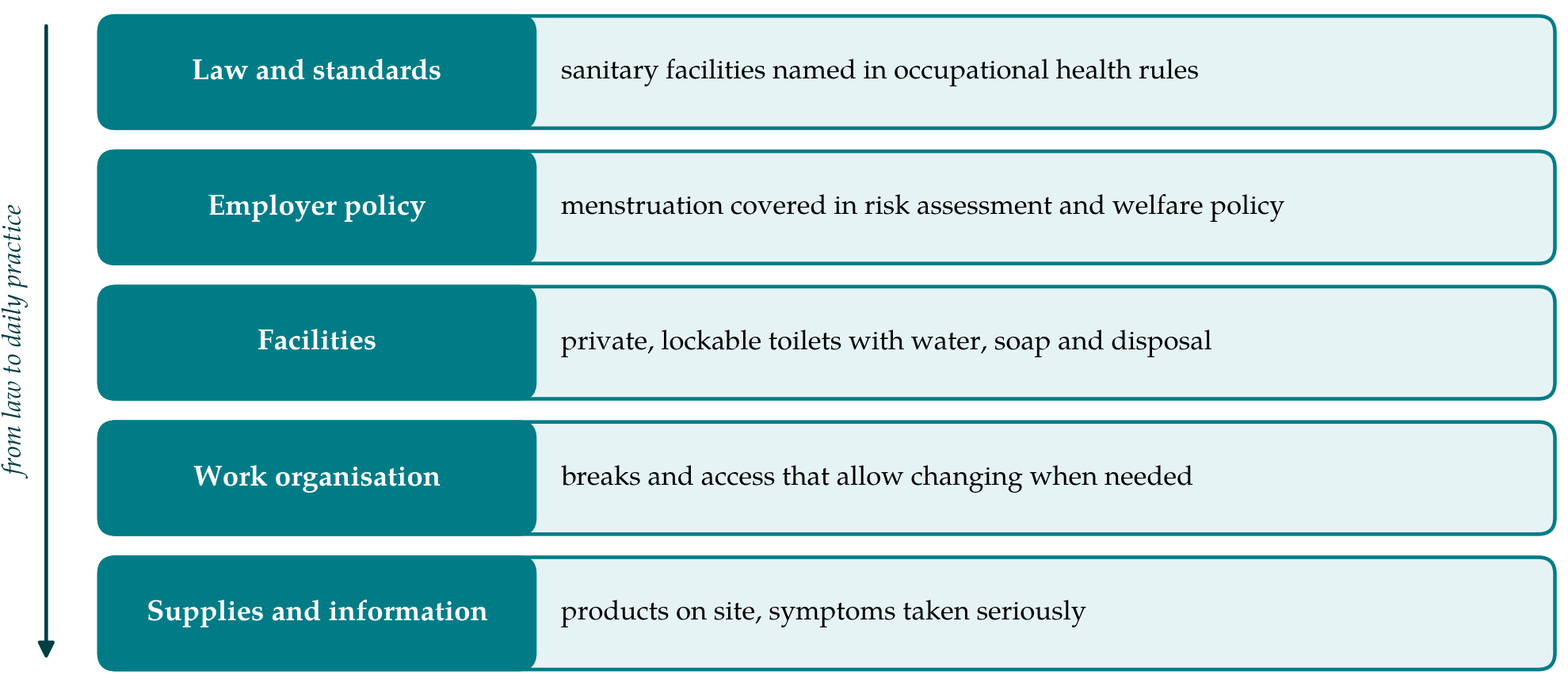
Seen this way, the task is mostly one of applying existing duties with women's bodies in mind. Figure 1 arranges the levels at which action is possible, from legal standards down to the supplies in a cubicle. Each level depends on the one above it: products placed in a toilet that workers are not permitted to visit accomplish little.
3. Objections Considered
Three objections are commonly raised against treating menstruation as an occupational matter. Each contains something true, and each is worth answering directly.
3.1. That menstruation is a private matter
Many women would prefer that their employer knew nothing of their cycle, and that preference deserves respect. Privacy, however, is an argument for good facilities and against intrusive ones. Nobody is asked to disclose a need for drinking water or a toilet; the employer simply provides them. Lockable cubicles, bins and freely available products serve everyone who needs them without requiring anyone to say so. Provision of this kind protects privacy better than the present arrangement, in which a worker must ask a supervisor, often a man, for permission to leave the line.
3.2. That attention will be turned against women
The more serious objection is that naming menstruation as a workplace issue invites employers to see women as costly or unreliable. The debate over menstrual leave shows that the risk is real. Statutory leave has existed in Japan since the late 1940s and has been adopted in several other countries, with Spain following in 2023, yet it is little used where it exists, and critics argue that it reinforces the idea that menstruating women are unfit for work (Levitt and Barnack-Tavlaris, 2020). The answer is to prefer measures that are universal and unremarkable. Adequate toilets, reasonable breaks and flexible sickness arrangements benefit all workers and single out none. Special leave tied to menstruation is a different instrument and should be judged separately on its merits.
3.3. That the evidence is too thin
It is true that almost no trials have tested workplace menstrual hygiene interventions and that the health effects of poor provision are uncertain. Occupational health has never required trial evidence before insisting on toilets, washing facilities or rest breaks; these are treated as basic welfare provisions, justified by dignity and by plausible effects on wellbeing. The same standard should apply here. Thin evidence is a reason to study the question, and it does not excuse leaving a known need unmet.
4. Implications
For employers, the first step is to include menstruation in the routine assessment of welfare facilities: counting usable toilets against the number of women on each shift, checking for locks, water, soap and bins, and reviewing rules on breaks. The second is supply. Scotland has legislated for free period products in public settings (Scottish Parliament, 2021), and an employer can do the equivalent on site at small cost. Reusable options deserve consideration where disposal is difficult; a systematic review found menstrual cups to be a safe and acceptable alternative, though users need somewhere to wash them (van Eijk et al., 2019).
For labour inspectorates and occupational health services, the implication is to read existing standards on sanitary conveniences as covering menstrual needs and to say so in inspection checklists and guidance. Informal and outdoor workers, who fall outside most inspection systems, will be reached only through municipal sanitation, markets and transport hubs, which makes this a matter for local government as well as for employers.
For researchers, the priorities are descriptive before they are experimental. Little is known about what facilities workplaces in different sectors actually provide, how women manage during long shifts, or how often work is missed or impaired. Validated measures of menstrual experience developed for schools need adapting for adults at work. Evaluations of simple packages, covering facilities, supplies and supervisor training, could then follow, with outcomes that include wellbeing and retention as well as attendance.
5. Conclusion
Menstruation at work has fallen between two fields. Those concerned with menstrual health have looked mainly at schools, and those concerned with occupational health have looked mainly at hazards that are shared by men. The result is that a regular, foreseeable need of a large part of the workforce is met badly or not at all in many workplaces, and that the women affected are expected to manage in silence. The remedy does not call for new principles. It calls for employers and regulators to apply the long-standing duty to provide suitable sanitary and welfare facilities, for researchers to document what is now provided, and for the subject to be discussed in the same plain terms as any other condition of work.
Conflict of interest
To be declared by the author(s) before publication.
Funding
To be declared by the author(s) before publication.