1. Introduction
Continuous positive airway pressure works by splinting the pharynx open with air, and when it is worn it abolishes obstructive events in nearly everyone. The difficulty has always been the wearing. Reviews of adherence describe a large proportion of patients who use the device for fewer hours than are thought necessary or who abandon it within the first months, for reasons that include mask discomfort, nasal symptoms, claustrophobia and a sense that the pressure itself is intolerable (Weaver and Grunstein, 2008). These patients remain at risk from untreated disease, and a clinical practice guideline of the American Academy of Sleep Medicine recommends that adults who cannot tolerate or accept pressure therapy be offered referral for a surgical opinion (Kent et al., 2021).
The surgeon who receives the referral needs to know where and how the airway closes. Examination of the awake patient predicts this poorly, and drug-induced sleep endoscopy (DISE) was devised to fill the gap. This short communication comments on the interpretation of DISE findings in the patient for whom pressure therapy has failed. It draws on the published literature and presents no cases of its own.
2. The Examination and Its Vocabulary
Croft and Pringle (1991) introduced the technique under the name sleep nasendoscopy: a flexible endoscope is passed through the nose while the patient, sedated to the point of snoring and obstruction, lies supine. Midazolam was the original agent. Propofol by target-controlled infusion and dexmedetomidine are now also used, and a European position paper gives recommendations on indications, setting, drugs and depth of sedation (De Vito et al., 2018).
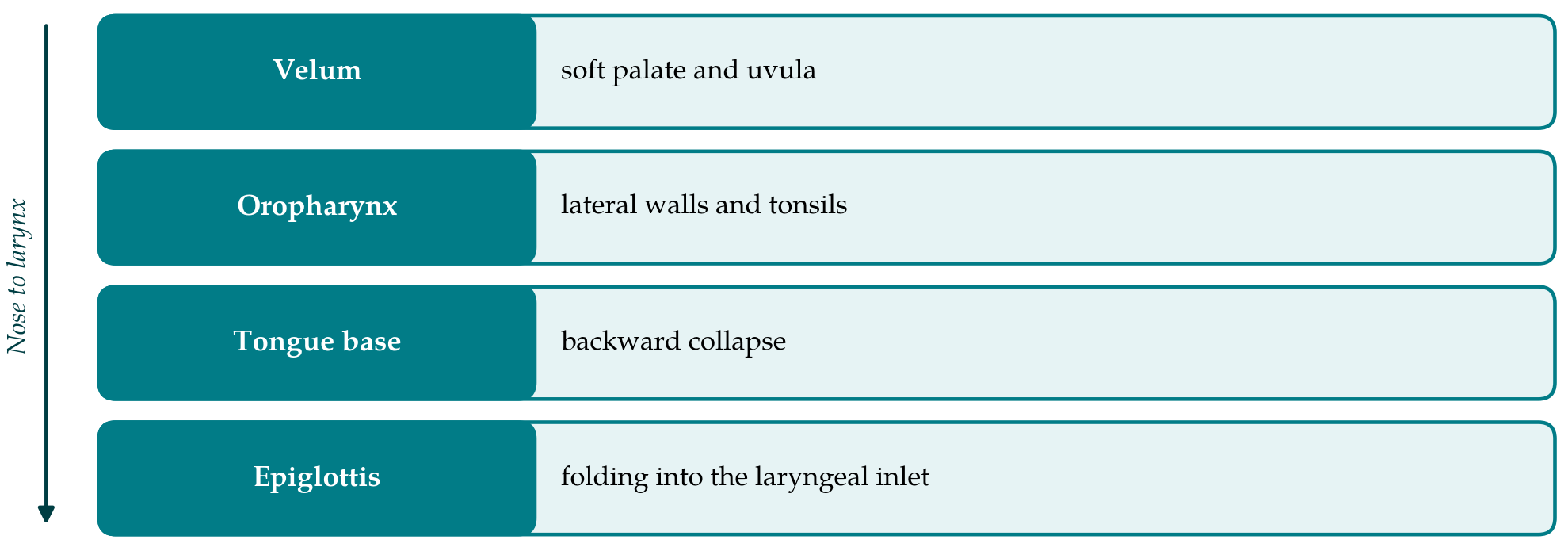
Several scoring systems exist. The most widely adopted is VOTE, which names four structures that can narrow the airway, shown in Figure 1 in order from above downward, and for each records the degree of obstruction as none, partial or complete and its configuration as anteroposterior, lateral or concentric (Kezirian et al., 2011). The system is deliberately simple. It trades anatomical detail for a common language, and that language is what makes findings from different centres comparable.
3. Findings That Change the Plan
In large series of patients examined for sleep-disordered breathing, collapse at the palate is the commonest single finding and collapse at more than one level is frequent, the more so with more severe disease and higher body mass (Vroegop et al., 2014). Patients referred after failure of pressure therapy are drawn from this population, and no pattern has been shown to be peculiar to them. What matters is which findings alter the choice among the alternatives, and Table 1 summarises the main ones.
| Level | Pattern seen | Bearing on treatment | Source |
|---|---|---|---|
| Velum | Complete concentric collapse | Excludes hypoglossal nerve stimulation | Vanderveken et al., 2013 |
| Velum | Anteroposterior collapse | Compatible with palatal surgery or nerve stimulation | Strollo et al., 2014 |
| Oropharynx | Lateral wall collapse | Associated with poorer surgical outcome | Green et al., 2019 |
| Tongue base | Complete anteroposterior collapse | Associated with poorer surgical outcome; consider tongue-directed options | Green et al., 2019 |
| Epiglottis | Anteroposterior or lateral folding | Possible anatomical reason for failure of pressure | Torre et al., 2016 |
The clearest example is complete concentric collapse at the velum. Vanderveken et al. (2013) found that patients with this pattern did not respond to implanted upper airway stimulation, and the trial that established the therapy excluded them on the basis of DISE (Strollo et al., 2014). Endoscopy is therefore a required step before an implant is offered, and for this one decision its role is not in dispute.
For conventional surgery the evidence is associative. A multicentre cohort study related DISE findings to results after pharyngeal operations and found lateral wall collapse in the oropharynx and complete obstruction related to the tongue to be associated with poorer outcomes (Green et al., 2019). Such findings argue for caution with palatal surgery alone and for considering procedures or devices that act at other levels.
Collapse of the epiglottis deserves particular attention in this group. A floppy epiglottis can fold backward over the laryngeal inlet, and it has been suggested that pressure delivered from above may push it further shut, which would give some patients an anatomical reason for failing therapy and not merely a behavioural one. A systematic review found the phenomenon to be more common than older accounts implied and to be detectable only during sleep or sedation (Torre et al., 2016). The explanation is plausible and unproven. Some centres apply pressure through a mask during endoscopy to observe its effect directly, and advance the jaw by hand to simulate an oral appliance. Both manoeuvres are described in the European position paper, which treats them as optional additions to the standard examination (De Vito et al., 2018).
4. Reasons for Caution
Sedation is not sleep. Polysomnography during propofol infusion shows altered sleep architecture, with rapid eye movement sleep absent, although the respiratory disturbance resembles that of natural sleep reasonably well (Rabelo et al., 2013). The examination lasts minutes, usually in one body position, and the depth of sedation influences what is seen. Scoring is subjective. Kezirian et al. (2010) found agreement between experienced observers to be moderate to substantial and better for the presence of obstruction at a level than for its degree or configuration.
Two further limits apply to the patient intolerant of pressure therapy. First, intolerance often has causes that endoscopy cannot show, such as mask fit, nasal obstruction, insomnia or anxiety, and these should be addressed before the failure is attributed to pharyngeal anatomy. Second, although DISE changes surgical plans, no randomised trial has shown that plans changed in this way lead to better results for patients. The findings guide judgement. They do not replace it.
A last point concerns how published series of such patients should be read. People who reach endoscopy after abandoning pressure therapy are a selected group: they have been referred, have accepted the prospect of surgery or an implant, and often fall within the weight limits that surgical guidelines set. The frequency of any pattern among them describes that group and cannot be taken as the frequency among all who struggle with the mask. Nor does a finding seen more often in these patients than in others show that it caused the intolerance.
5. Conclusion
For the patient who cannot use positive airway pressure, sleep endoscopy offers a structured look at the collapsing airway and a shared vocabulary in which to describe it. Its findings are decisive for hypoglossal nerve stimulation, informative for other surgery and suggestive, no more, as an explanation of why pressure therapy failed. Reports of DISE in this group would be most useful if they used a standard classification, described the reasons for intolerance and related the findings to the outcome of whatever treatment followed.
Conflict of interest
To be declared by the author(s) before publication.
Funding
To be declared by the author(s) before publication.