1. Introduction
Cities in dry regions produce a steady and growing flow of treated wastewater, and agriculture around them is short of water. Joining the two is an obvious step, and it has been taken in the Middle East and North Africa, in southern Europe, in Australia, in parts of South Asia and Latin America and in the western United States (Hamilton et al., 2007). The practice is older and wider than planned schemes suggest, since farmers downstream of cities have long irrigated with diluted or untreated sewage (Qadir et al., 2010).
Among the crops that can receive this water, fodder holds a privileged place. Guidelines on the safe use of wastewater rank crops by the route through which pathogens might reach people, and crops fed to animals stand well down the list (WHO, 2006). Fodder is therefore where planners send effluent when they wish to avoid controversy. This article takes the view that the choice has been made on one criterion and that a second, the fate of salt in the soil, has been given too little weight. The argument is not that fodder irrigation with treated wastewater should stop. It is that its long-term sustainability is an open question that current rules allow schemes to leave unasked.
2. Why Fodder Is the Favoured Outlet
The case for fodder is a strong one and deserves to be stated fully. Perennial forages such as lucerne, Rhodes grass and bermudagrass, and annual ones such as forage sorghum, maize for silage, barley and berseem clover, cover the ground for long periods and can absorb a supply that arrives every day of the year, which a treatment plant cannot switch off. They remove nitrogen and phosphorus in harvested biomass, turning nutrients that would pollute a river into feed (Pescod, 1992; Toze, 2006). Dairy and livestock producers near cities need green fodder and are willing to take the water. And several forage species are classed as tolerant or moderately tolerant of salinity in the standard compilation of crop salt tolerance (Maas and Hoffman, 1977).
That last point is double-edged. Salt tolerance means that the crop continues to yield as the soil becomes more saline. It does not slow the accumulation of salt, and it removes the early warning that a sensitive crop would give. A farmer growing beans would notice the damage within a season or two; a farmer growing bermudagrass may notice nothing for many years.
3. The Salt Balance That Reuse Rules Pass Over
The salinity of wastewater begins with the salinity of the water supplied to the city and rises with use. Households add sodium chloride from food and water softeners, sodium and boron from detergents, and further salts from cleaning products; some industries add more. Primary and secondary treatment are designed to remove solids, organic matter and, in more advanced plants, nutrients and pathogens. They leave dissolved salts essentially unchanged, and only membrane desalination removes them (Pescod, 1992; Toze, 2006). Effluent is therefore always saltier than the source water, and it is commonly richer in sodium relative to calcium and magnesium.
Once the effluent is applied to a field, the crop transpires the water and leaves the salt. The amount delivered each year is simply the volume applied multiplied by its concentration, and for a perennial forage irrigated year-round in a hot climate the volume is large. The classic water quality guidelines for irrigation place water with an electrical conductivity below 0.7 dS/m in the class with no restriction on use, and water above 3.0 dS/m in the class with severe restriction (Ayers and Westcot, 1985). Much municipal effluent in dry regions falls in the intermediate class, which calls for management and leaching, and soil is conventionally called saline when the conductivity of its saturation extract exceeds 4 dS/m (Richards, 1954).
Reuse regulation has been built around a different hazard. The World Health Organization guidelines are organised around health-based targets and a series of barriers between the wastewater and the consumer, an approach well suited to pathogens and of little use against a conservative solute that no barrier removes. Table 1 compares the main guidance documents by what they chiefly regulate and how they deal with salt. The European regulation on minimum requirements for water reuse, for example, sets quality classes by microbiological and basic physico-chemical parameters and leaves other substances to a site-specific risk management plan (European Union, 2020). The agronomic guidance that does address salinity predates most modern reuse schemes and is advisory.
| Document | Main concern | Treatment of salinity and sodicity |
|---|---|---|
| WHO (2006) guidelines, volume 2 | Health protection, pathogens | Discussed as an environmental aspect; no binding limits |
| European Union (2020) regulation | Minimum microbiological quality by crop class | Left to the risk management plan |
| Ayers and Westcot (1985), FAO | Irrigation water quality in general | Restriction classes for salinity, infiltration and specific ions |
| Pescod (1992), FAO | Wastewater treatment and use in agriculture | Adopts the FAO water quality classes |
| Rhoades et al. (1992), FAO | Use of saline water for crops | Leaching requirement and management practices |
| Richards (1954), USDA | Diagnosis of salt-affected soils | Defines saline and sodic soil; sodium adsorption ratio |
4. Sodicity and the Slow Loss of Soil Structure
Total salt is the smaller part of the concern. Sodium held on clay surfaces weakens the bonds between particles, and when the soil solution is dilute the clay swells and disperses, pores block, and water enters and drains more slowly. The hazard is expressed by the sodium adsorption ratio of the water, the concentration of sodium divided by the square root of half the sum of calcium and magnesium, all in milliequivalents per litre (Richards, 1954). The essential insight, due to Quirk and Schofield (1955), is that the damage done by a given level of exchangeable sodium depends on the electrolyte concentration of the percolating water: salty water keeps a sodic soil flocculated, and fresh water collapses it.
This produces an awkward sequence in climates with a wet season. Through the dry months effluent loads the soil with salt and sodium, and the salinity itself protects the structure. When rain arrives it leaches the soluble salts faster than it displaces the adsorbed sodium, the soil solution becomes dilute, and the surface seals. Reviews of effluent irrigation in arid and semi-arid zones describe reduced infiltration and hydraulic conductivity of this kind, aggravated by the suspended solids and dissolved organic matter that effluent also carries (Lado and Ben-Hur, 2009; Tarchitzky et al., 1999). Field studies have reported rising soil salinity and sodicity under effluent irrigation in south-eastern Australia (Muyen et al., 2011) and, in Tunisia, changes in soil chemical properties accompanied by a lower infiltration rate (Bedbabis et al., 2014). Structural decline is harder to reverse than salinity, and in a pasture that cannot be tilled it is harder still.
5. The Case That the Problem Is Manageable
Those who regard salt as a solved problem have four arguments, and each has substance. The first is leaching. Salts can be held at a steady level by applying more water than the crop uses, so that the surplus carries them below the roots, and the required fraction can be calculated from the salinity of the water and the tolerance of the crop (Rhoades et al., 1992). Recent reassessment suggests that the traditional steady-state formulas overstate the fraction needed (Letey et al., 2011). The second argument is rain: where a wet season delivers enough water to flush the profile, salts do not accumulate from year to year. The third is species choice, since tolerant forages keep producing at salinities that would end vegetable cropping. The fourth is amendment: gypsum supplies calcium to displace sodium, and its use on sodic soils is long established.
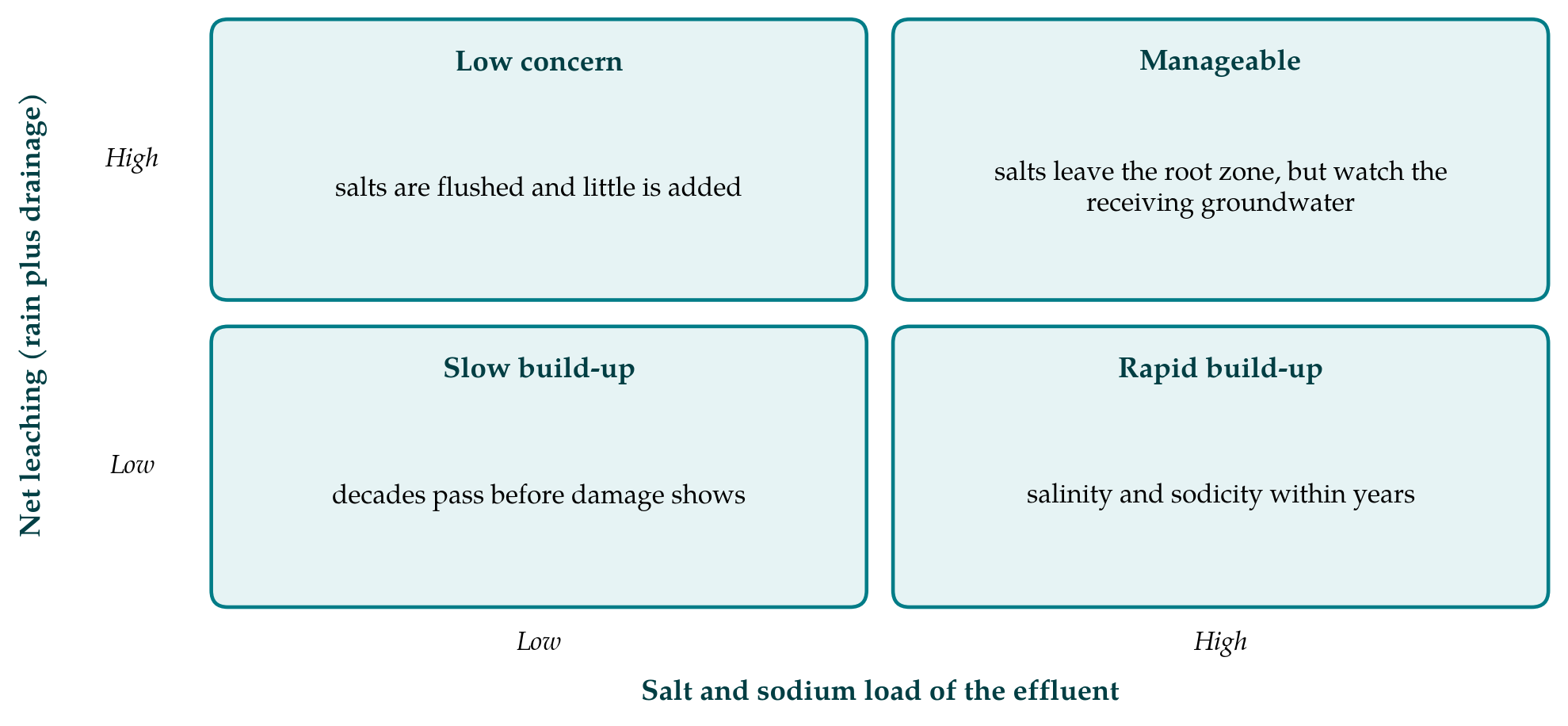
Each argument carries a condition. Leaching needs drainage, natural or installed, and it moves the salt into groundwater or a drain; it does not make it vanish. Rain helps with salinity and, as described above, can worsen the structural effect of sodium. Tolerant species postpone the reckoning. Gypsum works when it is applied regularly and when the displaced sodium can be leached away. Figure 1 arranges these conditions on two axes, the salt and sodium load of the effluent and the net leaching that climate and drainage allow. The reassuring arguments describe the upper half of the diagram. Many reuse schemes for fodder are found in the lower right, in arid basins with fine-textured soils, shallow or absent drainage and effluent drawn from an already brackish supply.
6. What Remains Unresolved
The disagreement persists because the evidence that would settle it is scarce. Salinisation under marginal water is a process of decades, while most field studies of effluent irrigation run for a few years and compare an effluent plot with a freshwater control at a single site. Such studies can show that salts and sodium increase. They cannot show whether the increase levels off at a tolerable equilibrium or continues. Modelling studies conclude that long-term irrigation with treated effluent threatens soil hydraulic function unless salt loads are reduced at source or by desalination (Assouline et al., 2015), but models of this kind have seldom been checked against multi-decade field records, because few such records exist.
Several specific matters are open. One is the behaviour of fodder systems in particular: perennial swards are not cultivated, are grazed or cut with heavy machinery, and may be more vulnerable to surface sealing than tilled fields, or less so because of their dense root systems; the literature does not decide. A second is the fate of the leached salt where groundwater is shallow or is itself a drinking water source. A third concerns the animals. Forage grown on saline, sodic soil differs in mineral composition, and the consequences for livestock nutrition have received far less attention than pathogen transfer. None of these questions is beyond study, since the instruments for mapping soil salinity repeatedly at field scale are well developed (Corwin and Lesch, 2005).
7. Implications for Policy and Practice
Three changes would follow from taking the question seriously. Approval of a reuse scheme for fodder should require a salt budget alongside the health risk assessment: the expected annual load of salt and sodium, the leaching that climate and drainage can provide, and the destination of the drainage. Where the budget does not balance, the options are to blend with fresher water, to reduce salt at source, for instance by regulating softener brines and detergent formulations, to install drainage, or to accept a finite life for the irrigated land and say so.
The budget cannot be drawn up once and filed. The salt load of effluent follows the water supply of the city, and that supply changes. A city that turns to brackish groundwater or recycles more of its own water will produce a saltier effluent. A city that adopts desalinated seawater will produce one lower in total salts but poor in calcium and magnesium relative to the sodium added in use, which can leave the sodium adsorption ratio unfavourable unless the supply is remineralised. The salt budget of a reuse scheme should therefore be revisited whenever the source of the city's water changes.
Monitoring should be a condition of operation and should run for the life of the scheme. Electrical conductivity and sodium adsorption ratio of the effluent, and salinity and exchangeable sodium of the soil at fixed points and depths, sampled at the same season each year, would cost little relative to the scheme and would create the long records now missing. Finally, guidance should stop treating fodder as a destination without drawbacks. Its tolerance of salt is a reason to watch the soil more closely, not less.
8. Conclusion
Irrigating fodder with treated wastewater solves a disposal problem and a feed problem together, and its health risks are comparatively well controlled. Whether the soil beneath can sustain it depends on a salt balance that most schemes have not drawn up and on processes of sodium accumulation that short experiments do not capture. Until long-term evidence is available, the prudent position is to treat soil salinity and sodicity as a design constraint to be budgeted and monitored from the outset.
Conflict of interest
To be declared by the author(s) before publication.
Funding
To be declared by the author(s) before publication.